초음파 커팅의 진동 원리
제조사들이 설명할 때ultrasonic cutting machines, they typically say the blade vibrates at high frequency and cuts cleanly. That's technically accurate but mechanically incomplete. It doesn't explain why a vibrating blade outperforms a sharp stationary one, or why frequency choice matters more than blade sharpness for specific applications.

초음파 커팅은 각 절단 사이클마다 세 가지 작동 원리가 동시에 적용됩니다:
- 마찰 계수 감소 — The blade tip oscillates at 20,000 cycles per second, meaning the food product never maintains continuous contact with the blade surface. Each microsecond of contact is interrupted by the vibration displacing the food relative to the blade.
- 국소적 재료 변위 — The high-frequency oscillation creates microscopic gaps at the blade-food interface. This eliminates the compression wave that conventional blades generate ahead of the cutting edge, which causes cellular structure damage in soft products like cakes and processed meats.
- 자동 세척 블레이드 표면 — Products with high sugar, fat, or moisture content do not adhere to a vibrating blade the way they stick to stationary steel. The vibration continuously breaks any adhesive bond forming between the food surface and the blade, preventing fouling during continuous operation.
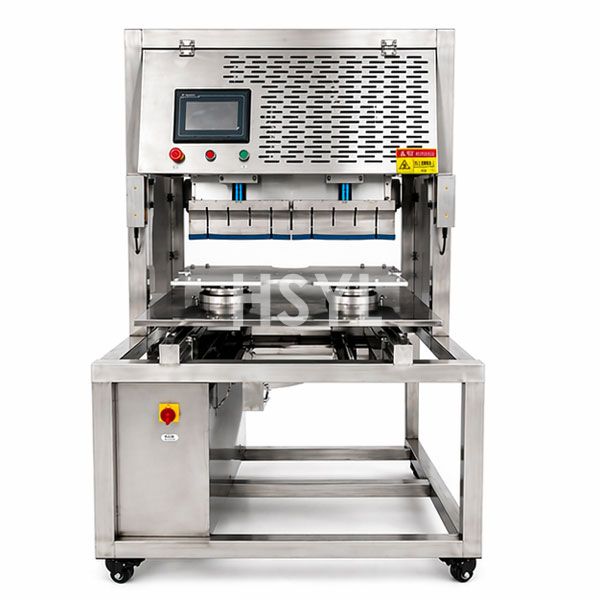
The practical result: a multi-layered cream cake cut with a conventional blade shows compressed, smeared layers at the cross-section. The same cake cut with an industrial ultrasonic cutting system at correct parameters displays clean, vertical layer separation with no visible evidence of the cutting action. This difference directly affects retail packaging appearance and consumer selection decisions.
주파수 선택이 임의적이지 않은 이유
Most industrial ultrasonic cutting systems operate at either 20kHz or 40kHz. Some dual-frequency systems offer both options. The frequency is not a marketing decision—it directly constrains the blade geometries that are physically possible and the product types the system can handle effectively.
고주파에서의 파장 문제
Higher frequencies generate shorter acoustic wavelengths. At 40kHz, the wavelength in titanium is approximately 122mm. At 20kHz, the wavelength is approximately 245mm. This matters because the blade (called a sonotrode) must be acoustically resonant—it must be an integer multiple of half-wavelengths long to maintain efficient energy transfer from the transducer to the cutting edge.
40kHz의 짧은 파장은 블레이드의 실질적 최대 길이가 더 짧아진다는 의미입니다.40kHz systems work well for shallow cuts under 50mm depth with narrow blade widths. 20kHz systems can accommodate blades 150-200mm long and 40-60mm wide. If you need to cut a 100mm-deep frozen meat block, 20kHz is effectively your only option with standard acoustic geometries.
제품별 권장 주파수 가이드
| 제품 유형 | 권장 주파수 | 기술적 근거 |
|---|---|---|
| 두께 80mm 이상의 냉동 블록 | 20kHz | 더 긴 공진 블레이드 형상이 필요합니다 |
| 높이 50mm 미만의 소프트 케이크 | 40kHz도 사용 가능합니다 | Shallow penetration allows compact blade design |
| 섬유질이 있는 통근육 고기 | 20kHz | Higher amplitude needed to separate collagen structures cleanly |
| 크림 필링이 들어간 다층 디저트류 | 40kHz | Clean cross-section priority with minimal penetration depth |
| 숙성 경성 치즈 | 20kHz | 고밀도 매트릭스에는 최대 진동 에너지 전달이 요구됩니다 |
| 초콜릿 및 제과류 제품 | 40kHz | Clean edge definition critical with low cutting resistance |
A common misjudgment buyers make: selecting a 40kHz system because higher frequency implies greater precision, then discovering the blade cannot physically penetrate their product to the required depth. Always validate the available blade geometry against your maximum cutting depth requirement before committing to a frequency.
연속 가동 시 트랜스듀서 동작 특성의 이해
The ultrasonic transducer converts electrical energy into mechanical vibration through piezoelectric stacks. Most spec sheets quote efficiency figures (typically 92-96% for industrial units) without explaining what that thermal reality means during extended operation.
Ninety-six percent efficiency sounds excellent, but 4% of a 2,000-watt system is 80 watts of heat that must be dissipated from the piezoelectric stack interface. This heat concentrates at the transducer-to-blade junction. Without adequate cooling, temperature rise causes the piezoelectric elements to shift their resonant frequency by approximately 50-200Hz per 10°C change.
A system tuned to 20,000Hz at start of shift might drift to 19,850Hz after four hours of continuous operation. That 150Hz deviation represents approximately 0.75% frequency offset—enough to reduce cutting efficiency noticeably and increase required cutting force. Operators notice the blade "working harder" in the final hours of a production run, often attributing it to blade wear when the actual cause is thermal drift.
교대 근무 시간에 따른 열 관리 요건
| 운전 모드 | 냉각 필요 조건 | 예상 주파수 드리프트 |
|---|---|---|
| 단일 교대(6시간 미만) | 수동 대류 냉각 허용 | 전체 교대 중 100Hz 미만 유지 |
| 이중 교대 (8-12 시간) | 강제 공기 냉각 필수 | 전체 교대 중 100-200Hz 범위 |
| 3교대 또는 연속 운전 (16+시간) | 능동형 수냉 재킷 필수 | Under 100Hz with active cooling |
~을 고려하여제과용 생산 라인 running two or three shifts, active transducer cooling is not optional—it is essential for consistent cutting quality throughout the operating period.
소노트로드(블레이드) 마모 기전 및 교체 시기
Equipment spec sheets list sonotrode (blade) lifespan at 3-5 years under standard maintenance protocols. That range is accurate but incomplete. The actual lifespan depends on specific failure mechanisms that determine whether you achieve the short end or the long end of that range.
점진적 마모에 의한 모드 형태(진동 패턴) 변동
As the titanium blade tip wears through continuous contact with abrasive food materials—particularly frozen vegetables, grain-based products, or anything with crystalline inclusions—the blade's effective mass distribution changes. This shifts the resonant mode shape. The blade remains resonant but no longer at its original designed frequency with maximum amplitude at the tip.
A blade resonant at 20,000Hz with a 15-micron tip amplitude at installation might develop a secondary node point 5-8mm from the tip after 2,000 operating hours. The blade continues to function but operates less efficiently. Cutting force requirements increase, energy consumption per cut rises, and product cross-section quality gradually deteriorates.
Most operators do not recognize this gradual degradation pattern. They attribute increased cutting resistance to general dullness and replace blades still operating at 40-50% of their original efficiency. This calendar-based replacement approach wastes significant maintenance budget.
상태 기반 교체 기준
- 동일한 절단 조건에서 서보 전동기의 전류 소비가 기준 대비 15%% 이상 증가
- 공장 출하 시 조정된 주파수에서 벗어남(드리프트)이 200Hz를 초과
- 블레이드 팁의 형태 변화가 원래 규격 대비 0.3mm 이상 발생
- 절단 시 소리 특성의 청각적 변화 (더 거친 소리나 "무리하게 작동하는" 듯한 소리로 변함)
- 절삭 파라미터가 정확하게 설정되었음에도 불구하고, 제품의 단면 품질이 저하되는 문제
If your maintenance protocol uses calendar-based blade replacement without monitoring these parameters, you are likely discarding blades with substantial remaining operational life.
구매자들이 간과하기 쉬운, 전환 과정에서 발생하는 숨겨진 비용
Ultrasonic cutting systems are not inherently slow at product changeover, but the way they are typically specified creates hidden time penalties that do not appear in equipment quotes or throughput specifications.
Most dual-frequency systems require physical replacement of the blade and booster assembly to switch between 20kHz and 40kHz operation. This mechanical changeover takes 15-30 minutes plus the re-tuning time required after reassembly. If your production schedule requires switching between product types requiring different frequencies multiple times per shift, you need to account for 30-90 minutes of changeover time daily.
The financial impact: consider two scenarios for a facility running both frozen meat blocks (requiring 20kHz) and soft desserts (suitable for 40kHz) across two shifts. Option A uses one dual-frequency system with daily frequency changes. Option B uses two dedicated single-frequency machines.
| 비용 요소 | 옵션 A: 이중 주파수 단일 장비 운영 | 옵션 B: 전용 머신 2대 도입 |
|---|---|---|
| 장비 자본 투자 비용 | 프리미엄 단품 ($180,000) | Two standard units ($150,000 each = $300,000) |
| 작업 교대 시 교체 소요 시간 | 하루 45분 | 0 (제품 전용 머신 사용 시) |
| 연간 전환 비용 (시간당 $150 기준) | 연간 비용 $16,425 | 무료 |
| 기계당 최대 생산량 | 공유 시 150 컷/분 | 전용 시 기계당 150 컷/분 |
| 블레이드 재고 필요량 | 블레이드 2세트 | 기계당 1세트 |
The payback period for Option B over Option A is approximately 6 years based purely on changeover time—not including the throughput advantages of dedicated equipment. The conventional assumption that one flexible machine is more economical than two dedicated machines often does not hold for high-mix production environments.
생산 라인 연동: 하드웨어 인터페이스 요건
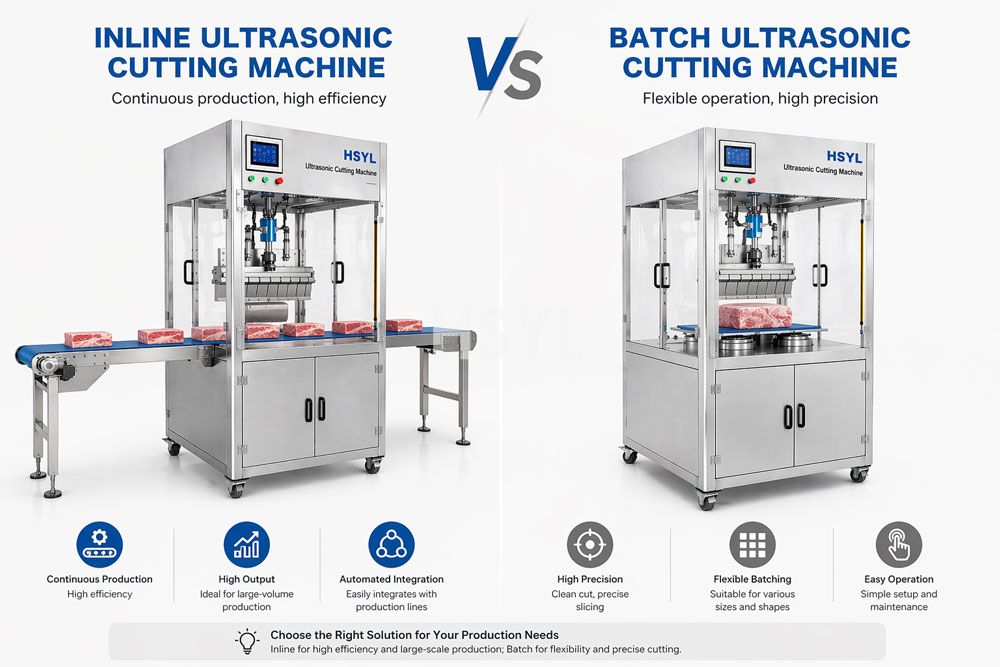
Installing an ultrasonic cutter into an existing production line requires more than finding floor space. The cutting station needs a product feeding mechanism that presents items to the blade at consistent height, angle, and spacing. It needs a reject mechanism for non-conforming pieces. It needs a discharge system for cut products. And it needs to communicate with your existing PLC for recipe parameter storage and production data logging.
사전 확정이 필요한 핵심 연동 파라미터
| 항목 | 기술 규격서 항목 | 현장에서 흔히 발생하는 설계 오류 |
|---|---|---|
| 절삭 각도 | 수직 절삭 대 경사 절삭 (일반적으로 수직선 기준 0-15°) | Assuming vertical cutting is always optimal for downstream product flow |
| 컨베이어 높이 | 블레이드 중심선을 기준으로 하되, 제품 높이 변동 공차를 적용 | Not accounting for product-to-product height variation within production runs |
| 블레이드 전진 기구 | Servo-controlled stroke precision vs continuous motion cutting | 인덱스 정지 방식이 위치 정확도에 더 유리할 경우에도 연속 모션을 선택하는 것 |
| 제품 투입 방식 | 개별 조각 투입 vs 연속 슬래브 투입 | Feeding loose pieces that shift or rotate during the cutting stroke |
| 불량품 배출 처리 | 수동 제거 vs 전용 컨베이어와 연동된 공압식 배출 | No defined reject pathway defined before line integration begins |
절단 헤드의 CIP(현장 세척) 호환 제약 사항
산업용 식품 가공 설비 with SUS304 stainless steel frames and IP65-rated motors supports standard washdown cleaning protocols. However, the ultrasonic transducer and blade assembly have cleaning constraints that differ from the rest of the machine frame.
High-pressure water spray directed at the transducer housing can damage electrical connections and compromise the acoustic coupling at the blade interface. Standard Clean-In-Place protocols designed for conveyors, rollers, and food-contact surfaces require modification when an ultrasonic cutting head is part of the system. Verify the IP rating of the transducer assembly separately from the machine frame rating—the overall enclosure might be IP65 while the transducer is only IP54.
초음파 커팅이 최선의 선택이 아닌 경우
Facilities sometimes install ultrasonic cutting systems where conventional band saws, rotary knives, or water jet cutters would perform better at significantly lower cost. Ultrasonic cutting has genuine performance advantages, but those advantages only translate to value for specific product characteristics.
일반적인 커팅 방법으로 충분한 제품
- 균일한 대량 블록 — Dense, uniform materials like large cheese blocks or unlayered meat slabs without internal structure to preserve often achieve acceptable results with conventional knives at lower cost and maintenance burden
- 초대량 단일 제품 라인 — Continuous production exceeding 200 cuts per minute typically exceeds ultrasonic system maximum throughput; mechanical cutting may be the only viable high-speed option
- 경질 내포물이 포함된 제품 — Ultrasonic blades do not significantly reduce cutting force against hard objects like bone fragments, nut clusters, or candy pieces embedded in soft matrices
- 단면 외관이 중요하지 않은 제품 — Some processed meats and cheeses are dense enough that conventional cutting produces no visible cellular damage; if customers do not complain about appearance, ultrasonic offers limited value
벤더 제안 평가: 역량 수준을 파악하기 위한 질문들
비교 시,ultrasonic cutting equipment proposals, these questions separate vendors who have characterized their own systems thoroughly from those reselling without deep application expertise:
- What is the frequency drift measured at the blade tip over a 6-hour continuous run at maximum amplitude? (Request actual test data, not theoretical estimates)
- 귀하가 제시한 하중 조건에서 표준 작동 주파수 시 블레이드 팁의 진폭(마이크론 단위)은 무엇입니까?
- What blade replacement procedure do you recommend, what tools are required, and what is the typical time for a trained operator to complete?
- Can you provide references for your stated product applications—not generic food processing references but specific installations processing similar materials?
- What blade lifespan do you project for my specific product matrix, and how does that compare to your general specification range?
- What cleaning procedures will not damage the transducer assembly, and what IP rating is required for my sanitation environment?
- Do you include recipe development support during Factory Acceptance Testing to optimize cutting parameters for my actual products?
A vendor who cannot answer questions 1 and 2 with documented test numbers probably has not performed rigorous characterization of their own equipment. A vendor who provides specification ranges without asking about your specific product is applying generic data to a specialized application.
생산 라인 계획을 위한 실용적 의사결정 프레임워크
Before reviewing equipment specifications for ultrasonic cutting systems, answer three foundational questions:
첫 번째: Does your product actually demonstrate visible quality improvement when cut with minimal compression damage? Obtain sample cuts on an ultrasonic system and compare against your current method with actual product samples. Most equipment suppliers will run sample cutting tests for prospective buyers using your actual materials.
두 번째: What is your actual changeover frequency between different product types? If your production schedule requires switching between products that require different cutting parameters—including different frequencies—multiple times per shift, factor changeover costs into your ROI calculation. Dedicated equipment for each product family may prove more economical than flexible equipment with high changeover overhead.
세 번째: Does your maintenance team have the technical capability to support ultrasonic equipment? These systems require less physical maintenance than mechanical blades (no sharpening) but demand more electrical parameter monitoring. If your technicians are uncomfortable interpreting frequency displays and evaluating drift data, budget for supplier training during installation and commissioning.
자주 묻는 질문
초음파 절단은 기존의 칼날 절단 방식과 어떤 물리적 원리에서 차이가 있나요?
제 응용 분야에 20kHz와 40kHz 중 어떤 주파수가 적합한지 어떻게 판단할 수 있나요?
초음파 칼날이 단순히 튜닝을 다시 하는 수준이 아닌, 실제로 교체가 필요한 시점을 알 수 있는 구체적인 지표는 무엇인가요?
장시간 연속 생산 시, 트랜스듀서의 열적 주파수 변화가 절단 품질에 어떤 영향을 주나요?
초음파 절단기를 다른 제품으로 전환할 때, 실제로 발생하는 제품 교체 비용은 어느 정도인가요?
초음파 절단 시스템은 기존 절단 장비와 비교하여 어떤 차별화된 유지보수 역량이 요구되나요?
맞춤형 초음파 절단기의 표준 제조 납기는 어느 정도인가요?
산업용 초음파 절단기 운용 시 별도의 전용 전원이나 특수 설비 요건이 필요한가요?
관련 콘텐츠



전문 상담을 받아보세요
이 콘텐츠에 대해 궁금한 점이나 기술 지원이 필요하신가요? 아래 양식을 작성해 주시면, 전문가 팀이 맞춤 솔루션을 제공해 드리겠습니다.