The Best Industrial Meat Slicer: A Chief Engineer's Guide to Yield, ROI, and Hygiene

  • Yield Optimization: Advanced servo-driven feeding mechanisms reduce off-cut meat waste to < 0.8%, recovering massive profit margins in high-volume production.
  • Sanitary Design Imperative: Implementing IP69K washdown ratings and automated CIP protocols slashes daily sanitation downtime by up to 60% while ensuring strict USDA/CE compliance.
  • Blade Kinematics & Thermal Wear: Matching blade RPM dynamically to the exact core temperature of the protein extends sharpening intervals and prevents cellular smearing.
  • Continuous Line Integration: Standalone slicers create bottlenecks; true efficiency requires a digital PLC handshake between the slicer and downstream thermoforming packaging machines.

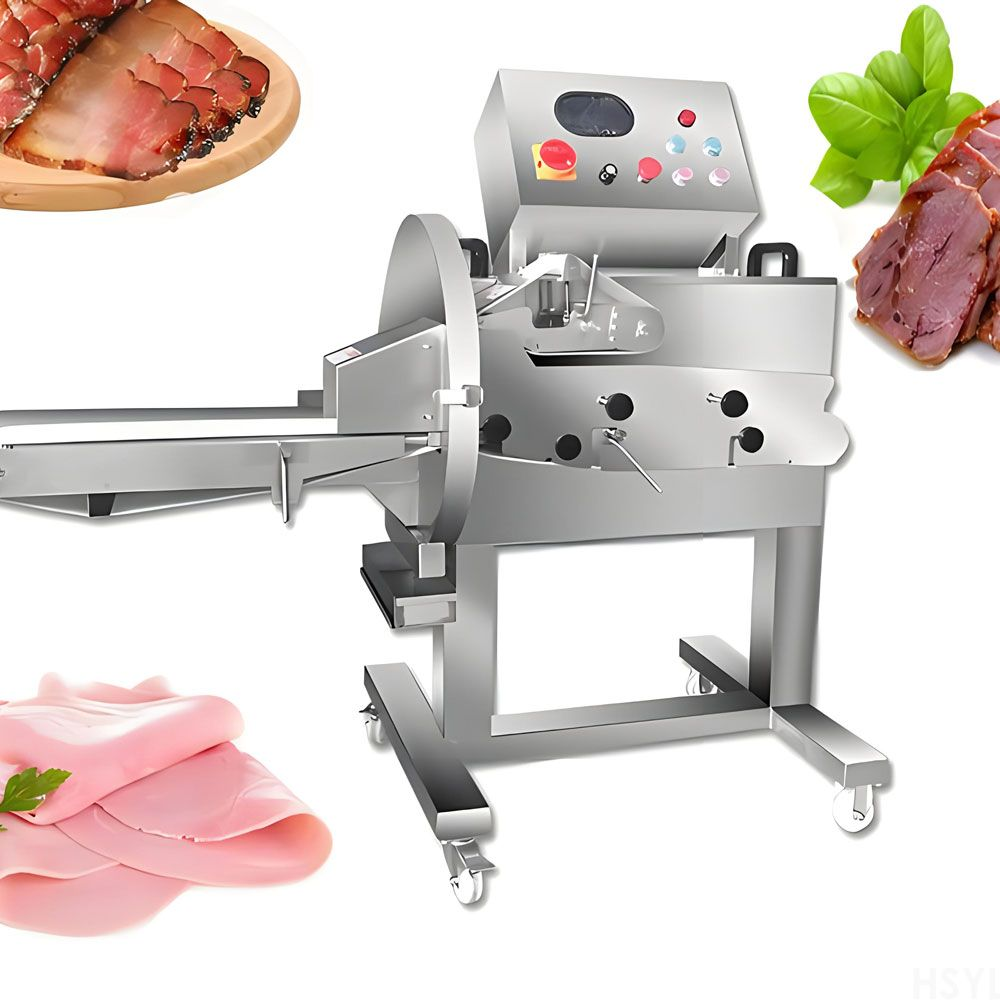
As a senior engineer at HSYL with over 20 years of boots-on-the-ground experience troubleshooting meat processing facilities from Frankfurt to Bangkok, I have repeatedly observed production margins evaporate due to inefficient cutting machinery. The criteria for selecting the best industrial meat slicer extend far beyond a polished stainless steel exterior and basic dimensional footprints. True operational efficiency lies deep within structural rigidity, servo-motor accuracy, and relentless hygiene compliance.

When a facility processes thousands of kilograms of protein per shift, a mere 1% drop in yield creates massive, compounding financial hemorrhaging. Purchasing decisions driven solely by upfront capital costs inevitably lead to catastrophic long-term losses through excessive blade wear, cross-contamination downtime, and target-weight packaging rejections. This engineering analysis deconstructs the mechanical specifications, thermodynamic variables, and line integration strategies required to ensure your next slicing equipment capital expenditure delivers absolute precision and a mathematically verifiable return on investment.

Deciphering Blade Kinematics and Direct-Drive Torque Architecture

Standard generic slicing equipment relies heavily on outdated asynchronous motors coupled with friction-based belt-and-pulley transmission systems. These legacy configurations inevitably suffer from kinetic micro-slippage during peak load cycles, particularly when processing dense, bone-in proteins or sub-zero tempered blocks. The modern industrial approach dictates the strict implementation of independent, closed-loop servo motors for both the rotary blade drive and the linear feeding carriage.

Operating continuously at speeds exceeding 400 cuts per minute, this direct-drive architecture guarantees a mathematically constant blade RPM. The closed-loop feedback mechanism detects density and resistance variations in the meat block within milliseconds, instantly adjusting torque output to prevent blade stalling or structural deflection. This ensures that the kinetic energy transferred to the cutting edge remains absolute, regardless of whether the machine is processing highly marbled Wagyu beef or dense frozen pork shoulders.

Metallurgy and Deflection Tolerance Thresholds

The physical cutting interface requires uncompromising material integrity. High-performance industrial slicers deploy cutting assemblies forged from SUS304 and SUS316L stainless steel, frequently treated with specialized titanium nitride coatings to drastically lower the surface friction coefficient. Standard commercial blades possess a Rockwell hardness (HRC) of approximately 54, which rapidly rolls and dulls under industrial volumes. We specify blades engineered with an HRC rating of 58-60, preventing lateral structural deflection during high-velocity impacts.

This microscopic rigidity directly dictates the machine's cutting thickness tolerance. A heavy-duty slicing mechanism must maintain a strict variation threshold of < 0.5mm per slice. Any deviation beyond this parameter immediately compromises downstream packaging volume uniformity, leading to excessive target-weight giveaway, fat smearing, and ultimately, regulatory rejections from retail distributors.

The Best Industrial Meat Slicer: Engineering Guide & ROI Analysis image 1

Synchronizing Slicers within Continuous Processing Flow Layouts

An industrial meat slicer cannot be evaluated as an isolated, standalone mechanical unit; it is a critical node within a much broader continuous processing ecosystem. Maximum operational throughput is exclusively achieved when the slicing unit operates in perfect synchronicity with upstream tempering racks, inline dynamic checkweighers, and downstream thermoforming packaging lines. Operating a high-speed slicer without automated off-take conveyors simply transfers the bottleneck from the cutting room to the packaging room.

Interfacing these diverse production modules requires sophisticated Programmable Logic Controller (PLC) integration. The slicer's outfeed conveyor must execute a continuous digital handshake with the packaging machine. This intelligence allows the slicer to automatically modulate its feeding rate to match exact packaging pocket availability, eliminating product accumulation and reducing the protein's prolonged exposure to ambient plant temperatures. We approach these complex capacity challenges by offering comprehensive turnkey food processing line solutions that mathematically map out the entire factory footprint for zero-friction product flow.

The Sanitary Imperative: Eliminating Cross-Contamination Bottlenecks

Sanitary engineering dictates actual production uptime. Traditional slicing machines harbor hidden crevices, exposed screw threads, and perfectly flat surfaces where moisture pools—creating ideal environmental breeding grounds for Listeria monocytogenes and Salmonella. Heavy-duty equipment must be structurally engineered with sloped surfaces maintaining a minimum 3-degree angle to ensure total liquid runoff during washdown phases.

To adhere to rigorous USDA Food Safety and Inspection Service guidelines and strict CE/BRC compliance, the machinery must achieve a verifiable IP69K washdown rating. This specialized certification allows facility sanitation crews to execute high-pressure (up to 1450 PSI), high-temperature (80°C) chemical washdowns without jeopardizing internal electrical components or servo drives. By fully integrating automated CIP (Clean-in-Place) cleaning protocols, facilities minimize human error in sanitation, virtually eliminate cross-contamination risks, and slash daily sanitation downtime by up to 60%.

The Thermal Slicing Equation: A Contrarian View on Blade Lifespan Costs

Standard procurement doctrine assumes that blade dulling and replacement schedules are strictly a function of calendar days or raw tonnage processed. Decades of field data extracted from high-volume operations prove otherwise. Blade degradation is exponentially accelerated by improper protein tempering temperatures combined with excessive kinetic friction.

Most plant managers focus solely on blade hardness, entirely ignoring the thermodynamics of the cutting action. HSYL engineering utilizes a proprietary Thermal Wear Coefficient to calculate actual blade degradation:

Wear Index = (Blade Diameter * Blade RPM * Friction Factor) / (Meat Core Temp + 5)

When proteins are sliced at an exact, uniform core temperature of -3°C, the structured ice crystals provide crucial physical support to the muscle fibers. This specific thermal state reduces micro-abrasions on the cutting edge by 28% compared to slicing at -1°C. However, if tempering rooms have uneven air circulation, the outer layer of the meat block thaws while the core remains frozen solid. This aggressive temperature gradient causes the blade to "wedge" rather than slice cleanly, spiking the electrical load on the servo motor and causing catastrophic micro-fractures on the blade edge. Modulating the blade RPM to dynamically match the specific thermal density of the incoming meat drastically extends the sharpening interval.

Operational MetricLegacy Belt-Driven SlicerHSYL Servo-Driven Slicer
Average Volumetric Yield Rate94.0% - 96.5%> 99.2%
Slice Thickness Tolerance± 1.5mm< 0.5mm
Blade Sharpening IntervalEvery 3 to 4 shiftsEvery 10 to 14 shifts
Sanitation Downtime (Per Cycle)45 minutes (Manual Disassembly)15 minutes (IP69K/CIP Auto)
Drive Mechanism Efficiency Loss12% (Belt slippage & heat)0% (Direct drive closed-loop)

Eradicating Capacity Constraints: A 2,000kg/h High-Volume Production Case Study

A prominent European bacon and deli meat processor recently faced severe operational limitations with their existing fleet of semi-automatic cutting equipment. The factory was paralyzed by a massive 5.2% meat waste ratio, largely driven by inconsistent feed carriage blockages, fat smearing, and severe end-piece yield loss. Furthermore, the lack of synchronized continuous feeding led to massive bottlenecks prior to the vacuum packaging stage, requiring eight full-time employees merely to manage product accumulation and manual loading.

Our engineering team conducted a comprehensive facility line audit and deployed a fully automated, multi-lane continuous slicing system tailored specifically for dense, chilled pork bellies. By integrating a servo-driven, active-pneumatic grip feeding mechanism, the new equipment entirely eliminated the slippage of the raw meat blocks under heavy load.

The quantitative results were absolute. The facility immediately scaled production to a continuous 2,000kg/h throughput. The mechanical cutting error rate plummeted to < 0.8%. By transitioning from isolated, manual workstations to a cohesive layout, the client successfully reallocated six operators to higher-value downstream quality control tasks, achieving complete project ROI within exactly 8.5 months.

The Best Industrial Meat Slicer: Engineering Guide & ROI Analysis image 2

5-Point End-of-Shift Machinery Inspection Protocol for Plant Managers

To preserve asset integrity and maintain continuous regulatory compliance, plant managers and maintenance supervisors must enforce strict, daily mechanical verifications that go far beyond basic visual sanitation checks:

  • Carriage Alignment and Bearing Verification: Measure the kinetic gap between the rotary blade edge and the feeding carriage utilizing a precision feeler gauge. It must remain perfectly parallel; any asymmetric variance indicates immediate linear bearing wear, which will exponentially increase off-cut waste.
  • Servo Motor Housing Thermal Profiling: Utilize an industrial infrared thermometer on the servo motor housing 15 minutes after concluding a heavy processing shift. Surface temperatures exceeding 65°C strongly indicate electrical phase imbalance, inadequate internal lubrication, or mechanical binding in the main drive shaft.
  • Pneumatic Gripper Pressure Audits: For automated lines, rigorously verify the compressed air supply to the meat grippers. The pressure must strictly maintain the manufacturer-specified Bar rating. A drop of even 0.5 Bar will cause the dense meat block to slip backward upon blade impact, instantly destroying slice thickness uniformity.
  • Sanitary Weld Fissure Inspection: Visually and tactilely inspect all SUS304 junction welds and product contact zones for micro-fissures. Even microscopic cracks allow bacterial biofilms to bypass standard CIP chemical protocols.
  • CIP Chemical Concentration Logs: Verify that the automated dosing pumps are delivering exact concentrations of caustic and acidic washdown chemicals. Over-concentration degrades the specialized titanium blade coatings, while under-concentration fails to eliminate lipid proteins.

Engineered for Absolute Production Dominance

Scaling an industrial food processing facility requires absolute certainty that every individual mechanical upgrade aligns perfectly with the overarching factory architecture. Isolated, uncalculated machinery purchases inevitably lead to mismatched line capacities, stranded assets, and trapped capital. As an internationally certified custom food processing equipment manufacturer, we mathematically verify that every component interfaces seamlessly with your current layout and future expansion parameters.

Stop accepting generic machinery solutions that silently bleed your profit margins through micro-yield loss and excessive, unpredictable downtime. Contact the HSYL engineering division today to request a bespoke factory layout schematic and a highly detailed ROI analysis tailored to your exact protein processing parameters and thermal requirements.