Engineering Architecture of the 8000 CPH Algeria Fish Canning Production Line for 125g Formats
- System Capacity Matrix: Continuous output of 133 Cans Per Minute (CPM), specifically calibrated for the mechanical tolerances of 125g rectangular club cans.
- Seaming Integrity: Integration of high-vacuum double seaming technology to guarantee a minimum of 45% hook overlap, eliminating aerobic bacterial proliferation.
- Thermal Compliance: Standardized overpressure retort configurations ensuring precise Fo value attainment (F0 3.0-5.0) in accordance with global low-acid canned food regulations.
- Labor Optimization: Transitioning from manual alignment to automated continuous feeding, reducing per-shift operator requirements by up to 65% in North African facilities.
As a senior chief engineer at HSYL, I have spent the last two decades designing, commissioning, and troubleshooting industrial food processing layouts globally. During a recent technical audit of coastal processing facilities near Oran and Boumerdès, the operational bottleneck became glaringly apparent. Many Algerian seafood processors are grappling with legacy semi-automatic equipment that fails to maintain consistent drained weights and yields high defect rates when handling local pelagic species like sardines and mackerel. Upgrading to an 8000 CPH (Cans Per Hour) full automatic solution is no longer an optional capital expenditure; it is a critical baseline for maintaining domestic market share and pursuing export compliance under BRC and IFS frameworks.For complete autoclave batch scheduling and facility sanitation planning, refer to our engineering overview on sardine canning food processing line.
The 125g tinplate club can is the undisputed standard for the regional market, yet its rectangular geometry presents severe kinetic challenges at high speeds. Unlike round cans, rectangular profiles require specialized irregular seaming chucks and deceleration cams to prevent corner wrinkling and fluid displacement. In this technical breakdown, we will examine the mechanical staging, metallurgical requirements, and thermal thermodynamics required to operate an 8000 CPH line seamlessly.

Metallurgical and Geometrical Challenges of 125g Club Can Seaming at 133 CPM
The transition from 3000 CPH to 8000 CPH necessitates a paradigm shift in mechanical synchronization. At approximately 133 cans per minute, the centrifugal forces exerted on the 125g club cans dictate stringent tolerances for conveying and transfer systems. The primary processing challenge lies not in the speed itself, but in managing the hydrodynamics of the oil or tomato sauce medium during rapid acceleration and deceleration across the conveyor network. We engineer our transfer star-wheels using high-density POM (Polyoxymethylene) machined to a 0.01mm tolerance to mitigate sloshing and headspace contamination.
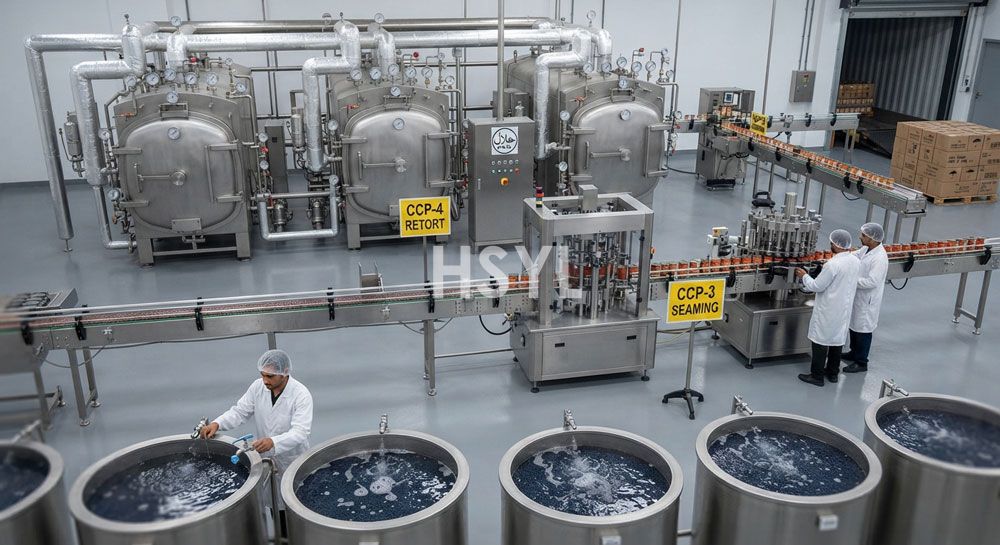
Double seaming a rectangular container at these velocities introduces uneven radial forces. The seamer must execute the first operation roll to curl the cover hook over the body hook, followed immediately by the second operation roll to iron the seam hermetically. To achieve this on a 125g club format, our seaming heads utilize a proprietary cam-driven copying mechanism. This ensures constant roller pressure against the variable radii of the can corners. Operators must consistently verify that the actual overlap exceeds 45% and that the tightness rating does not fall below 75%, as specified in standard FDA CFR Title 21 Part 113 guidelines.
Additionally, equipment in the coastal Algerian environment faces aggressive chloride-induced stress corrosion cracking. The ambient humidity, combined with concentrated sodium chloride from the brining stations, demands rigorous material selection. All product-contact surfaces and structural sub-frames must be fabricated from AISI 316L stainless steel. Relying on standard 304-grade steel in the pre-cooking or brining zones will inevitably lead to pitting corrosion within the first 24 months of continuous operation, severely compromising food safety protocols.
Sequential Module Configuration for Maximized Sardine Yield
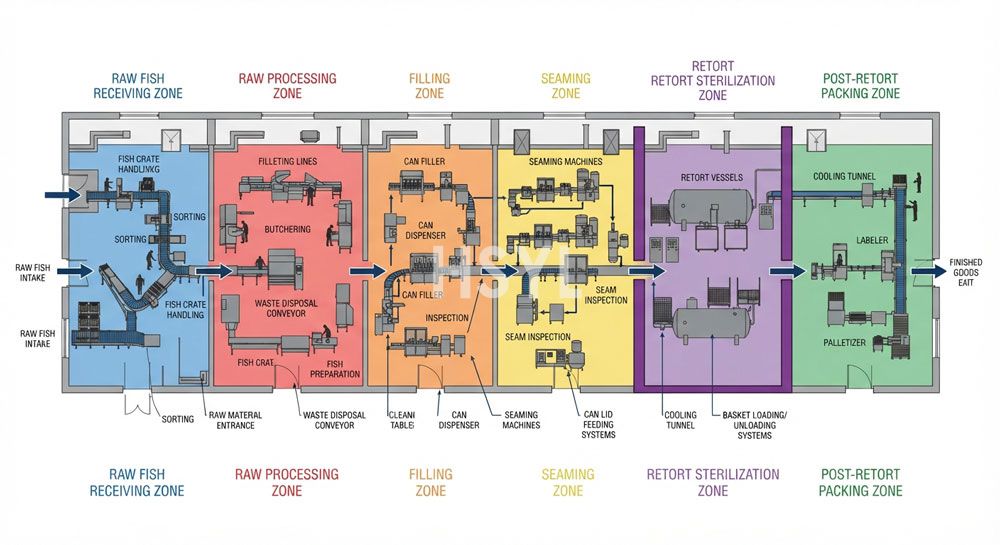
Achieving 8000 CPH with a raw material like Mediterranean sardines requires absolute precision in the primary processing stages. The raw fish must be graded, headed, gutted, and washed before being introduced to the automatic packers. Any deviation in raw material preparation directly impacts the final drained weight and the automated oil filling accuracy.
Automated Nobbing and Precision Packing Mechanisms
The heading and gutting (nobbing) process utilizes rotating rotary blades and vacuum suction systems to remove viscera without damaging the belly walls. Calibrating the blade RPM to the specific sizing index of the catch ensures a raw material yield rate of 60% to 65%. Once cleaned, the fish proceed to the automatic weighing and packing modules. Because the 125g can typically requires 90g of solid fish and 35g of covering liquid, the packing cylinders are pneumatically actuated to compress the fish blocks precisely into the rectangular cavities. We integrate load-cell feedback loops to reject any underweight units before they enter the thermal processing phase, minimizing downstream wastage.
Continuous Exhausting and Volumetric Fluid Dosing
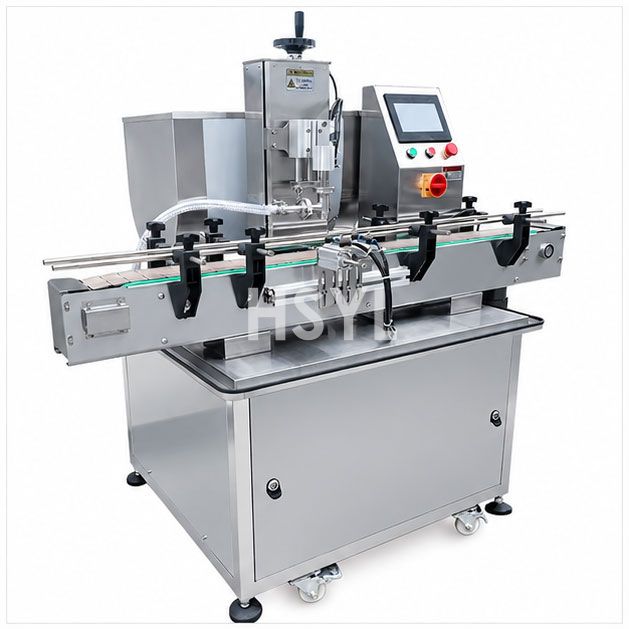
Before the cans are sealed, it is imperative to remove dissolved oxygen from the fish tissues to prevent internal oxidation and tinplate detinning. The packed cans travel through a continuous steam exhauster, operating at 95°C to 98°C for a residence time of 15 to 20 minutes. This thermal shock coagulates surface proteins and expands the ambient air within the headspace. Immediately upon exiting the exhauster, the cans enter the volumetric liquid filler. Whether dispensing hot vegetable oil or concentrated tomato sauce, the dosing piston maintains an accuracy of ±1.5 grams per 125g can. The dosing temperature is strictly maintained above 85°C to ensure a robust vacuum is formed upon cooling post-seam.

Thermodynamics of Overpressure Retort Sterilization
The lethality phase of the fish canning line is the most critical juncture for public health. Low-acid canned foods (pH > 4.6, Aw > 0.85) require aggressive thermal processing to achieve the target Fo value (typically between F0 3.0 and F0 5.0 for sardines in oil) to destroy Clostridium botulinum spores. At an output of 8000 CPH, continuous retorts are often cost-prohibitive; thus, high-capacity batch overpressure retorts are deployed.
For 125g club cans, we recommend water cascading or water immersion retorts rather than pure saturated steam. Rectangular cans are highly susceptible to paneling or peaking (permanent deformation of the flat surfaces) due to internal pressure imbalances during the heating and cooling phases. By utilizing a water cascading system, the PLC controller precisely modulates the counter-pressure via compressed air. As the internal temperature reaches 115°C to 121°C, the external retort pressure is synchronized to offset the internal expansion of the entrapped gases and liquid medium.
Cooling is equally critical. The core temperature must be rapidly reduced to below 40°C to prevent thermophilic spoilage and overcooking of the fish texture. The cooling water must be hyper-chlorinated to a free residual chlorine level of 1.0 to 3.0 ppm. Micro-leaks can occur momentarily during the cooling phase as the seaming compound contracts; sterile cooling water is the absolute final barrier against post-process contamination.
Utility Consumption and Equipment Specifications Matrix
Facility managers must dimension their boiler, compressor, and chiller capacities to match the simultaneous peak loads of the 8000 CPH layout. Undersizing the utility headers will lead to steam pressure drops during retort venting, invalidating the thermal process schedule. Below is a baseline engineering matrix for a standard continuous 125g line.
| Processing Module | Drive Power (kW) | Core Utility Requirement | Critical Engineering Tolerance |
|---|---|---|---|
| Automatic Nobbing Machine | 4.5 kW | Vacuum extraction 0.6 MPa | Cut precision ±2mm from operculum |
| Continuous Steam Exhauster | 1.5 kW (Drive) | Saturated Steam 600 kg/h | Core fish temperature >75°C at exit |
| Volumetric Oil Doser | 2.2 kW | Thermal jacketing heating | Fill weight accuracy ±1.5g |
| Irregular Can Seamer | 5.5 kW | Pneumatic pressure 0.5 MPa | Hook overlap >45%, Tightness >75% |
| Water Cascade Retort (4-Basket) | 3.0 kW (Pumps) | Steam 800 kg/h / cycle | Temperature distribution ±0.5°C |
To ensure seamless integration, project engineers should review our HSYL Turnkey Fish Canning Solutions to verify floor space geometry, which typically requires a linear footprint of approximately 45 meters by 12 meters, exclusive of raw material cold storage and final incubation quarantine zones.
Execution Protocols for Plant Directors During Commissioning
Procuring the machinery is only the initial phase; the actualization of ROI depends entirely on mechanical calibration, preventive maintenance schedules, and operator discipline. For plant directors overseeing the installation of an 8000 CPH line, relying on generic operational manuals is insufficient. Based on our field commissioning experience across North Africa, immediate implementation of the following protocols is mandatory.
First, mandate daily tear-down analysis of the double seams. Do not rely solely on external micrometers. Operators must be trained to cut the 125g cans, strip the cover hook, and visually inspect the body hook for wrinkles using a seam projector. At 133 CPM, a seamer running out of specification for just one hour will generate nearly 8,000 defective units. Establish a strict protocol where seam teardowns are performed and documented every four hours, and immediately after any machine jam.
Second, standardize your CIP (Clean-In-Place) and manual sanitation chemistry. Fish proteins and oils polymerize rapidly on conveyor belts and inside dosing cylinders. Use alkaline detergents formulated specifically for heavy organic soils, followed by acidic rinses to neutralize residues and prevent mineral scaling from hard coastal water. Instruct your sanitation crew to inspect the undercarriages of the transfer belts; neglected organic buildup here serves as a primary vector for Listeria monocytogenes.
Third, validate the thermal process schedule annually or whenever raw material sizing changes. Do not assume that the retort programming used for summer sardines will apply safely to larger winter mackerel. Engage a competent thermal processing authority to conduct heat penetration studies using wireless data loggers placed at the geometric cold spot of the 125g cans. Ensuring that the minimum Fo value is achieved consistently is your ultimate safeguard against product recalls and brand destruction.
Call To Action
Frequently Asked Questions
What is the optimal steam pressure required for an 8000 CPH fish canning line
How frequently should the seaming chucks and rolls be replaced for 125g club cans
Can the same production line handle both oil-filled and tomato sauce sardines
What causes paneling or can deformation during retort cooling
Related Articles




Get professional consultation
Do you have any questions or need technical support regarding the content of this article? Fill out the form below, and our expert team will provide you with professional solutions.