Precision Engineering: How to Integrate Automatic Weighing and Filling Systems in Fish Production for Zero Giveaway
- Target Weight Accuracy: Achieving a dynamic tolerance of ±0.5g to ±1.5g on 125g to 250g seafood portions using high-frequency digital load cell filtration.
- Moisture Adhesion Mitigation: Implementing dimpled SUS316L contact surfaces and optimized vibratory frequencies to prevent sticky fish tissues from bridging inside the weigh hoppers.
- Sanitary Equipment Design: Specifying complete IP69K-rated electrical enclosures and open-frame architectures to withstand harsh, continuous alkaline foam washdowns.
- Giveaway Reduction Economics: Lowering product giveaway from a manual average of 4.5% down to less than 0.8%, recovering massive raw material costs per shift.
As a senior chief engineer at HSYL with over two decades of mechanical troubleshooting across global seafood processing facilities, I frequently evaluate manual packing lines that suffer from severe financial hemorrhage. Plant managers often overlook the compounding cost of "giveaway"—the excess meat added to a package to ensure regulatory compliance. When packing semi-frozen or brined fish, operators instinctively overfill. Integrating automatic weighing and filling systems in fish production shifts this process from human guesswork to algorithmic precision, provided the mechanical integration accounts for the biological realities of seafood.
Seafood presents unique fluid dynamics and friction coefficients. Unlike dry granules or frozen peas, fresh or marinated fish fillets possess high surface moisture and sticky proteins. A standard multi-head weigher designed for snacks will fail immediately in a fish plant. The hoppers will blind, the load cells will fail to register accurate tare weights, and the pneumatic gates will jam with organic debris. In this technical breakdown, we will examine the electromechanical requirements, vibration isolation techniques, and sanitary protocols necessary to engineer a high-yield, continuous weighing module.

Overcoming Moisture Adhesion: Material Geometry and Vibratory Feeding
The primary point of failure in automated fish weighing occurs at the central dispersion cone and the radial feeder pans. As sticky fish pieces enter the system, they tend to cluster. If the material does not feed evenly into the pool hoppers, the combinational logic algorithm is starved of weight options, crippling the machine's operational speed. Standard flat stainless steel creates a high vacuum seal against wet fish skin.
To break this surface tension, the entire product contact pathway must utilize rigidized or dimpled SUS316L stainless steel. The dimpled topography reduces the actual contact area by approximately 60%. Furthermore, the linear vibrator pans must be calibrated to a specific amplitude and frequency. Standard 50 Hz vibration often causes fish to bounce erratically or compact into clumps. We engineer our vibratory drives to operate at a lower frequency range of 25 Hz to 35 Hz with a higher physical amplitude, effectively "walking" the sticky product forward without macerating the delicate muscle fibers.
Hopper gate geometry is equally critical. For aquatic products, standard clam-shell doors frequently pinch the product. An integrated system requires steep-angle discharge hoppers (typically 60 degrees rather than standard 45 degrees) and single-door or specialized scraper-gate designs. This ensures that when the pneumatic actuator fires, the complete mass of the fish drops cleanly into the timing hopper without leaving residue that would corrupt the subsequent zero-tare cycle.
Dynamic Load Cell Stabilization and Resonance Isolation
A persistent contrarian engineering reality in facility design is that most weighing inaccuracies do not stem from faulty load cells, but from unmanaged mechanical resonance. Plant engineers often bolt the multi-head weigher directly to the same platform supporting high-impact machinery like seaming equipment or volumetric piston fillers. The low-frequency vibrations travel through the structural steel, creating mechanical "noise" that the load cells interpret as weight fluctuations.
To combat this, the support structure for the automatic weighing system must be physically decoupled from the primary packing conveyor. We utilize isolated stanchions equipped with elastomeric dampening pads. Inside the control unit, HSYL employs a proprietary Digital Signal Processing (DSP) filter algorithm. This software continuously monitors the incoming analog signal from the strain gauge, calculating a rolling average while discarding high-amplitude frequency spikes generated by external plant vibrations.
The stabilization time—the micro-seconds required for the load cell to settle and record an accurate weight—dictates the maximum speed of the line. By isolating the structure and applying aggressive DSP filtering, the load cell stabilization time can be reduced to under 120 milliseconds. This allows a 14-head weigher to comfortably execute 80 to 100 accurate dumps per minute on sticky fish products, maintaining a standard deviation of less than 1.0 gram.
System Architecture: Weighing vs. Volumetric Dosing Synergy
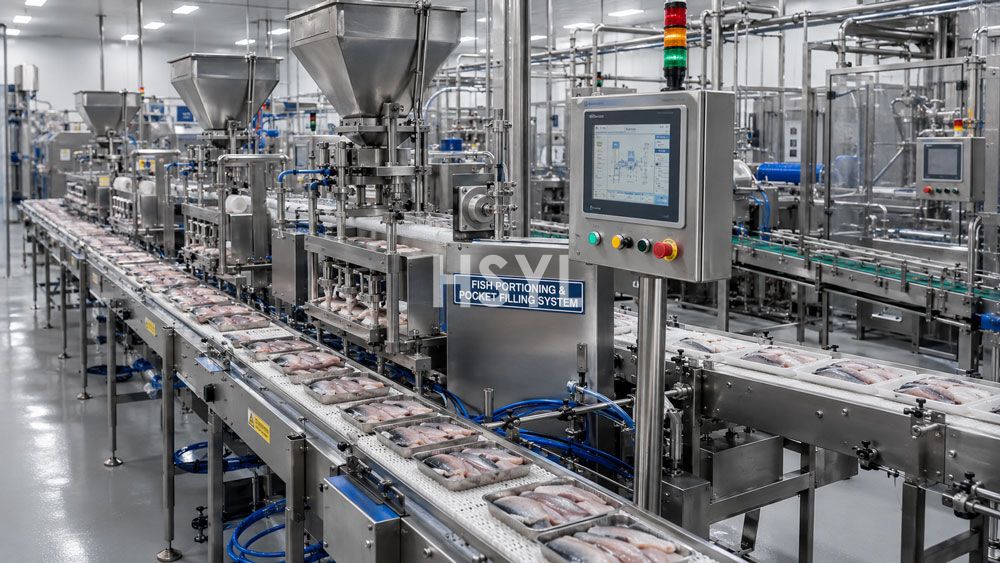
When integrating these systems, one must distinguish between handling the solid fish mass and the liquid medium (brine, oil, or tomato sauce). A modern fish canning or pouching line requires a two-stage approach: multi-head combinational weighing for the solid meat, followed by volumetric piston dosing for the covering liquid. Attempting to weigh the liquid and solid simultaneously inevitably leads to splashing, seal contamination, and headspace variability.
The synchronization between the timing hopper of the weigher and the indexing conveyor of the packaging machine is managed via encoder feedback. As a can or tray arrives under the discharge chute, a photoelectric sensor registers its presence. A signal is sent to the PLC, which commands the timing hopper to open. The descent speed of the fish must be calculated to prevent it from bridging in the narrow neck of the filling funnel.
Below is a baseline technical comparison to guide procurement teams when selecting the primary solid-fill architecture.
| Engineering Parameter | Standard Linear Weigher | Advanced Multi-Head Combinational Weigher | Volumetric Cylinder Filler (Solids) |
|---|---|---|---|
| Optimal Product Type | Uniform, dry, frozen chunks | Irregular, sticky, wet fish fillets | Minced or highly processed pastes |
| Speed (100g Target) | 30 - 40 cycles / min | 80 - 120 cycles / min | 150+ cycles / min |
| Giveaway Average | 2.5% - 4.0% | < 0.8% | Volume accurate, weight highly variable |
| Target Weight Accuracy | ± 3.0g | ± 0.5g to ± 1.5g | Density dependent (± 5.0g) |
| Mechanisms | Vibratory feed to single load cell | 10-14 independent load cells with algorithm | Pneumatic displacement piston |
To ensure optimal layout geometry and synchronization, engineers should consult HSYL automatic multi-head weighers to verify dimensional footprints and integration interface protocols with existing downstream vacuum sealers or cartoners.
IP69K Sanitary Washdown Protocols and Compliance
The bacteriological load in a seafood processing plant mandates aggressive sanitation. Fish proteins polymerize rapidly upon contact with stainless steel, and fish oils form hydrophobic biofilms. Daily washdowns typically involve high-pressure water at 80 bar (1160 PSI) heated to 80°C, combined with highly caustic alkaline foams. If the weighing equipment is not explicitly engineered for these conditions, electrical failure is imminent.
Integrating a system with an IP69K rating is non-negotiable. This certification guarantees that all servo motors, load cell housings, and touch-screen HMIs are impervious to high-temperature, high-pressure water jets from any angle. The structural frame must feature a sloped, open-channel design. Closed tubular framing, while structurally sound, creates internal condensation and anaerobic breeding grounds for Listeria monocytogenes if micro-cracks develop in the welds.
Furthermore, the weighing buckets and linear feeder pans must feature tool-less removal. Sanitation crews must be able to dismount all product-contact parts by hand within ten minutes for offline soaking. This design philosophy directly supports compliance with FDA CFR Title 21 sanitation requirements, ensuring that no dead-zones exist where pathogenic biofilms can mature unhindered.
Plant Manager's Audit: 3 Actionable Calibrations for Weighing Accuracy
Purchasing an advanced multi-head weigher solves the mechanical challenge, but maintaining sub-gram accuracy requires strict daily floor discipline. Drifting load cells and pneumatic delays will silently erode your yield. Plant managers must implement the following three equipment audits as mandatory shift-start procedures.
1. Execute a mandatory dynamic Auto-Tare verification. Do not rely solely on the factory zero-point calibration. During operation, fish proteins and moisture will inevitably build up on the hopper walls. Verify that the PLC is programmed to execute an auto-tare routine automatically every 15 to 20 cycles. This forces the system to recalculate the baseline zero weight of the empty hopper, negating the added mass of the sticky residue.
2. Inspect the main pneumatic manifold supply pressure. The opening and closing speeds of the hopper gates are dictated by compressed air. If the plant air pressure drops below 0.5 MPa (5 bar), the gate actuation will lag. A delayed gate closure allows subsequent product from the linear feeder to fall into a discharging hopper, destroying the weight calculation. Install a dedicated local air receiver tank next to the weigher to absorb facility pressure drops.
3. Verify the mechanical alignment of the discharge chutes. A common integration failure occurs when the synchronization between the weigher's discharge chute and the packaging machine's receptacle shifts due to vibration. If the product strikes the side of the funnel before entering the can, the kinetic energy scatters the fish pieces, causing seal zone contamination. Run a dry mechanical cycle daily to confirm absolute vertical alignment.
Call To Action
Frequently Asked Questions
What types of fish products can automatic weighing and filling systems handle?
How accurate are automatic weighing and filling systems in fish production?
Can these systems be integrated into existing fish processing lines?
What hygiene features should buyers prioritize?
How do automatic systems perform with irregular fish pieces?
What maintenance is required for weighing and filling systems?
Are these systems suitable for export-oriented production?
Related Articles



Get professional consultation
Do you have any questions or need technical support regarding the content of this article? Fill out the form below, and our expert team will provide you with professional solutions.