Retort sterilization plays a decisive role in ensuring fish canning safety, regulatory compliance, and long-term product stability across global markets. For industrial fish processors, seafood canneries, and integrated food manufacturing groups, retort sterilization is not merely a thermal step—it is the core control point that determines microbiological safety, shelf life, export eligibility, and brand risk management. In modern fish canning operations, where large batch volumes, strict food safety laws, and increasingly complex product formulations intersect, the effectiveness and reliability of retort sterilization directly influence operational viability and market access.For complete autoclave batch scheduling and facility sanitation planning, refer to our engineering overview on vacuum seamer vs atmospheric seamer.
This article examines the critical role of retort sterilization in fish canning safety from an industrial, engineering, and compliance-driven perspective. It is written for B2B decision-makers including plant managers, food safety directors, engineering teams, and procurement professionals evaluating retort systems for new canning lines or facility upgrades. Rather than marketing claims, the focus is on process logic, industry challenges, equipment design considerations, and buyer decision factors grounded in real production environments.

Understanding Retort Sterilization in Fish Canning Safety
What Retort Sterilization Is
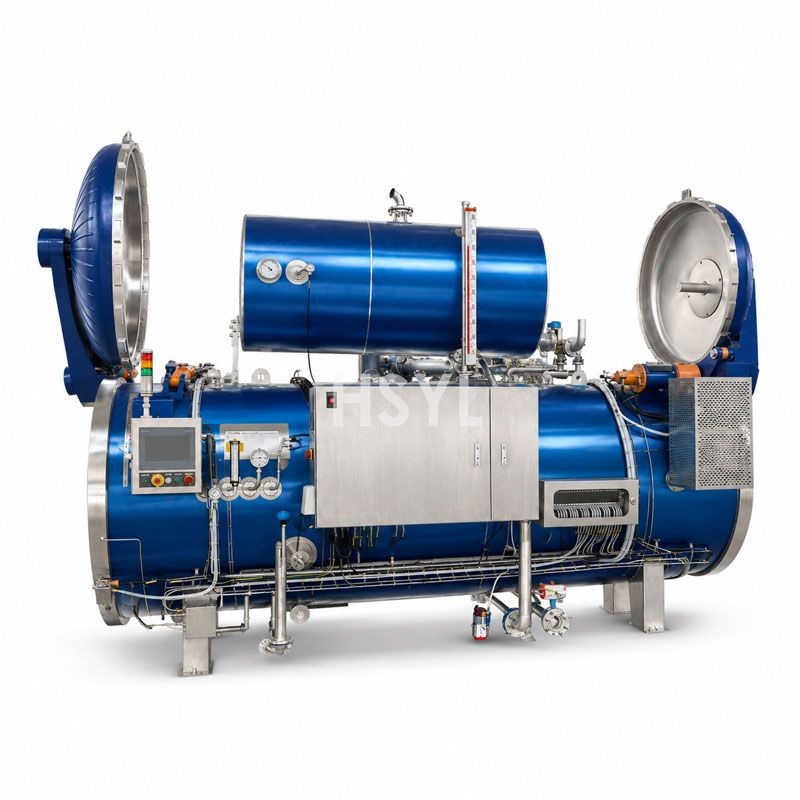
Retort sterilization is a high-temperature, high-pressure thermal processing method used to achieve commercial sterility in canned fish products. The process involves heating sealed containers—typically metal cans, aluminum trays, or retort pouches—inside a pressurized vessel (the retort) to a temperature sufficient to inactivate pathogenic microorganisms, including heat-resistant spores such as Clostridium botulinum.
In the context of fish canning safety, retort sterilization is the final and most critical lethality step. Once fish has been cleaned, cooked or pre-treated, filled, and hermetically sealed, the retort process ensures that the product can be safely stored at ambient temperature without refrigeration while maintaining microbiological stability throughout its declared shelf life.
How Retort Sterilization Works in Practice
A standard fish canning retort sterilization cycle consists of three primary phases:
Come-Up Phase
The retort chamber is pressurized and heated using steam, water spray, water immersion, or a combination system. Temperature rises rapidly to the target sterilization setpoint, typically ranging from 115°C to 121°C depending on product formulation, container size, and regulatory requirements.Holding (Sterilization) Phase
The product is held at the target temperature for a validated time sufficient to achieve the required lethality value (F₀). This phase is tightly controlled and monitored, as it directly determines food safety and regulatory compliance.Cooling Phase
After sterilization, controlled cooling reduces product temperature while maintaining counter-pressure to prevent container deformation, seal failure, or paneling. Proper cooling is essential to both safety and finished product appearance.
Throughout the entire cycle, temperature, pressure, time, and sometimes agitation parameters are continuously logged and validated, forming the backbone of fish canning safety documentation.
Why Retort Sterilization Is Non-Negotiable for Fish Canning Safety
The Unique Safety Risks of Canned Fish
Fish and seafood products present specific safety challenges that make retort sterilization indispensable:
High protein and moisture content, creating an ideal environment for bacterial growth if inadequately processed
Risk of anaerobic pathogens, particularly Clostridium botulinum, in sealed containers
Natural variability in raw material, including fat content, size, and tissue density
Global distribution requirements, often requiring 2–5 years of ambient shelf life
Without properly designed and validated retort sterilization, these factors translate into unacceptable food safety risks and regulatory exposure.
Regulatory Expectations and Zero-Tolerance Risk
In major markets such as the United States, European Union, and Japan, canned fish safety is regulated under strict frameworks. Authorities do not tolerate process deviations, undocumented lethality, or equipment instability. A single failure in retort sterilization can result in:
Mandatory recalls
Import alerts or export bans
Facility shutdowns
Long-term brand damage
As a result, retort sterilization is not treated as a standalone machine but as a validated safety system integrated into the entire fish canning line.
Industry Problems Solved by Retort Sterilization Systems
Eliminating Microbiological Safety Risks
The primary function of retort sterilization in fish canning safety is the reliable inactivation of pathogens and spoilage organisms. Industrial-grade retorts are engineered to deliver uniform heat penetration across all containers, even in dense fish products packed in oil, brine, or sauces.
Reducing Product Loss and Rework
Inconsistent thermal processing often leads to under-processed or over-processed batches. Under-processing results in unsafe product, while over-processing degrades texture, flavor, and yield. Modern retort systems minimize both risks through precise control, reducing waste and reprocessing costs.
Supporting High-Volume, Continuous Production
Manual or semi-controlled thermal processes cannot scale effectively for industrial fish canning. Automated retort sterilization systems support predictable cycle times, high throughput, and repeatable results across multiple shifts and product SKUs.
Improving Compliance and Audit Readiness
Retort sterilization systems designed for fish canning safety provide automatic data logging, batch traceability, and audit-ready documentation aligned with HACCP, FDA, and ISO requirements. This significantly reduces the administrative burden during inspections.
Key Features and Technical Advantages of Modern Retort Sterilization Systems
Precise Temperature and Pressure Control
Advanced control systems ensure stable thermal conditions throughout the retort chamber, even during load variations. This is essential for fish canning safety, where uneven heating can compromise lethality validation.
Multiple Heating Media Options
Depending on product and packaging, retort sterilization systems may use:
Saturated steam
Water spray
Water immersion
Steam-air mixtures
Each method offers specific advantages for different fish products, such as whole fish, fillets, pâtés, or ready-to-eat meals.
Uniform Heat Distribution Design
Chamber geometry, nozzle placement, circulation pumps, and load configuration are engineered to eliminate cold spots. Uniformity is a critical requirement for validated fish canning safety processes.
Integrated Process Monitoring and Data Recording
Industrial retorts are equipped with PLC and HMI systems that record temperature, pressure, time, and alarm events. These records form the legal evidence of compliance for each production batch.
Typical Applications and Production Scenarios in Fish Canning
Retort sterilization is applied across a wide range of fish canning operations, including:
Tuna, sardine, mackerel, and salmon canning lines
Whole fish, chunk, shredded, or minced formats
Products packed in oil, brine, tomato sauce, or flavored sauces
Metal cans, aluminum trays, and flexible retort pouches
In integrated factories, retorts are positioned downstream of filling and seaming machines and upstream of labeling and packing lines, forming the final safety barrier in the production flow.
Capacity Options and Selection Guidance for Retort Sterilization
Batch vs. Continuous Retort Systems
Most fish canning facilities rely on batch retort sterilization due to product diversity and packaging variability. Continuous systems may be used in very high-volume, single-SKU operations but require greater standardization.
Capacity Considerations
When selecting retort sterilization equipment for fish canning safety, buyers should evaluate:
Daily production volume
Container size and stacking configuration
Number of SKUs and changeover frequency
Available floor space and utility capacity
Oversizing increases capital and energy costs, while undersizing creates production bottlenecks.
Validation and Process Flexibility
A well-selected retort should support future product expansion without requiring complete revalidation. Flexible control logic and recipe management are essential for long-term operational efficiency.
Buyer Benefits of Proper Retort Sterilization in Fish Canning Safety
Improved Product Safety and Risk Control
Validated retort sterilization provides confidence that every unit leaving the factory meets food safety requirements, protecting both consumers and brand equity.
Consistent Product Quality
Controlled thermal profiles help preserve fish texture, color, and sensory characteristics while achieving required lethality.
Lower Labor and Supervision Costs
Automated retorts reduce manual intervention, operator dependency, and human error in critical safety steps.
Scalability and Market Access
Reliable retort sterilization enables processors to scale production and access regulated export markets with confidence.
Customization and Engineering Support in Retort Projects
Fish canning operations vary significantly in product mix, packaging, and regulatory requirements. As a result, retort sterilization systems are rarely one-size-fits-all. Industrial manufacturers typically provide:
Process analysis and capacity modeling
Retort configuration design based on product characteristics
Integration with upstream and downstream equipment
Installation, commissioning, and operator training
Support for thermal validation and process authority documentation
Engineering support is particularly critical when upgrading existing lines or transitioning to new packaging formats.
Standards, Certifications, and Compliance for Fish Canning Retort Sterilization
HACCP and Food Safety Management Systems
Retort sterilization is a critical control point (CCP) under HACCP plans for canned fish. Equipment design must support monitoring, verification, and corrective action procedures.
FDA and US Market Requirements
For US-bound products, retort systems must align with FDA low-acid canned food (LACF) regulations, including process filing, recordkeeping, and equipment performance expectations.
International Standards
Depending on the market, retort sterilization equipment may also comply with:
CE marking for mechanical and pressure vessel safety
ISO 22000 food safety management systems
ASME or equivalent pressure vessel codes
Compliance is not optional; it is foundational to fish canning safety and export eligibility.
Conclusion: Retort Sterilization as the Foundation of Fish Canning Safety
The critical role of retort sterilization in fish canning safety cannot be overstated. It is the final safeguard that transforms raw fish into a shelf-stable, globally marketable product. For industrial processors, investing in properly designed, validated, and supported retort sterilization systems is not simply a compliance decision—it is a strategic commitment to product integrity, operational stability, and long-term business sustainability.
Manufacturers with experience in fish canning projects understand that effective retort sterilization is achieved through a combination of equipment design, process engineering, validation discipline, and ongoing technical support. For processors planning new lines, expanding capacity, or upgrading aging systems, engaging with an experienced retort solution provider is a critical step toward ensuring fish canning safety at every level.
Frequently Asked Questions
What role does retort sterilization play in fish canning safety?
How is the correct sterilization time and temperature determined?
Can one retort handle multiple fish products?
What happens if retort parameters deviate during processing?
Is retort sterilization required for all canned fish products?
How does retort design affect product quality?
What documentation is required for compliance audits?
Related Articles





Get professional consultation
Do you have any questions or need technical support regarding the content of this article? Fill out the form below, and our expert team will provide you with professional solutions.