The Durability Gap in Industrial Bakery Slicing
In the transition from mechanical slicing to ultrasonic technology, many plant managers make the error of evaluating knives solely on their initial cutting precision. While a clean cut on a multi-layer cheesecake is the immediate goal, the true engineering challenge lies in mechanical resilience. In a 24/7 production environment, an ultrasonic knife is not just a blade; it is a resonant acoustic component subjected to 20,000 to 40,000 cycles per second. This high-frequency oscillation creates internal stress that can lead to microscopic grain boundary separation and eventual structural failure.
Durability in the bakery business is often compromised by "thermal de-tuning." As a blade interacts with sticky fats, sugars, or frozen inclusions, the friction generates heat. This heat causes the metal to expand, altering its resonant frequency. If the generator cannot compensate for this "drift," the system forces vibration into a non-resonant state, dramatically accelerating material fatigue. At HSYL, we approach knife design not as a cutlery problem, but as a metallurgy and acoustics problem. The following five knife configurations represent the current frontier in durable, industrial-grade ultrasonic cutting.
Top 5 Durable Ultrasonic Cutting Knife Configurations
1. Monolithic Grade 5 Titanium (Ti-6Al-4V) Sonotrodes
For high-throughput lines processing dense products like nut-filled energy bars or heavy fruit cakes, the monolithic titanium blade is the baseline for durability. Unlike composite blades, these are machined from a single block of aerospace-grade titanium alloy. The fatigue limit of Ti-6Al-4V allows it to withstand hundreds of millions of cycles without the work-hardening that causes stainless steel blades to snap.
The primary advantage here is the consistency of the mechanical impedance. Because the material is uniform, the standing wave remains stable across the entire width of the blade, preventing "hot spots" where vibration might concentrate and cause localized fractures. For engineers, this means fewer emergency line stoppages and a predictable replacement cycle based on actual wear rather than catastrophic failure.
2. Vacuum-Hardened Ceramic-Coated Blades
Bakery products with high sugar content or honey-based glazes present a unique durability challenge: stickiness leading to drag. Drag increases the power draw of the ultrasonic generator, which in turn increases the heat load on the blade. The most durable response to this is a vacuum-deposited ceramic or diamond-like carbon (DLC) coating.
These coatings are not merely "paint." They are molecularly bonded to the titanium substrate in a vacuum chamber. This results in a surface with an extremely low coefficient of friction. By reducing the drag, we reduce the heat generated at the cutting interface. This keeps the blade within its optimal thermal range for longer periods, significantly extending the life of both the blade and the transducer stack. This is particularly effective for automatic ultrasonic cutting machines processing sticky marshmallows or caramel-layered brownies.
3. Heat-Dissipating Liquid-Cooled Knife Blocks
When running continuous 24/7 cycles on frozen cakes or refrigerated dough, the air-cooling capacity of a standard knife is often insufficient. Heat builds up in the transducer-to-blade interface (the "stud" area), which is the most common point of failure. The solution for high-duty-cycle environments is an integrated liquid-cooling channel within the knife block or the booster assembly.
By circulating a food-grade coolant or chilled air through the core of the cutting assembly, we maintain a stable temperature. This prevents the thermal expansion that leads to frequency mismatch. From an operational standpoint, this configuration is the most durable because it protects the most expensive component—the piezoelectric transducer—from thermal damage, while allowing the blade to maintain its resonant peak under heavy load.
4. Modular Segmented Cutting Arrays
In wide-format sheet cake production, using a single, long blade (over 500mm) creates a "nodes and antinodes" problem. The center of a massive blade is often less stable than the edges, leading to uneven wear and localized stress concentration. The engineering pivot for durability is the modular segmented array. Instead of one long knife, the system uses a series of smaller, independently driven knives synchronized via PLC.
This approach offers two major durability benefits. First, smaller knives are inherently stiffer and more resonant, meaning they require less power to achieve the same amplitude. Second, if one knife is damaged by an accidental inclusion (such as a stray metal fragment), you only replace a 100mm segment rather than a 600mm custom-indexed blade. This modularity is a core feature in high-capacity frozen cake cutting lines where downtime is measured in thousands of dollars per hour.
5. Amplitude-Adaptive Intelligent Knives
The latest trend in durability involves "feedback-loop" cutting. Many knives fail because they are driven at 100% amplitude regardless of the product resistance. Intelligent knives work with generators that feature Phase-Locked-Loop (PLL) Control. The system senses the resistance of the product (e.g., a crusty bread vs. a soft crumb) and adjusts the vibratory amplitude in real-time.
By only using the necessary energy to complete a cut, we reduce the total vibration load on the titanium grain structure. Think of it as a variable-speed drive for your cutting system. This adaptive logic can increase blade life by 30-50% in facilities that process a wide variety of SKUs, such as those integrated into a fully automatic bread production line. It turns the knife into a "smart" component that protects itself from over-exertion.
Engineering Trade-off: Frequency vs. Longevity
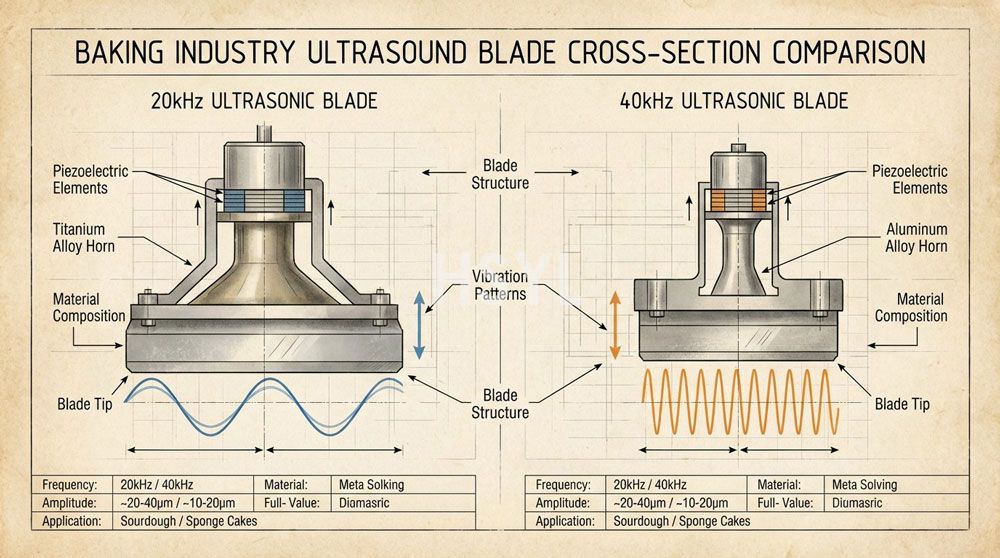
A common mistake in technical procurement is choosing the highest frequency (e.g., 40kHz) for every application. While 40kHz provides a superior finish on delicate pastries, the blades are necessarily thinner and have a higher surface-area-to-mass ratio, meaning they heat up faster and are more susceptible to snapping. For most industrial bakery applications—cakes, brownies, and dense bars—20kHz is the engineer's choice for durability. The thicker cross-section of a 20kHz blade handles the mechanical resistance of dense bakery loads with much higher reliability.
Technical Selection Matrix: Ultrasonic Knife ROI
| Product Category | Primary Challenge | Recommended Knife Type | Est. Life Increase vs. Standard |
|---|---|---|---|
| Dense Energy Bars | Inclusions (Nuts/Seeds) | Monolithic Grade 5 Titanium | +40% Fatigue Resistance |
| Brownies/Caramel | Sugar Adhesion | Ceramic-Coated Anti-Stick | +25% Uptime (Cleaning reduction) |
| Frozen Slab Cakes | Thermal De-tuning | Liquid-Cooled Assemblies | +60% Transducer Protection |
| Puff Pastry | Delicacy vs. Speed | Intelligent PLL Adaptive | +30% Material Life |
The "Floor Level" Durability Audit: Immediate Action for Managers
If you are experiencing premature blade failure, the issue is rarely the knife alone. I have seen hundreds of thousands of dollars wasted because of improper torque settings. The interface between the booster and the blade must be tightened to a specific Newton-meter (Nm) value using a calibrated torque wrench. An under-tightened joint creates an air gap that acts as a heat barrier, causing the stud to melt. An over-tightened joint creates stress fractures in the titanium threads. Audit your maintenance team's tooling today: if they aren't using a torque wrench, your knives are already failing.
Integrating HSYL Engineering into Your Line
Selecting a durable knife is the first step, but the second is ensuring your system layout supports it. A knife that is perfectly durable can still fail if the conveyor timing or the product temp control is off. At HSYL, we specialize in the engineering of the entire ultrasonic vs. mechanical cutting comparison, helping you decide which technology yields the highest ROI for your specific SKU mix.
Related Topics
- Ultrasonic vs. Mechanical Cutting: What Plant Engineers Should Compare
- Advanced Automatic Ultrasonic Frozen Cake Cutting Systems
- Technical Guide: Choosing Industrial Bakery Cutting Equipment
Contact HSYL for Production Line Optimization
If you are struggling with excessive downtime in your cutting section or planning a new bakery facility, our engineering team can help. We provide complete turnkey solutions, from specialized knife selection to the integration of fully automated production lines. Contact HSYL today to discuss your specific product textures and throughput requirements with an engineer.
Frequently Asked Questions
What is the best material for industrial ultrasonic knives
How long do ultrasonic blades typically last in a bakery
Why do my ultrasonic knives snap at the threads
Can I sharpen ultrasonic knives myself
Does moisture in the bakery affect blade life
What is the difference between 20kHz and 40kHz for durability
Related Articles




Get professional consultation
Do you have any questions or need technical support regarding the content of this article? Fill out the form below, and our expert team will provide you with professional solutions.