The global snack market is rapidly diverging from standard potato and corn-based extrusions. Driven by intense consumer demand for high-protein alternatives and premium localized delicacies, regional processors are attempting to mass-produce previously niche items. Products such as crispy small fish, vacuum-fried squid, edible insects (like silkworm pupae), and ultra-premium health supplements like edible bird's nest (cubilose) command extraordinary retail profit margins. However, factory directors attempting to bridge the gap between small-batch artisanal production and continuous industrial output face a massive engineering roadblock: there is simply no ready-made, off-the-shelf dehydration equipment designed to handle these highly specific biological materials.

When factory managers force these exotic raw materials through standard commercial dehydrators or generic continuous atmospheric fryers, the physical results are universally disastrous. The raw materials either burn, explosively shatter, or degrade into an unsellable, malodorous waste. Achieving industrial-grade mass production requires discarding standardized machinery concepts and instead applying aggressive, custom-engineered vacuum dehydration technologies.
The Physics of Processing Exoskeletons and Marine Lipids
Dehydrating small aquatic species (shrimp, squid rings, small whole fish) and edible insects presents a violent thermodynamic challenge. In traditional high-heat atmospheric frying, the raw material is shocked with extreme thermal energy (typically exceeding 170°C). For insects like silkworm pupae, the moisture trapped inside the dense biological exoskeleton violently attempts to expand into steam. Because the exoskeleton restricts vapor release, the internal pressure spikes exponentially until the insect literally explodes within the oil bath. This not only destroys the product yield but rapidly degrades the frying oil with microscopic suspended biological debris.
Simultaneously, marine products possess high concentrations of polyunsaturated fatty acids (Omega-3 lipids). When these delicate fatty acid chains are exposed to high atmospheric heat and raw oxygen, they undergo immediate and aggressive lipid oxidation. This chemical failure pathway generates a highly offensive, rancid "fishy" odor that contaminates the entire factory floor and ruins the retail shelf stability of the snack.
The sole industrial solution is to rely on a specialized vacuum frying machine. By pulling the heavy-duty frying chamber down to exactly -0.098 MPa, the oil bath is maintained at a highly controlled 85°C. At this low temperature, the internal moisture transitions to vapor gently rather than explosively, completely preserving the physical integrity of the insect exoskeleton or the delicate structure of small shrimp. Additionally, because the entire frying sequence occurs within an oxygen-depleted vacuum environment, lipid oxidation is mechanically halted. The final product emerges perfectly intact, exceptionally crisp, and free from any rancid odor anomalies.
[Insert image: Customized compartmentalized SUS304 vacuum frying basket designed specifically for delicate seafood and insect snack processing]
Protecting Glycoproteins: The Edible Bird's Nest Challenge
While seafood demands low-temperature oil extraction, certain ultra-premium medicinal materials absolutely cannot tolerate any contact with external lipids or elevated atmospheric temperatures. Edible bird's nest is composed primarily of mucin glycoproteins and high concentrations of bio-active sialic acid. Attempting to dry raw, cleaned bird's nest using standard forced-air convection ovens or microwave dehydration units introduces devastating thermal stress.
Applying temperatures over 60°C to wet cubilose causes the delicate protein strands to irreversibly denature. The physical matrix shrinks aggressively, transforming into a hard, dense yellow puck that requires 24 hours of soaking by the end consumer just to rehydrate. In the premium supplement market, this thermal discoloration and physical contraction instantly wipe out 90% of the product's wholesale monetary value.
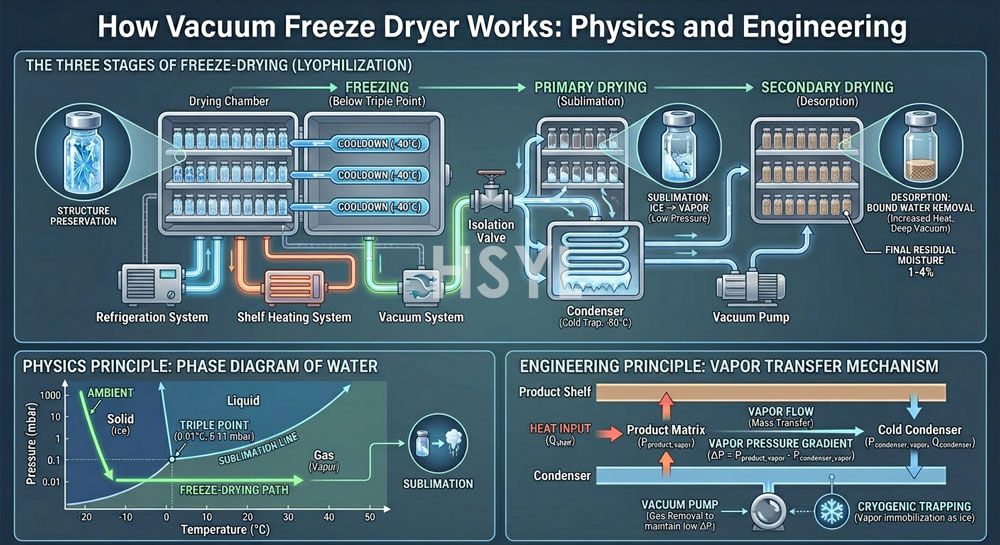
For these materials, factories must exclusively deploy a high-grade vacuum freeze dryer. Lyophilization fundamentally bypasses the liquid phase entirely. The moist, cleaned bird's nests are deep-frozen below -35°C in custom molding cups that maintain their natural cup-like geometry. Once subjected to deep vacuum (< 5 Pa), the ice locked within the protein matrix sublimates directly into vapor. Because there is zero liquid water transition and absolutely no heat stress, the sialic acid remains biologically active. The final freeze-dried nest retains its pristine icy-white coloration and acts as a highly porous micro-sponge. When the consumer adds hot water, this freeze-dried matrix fully rehydrates into a gelatinous, aromatic soup in under five minutes.

Flexible Chamber Modification: Our Automation Philosophy
Purchasing a machine with a vacuum pump attached does not automatically solve the processing demands of niche materials. The actual engineering secret to high-yield mass production lies completely within the internal chamber configuration and the dynamic rotation algorithms integrated into the PLC logic. Standard centrifugal extraction baskets designed for rigid potato chips will physically crush delicate squid rings or brittle insect shells under the sheer weight of a 200 kg batch depth.
When handling these fragile items, our mechanical engineers do not use standard open-cavity frying baskets. Instead, we heavily modify the interior with multi-tiered, compartmentalized vacuum frying machine baskets. Each vertical layer independently supports a shallow load of raw material. This strictly limits the physical pressure exerted on the bottom layer. During the final centrifugal deoiling sequence, the variable-frequency drive initiates a remarkably gentle, slow-ramp spin cycle that pulls the residual oil away from the marine products without inducing structural crushing or cracking.
Additionally, for products like spiced fish or marinated insects, upstream handling greatly dictates success. Pre-treating the raw material inside a vacuum tumbler machine before sending it directly to the fryer allows heavy marinades to penetrate deep into the biological tissue. Because standard marinades heavily alter the specific heat capacity and sugar content of the raw material, our automation team writes entirely bespoke thermal recovery curves into the Siemens control panel to compensate for the liquid marinade load during the initial thermal immersion drop.
Precision Thermal Sensors for Lyophilizers
The customization philosophy extends heavily into our freeze-drying divisions. Standard lyophilizers measure the ambient vapor temperature within the primary vessel. While adequate for robust commercial vegetables, ambient tracking is disastrously inaccurate for materials like bird's nest or rare medicinal herbs that have highly volatile eutectic points.
To safely mass-produce millions of dollars of premium organic supplements, our engineers actively embed ultra-sensitive PT100 temperature probes directly into the specialized aluminum loading trays, maintaining direct physical contact with the product. As the primary radiant heating plates emit energy to drive sublimation, the sensors feed localized biological core temperatures instantly back to the central microprocessor. If a specific tray of bird's nest registers a temperature rising too close to the critical collapse point, the PLC independently throttles the heating fluid bypass valves for that specific sector, preventing local overheating and guaranteeing complete batch uniformity across 100 square meters of drying rack space.
Overcoming Supply Chain Standardization
Transitioning a hand-crafted regional specialty into a fully certified, mass-exportable commodity demands aggressive mechanical intervention. Operating a factory processing specialized marine products, insects, or medicinal herbs means dealing with biological variances that break standard machinery. High protein levels foul the frying oil instantly. Delicate physical structures shatter during handling. Volatile aromatic compounds escape through poor vacuum seals.
Succeeding in this specialized high-margin sector requires acknowledging that the equipment must adapt stringently to the biology of the food, not the inverse. Opting for non-standard, custom-built dehydration technology ensures your facility operates smoothly without fighting catastrophic batch losses, positioning you aggressively against competitors stalled out utilizing standardized, rigid hardware.
Related Topics
- Engineered Vacuum Frying Solutions
- Industrial Lyophilization and Freeze Drying Plants
- Vacuum Tumbling Equipment for Deep Marination
Non-Standard Customization Engineering Services
Transforming complex, highly fragile regional ingredients into scalable retail commodities requires moving beyond off-the-shelf equipment catalogs. If your facility is struggling to industrialize an unconventional high-margin product without ruining its structural integrity, our mechanical customization division is available. Contact our lead engineers directly to discuss non-standard machinery integration, bespoke basket geometries, and proprietary thermal curve programming tailored entirely to your specific raw material.
Frequently Asked Questions
Why do crispy fish snacks processed in standard fryers smell fishy and oxidize quickly
Can fragile items like whole small crab or shrimp survive the centrifugal deoiling phase
What is the primary visual difference between hot-air dried and freeze-dried bird's nest
How does a factory handle the intense odor of processing large volumes of seafood
Is the initial capital investment justified for processing localized niche snacks
Related Articles



Get professional consultation
Do you have any questions or need technical support regarding the content of this article? Fill out the form below, and our expert team will provide you with professional solutions.