If you are managing an active snack manufacturing facility, there is no technical operational failure more frustrating than a rejected wholesale shipment due to poor product texture. Factory directors running first-generation or budget-grade vacuum fryers frequently struggle with two systemic, profit-destroying complaints: the fruit and vegetable chips have turned dark brown, or they feel unacceptably greasy and heavy with oil. In retail environments, high oil retention ruins shelf-stability by aggressively accelerating lipid oxidation (rancidity), while dark discoloration signals to the consumer that the product is overcooked or burned.

These issues are rarely caused by operator error on the factory floor. Instead, they are direct symptoms of fundamental mechanical design failures within your dehydration equipment. Processing high-sugar tropical fruits like jackfruit, highly porous materials like shiitake mushrooms, or protein-dense commercial seafood like squid requires exact thermodynamic precision. When an off-the-shelf vacuum fryer struggles to balance absolute negative pressure against raw material density, the batch is instantly compromised.
The Universal Equipment Myth: Why Standard Fryers Fail
A prevalent and dangerous misconception in food processing procurement is the assumption that a standard commercial vacuum fryer can universally handle all agricultural crops. While a generic machine might successfully process robust, starchy potatoes, feeding it high-sugar pineapples or dense seafood directly results in catastrophic batch failures. Every biological material possesses a unique structural matrix, moisture content ratio, and eutectic threshold.
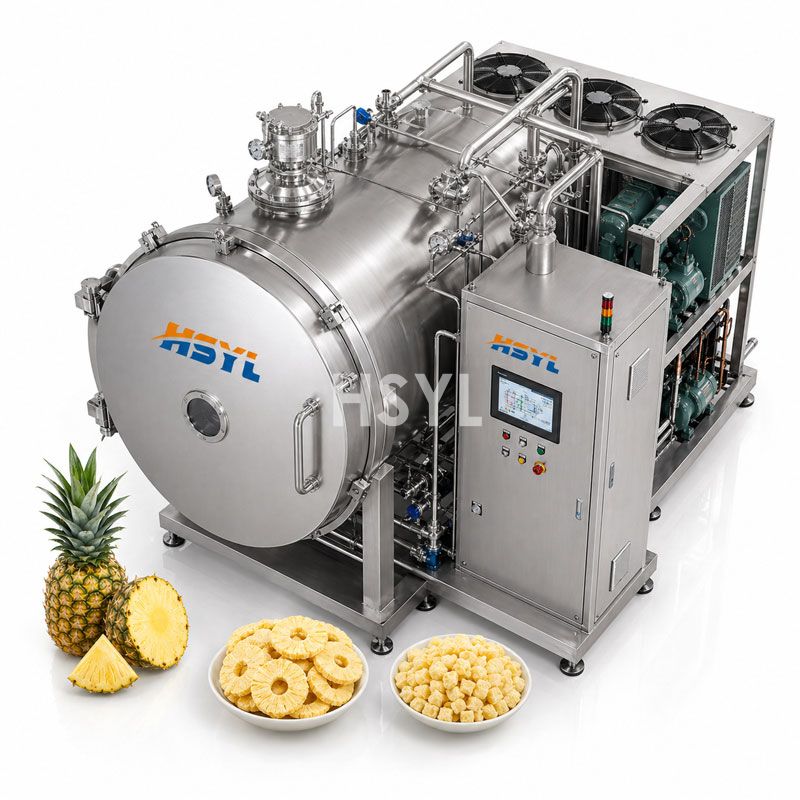
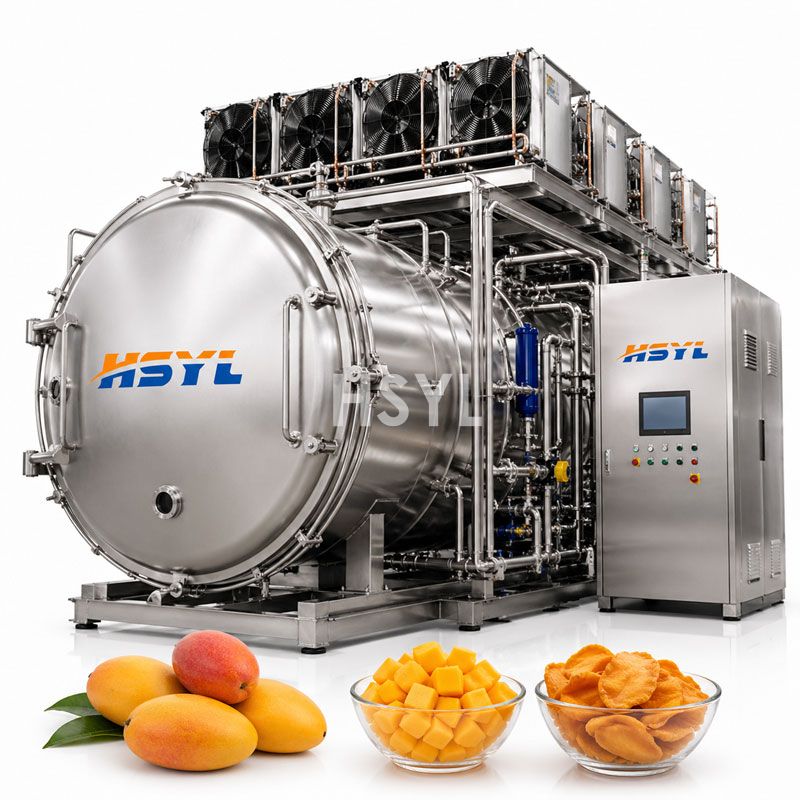
Consider the classic processing disaster involving jackfruit or ripe mangoes. These tropical fruits measure extraordinarily high on the Brix (sugar content) scale. When loaded into a generic frying chamber lacking precise temperature gradient control, the surface sugars undergo rapid caramelization and aggressively drive the Maillard reaction. This turns the vibrant yellow fruit into a dark, bitter, and unsellable black mass within minutes. Conversely, attempting to process porous shiitake mushrooms or delicate seafood often results in massive oil absorption. The mushroom caps act like biological sponges; if the fryer's internal deoiling basket cannot generate specific radial G-forces matched to the sponge-like matrix, the final chip will easily exceed 30% oil retention.
Parameter 1: Absolute Target Vacuum vs. The Maillard Reaction
The entire premise of vacuum low-temperature frying relies on artificially shifting the boiling point of water. At standard atmospheric pressure, water boils at 100°C, requiring the frying oil to be heated well above 160°C to achieve internal moisture evaporation. At 160°C, all natural plant sugars violently burn. By evacuating the internal chamber, we manipulate physics.
Upgraded, modern industrial equipment utilizes massive liquid ring vacuum pump networks to drag the internal atmospheric pressure down to a steady -0.098 MPa. At this extreme negative threshold, the boiling point of trapped cellular moisture collapses to roughly 80°C. Maintaining exactly -0.098 MPa allows the external heat exchangers to keep the primary oil bath between 85°C and 90°C. Processing below 90°C strictly bypasses the thermal trigger points for sucrose and fructose caramelization. The natural sugars remain completely stable, securing the vibrant original coloration of the slice.
However, if your vacuum pump is worn, undersized, or experiencing microscopic pneumatic leaks, the pressure may drift upward to -0.080 MPa or higher. When the vacuum degrades, the boiling point of the water naturally rises. The PLC, sensing that the water has stopped evaporating, automatically forces the heat exchanger to inject more thermal energy, driving the oil temperature dangerously past 100°C. The moment the oil crosses this critical thermal boundary, your high-Brix fruit slices will instantly denature, darken, and burn. Absolute, verified vacuum stability is non-negotiable.
Parameter 2: Variable-Frequency Centrifugal Physics
If your chips are emerging soggy, translucent, and heavily saturated with frying oil, the mechanical failure lies entirely within your chamber's final extraction phase. While the vegetable slice is submerged and boiling perfectly under a vacuum, the intense vapor pressure of the exiting steam physically repels the heavy liquid oil from entering the cellular pores. However, the moment the frying cycle concludes, the vapor pressure stops. If you break the vacuum (restore normal atmospheric pressure) while the chip is still coated in surface oil, the sudden rush of air acts as a hydraulic ram, instantly forcing the warm oil violently deep into the expanded cellular capillaries of the food matrix. Once the oil is driven inside the matrix, it is impossible to remove via secondary external blotting.
To interrupt this destructive capillary action, heavy-duty industrial units execute Centrifugal Deoiling while the chamber remains strictly under absolute vacuum. By rapidly spinning the internal basket containing the cooked chips before the air valve is opened, centripetal G-forces mechanically shear the surface oil away from the food. The stripped oil drains away to the lower reservoir. Only after the surface oil is violently removed does the PLC allow atmospheric air back into the vessel. This sequence strictly guarantees a final batch oil retention rate of < 15%.
Yet, a single centrifugal speed does not fit all materials. Flimsy, delicate slices like dried shrimp or fragile apple rings will shatter into useless powder if spun at 400 RPM. Conversely, a dense, heavy cut of sweet potato must be spun aggressively to break the surface tension of the cooling oil. A high-tier vacuum frying machine utilizes an advanced Siemens or Schneider Variable-Frequency Drive (VFD). This allows the plant engineer to precisely calibrate the exact rotational RPM of the extraction basket tailored specifically to the structural fragility of the current crop, maximizing oil shedding while maintaining a zero-breakage yield.
Parameter 3: Instant Thermal Recovery and Exchanger Sizing
When an operator drops 200 kg of cold, wet, washed produce into a hot oil bath, a massive localized thermodynamic shock occurs. The temperature of the circulating oil violently crashes. If your equipment integrates a poorly sized or inefficient external tube heat exchanger, it may take the system upwards of twenty minutes to recover from the thermal deficit back to the baseline 85°C setpoint.
During this prolonged recovery window, the raw material essentially stews in warm, stagnant oil rather than aggressively boiling. This highly extended submersion time allows the biological tissue to soak up massive volumes of liquid fat. The chip becomes structurally saturated, dense, and physically unappetizing. Additionally, extended cycle times massacre your daily processing throughput metrics.
Proper industrial design mandates that the thermal transfer architecture is vastly over-engineered. High-velocity circulation pumps must cycle the entire oil payload through an external shell-and-tube heat exchanger multiple times per minute. This guarantees that when the chilled payload hits the oil, the PLC detects the localized temperature drop instantly and commands a massive thermal injection from your steam boiler matrix. The oil temperature must physically recover to the exact programmed setpoint within 60 to 90 seconds, sealing the exterior of the chip and preventing deep lipid penetration.
Surgical Customization: The Turnkey Layout Advantage
Resolving catastrophic dark yields and unmanageable oil levels ultimately requires migrating away from standardized, off-the-shelf equipment geometries. Every aspect of the primary dehydration cycle is interconnected with the efficiency of your upstream handling. If your fresh-cut apples run through an inferior washing stage and enter the frying chamber bloated with excessive surface water, you actively cripple the vacuum pump's extraction timeline. Properly synchronizing your line means integrating high-efficiency pre-processing steps, such as a drum bubble washing machine equipped with aggressive centrifugal surface-water blowers, ensuring the raw material enters the primary vessel correctly prepped.
Whether you are trying to perfect an ultra-low-oil shiitake mushroom snack, eliminate the fishy volatile compounds from a squid ring product line, or stop heavy caramelization in tropical fruit chips, your machinery must be structurally modified at the factory level. This means analyzing the basket volume-to-shaft ratio, scaling the vapor condenser dimensions precisely against the expected moisture load, and dynamically rewriting the automated heating curves.
Stop accepting 20% batch failure rates as an industry standard. Engineering out the thermodynamic flaws in your processing line immediately restores your operational margins, guarantees a clean, unoxidized flavor profile, and allows you to confidently scale production into premium retail channels.
Related Topics
- High-Capacity Custom Vacuum Frying Machinery
- Complete Industrial Snack Processing Lines
- Industrial Pre-Processing and Drum Bubble Washing Units
Engineering Consultation and Deoiling Analytics
If your current dehydration equipment is chronically failing to achieve the strict < 15% retail oil retention mandate, or if you are losing critical operational shifts to burnt product, your thermodynamic parameters are fatally misaligned. Contact our international engineering division to request a comprehensive raw-material testing protocol. We can generate certified oil-retention evaluation reports using your specific crops, and provide direct technical upgrade pathways to replace your aging fryers with fully customized, variable-frequency solutions.
Frequently Asked Questions
What causes high-sugar tropical fruits to turn black inside a vacuum fryer
How does the vacuum extraction process actually lower the final fat content
Why do fragile items like sliced apples or squash shatter during the deoiling phase
Can an older manual vacuum fryer be easily retrofitted with modern PLC thermal controls
Why is my frying oil turning dark and bitter after only a few short production shifts
Related Articles


Get professional consultation
Do you have any questions or need technical support regarding the content of this article? Fill out the form below, and our expert team will provide you with professional solutions.