In mid-to-high volume bakery production, specifically lines handling cheesecakes, multi-layer mousse, and high-fat laminated doughs, the cutting station is often the silent bottleneck of the entire plant. As an engineer who has spent nearly two decades navigating the trade-offs of food processing machinery, I’ve seen countless facility managers try to "brute force" their way through sticky product using harder steels, sharper grinds, or chilled blades. None of these address the core physics of the problem: Friction Drag.

The Physics of Failure: Why Stationary Steel Squashes Butter
Traditional mechanical slicing relies on the wedge action of a blade to separate material. In high-tensile materials like meat or hard vegetables, this works reasonably well. However, bakery products are non-Newtonian in behavior. High-fat pastries, sponges, and cream bases are effectively semi-solids that exhibit high levels of viscosity and adhesion.
The failure of a traditional blade on a high-fat pastry occurs in three distinct engineering phases:
- Initial Compression: Before the blade edge actually penetrates the crust, the downward force required to overcome the surface tension of the fat-rich layer exceeds the vertical support of the sponge below. This is what we call "squashing."
- Friction Drag: As the blade moves through the product, the side walls of the blade attract the high-viscosity fats and sugars. This creates a vacuum-like suction or "drag" that pulls the layers downward, causing the dreaded "smear" effect.
- Material Displacement: Because the product is sticking to the blade, part of the cake is physically "transported" with the blade during its stroke, resulting in jagged edges and cross-contamination of layers (Zero-smear becomes impossible).
For a deeper dive into how these mechanical challenges vary across the industry, see our technical analysis on ultrasonic vs. mechanical cutting in bakery processing.
Enter Ultrasonic Science: The Micro-Vibration Air Cushion
When we integrate an ultrasonic generator—typically operating at 20kHz or 40kHz—to a titanium cutting blade, we aren't just making the blade "faster." We are fundamentally changing the surface interface between the metal and the food.
The Frequency Response and Surface Decoupling
An ultrasonic blade vibrates with an amplitude of roughly 30 to 100 microns, thousands of times per second. This high-frequency oscillation creates a phenomenon where the blade is only in actual physical contact with the product for a fraction of the total cutting time. In the gaps between these micro-vibrations, the rapid movement creates a thin, microscopic boundary layer—effectively a micro-air cushion.
This "cushion" reduces the coefficient of friction to near-zero. Even high-viscosity food processing materials, which would normally act like glue on stainless steel, cannot gain a foothold on a surface that is vibrating at 20,000 cycles per second. The result is frictionless slicing where the blade passes through the product like it’s not even there.
[Insert image: Diagram showing the microscopic air boundary layer between an ultrasonic titanium blade and a fat-rich cake layer during high-frequency vibration.]
Engineering Trade-offs: ROI, Maintenance, and Yield
From a project engineer's perspective, switching to ultrasonic isn't just about "looking pretty." It’s about the yield and OEE (Overall Equipment Effectiveness). When a traditional blade smears, you lose product. If 1/8th of an inch of every slice is mangled or stuck to the blade, that is lost profit. Over a year of 24/7 production, that 2-5% of "wastage" pays for the ultrasonic system twice over.
Sanitation and Downtime Reality
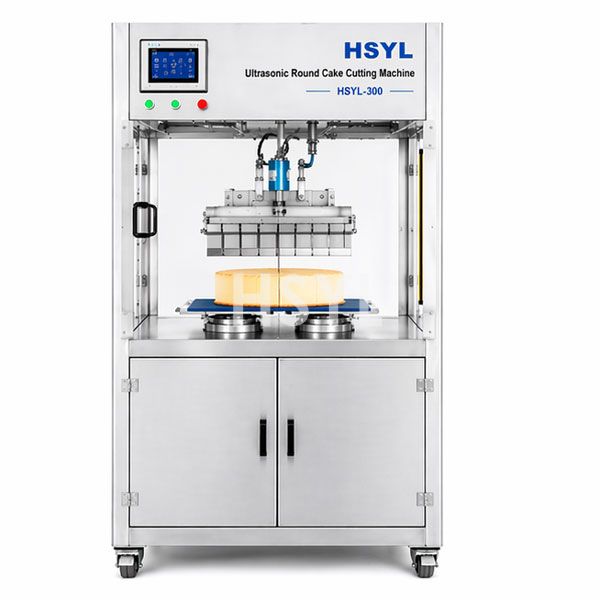
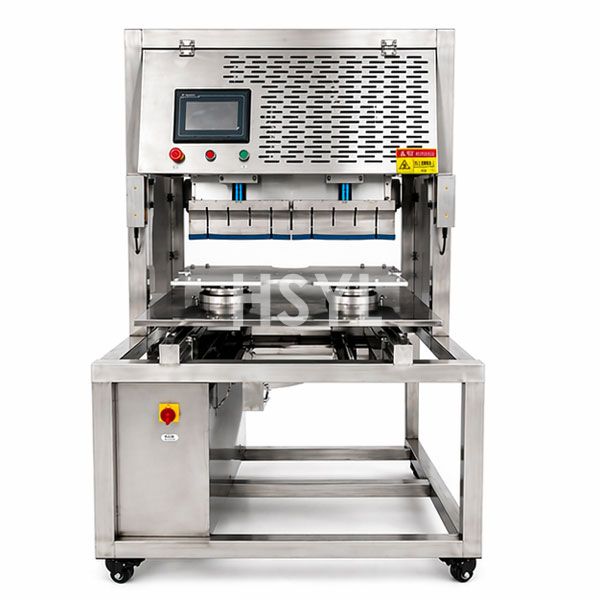
One of the biggest lies in food processing marketing is that ultrasonic blades are "self-cleaning." They are not. However, because the friction is so low, product buildup is minimized by up to 90%. In a mechanical line, you might have to stop the conveyor every 45 minutes to wipe down the blade to prevent cross-contamination. With an automatic ultrasonic cake cutting machine, the cleaning cycles are significantly reduced, allowing for longer continuous runs.
| Yield Waste (Clinging) | 2% - 7% | <0.5% |
| Parameter | Traditional Mechanical Blade | Ultrasonic Vibratory Blade |
|---|---|---|
| Cutting Edge Friction | High (Viscosity Dependent) | Extremely Low (Frictionless) |
| Product Compression | Visible (The "Squash" Effect) | Negligible |
| Cleaning Frequency | Every 30-60 minutes | End of shift / SKU change |
| Tooling Material | Stainless Steel | Titanium Alloy (Grade 5) |
Common Pitfalls in Ultrasonic Implementation
Not all ultrasonic systems are equal. If you are an engineering manager looking at a CAPEX proposal, you need to look beyond the frequency. The Horn (Sonotrode) geometry and the Generator output stability are what determine your success on the floor.
- Amplitude Management: If the amplitude is too low for the viscosity of your chocolate or cheese, the air cushion won't form. If it's too high, you risk fat separation or "melting" the edges of the product due to localized energy transfer.
- Frequency Calibration: 20kHz is the workhorse for large, heavy loaves or blocks. 40kHz is the precision tool for delicate, thin-walled pastries. Choosing the wrong frequency for your fully automatic bread production line can lead to premature blade fatigue or poor cut quality.
- Thermal Control: While ultrasonic is "cool" cutting, the electronics in the generator need proper ventilation. I've walked into many plants where the generators were housed in non-ventilated NEMA 4X enclosures, leading to heat-based frequency drift and inconsistent cuts.
The Plant Manager’s Checklist for Transitioning
If you're stuck with a mechanical slicer that's currently destroying your yield on a high-fat SKU, here is my engineer-to-engineer advice on the next 48 hours:
- Measure the "Cling" waste: Scrape the blade after 50 cuts. Weigh that residue. Multiply it by your annual production. That number is your budget for an upgrade.
- Analyze the Smear: Is the smear consistent throughout the cut, or only at the top? Top-heavy smearing indicates compression issues (need better edge profile); inconsistent smearing indicates friction drag (need ultrasonic air-cushion).
- Check sanitization logs: How much labor time is spent specifically on mid-run blade cleaning? Usually, this is hidden in "incidental downtime" but it’s a massive OEE killer.
Ultimately, the move to ultrasonic isn't about chasing the latest trend. It’s about respecting the science of food materials. If your product is high-fat, high-sugar, or high-viscosity, you are fighting a losing battle against the laws of friction with a stationary blade. It's time to let the physics of vibration do the heavy lifting.
Related Industrial Solving Guides
- Ultrasonic Food Cutting: Engineering Principles and Industrial Selection Guide
- How to Choose Industrial Bakery Cutting Equipment: Technical Guide
- Cutting Technology Impact on Bakery Product Quality: Technical Analysis
Consult with a HSYL Application Engineer
Managing the intersection of throughput and product integrity is a complex engineering challenge. If you are struggling with friction drag, smearing, or yield loss in your high-fat bakery line, let’s look at the data together. At HSYL, we provide more than just machines—we provide the engineering expertise needed to optimize your production floor for the long term. Contact us today to discuss your specific ROI goals and technical constraints.
Frequently Asked Questions
Does ultrasonic cutting generate heat that melts the fat in pastries
Can I retrofit my existing mechanical slicer with an ultrasonic blade
What is the typical lifespan of a titanium ultrasonic blade
Does ultrasonic cutting work on frozen cakes
What happens if the product contains hard inclusions like nuts or chocolate chips
How do you clean an ultrasonic blade specifically
Related Articles



Get professional consultation
Do you have any questions or need technical support regarding the content of this article? Fill out the form below, and our expert team will provide you with professional solutions.