Executive summary
This guide translates shop-floor experience into design and commissioning decisions for fish canning lines. It focuses on the sequence from preprocessing through filling, seaming and sterilization, and highlights the operational trade-offs that most often determine successful launch and long-term reliability.To maintain hermetic seal integrity and high-speed canning output, configure this stage with our industrial retort sterilizer.
Primary failure modes and what they mean for line design
- Headspace and foam: oily or sauce fillings trap air and foam; this affects seam geometry and retort lethality. Address at filling and pre-seam stages.
- Seam contamination: oil/brine on flange or lid causes seam slippage and leaks. Hygienic transfer and targeted cleaning are essential.
- Uneven thermal load: mixed can packs (different fill mass or thermal conductivity) cause under-processed pockets; plan batch uniformity or use detailed retort profiling.
- Changeover downtime: frequent SKU switches require quick-disconnects, modular nests and validated recipe libraries to keep OEE acceptable.
Process flow overview (high level)
- Raw fish receiving and grading → trimming and optional precook.
- Portioning and mixing with brine/oil/sauce in controlled kettles.
- Hot or cold filling into cans; minimize drop height and turbulence.
- Can orienting, lid placement, vacuum extraction (where used), and seaming.
- Leak inspection, accumulation and queuing to retort.
- Sterilization (batch/rotary/continuous) with thermal mapping and validation.
- Cooling, drying, coding, palletizing and storage.
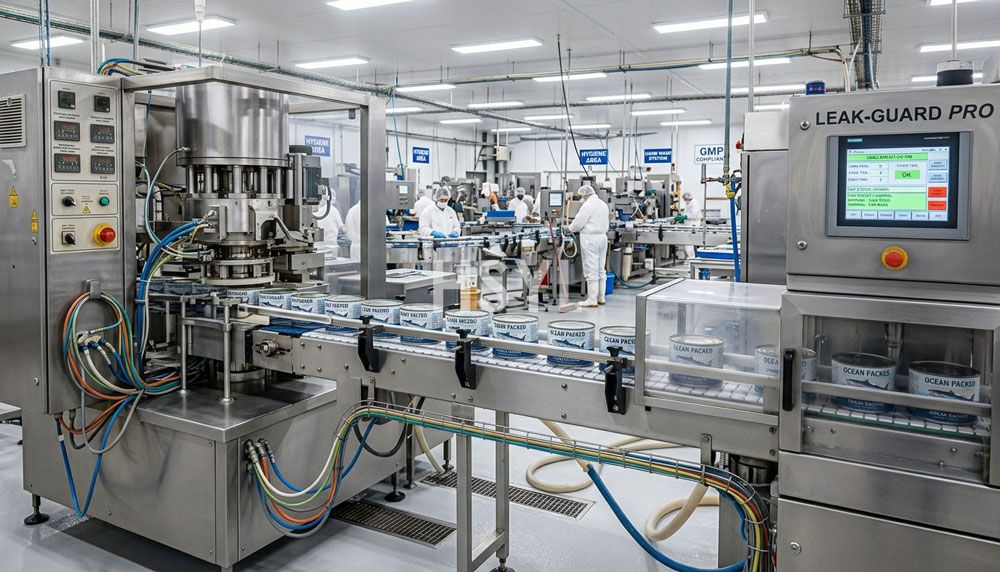
Line balance and takt alignment — practical rules
Start with a target plant takt that reflects realistic shift patterns and uptime (account for planned cleaning and regularly scheduled maintenance). Size upstream and downstream modules to maintain a short, stable accumulation buffer before the retort. Long uncontrolled buffers amplify variability and make thermal validation harder.
Engineering checklist for line balance
| Item | Decision Criteria |
|---|---|
| Target takt | Based on daily output target and available operating time per shift |
| Buffer capacity | Enough for 10–20 minutes’ production to allow short interruptions |
| Cross-check points | Filling throughput vs seamer capacity vs retort throughput |
| Operator stations | Place at predictable line breaks for fast response |
Filling and headspace management — engineering controls
For chunky fish and viscous sauces, the filler must combine robust agitation, positive-displacement metering and controlled nozzle immersion to prevent foam. Where headspace is a risk, add a vacuum hood or headspace extraction station between filling and seaming. That simple sequence—meter, settle, vacuum, seam—reduces seam defects far more reliably than post-failure rework.
Seaming and inspection — what to prioritize
Seam quality is a mechanical and hygienic problem. Prioritize:
- Repeatable can presentation (indexing nests or servo-guided fixtures).
- Regularly calibrated seaming rollers and torque monitoring.
- Automated seam profile measurement where regulatory risk is high.
- Oil traps and guards to prevent flange contamination; schedule quick-clean procedures during SKU changeover.
Sterilization and thermal validation — practical approach
Choose the retort type according to product variability and throughput needs. Batch retorts give flexibility for small runs and complex packs; continuous or rotary retorts suit stable high-throughput lines. Whatever the choice, treat thermal validation as a design deliverable: place validation sensors at representative can positions and map the worst-case cold spots before production acceptance.
Operational trade-offs
- Batch retort: easier validation per load, but higher labor and floor space per ton.
- Rotary/continuous retort: better throughput and lower per-can energy, but requires stricter mix of can types and more complex controls.
- Vacuum extraction: reduces seam risk but increases upstream equipment cost and adds maintenance scope for vacuum pumps.
Hygiene design and maintenance realities
Design piping and manifolds for CIP access; avoid horizontal dead legs in filler and transfer piping. Use food-grade surface finishes on contact parts and specify quick-release clamps for components that need daily inspection. Create an operational calendar that separates quick-change cleaning from full-line sterilization days to limit downtime.
Common buyer misjudgments and how to avoid them
- Assuming seamer speed alone equals line capacity — instead, verify end-to-end takt including inspection and retort throughput.
- Underestimating the maintenance burden of vacuum systems — include filter and pump replacement schedules in OPEX modelling.
- Counting on operator improvisation for sanitary issues — design access and tool-less disassembly into the machine footprint.
Parameter matrix — what to specify in RFQ
| Spec | Why it matters |
|---|---|
| Target daily output (cases/day) | Determines retort type and filler/seamer sizing |
| Primary product forms | Chunky vs paste vs brined affects filler and hopper design |
| Can sizes and lid types | Define nests, seamer tooling and retort load geometry |
| Validation requirements | Thermal mapping and documentation scope for regulators |
| Changeover frequency | Impacts choice of modular fixtures and quick-clean design |
Startup and commissioning tips from the floor
- Run an initial validation using worst-case fill and the heaviest can pack you expect; it reduces surprises in acceptance.
- Stage commissioning in short, measurable milestones: mechanical run, dry electrical, wet run with water, then product trials and thermal validation.
- Retain a small spare-kitting list on site for fast replacement of gaskets, valve seals and vacuum filters during the first 90 production days.
- Train a local team on basic seam checks and pressure-decay leak testing; these catch issues before they affect shelf-life.
Decision guide — quick selection pointers
- If SKU mix fluctuates and batch sizes are small, prioritize flexibility (batch retort, modular filler heads).
- If throughput is stable and scale is large, prioritize continuous-retort integration and automated thermal logging.
- If formula contains lots of oil or particulate, require headspace control and robust seam inspection before accepting offers.
Related Topics
- Canned food production line
- Automatic fish canning production line
- Retort sterilization in fish canning
Call to Action
If you are planning or upgrading a fish canning line, send your current takt target, primary SKU list and available plant utilities to our engineering team. We can review layout risks, suggest a retort type and provide a draft validation checklist you can use in FAT and SAT planning.
Frequently Asked Questions
What is the minimum utilities required to run a fish canning line (steam, power, air)?
How do I decide between batch and continuous retort for my plant?
What is the recommended approach to reduce seam failures in oily fish products?
How should I structure FAT and thermal validation during acceptance testing?
Can I run mixed can packs through a continuous retort?
Related Articles


Get professional consultation
Do you have any questions or need technical support regarding the content of this article? Fill out the form below, and our expert team will provide you with professional solutions.