Executive summary
This guide covers the end-to-end canned fish production process from reception through sterilization and packing, with an emphasis on engineering decisions that affect reliability, regulatory acceptance and commissioning time. It is written for plant managers, project engineers and technical buyers who must convert production targets into a robust line layout and validation plan.For complete autoclave batch scheduling and facility sanitation planning, refer to our engineering overview on fish canning process flow practical.
High-level process flow
- Raw material receiving, grading and cold storage
- Preprocessing: gutting, trimming, cooking or steam-stabilization
- Portioning and mixing with brine/oil/sauce in controlled kettles
- Filling: metered, agitation-managed, headspace control
- Lid placement, vacuum/headspace extraction (if used), seaming
- Leak detection and accumulation buffer
- Sterilization/retorting (batch, rotary or continuous)
- Cooling, drying, coding, inspection, palletizing and storage
Key engineering challenges and practical mitigations
- Headspace and foam: Oily sauces and brines trap air and form foam. Mitigation: design filler with immersion nozzles, low-turbulence metering and a brief settle zone ahead of any vacuum extraction or seaming station.
- Seam contamination: Oil and particulate on the flange prevent proper roller bite. Mitigation: install flange guards, local air-knives or targeted diverter plates and schedule short, frequent cleaning cycles during SKU changeover.
- Thermal non-uniformity: Mixed can packs or varied fill masses create cold pockets in the retort. Mitigation: restrict mixed packing across a retort zone or perform worst-case thermal mapping and rebalance loads accordingly.
- Changeover impact: Frequent SKU changes increase downtime. Mitigation: use modular nests, quick-change seamer tooling and maintain validated recipe sets in the PLC.
Preprocessing and cook-stabilization
Decide whether you will precook fish upstream or use a retort-cook process based on desired texture and yield. Precooking gives predictable portion sizes and reduces retort load but adds steam and condensate management upstream. If precooking, provide controlled cooling to the filler feed to avoid over-temperature fills that extend retort cycles.
Filling station: design elements that reduce defects
- Choose metering suited to the product: piston/positive-displacement for particulate-laden formulas; servo volumetric for uniform liquids.
- Agitation strategy: hopper paddles or recirculation loops to keep chunks suspended without breaking pieces.
- Settling and degassing: a short calm zone after flow metering allows entrained air to escape; if headspace remains a problem, add a vacuum hood prior to seaming.
- Sanitary design: specify sloped hoppers, adequate drain valves and CIP spray coverage for the filler and feed lines.
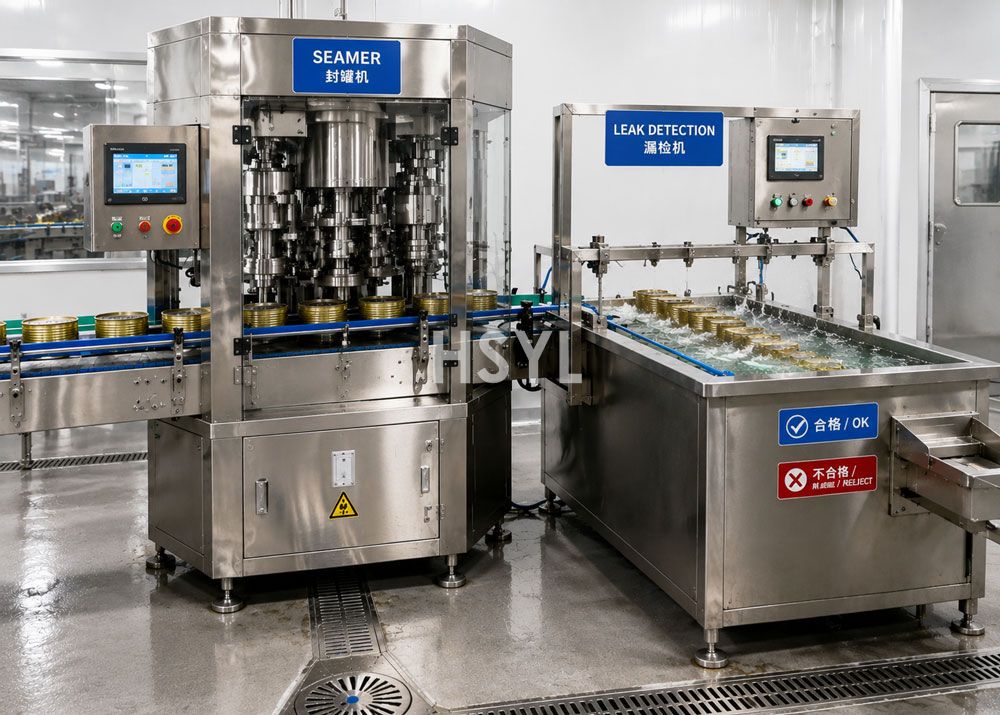
Seaming and inspection — mechanical + QA controls
Seam quality is controlled by repeatable can presentation, roller geometry and torque control. Include automated seam-profile measurement during FAT or SAT where possible; otherwise use spot checks and torque trending during production runs. Plan an inspection lane (pressure-decay or vacuum leak test) immediately downstream of the seamer and before retort accumulation.
Sterilization: selecting the retort type
Selection depends on throughput, SKU mix and validation resources. Batch retorts are flexible for varied packs and easier for thermal validation on short runs. Rotary and continuous retorts suit high-throughput, standardized packs but require stricter upstream discipline and more complex controls. For oily or brined fish, vacuum-assisted cycles reduce headspace and improve seam reliability; include vacuum pockets or extraction phases in the sterilization sequence if seam bubbles have been a historical issue.
Controls, data and validation
- PLC recipe management: store per-SKU cycle sets, including F-value targets, conveyor speeds and vacuum setpoints.
- Thermal mapping: place sensors at worst-case can positions identified during F0 risk assessment; record data to support regulatory files.
- Integration: provide OPC-UA or Ethernet handoff with upstream modules to ensure synchronized recipe changes and traceability.
Utilities, footprint and plant services
Plan steam generation, condensate return, adequate drainage for washdown, electrical capacity for drive and control panels, and compressed air for pneumatic actuators. Locate the retort and its condensate handling close to the utility trenches and provide service access for both sides of the vessel for maintenance and thermal mapping sensor access.
Maintenance, spares and OPEX considerations
Define a minimum spare kit for commissioning: seamer rollers, gaskets, vacuum pump filters and critical valves. Document routine tasks with frequency (daily, weekly, monthly) and include quick-clean steps in the SOP to minimize long-line stops during SKU swaps. Factor vacuum system maintenance into OPEX if headspace control is required.
Common procurement and design mistakes
- Buying the fastest filler without matching seamer or retort capacity — leads to chokepoints and wasted capital.
- Assuming CIP alone solves flange contamination — targeted hardware like drip pans and seals are often needed.
- Under-resourcing validation — thermal mapping and reporting are often underestimated in schedule and budget.
Practical checklist for RFQ and OEM discussions
- Provide target daily output, shift pattern and acceptable uptime.
- List primary SKUs, expected can sizes and any special lids (easy-open, two-piece, etc.).
- State whether precooking is planned and the expected fill temperature range.
- Specify regulatory expectations (e.g., documentation for HACCP, local food authority filings).
- Describe changeover frequency and acceptable changeover time targets.
Startup and commissioning priorities
Break commissioning into measurable milestones: mechanical dry run, electrical checks, wet commissioning with water, product trials and finally thermal validation runs. Validate using the worst-case can and pack arrangement first; accept subsequent runs only after corrective actions are closed.
Related Topics
- Canned food production line
- Automatic fish canning production line
- Retort sterilization in fish canning
Call to Action
For a pragmatic review of your current layout or an RFQ checklist tailored to your SKUs, provide your target output, primary can sizes and changeover cadence. Our engineering team will produce a focused layout risk review and a draft validation scope you can use in FAT planning.
Frequently Asked Questions
What utilities (steam, condensate, air, power) do I need to prepare for a canned fish line?
How do I choose between batch, rotary and continuous retorts?
What is the best immediate step to reduce seam failures I currently see on oily fish cans?
What should I include in the RFQ to avoid ambiguous technical offers?
How do you validate a new retort installation for regulatory acceptance?
Can I run mixed can sizes in a continuous retort?
Related Articles



Get professional consultation
Do you have any questions or need technical support regarding the content of this article? Fill out the form below, and our expert team will provide you with professional solutions.