Executive Summary
Modern canned beef production is no longer a simple preservation method—it is a tightly controlled thermal manufacturing process that must balance microbiological lethality, protein texture retention, and industrial-scale throughput. As global demand for shelf-stable protein increases across military supply, retail ready-meals, and emergency food reserves, processors are under pressure to produce consistent canned meat products while maintaining strict food safety validation.For complete autoclave batch scheduling and facility sanitation planning, refer to our engineering overview on top commercial canned fish production.
Traditional meat canning facilities often rely on fragmented equipment layouts, manual trimming operations, and outdated batch sterilization practices. These legacy approaches introduce significant operational inefficiencies:
Yield loss caused by uncontrolled pre-cooking shrinkage
Inconsistent texture due to uneven thermal penetration in dense meat matrices
Excess labor dependency for loading, filling, and handling
High energy consumption from poorly optimized retort cycles
Food safety exposure when sterilization data cannot be validated digitally
Unlike fish, beef presents unique engineering challenges. Muscle fiber density, connective tissue composition, and fat distribution create higher resistance to heat transfer. Without proper process control, sterilization may either underperform (risking microbial survival) or overperform (destroying product quality and saleable weight).

A modern canned beef production line integrates mechanical automation, thermal science, and hygienic system design into a synchronized workflow capable of delivering predictable lethality (F₀ values), repeatable fill weights, and scalable production capacity.
This article explains how advanced production lines engineered by leading Chinese manufacturers solve these problems through integrated automation, precision thermal control, and lifecycle-oriented plant design—helping processors transition from labor-driven operations to data-driven manufacturing environments.
Engineering Deep Dive: What It Is & How It Works
A canned beef production line is a continuous thermodynamic and mechanical transformation system that converts raw muscle tissue into commercially sterile packaged food.
Process Flow Architecture
Raw Meat Receiving & Inspection
Cutting / Cubing / Trimming
Pre-Cooking or Blanching
Can Filling & Weight Control
Gravy / Brine / Sauce Dosing
Vacuum Seaming
Retort Sterilization
Rapid Cooling & Drying
Inspection & Secondary Packaging
Each step must maintain strict control over mass flow rate, heat load distribution, and contamination barriers.
Mechanics of Thermal Processing in Beef
Beef has lower thermal conductivity than fish due to its dense protein structure. During sterilization:
Heat must migrate through solid conduction, not convection
Collagen begins converting to gelatin at ~70–85°C
Internal can temperature must reach validated lethality without exceeding moisture loss thresholds
To manage this, modern retort systems use:
Overpressure steam-air mixtures to prevent can deformation
Distributed thermocouples to map cold spots
Dynamic cycle control adjusting come-up time and dwell phase
Key Subsystems Explained
Automated Meat Preparation Module
Servo-driven dicers maintain uniform cube geometry, which directly influences heat penetration models. Uniform size equals predictable sterilization behavior.
Precision Filling System
Weigh-cell-controlled fillers compensate for meat density variation to maintain net weight compliance without overfilling.
Vacuum Seaming Technology
Air evacuation reduces oxidative degradation and ensures hermetic sealing capable of withstanding high-pressure sterilization.
Intelligent Retort Control Platform
PLC-based systems regulate:
Pressure differentials
Thermal ramp curves
Cooling gradients to avoid protein shock
This creates repeatable sterilization validated by digital batch records.
Critical Industry Challenges & Solutions
Challenge 1: Protein Shrinkage and Yield Loss
During cooking, beef releases bound moisture, causing weight reduction of up to 18% if unmanaged. Inconsistent pre-cooking leads to unpredictable final fill weights and margin erosion.
Solution: Controlled steam pre-cooking tunnels stabilize protein contraction before filling, allowing processors to calculate true drained weight and reduce giveaway.
Challenge 2: Sterilization of High-Density Products
Beef chunks create thermal resistance zones where bacteria can survive if heat penetration is not uniform.
Solution: Advanced retort agitation or forced convection systems enhance heat distribution, eliminating cold spots and reducing total cycle time while maintaining lethality targets.
Challenge 3: Labor-Intensive Handling and Contamination Risk
Manual loading introduces hygiene variability and slows throughput.
Solution: Automated transfer and filling systems establish a closed production environment, reducing human contact and improving sanitary repeatability.
Key Features & Technical Advantages
Hygienic Structural Fabrication
Food-grade stainless construction → Eliminates corrosion from saline or protein-rich environments → Maintains sanitary integrity across long production cycles.
Closed-Loop Thermal Control
Real-time temperature feedback → Adjusts sterilization dynamically → Prevents overcooking while guaranteeing microbial safety.
Servo-Controlled Portioning
Precision motion synchronization → Maintains uniform meat geometry → Improves heat penetration predictability and label weight accuracy.
Integrated CIP Sanitation Systems
Automated cleaning validation → Reduces manual sanitation variability → Ensures repeatable hygiene compliance and faster changeovers.
Energy Recovery Engineering
Condensate heat exchange reuse → Captures thermal waste → Reduces steam demand and operating cost per can.
Selection Criteria & Capacity Planning
Determining Required Throughput
Capacity must align with both market demand and sterilization limitations.
Formula:
Line Capacity (cans/hour) =
Daily Output ÷ Operating Hours ÷ Efficiency Factor
Example:
80,000 cans/day
14-hour shift
85% efficiency
Required capacity ≈ 6,700 cans/hour.
Utility Infrastructure Planning
Typical requirements for mid-scale canned beef line:
Steam Supply: 1.5–2.0 tons/hour
Electrical Load: 300 kW connected
Cooling Water: 10 m³/hour
Compressed Air: Stable 6–8 bar
Undersized utilities are a primary cause of commissioning delays.
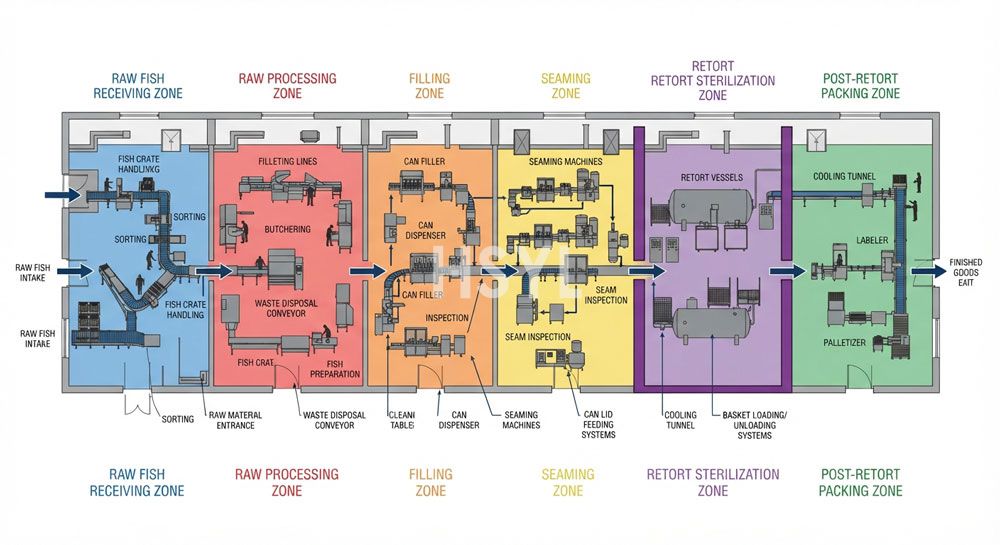
Layout Considerations
Effective plant layouts must:
Separate raw and cooked zones to prevent cross-contamination
Allow linear material flow to avoid backtracking
Provide maintenance corridors for retort servicing
Integrate hygienic drainage systems for washdown environments
Future Expansion Strategy
Design lines with modular scalability:
Parallel filling lanes to double output without replacing sterilization assets
PLC systems designed for additional SKUs
Retort capacity sized for long-term production forecasts
Standards, Compliance & Safety
Commercial canned beef production must comply with internationally recognized safety and quality frameworks to ensure export eligibility and liability protection.
Production lines are typically engineered in accordance with:
International Organization for Standardization hygienic design and quality management principles
U.S. Food and Drug Administration low-acid canned food regulations governing thermal processing validation
Occupational Safety and Health Administration requirements for pressure vessels, operator safety, and lockout systems
Compliance ensures:
Acceptance in international export markets
Reduced insurance risk through validated safety systems
Audit readiness for global food brands
Documented sterilization traceability for recall protection
Conclusion & Call to Action
Canned beef production is a highly engineered balance between microbiological safety, protein chemistry, and industrial throughput. Facilities that rely on outdated or semi-manual methods face escalating labor costs, inconsistent product quality, and increasing regulatory scrutiny. Modern automated systems provide a pathway to stable, validated production capable of meeting both domestic and export market expectations.
Leading Chinese manufacturers now deliver integrated canned beef production solutions that combine precision automation, hygienic design, and energy-efficient thermal processing—allowing processors to scale output while maintaining strict safety compliance and predictable operating costs.
However, equipment selection alone does not guarantee success. Accurate capacity modeling, utility planning, and validated thermal process design are essential to achieving the expected financial and operational outcomes.
If you are evaluating a new project or upgrading an existing facility, the most effective next step is a Process Audit or Capacity Calculation to align engineering specifications with your production goals. A properly designed canned beef production line becomes not just a piece of equipment—but the foundation of a reliable, scalable food manufacturing operation.
Frequently Asked Questions
What sterilization value is typically required for canned beef?
How often should retort seals and valves be inspected?
Can one production line handle multiple can sizes?
What is the expected ROI timeline for automation upgrades?
How is fill-weight accuracy maintained with variable meat density?
What maintenance most impacts uptime?
How is cross-contamination prevented between raw and cooked zones?
What utilities drive the highest operational cost?
How long does installation and commissioning typically take?
What spare parts inventory is recommended?
Related Articles


Get professional consultation
Do you have any questions or need technical support regarding the content of this article? Fill out the form below, and our expert team will provide you with professional solutions.