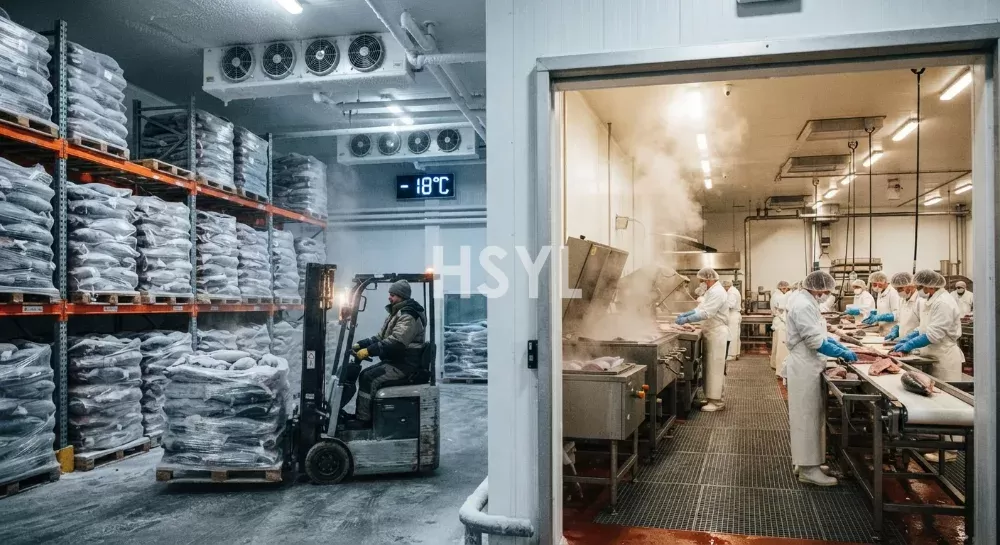
Seasonal Fish Canning: Cold Storage, Multi-Species Rotation and Year-Round Line Utilization
Direct AnswerThe most expensive asset in a fish cannery is not the retort or the...

Canned meat production lines configured for chunks, minced meat and luncheon meat. Discuss preparation, filling, can closing and retort requirements with HSYL.
Canned meat production is one of the most demanding processes in the food industry.
Different meat types, different textures, strict sterilization requirements — all of these mean equipment stability and food safety cannot be compromised.For complete autoclave batch scheduling and facility sanitation planning, refer to our engineering overview on fruit and vegetable canned production line.
HSYL configures canned meat production lines for beef, pork, chicken and mixed-meat products. Preparation, mixing, filling and thermal-processing equipment are selected around the formulation, finished texture, container and required output.
At HSYL, we design meat canning lines based on real factory conditions, not ideal lab scenarios.
Meat chunks, minced products and luncheon meat require different preparation and filling arrangements. Define the finished texture and formulation before selecting the equipment. Pre-cooking before filling is product-specific and should not be assumed to be a mandatory stage for every recipe.
| Product form | Preparation requirements | Filling considerations |
|---|---|---|
| Meat chunks or slices | Trimming, portioning and any pre-cooking required by the process | Piece dimensions, handling damage and distribution inside the container |
| Minced meat products | Grinding and controlled mixing to the required particle structure | Product consistency, ingredient distribution and portion control |
| Luncheon meat | Grinding, mixing and fine comminution where required by the formulation | Depositing a cohesive mixture with controlled filling and air inclusion |
| Meat in gravy or sauce | Meat preparation combined with a separate sauce system where needed | Solid-to-liquid ratio, sauce properties and filling sequence |
Specify the incoming meat condition, required particle size, ingredients and mixing sequence. Confirm which operations need dedicated equipment and which can share equipment after the required changeover and cleaning.
Evaluate the finished product after thermal processing. For chunks, inspect piece integrity; for luncheon meat, assess the intended slice structure, texture and visible voids.
Select the filler for the actual product consistency and particle size. A machine suited to a homogeneous mixture should not automatically be assumed suitable for large meat pieces in sauce.
Confirm the can body, end and seaming tooling as a matched arrangement. If glass jars are included, specify a compatible jar-closing system separately.
The process schedule must be established by a qualified processing authority for the relevant product, container and processing system. Recipe, particle-size or filling changes should be reviewed before an existing process is reused.
Equipment controls monitor the specified conditions; they do not replace thermal-process establishment and validation. Follow the established cooling and container-handling procedures before drying, coding and packing.
Tin cans
Aluminum cans
Easy-open cans
Glass jars (optional)
Typical filling range: 100g – 3000g (customizable)
| Item | Specification |
|---|---|
| Capacity | 1–10 tons/day |
| Filling Accuracy | ±1% |
| Sterilization Temperature | Product-specific process schedule, established for the formulation, container and thermal-processing system. |
| Control System | PLC + Touch Screen |
| Material | SUS304 / SUS316 |
| Power Supply | 380V / 50Hz / 3 Phase |
Identify the requirements applicable to the finished meat product and its destination market. Equipment conformity documents, food-contact material documentation, factory operating systems and product-process requirements have different scopes.
Request the documents applicable to the quoted machinery and define responsibility for process establishment, closure verification, sanitation procedures and production records. For U.S.-bound products, confirm the applicable regulatory jurisdiction for the formulation rather than treating a general FDA statement as evidence of market access.
Compare configurations using the same recipe, container, working schedule and finished-product criteria. Include preparation losses, cooking losses where applicable, filling giveaway, rejected packs and changeover time.
The operating-cost assessment should cover meat and ingredients, packaging, labor, utilities, cleaning, maintenance and quality control. Separate equipment cost from building work, utility installation and commissioning expenses.
Expected payback depends on actual sales, margins, utilization and total project investment. Use project-specific assumptions rather than a fixed recovery period for every meat canning factory.
| Process Stage | Optional Equipment | Purpose |
|---|---|---|
| Raw Prep | Frozen Meat Block Crusher | Faster meat handling |
| Cooking | Continuous Meat Cooker | Stable cooking results |
| Filling | Multi-head Servo Filler | Higher accuracy |
| Sterilization | Water Spray Retort | Uniform heat penetration |
| Packaging | Carton Packer / Palletizer | End-of-line automation |
Professional canned meat production line manufacturer
Turnkey solutions from layout design to commissioning
Export experience in Asia, Middle East, Africa, and Europe
Reliable after-sales support and spare parts availability
Factory layout & capacity planning
Equipment manufacturing & installation
On-site commissioning & training
Long-term technical and maintenance support
If you’re planning to start or upgrade a canned meat production project, HSYL provides a reliable, scalable, and food-safe solution tailored to your products and target markets.
📩 Contact us today for a customized quotation and production layout.


Direct AnswerThe most expensive asset in a fish cannery is not the retort or the...
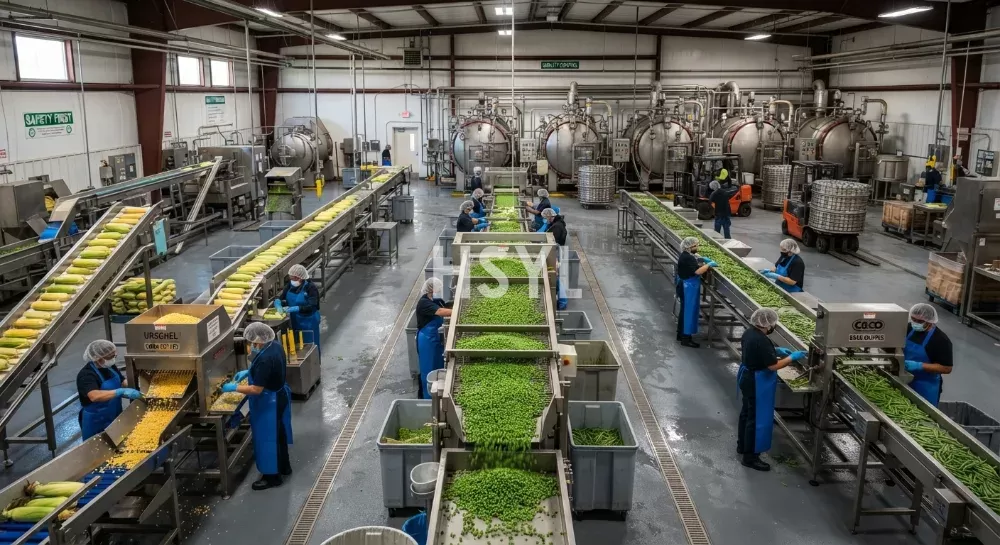
Direct AnswerA low-acid canned vegetable processing line — corn, peas, and green...
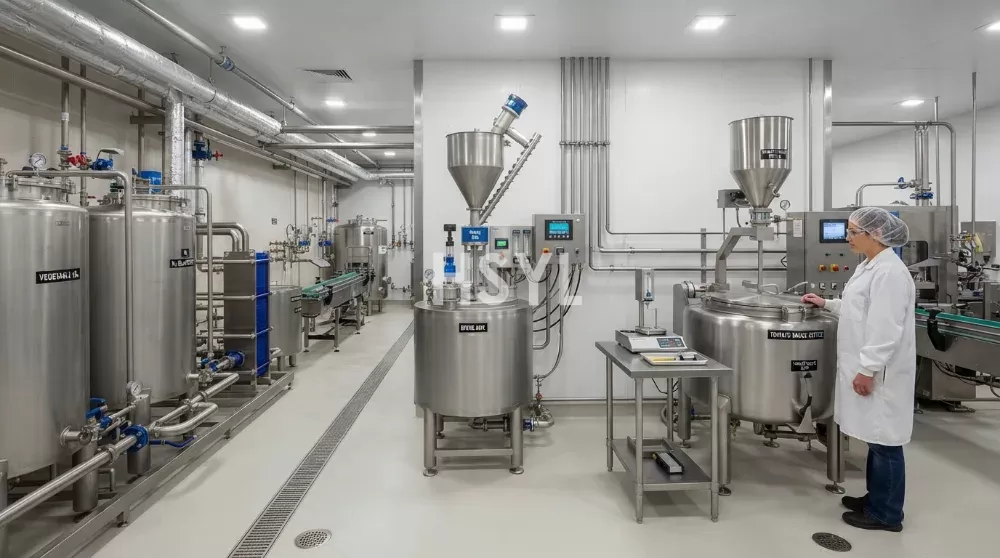
The filling medium — the liquid that fills the void spaces between the fish piec...
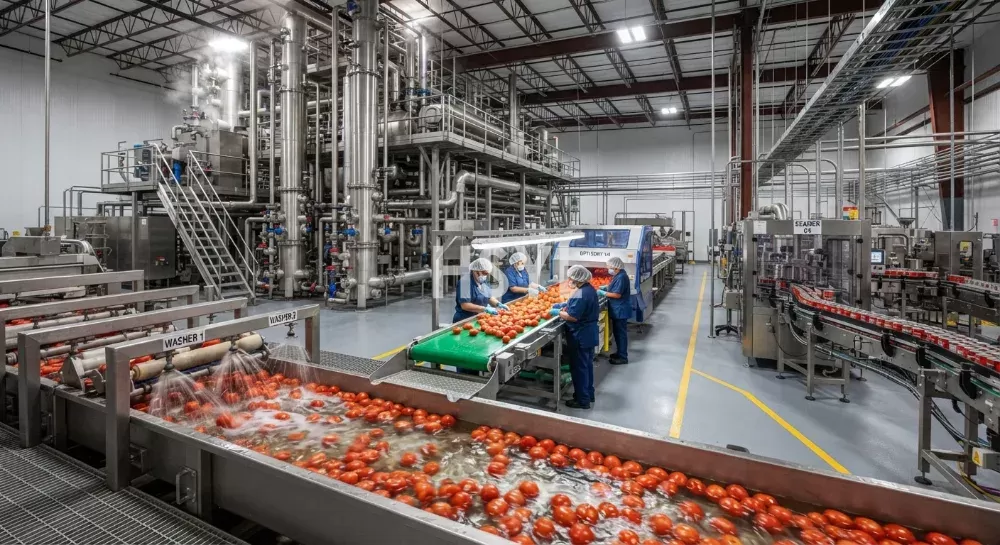
Direct AnswerA tomato products canning line converts fresh tomatoes into four di...