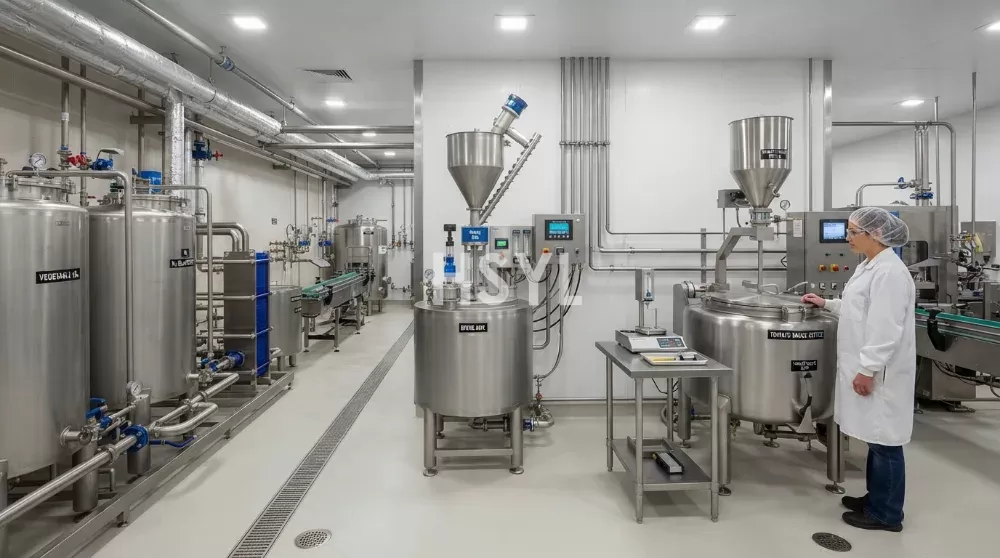
The filling medium — the liquid that fills the void spaces between the fish pieces in the can — is simultaneously a product-quality component (it contributes flavor, mouthfeel, and appearance), a process-control variable (the fill temperature determines the initial can temperature entering the retort, which affects the retort come-up time), and a significant cost component (vegetable oil in an oil-packed tuna can represents approximately 15–25% of the total raw-material cost per can). The filling-medium preparation system — the oil receiving, filtering, heating, and dosing circuit; the brine batching, heating, and dosing circuit; the tomato sauce cooking, viscosity-control, and dosing circuit — is a parallel production line that operates alongside the fish-processing line and must deliver a precise volume of the correct medium at the correct temperature to every can at the line speed. A failure in the filling-medium system — an oil filter blockage, a brine concentration drift, a sauce viscosity change — stops the entire canning line. This guide covers the four filling-medium systems used in fish canning, their equipment, their quality-control parameters, and their integration with the can-filling operation.For complete autoclave batch scheduling and facility sanitation planning, refer to our engineering overview on build a canned beans production line.
System 1: Vegetable Oil Filling
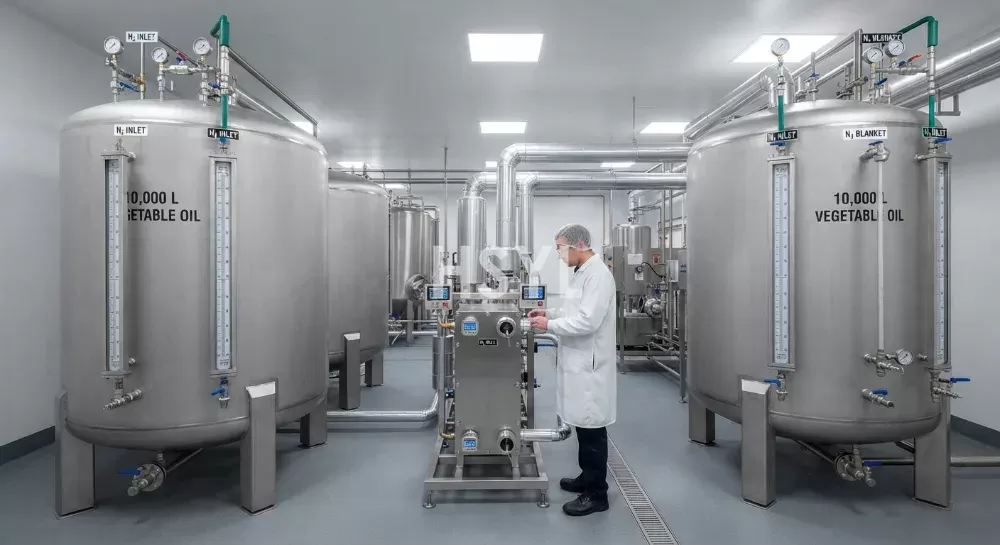
Vegetable oil is the dominant filling medium for canned tuna and is widely used for canned sardines and mackerel. The oil arrives at the cannery in bulk tankers or in 1,000 L IBC totes. The oil system consists of:
- Receiving and storage: oil is pumped from the tanker into stainless steel storage tanks, typically 10,000–30,000 L capacity, located in a temperature-controlled tank farm. The storage temperature is 20–30°C — below this, some oils (particularly olive oil) begin to cloud as waxes and high-melting triglycerides precipitate; above this, the oil oxidizes more rapidly. The storage tanks are blanketed with nitrogen to exclude oxygen and retard oxidation. Oil is rotated on a first-in-first-out basis, and the storage time should not exceed 3–6 months to prevent the development of rancidity before the oil reaches the consumer.
- Oil type selection: soybean oil is the global commodity standard for canned tuna because it is neutral in flavor, stable to oxidation, and the lowest cost. Sunflower oil is used in markets where soybean oil is less available or where a "sunflower oil" claim on the label is a marketing advantage. Olive oil is used for premium products — often labeled as "tuna in olive oil" at a price premium of 30–50% over soybean-oil-packed tuna. Olive oil has a distinct flavor that consumers expect when they purchase the product, and the flavor compounds in the oil must be preserved during the heating and retort process — overheating the olive oil above 120°C drives off the volatile flavor compounds and oxidizes the polyphenols that give the oil its characteristic taste.
- Oil quality parameters: before use, the oil is tested for: free fatty acid (FFA) content (an indicator of hydrolysis and oil degradation, typically below 0.1% as oleic acid for fresh oil), peroxide value (PV, an indicator of primary oxidation, typically below 2 meq O₂/kg), and sensory quality (the absence of rancid, painty, or fishy off-odors). Oil that fails any of these parameters is rejected and returned to the supplier.
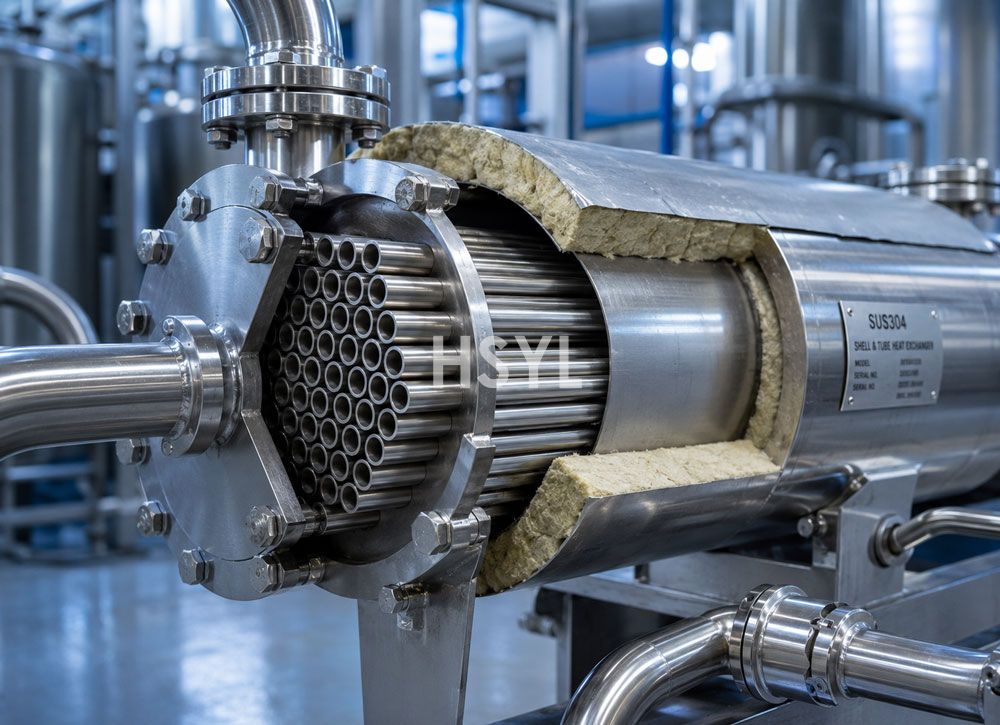
Heating and dosing: the oil is pumped from the storage tank through a plate heat exchanger or shell-and-tube heat exchanger that raises the oil temperature to 80–90°C. The heated oil is delivered to a dosing system — a piston filler or a volumetric doser — that dispenses the target oil volume into each can. The dosing accuracy must be ±2% because under-dosing produces a can with visible tuna above the oil line (a visual defect), and over-dosing wastes oil (a cost defect). The temperature of the oil at the point of dosing is recorded and must meet the minimum initial temperature specified in the scheduled process.
System 2: Brine Filling
Brine — a salt solution — is the simplest filling medium and is used for tuna in brine, sardines in brine, and mackerel in brine. The brine system consists of:
- Brine batching: potable water is heated to 50–60°C in a batching tank. Food-grade salt (sodium chloride, purity ≥ 99.5%, free from anti-caking agents that would produce haze in the brine) is added to the target concentration — typically 1.5–2.5% w/v for the finished product, though the batching concentration is higher because the brine entering the can will be diluted by water released from the fish during retort. The salt dissolves rapidly in warm water with agitation. The brine concentration is measured with a salinometer or a conductivity meter and adjusted if needed.
- Heating: the brine is heated to 85–90°C in the holding tank. The tank must have adequate agitation to prevent salt stratification — without agitation, the denser salt solution settles to the bottom of the tank, and the brine composition delivered to the cans drifts over the production batch.
- Dosing: the hot brine is dosed into the can by a volumetric doser or a piston filler. The dosing volume must be consistent because the brine fills the can to the target headspace. Over-dosing produces insufficient headspace and can deformation during retort; under-dosing produces excessive headspace and a weak vacuum.
System 3: Tomato Sauce Filling
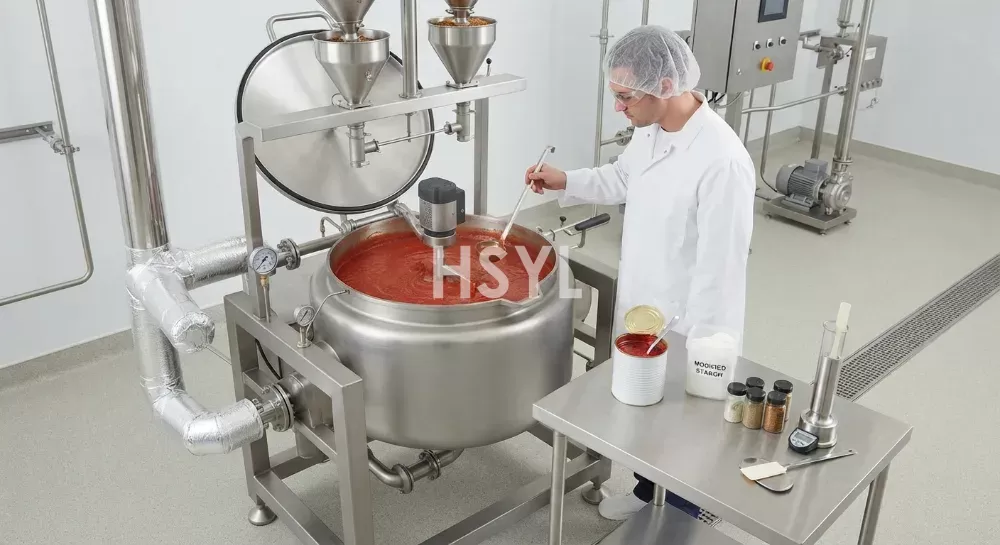
Tomato sauce is the characteristic filling medium for canned sardines in many markets — "sardines in tomato sauce" is a standard product in the UK, Europe, Africa, and Asia. The sauce system is more complex than the brine system because the sauce must be cooked, its viscosity must be controlled, and the sauce must adhere to the fish surface without separating during retort:
- Sauce cooking: tomato paste (28–30°Brix) is the base ingredient and is reconstituted with water to the target Brix (typically 10–14°Brix for the finished sauce). Salt, sugar, thickeners (modified corn starch or xanthan gum, at 2–4% to achieve the target viscosity), and flavorings (onion powder, garlic powder, herbs) are added. The mixture is heated to 85–90°C in a steam-jacketed kettle or a continuous tubular cooker with agitation to cook the starch thickener (which must gelatinize to develop its thickening effect) and to pasteurize the sauce before it enters the can. The cooking time — typically 15–25 minutes at temperature — must be sufficient to fully hydrate and gelatinize the starch; under-cooked starch does not develop full viscosity and the sauce is thin; over-cooked starch breaks down and the sauce loses viscosity.
- Viscosity control: the sauce viscosity is measured with a Bostwick consistometer at the cooking temperature and must be within the target range (typically 6–10 cm/30s). The viscosity determines how the sauce coats the fish and how it appears in the opened can — too thin and the sauce runs off, leaving the fish exposed; too thick and the sauce does not flow between the fish pieces, leaving air pockets. The viscosity is adjusted by changing the thickener addition rate or the water-to-paste ratio.
- Dosing: the hot sauce is dosed into the can through a piston filler designed for viscous products. The dosing nozzle must be wide enough to pass the sauce without clogging but narrow enough to deliver a clean cut-off without stringing. The dosing temperature is critical: if the sauce cools in the dosing line, its viscosity increases and the dose volume varies. The dosing line must be insulated or heated (jacketed pipe or heat-traced) to maintain the target temperature from the cooking kettle to the dosing nozzle.
System 4: Flavored Sauce and Marinade Systems
Flavored sauces — chili sauce, lemon-and-herb marinade, mustard sauce, curry sauce — are used for premium and specialty canned fish products. The equipment is similar to the tomato sauce system but with additional ingredient dosing: the flavor ingredients (spice extracts, citrus oils, vinegar, wine) are added in a secondary dosing step after the base sauce is cooked, because the volatile flavor compounds would be lost if they were boiled with the base sauce.
Integration with the Canning Line
The filling-medium system must be synchronized with the can-filling operation. The key integration points are: the medium temperature at the dosing nozzle (must match the scheduled process initial-temperature specification), the dose volume per can (must produce the correct headspace), the medium supply rate (must match the line speed so the doser never runs dry or overflows), and the changeover between media (if the line switches from brine to oil, the dosing system and all pipework must be flushed and cleaned to prevent cross-contamination). The filling-medium kitchen is typically a separate room from the fish-processing area to prevent fish odors and microbiological contamination from the raw-fish side from entering the sauce or oil preparation area.
Conclusion
The filling-medium preparation system is the parallel production line that, if it fails, stops the entire canning operation. The oil system manages the quality and temperature of the highest-cost ingredient per can. The brine system, though simple in composition, requires concentration consistency to deliver the expected salt level in the finished product. The tomato sauce system is the most complex — a cooking, viscosity-control, and dosing operation that must deliver a consistent, coating, non-separating sauce to every can. For the fish-processing side of the line, see the guides on canned fish sterilization process engineering and canning line procurement.
Frequently Asked Questions
What type of oil is used in canned tuna?
Why does the filling medium temperature matter for retort processing?
How is tomato sauce viscosity controlled for canned fish?
Related Articles



Get professional consultation
Do you have any questions or need technical support regarding the content of this article? Fill out the form below, and our expert team will provide you with professional solutions.