Commercial kitchen equipment manufacturing requires more than selecting the correct grade of stainless steel. The quality of the finished product also depends on the accuracy of cutting, bending, welding, grinding, assembly and inspection.
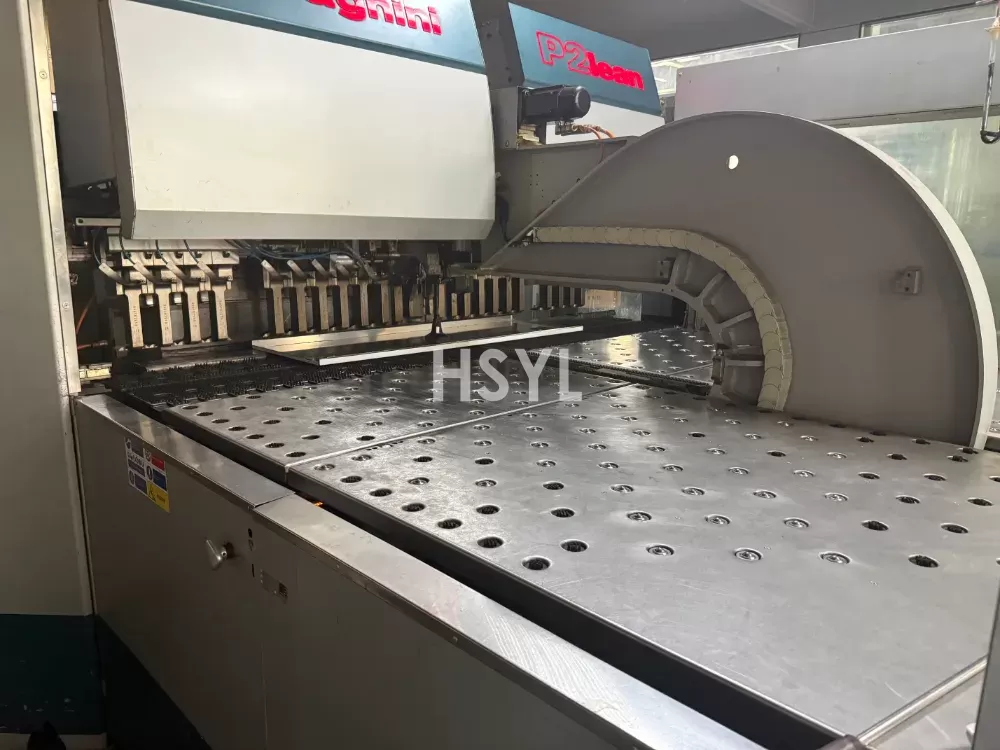
For stainless steel worktables, sinks, cabinets, exhaust hoods, heating cabinets and food processing equipment, sheet metal bending is one of the most important manufacturing processes. The accuracy of each bend can affect the dimensions, structural strength, door alignment, welding gaps, surface appearance and installation performance of the finished equipment.
Traditional bending methods often require operators to measure, position, rotate and support metal sheets manually. The final result may therefore be influenced by operator experience, material springback, positioning accuracy and the complexity of the component.
Automated bending equipment helps kitchen equipment manufacturers improve repeatability, reduce manual positioning errors and produce standardized sheet metal components more efficiently. It is particularly valuable for factories manufacturing stainless steel cabinets, doors, panels, enclosures and other products that require multiple bends.
Why Bending Accuracy Matters in Commercial Kitchen Equipment Production
Many commercial kitchen products are assembled from several stainless steel panels. These panels must fit together accurately before welding, fastening or final assembly.
If the bending angle or flange dimension is incorrect, several problems may occur:
- Cabinet bodies may not remain square.
- Doors and drawers may not close correctly.
- Gaps between panels may become uneven.
- Welding joints may require additional adjustment.
- Worktable surfaces may become uneven.
- Equipment may not match the required installation dimensions.
- Insulated or heated cabinets may have reduced sealing performance.
- Products from the same batch may have visible dimensional differences.
For customized kitchen projects, accurate bending is also necessary to ensure that equipment fits the available space, utility connections and surrounding workstations.
Automated bending technology allows the manufacturer to control the bending sequence, back-gauge position, bending angle and compensation settings through a digital program. This creates a more consistent production process for both standard products and customized projects.
What Is Automated Bending Equipment?
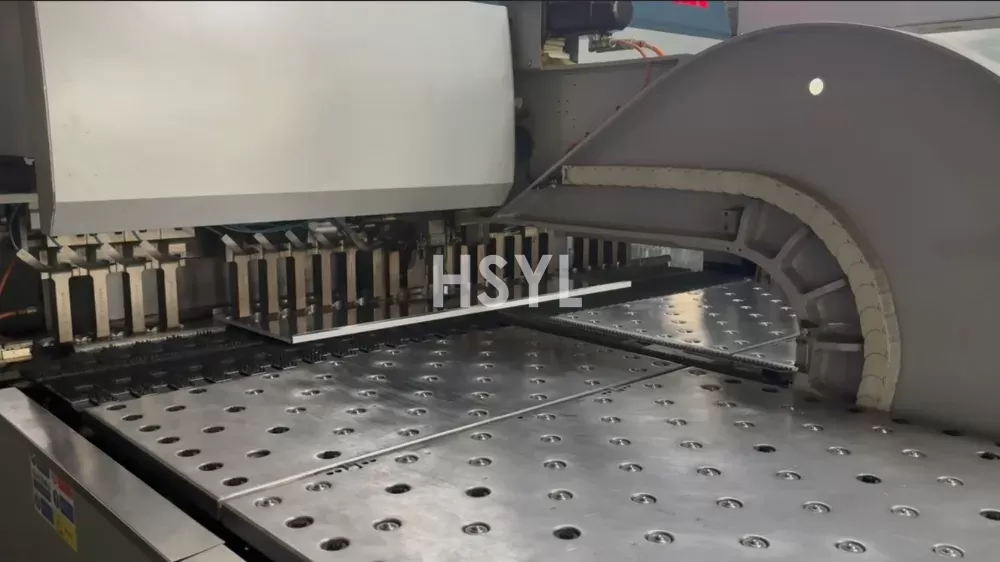
Automated bending equipment is used to form sheet metal into specified angles and shapes through digitally controlled positioning and bending movements.
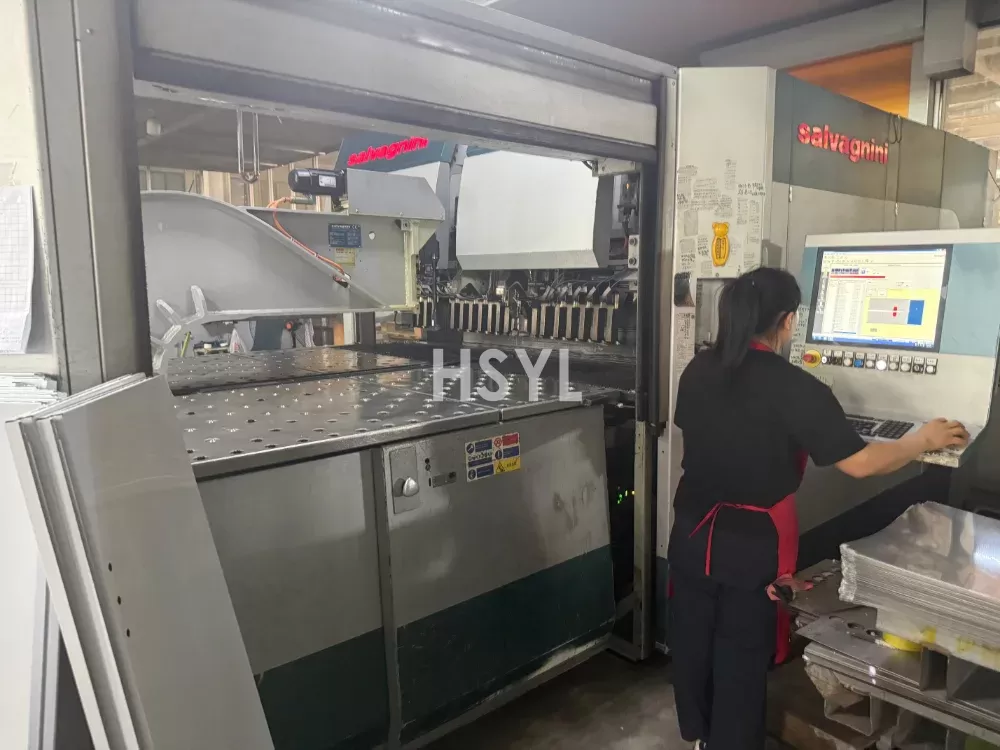
Depending on the production requirement, a kitchen equipment factory may use:
- CNC press brakes
- Servo-electric press brakes
- Hydraulic CNC press brakes
- Automatic panel bending centers
- Robotic bending cells
- Automatic loading and unloading systems
A CNC press brake controls the position of the back gauge and the movement of the bending beam or ram. The operator still needs to load, rotate and reposition the sheet in many applications.
An automatic panel bender can complete several bending operations with less manual handling. Depending on the equipment configuration, it may automatically position, rotate and bend different sides of a panel.
This makes automated panel bending especially suitable for doors, cabinet panels, machine covers, electrical enclosures and box-shaped components.
Robotic bending systems combine a CNC press brake with a robot for loading, positioning, rotating and unloading the workpiece. These systems are usually used when the product design, order quantity and production process are sufficiently standardized.
Kitchen Equipment Components Produced by Automated Bending
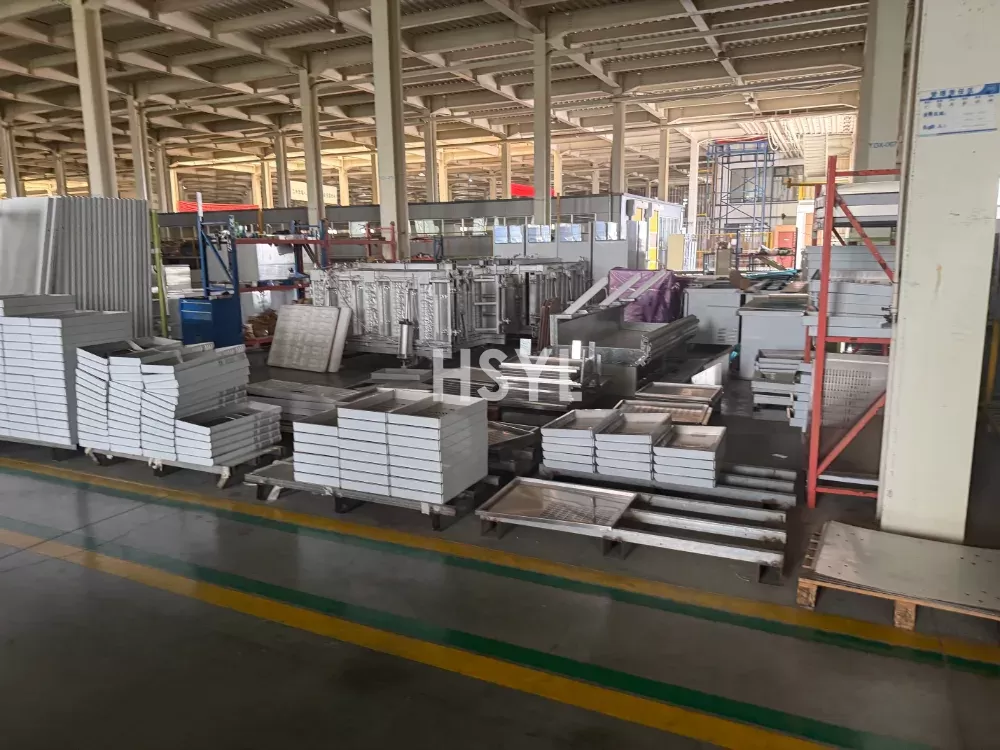
Stainless Steel Worktables
Commercial kitchen worktables normally include a stainless steel top, reinforced edges, undershelves, legs and optional backsplashes.
The worktable top may require several bending operations to create:
- Front and side edges
- Reinforced lower flanges
- Backsplashes
- Anti-drip edges
- Mounting structures
Accurate bending helps keep the table surface level and ensures that the edges, supports and lower components can be assembled correctly.
Commercial Kitchen Cabinets
Stainless steel cabinets contain multiple folded components, including side panels, bottom panels, shelves, doors and reinforcement structures.
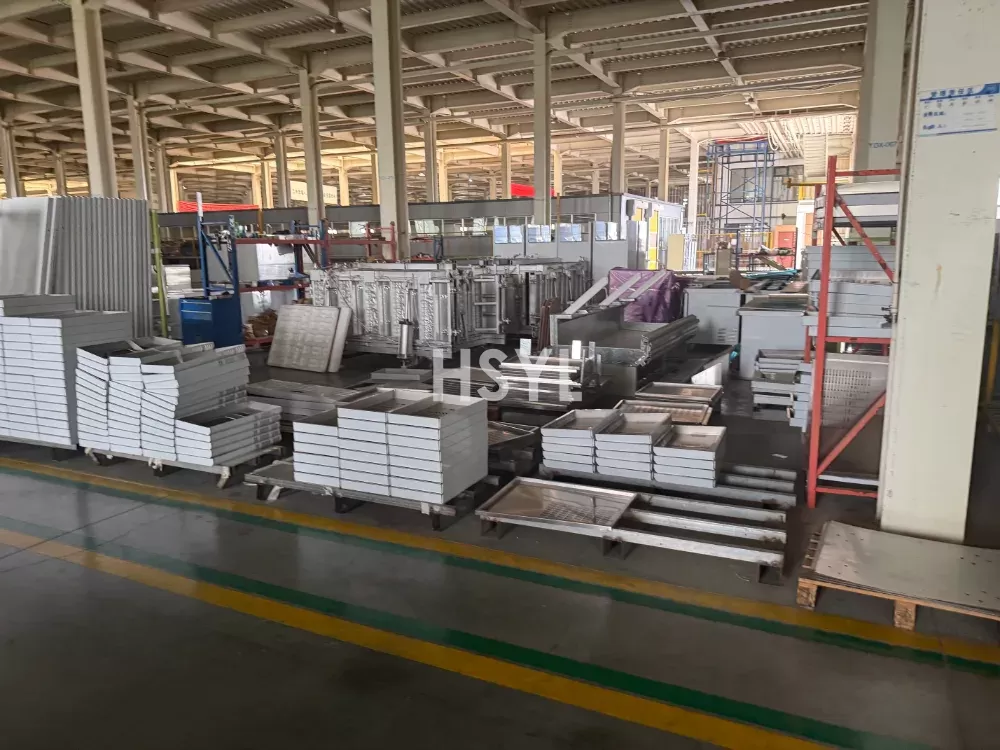
Automated bending can improve:
- Cabinet dimensional consistency
- Door alignment
- Drawer installation
- Hinge positioning
- Shelf support accuracy
- Panel fitting before welding
Consistent bending is particularly important for modular kitchen cabinets that must be installed in a continuous line.
Stainless Steel Sinks
Commercial sink units may include welded sink bowls, top panels, drainage surfaces, backsplashes, side edges and cabinet structures.
The top panel and supporting structure must be formed accurately to maintain proper drainage, installation dimensions and structural stability.
Incorrect bending may result in uneven surfaces, large welding gaps or difficulty assembling the sink bowl with the surrounding panel.
Kitchen Exhaust Hoods
Commercial exhaust hoods often contain large stainless steel panels with inclined surfaces, reinforced edges and multiple connection points.
CNC bending allows the factory to process these panels according to the required dimensions and angles. This can reduce manual marking and improve the consistency of large hood components.
For customized exhaust systems, the bending program can be adjusted according to the project drawing, installation height and duct connection requirements.
Heating and Insulated Cabinets
Heating cabinets, holding cabinets and insulated food cabinets require accurate internal and external panels.
Precise bending can help improve:
- Door and body alignment
- Insulation cavity consistency
- Gasket contact
- Internal rack installation
- External panel appearance
- Assembly efficiency
Bending accuracy alone does not determine insulation performance, but it supports better panel fitting and more consistent assembly.
Food Processing Equipment Enclosures
Many food processing machines use stainless steel covers, control cabinets, access doors, frames and protective enclosures.
Automated bending can be used to manufacture these components with consistent dimensions, helping the factory improve machine appearance, operator access and component installation.
How the Automated Bending Process Works
1. Product Design and Drawing Preparation
The production process begins with the product drawing. Engineers define the overall dimensions, material thickness, hole positions, bending lines, flange dimensions, internal radius and assembly requirements.
The design team must also consider:
- Material grade
- Sheet thickness
- Bending direction
- Surface finish direction
- Tooling availability
- Welding requirements
- Installation tolerances
- Equipment function
A correct unfolded drawing is essential. Even advanced bending equipment cannot compensate for an incorrect product design or sheet metal development.
2. Laser Cutting or Sheet Preparation
The stainless steel sheet is cut into the required shape before bending. Laser cutting is commonly used because it can process the external profile, holes, slots and notches according to the digital drawing.
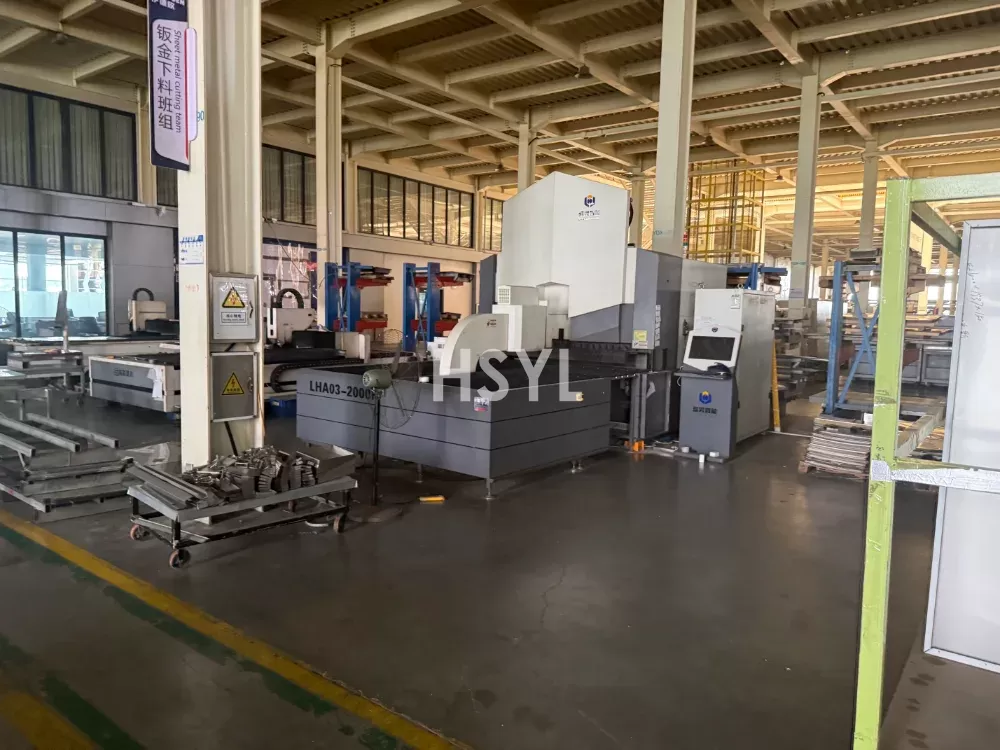
After cutting, the workpiece should be checked for:
- Correct dimensions
- Correct hole positions
- Cutting burrs
- Surface damage
- Material identification
- Protective film condition
Cutting and bending must be coordinated. Incorrect notch dimensions or insufficient bending clearance may cause interference during forming.
3. Bending Program Setup
The bending program is created according to the component drawing and machine configuration.
The program may include:
- Bending sequence
- Back-gauge position
- Bending angle
- Tool selection
- Pressure or force settings
- Material thickness
- Springback compensation
- Part rotation instructions
For complex parts, the bending sequence must be evaluated carefully. An incorrect sequence may prevent the component from fitting into the tooling during later bends.
4. Positioning and Bending
During production, the sheet is positioned according to the programmed dimensions. The machine then applies controlled force to form the required angle.
Depending on the equipment type, the process may include:
- Automatic back-gauge positioning
- Automatic angle adjustment
- Multiple-side bending
- Positive and negative bending
- Automatic panel rotation
- Automatic loading and unloading
The exact level of automation depends on the machine configuration and the geometry of the component.
5. First-Article Inspection
Before continuous production begins, the first completed component should be inspected.
Typical inspection points include:
- Bending angle
- Flange length
- Overall dimensions
- Diagonal dimensions
- Hole position
- Panel flatness
- Surface condition
- Fit with related components
If necessary, the bending program is adjusted before batch production continues.
6. Welding, Grinding and Assembly
After bending, the components proceed to welding, grinding, polishing, fastening or assembly.
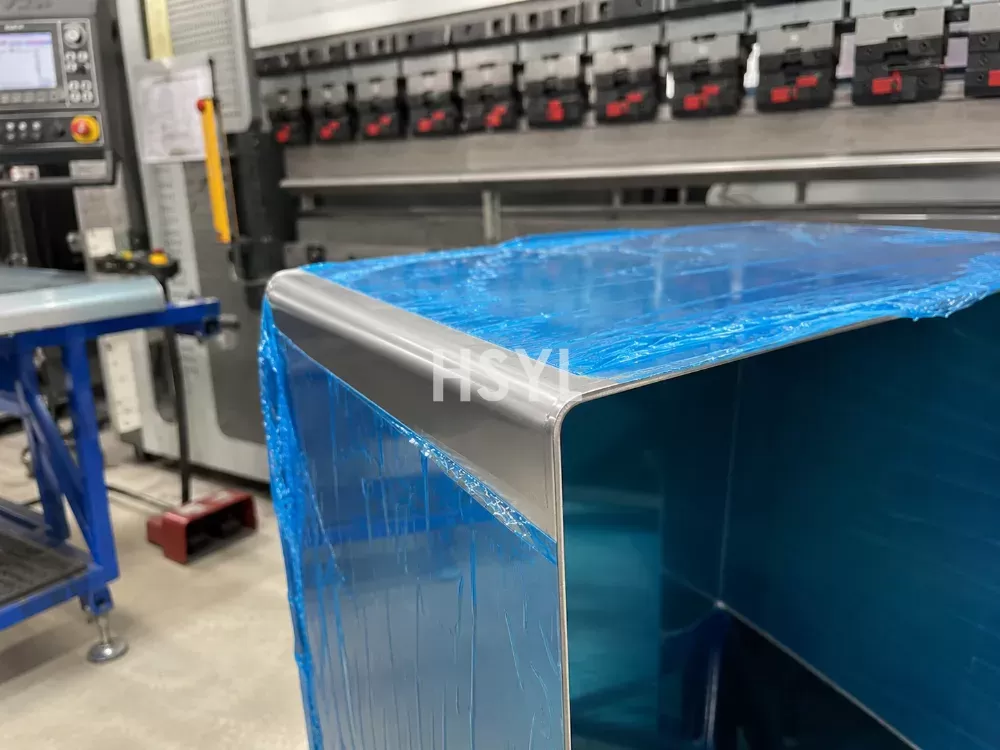
Accurately bent components usually fit together more consistently. This can reduce adjustment work before welding and help maintain stable external dimensions.
However, final product quality still depends on welding control, grinding quality, frame accuracy, assembly procedures and inspection standards.
Important Technical Factors in Stainless Steel Bending
Material Thickness
Material thickness affects the required bending force, tooling selection, minimum bending radius and final component geometry.
Commercial kitchen equipment may use different sheet thicknesses depending on the product structure, load requirement, equipment type and customer specification.
The manufacturer should not apply the same bending settings to every sheet thickness. The program and tooling should be selected according to the actual material.
Bending Radius
The internal bending radius influences both appearance and material performance.
If the radius is too small for the selected stainless steel sheet, the material may experience excessive deformation. Possible problems include:
- Surface cracking
- Visible deformation
- Damage to the brushed finish
- Reduced edge quality
- Inconsistent angles
The appropriate bending radius should be determined according to material grade, sheet thickness, product design and tooling conditions.
Material Springback
After the bending force is removed, stainless steel may recover slightly toward its original shape. This is known as springback.
Springback can be influenced by:
- Stainless steel grade
- Material hardness
- Sheet thickness
- Bending radius
- Tool opening
- Rolling direction
- Bending method
CNC bending systems can use angle correction and program compensation to reduce the effect of springback. The correct settings normally require practical testing and first-article inspection.
304 and 316 Stainless Steel
304 stainless steel is widely used in commercial kitchen equipment because it provides a practical balance of corrosion resistance, formability, cleanability and cost.
It is commonly used for:
- Worktables
- Sinks
- Cabinets
- Shelves
- Exhaust hoods
- Food preparation equipment
316 stainless steel may be selected for environments involving higher salt exposure, seafood processing, aggressive cleaning conditions or specific customer requirements.
Different stainless steel grades may require adjustments to bending force, tooling and springback compensation. Material selection should be based on the actual operating environment rather than appearance alone.
Rolling and Brushing Direction
Stainless steel sheets may behave differently when bent parallel or perpendicular to the rolling direction. The visible brushed texture must also be considered when planning the unfolded component.
For products with multiple external panels, consistent brushing direction helps create a more uniform finished appearance.
Surface Protection
Commercial kitchen equipment is often evaluated by both functional performance and external appearance. Scratches, tooling marks and damaged protective film can reduce the visual quality of the finished product.
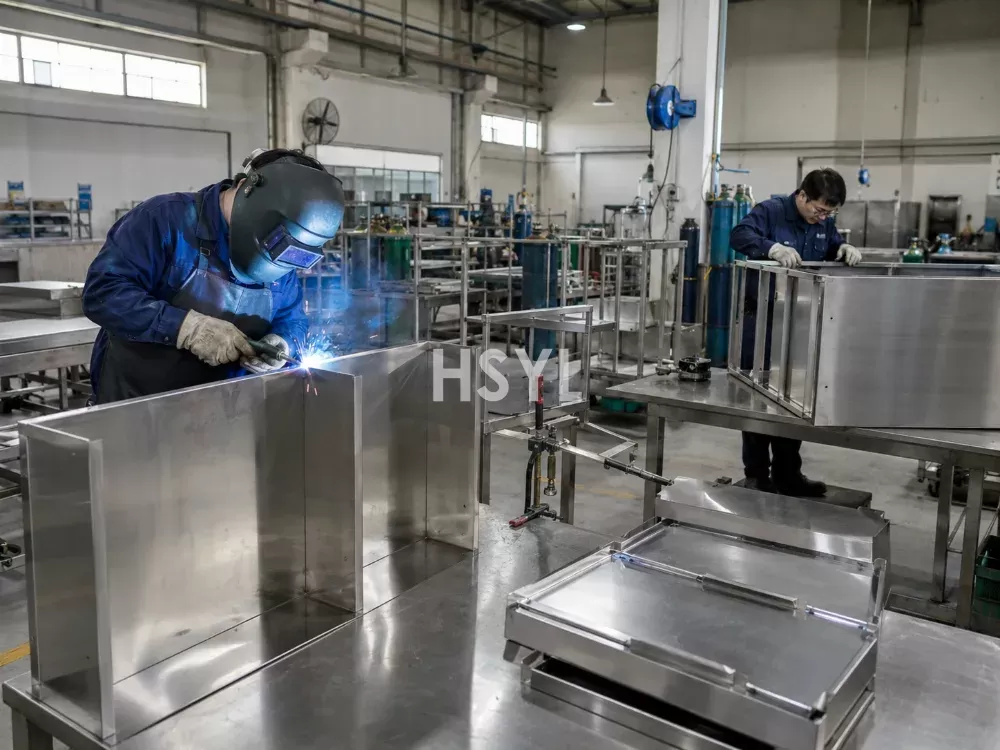
Manufacturers may use several methods to reduce surface damage:
- Keeping the protective film in place during processing
- Using clean tooling
- Using suitable protective pads or films
- Applying non-marking tooling when appropriate
- Cleaning worktables and handling equipment
- Separating finished parts during transportation
- Training operators in surface protection procedures
Surface protection must continue through bending, welding, grinding, assembly and packing.
Benefits of Automated Bending for Kitchen Equipment Manufacturers
Improved Batch Consistency
When the material, tooling and program remain stable, automated bending can help reduce dimensional differences between products in the same batch.
This is important for standard worktables, cabinets, shelves, machine panels and OEM production.
Reduced Manual Positioning Errors
Digital back-gauge positioning reduces the need for repeated manual measurement. This can improve consistency and reduce errors caused by incorrect marking or positioning.
Higher Production Efficiency
Automatic positioning and programmed bending sequences can reduce the time required to set up and process repeated components.
The actual productivity improvement depends on part size, complexity, order quantity, loading method and equipment configuration.
Better Component Fitting
Accurate bends help related components fit together before welding and assembly. This may reduce correction work and improve the consistency of cabinet dimensions, door gaps and external panels.
Support for Customized Production
Commercial kitchen projects often require customized dimensions, configurations and installation details.
CNC programs can be adjusted according to approved drawings, allowing the factory to manufacture different product sizes without relying only on fixed molds.
Improved Finished Appearance
Consistent bending angles, flange dimensions and panel alignment help create straighter edges, more uniform gaps and a cleaner external appearance.
Reduced Dependence on Manual Experience
Automation can reduce some repetitive tasks that depend heavily on manual positioning. However, skilled operators and engineers are still required for programming, tooling selection, inspection and process adjustment.
Automated Bending vs. Traditional Manual Bending
| Comparison Item | Traditional Bending | Automated Bending |
|---|---|---|
| Positioning | More dependent on manual measurement and operator experience | Controlled through digital positioning and programmed settings |
| Batch consistency | May vary according to the operator and setup | Generally more consistent when the process remains stable |
| Complex components | May require repeated marking and repositioning | Can use programmed bending sequences |
| Changeover | May require manual setup and adjustment | Programs can be stored and reused for repeat orders |
| Labor requirement | More manual handling and positioning | Can reduce repetitive manual operations |
| Quality control | Requires frequent manual verification | Still requires inspection, but process settings are more repeatable |
Automated bending does not mean that every production step becomes fully unmanned. Large panels, small production batches, unusual shapes and highly customized products may still require manual handling or operator intervention.
The correct production method should be selected according to product geometry, order quantity, quality requirements and investment level.
How Automated Bending Can Reduce Welding and Finishing Work
Many sheet metal products can be designed with folded edges and integrated panels instead of assembling several small pieces.
Where the product structure allows, additional bending may reduce the number of welded joints. This can provide several benefits:
- Fewer welding seams
- Reduced grinding requirements
- Lower risk of heat distortion
- Cleaner external appearance
- More consistent dimensions
- Potentially easier cleaning
However, reducing welds must not weaken the structure or interfere with equipment maintenance. The design should consider load, hygiene, cleaning, production cost and assembly requirements.
Quality Control During the Bending Process
Automated machinery improves process control, but it does not replace quality inspection.
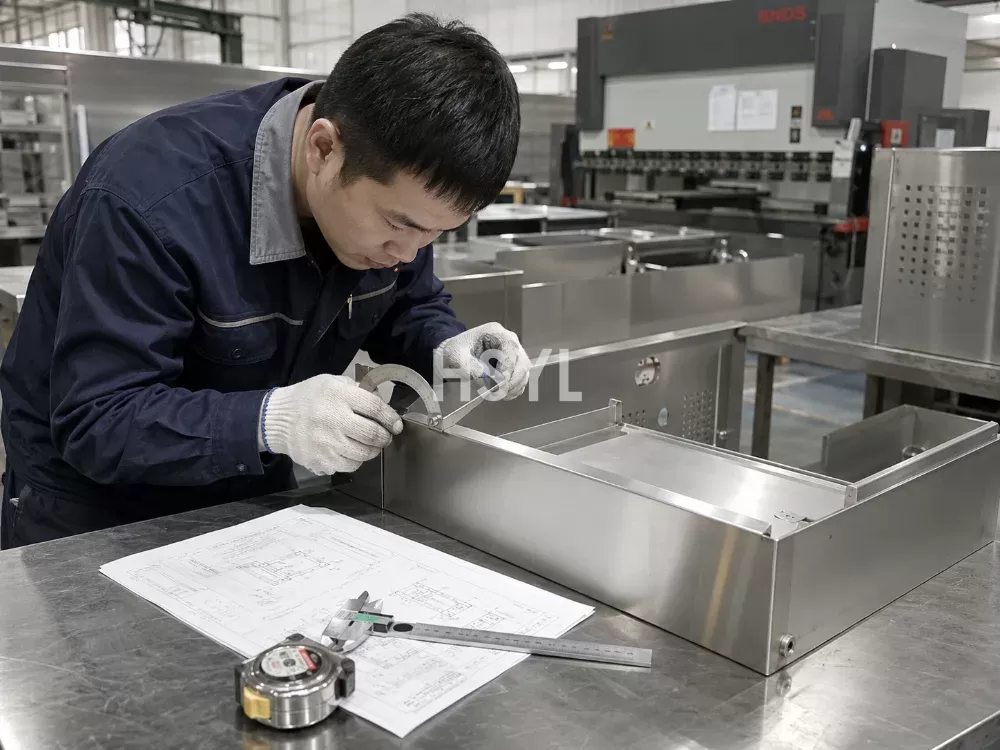
A reliable bending quality-control procedure may include:
- Confirming the stainless steel grade and thickness
- Checking the cutting dimensions before bending
- Verifying the correct drawing revision
- Inspecting the first completed component
- Measuring angles and flange dimensions
- Checking diagonal dimensions for box-shaped parts
- Inspecting the stainless steel surface
- Testing component fitting before batch assembly
- Recording and correcting production deviations
For repeated products, approved samples or inspection records can be used as references for future production.
Automated Bending Does Not Eliminate Skilled Manufacturing
Automated bending equipment reduces repetitive work and improves process repeatability, but qualified personnel remain essential.
Engineers and operators are still responsible for:
- Reviewing product drawings
- Selecting the correct material
- Preparing the unfolded design
- Choosing suitable tooling
- Creating and checking the bending program
- Inspecting the first component
- Adjusting springback compensation
- Protecting stainless steel surfaces
- Maintaining the equipment
- Controlling final product quality
A high-quality commercial kitchen product is the result of equipment capability, engineering experience, production management and inspection working together.
What Buyers Should Evaluate When Choosing a Kitchen Equipment Manufacturer
When selecting a commercial kitchen equipment supplier, buyers should not evaluate the factory only by the number of machines it owns.
It is also important to consider:
- Whether the supplier can prepare and review technical drawings
- Whether the factory has suitable cutting and bending equipment
- Whether stainless steel materials can be identified and controlled
- Whether the supplier performs first-article inspection
- Whether welding and grinding quality is consistent
- Whether customized dimensions can be produced accurately
- Whether the finished equipment is inspected before packing
- Whether production records and project requirements are managed correctly
For customized projects, the buyer should provide product dimensions, operating requirements, installation conditions and relevant drawings. Clear technical communication before production can reduce errors and improve the final result.
Conclusion
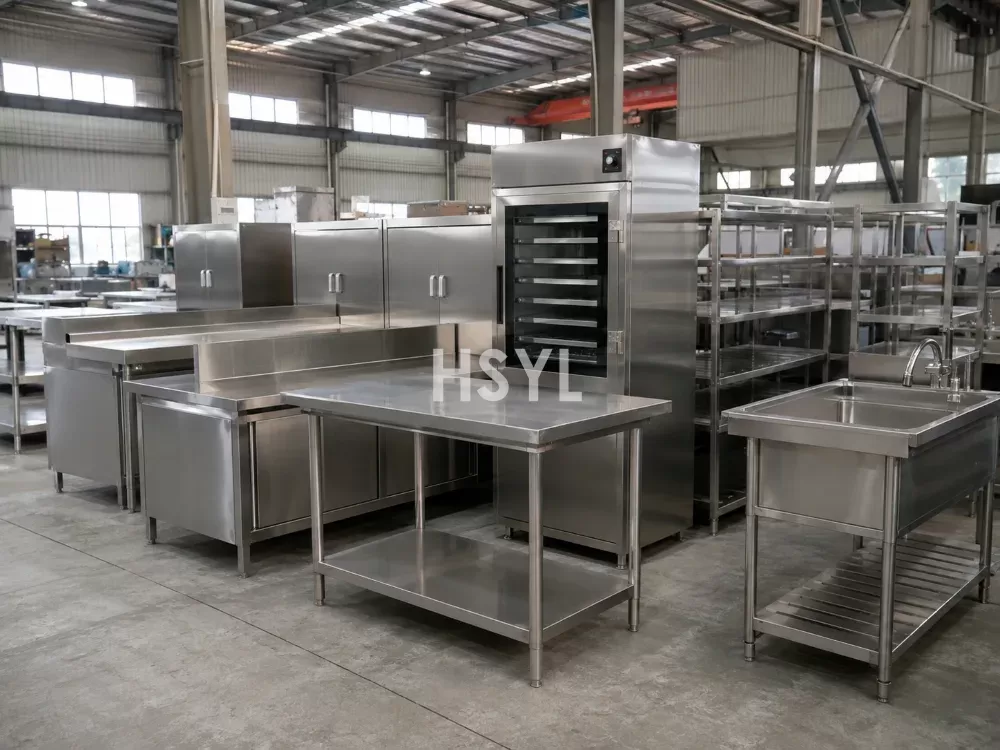
Automated bending equipment has become an important part of modern commercial kitchen equipment manufacturing.
By controlling positioning, bending sequence and forming parameters digitally, manufacturers can improve the consistency of stainless steel worktables, cabinets, sinks, exhaust hoods, heating equipment and food processing machine enclosures.
The main benefits include improved repeatability, reduced manual positioning errors, better component fitting and more efficient production of repeated or customized sheet metal parts.
However, automated bending is only one part of the manufacturing process. Product design, material selection, laser cutting, welding, grinding, assembly, surface protection and quality inspection remain equally important.
For commercial kitchen projects, reliable manufacturing depends on combining suitable automation equipment with experienced engineering and effective quality control.
HSYL provides commercial kitchen equipment and customized stainless steel fabrication solutions for foodservice, catering, central kitchen and food processing applications. Project requirements can be evaluated according to product dimensions, material specifications, production quantity and installation conditions.
Frequently Asked Questions
What is automated bending equipment used for in commercial kitchen manufacturing?
What is the difference between a CNC press brake and an automatic panel bender?
Can automated bending equipment process 304 stainless steel?
Can 316 stainless steel be bent automatically?
How does automated bending improve kitchen equipment quality?
Does automated bending eliminate welding?
Can automated bending be used for customized kitchen equipment?
Does automated bending mean the production process is fully unmanned?
How does springback affect stainless steel bending?
How can manufacturers prevent scratches during stainless steel bending?
Related Articles


Get professional consultation
Do you have any questions or need technical support regarding the content of this article? Fill out the form below, and our expert team will provide you with professional solutions.