1. Key Commercial Determinants of Fruit Pulping Machine Quotations
Fruit pulping and refining machinery constitutes the core extraction station in fruit canning, puree, jam, and nectar processing lines. When evaluating fruit pulping machine prices, equipment buyers must ensure quotations compare identical functional boundaries rather than simply comparing motor horsepower or machine weight.
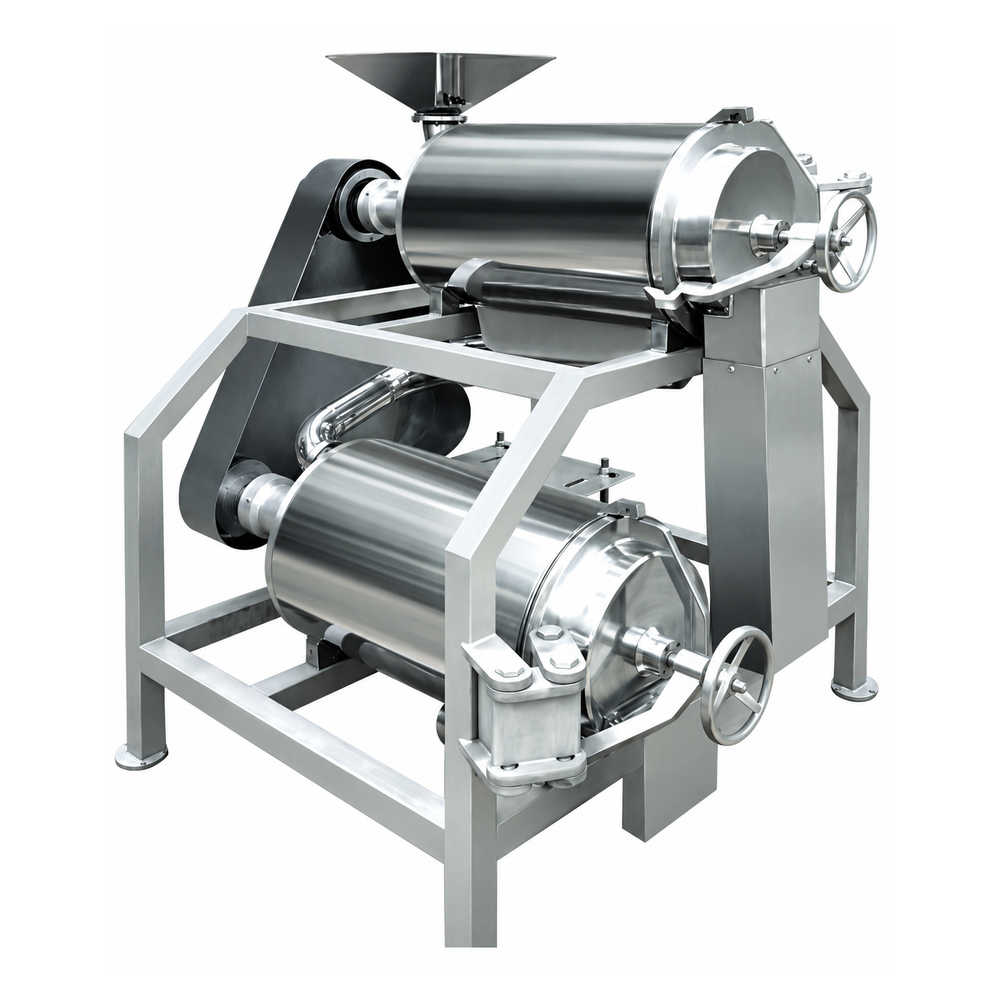
Prices vary based on fruit handling suitability, throughput capacity (500 kg/h pilot units up to 10,000 kg/h industrial lines), sanitary construction standards, and whether the machine provides single-stage crushing or dual-stage refining, as seen in our two-stage fruit pulping and refining machine.
Purchasers who evaluate only capital price without reviewing rotor metallurgy and sieve wear characteristics often face premature screen failure and high fruit product wastage. A high-efficiency fruit pulper pays for itself rapidly through superior juice and pulp extraction yields.
2. Raw Fruit Anatomy: Stone Fruit Pitting vs Berry/Pome Pulping Systems
The botanical classification and physical morphology of incoming fruit directly define pulping rotor architecture and drive train engineering:
- Stone Fruit Pitting Pulpers: Processing stone fruits (peaches, mangoes, cherries) requires specialized fruit pitting and pulping machine configurations. Rotors must operate at calibrated clearances to strip fruit pulp completely from the central seed while avoiding seed fracturing, which releases bitter amygdalin compounds and damages stainless steel sieves.
- Pome Fruit & Berry Pulpers: Apples, pears, berries, and tomatoes require high-speed centrifugal beater blades rotating at 800 to 1400 RPM to shear cellular walls, separate skin, calyx, and seeds, and force clean pulp through perforated sieves.
A machine engineered specifically for soft tomatoes will fail if fed whole hard stone fruits, underscoring why quotes must strictly match raw material input specifications.
3. Single-Channel vs Dual-Channel Pulping and Refining Configurations
The processing architecture establishes the baseline machine investment. A single-channel pulper features one cylindrical sieve drum. While cost-effective, achieving fine purees requires recirculating pulp or accepting higher seed and fiber carryover.
Industrial lines utilize two-stage or three-stage cascade pulpers mounted on a unified sanitary chassis. The first channel separates seeds, stems, and peel fragments through a coarse 1.2 mm to 1.5 mm sieve. The discharge drops directly into the second refining channel, where high-speed scraper paddles force pulp through a micro-mesh (0.4 mm to 0.6 mm), producing smooth, aerated puree in a single pass.
Dual-stage machines eliminate intermediate buffer tanks, positive displacement pumps, and interconnecting sanitary pipework, lowering plant floor space requirements and operational cleanout times.
4. Sieve Mesh Geometry, Scraper Blade Clearance, and Wear Metallurgy
Mechanical wear resistance determines long-term operating costs. Cylindrical sieves must be precision laser-cut or perforated from sanitary AISI 304 or 316L stainless steel, reinforced with circumferential bands to resist centrifugal deflection under heavy fruit slurry loads.
Scraper beaters feature adjustable lead angles and radial gap clearance (calibrated between 0.8 mm and 2.5 mm from the inner sieve surface). Advanced machines feature dynamic scrapers with food-grade EPDM, polyurethane, or UHMW-PE wiping edges that self-adjust against the sieve wall to maximize pulp extraction yield (> 92%) while minimizing waste moisture.
Cheap pulpers utilize stamped mild steel screens or poorly balanced rotor shafts that vibrate excessively, causing rapid metal fatigue and inconsistent pulp recovery percentages.
5. Infeed Hoppers, Discharge Waste Chutes, and CIP Sanitary Interfaces
Equipment quotations must encompass the full sanitary integration envelope. Premium industrial fruit pulpers include hinged end-doors equipped with gas spring lifters and safety proximity interlocks, providing rapid access for sieve changeouts and sanitary inspection.
Furthermore, internal 360-degree CIP spray balls connected to rotary manifolds allow automated washdown between product batches, preventing bacterial biofilm build-up and eliminating manual disassembly labor.
Infeed hoppers should feature liquid spray manifolds for introducing hot water or antioxidant solutions (such as ascorbic acid) to inhibit enzymatic browning in light-colored apple and peach purees during mechanical shear extraction.
6. RFQ Technical Parameter Specification and Scope Matrix
To secure accurate, binding quotations from equipment suppliers, refer to the engineering parameter matrix below, as outlined in our broad fruit and vegetable processing equipment price overview:
| Specification Parameter | Pilot / Small Enterprise Tier | High-Volume Commercial Tier | Quotation Impact Factor |
|---|---|---|---|
| Raw Feed Throughput | 500 - 1,500 kg/h | 3,000 - 10,000 kg/h | Motor kW, shaft diameter, bearing housing size |
| Machine Staging | Single-Stage (Pulper only) | Dual-Stage (Pulping + Fine Refining) | Dual motors, secondary sieve, integrated chute |
| De-Stoning Capability | Soft fruit / pre-destoned feed | Integrated heavy-duty de-pitting rotor | Specialized rotor geometry, reinforced chassis |
| Drive & Control | Direct DOL motor starter, fixed RPM | VFD variable speed, torque overload sensors | Yield optimization across diverse fruit ripeness |
| Sanitary Finish | Standard industrial bead-blast | Internal mirror polish Ra < 0.4 um, CIP manifold | Hygienic standard, rapid cleanout compliance |
Defining these criteria upfront ensures that competing machinery suppliers bid on equivalent commercial capacities and material specifications.
Motor Sizing, VFD Torque Dynamics, and Energy Optimization
Driving high-speed pulping rotors requires robust motor torque engineering. Processing hard fruits or fibrous vegetables produces substantial torque spikes when fruit surges enter the infeed hopper. Heavy-duty industrial pulpers utilize high-efficiency IE3/IE4 motors (5.5 kW to 22 kW) coupled to heavy-duty cast-iron helical bevel gear reducers or high-torque timing belts.
Integrating Variable Frequency Drives (VFDs) enables soft starting under full fruit load, dynamic torque limiting to protect sieves against foreign object damage, and electronic speed modulation (400 to 1400 RPM). Modulating rotor RPM according to fruit ripeness optimizes pulp extraction yield while preventing excessive foaming or aeration in fruit juices.
Screen Replacement Procedures and Scraper Wear Diagnostics
Maintaining high yield requires systematic screen and scraper maintenance protocols:
- Daily Inspection: Check cylindrical screen perforations for fiber blinding; run high-pressure warm water rinse through internal CIP nozzles after every shift; inspect discharge pomace dryness.
- Weekly Calibration: Measure scraper blade-to-screen clearance using feeler gauges; adjust radial lead angle if excessive fruit juice carries over into the waste pomace discharge chute.
- Bi-Annual Overhaul: Replace scraper wiping elastomers (silicone/EPDM); replace drive shaft rotary mechanical cartridge seals; re-balance the main rotor assembly dynamically on precision balancing rigs to eliminate high-speed harmonic vibration.
7. Factory Trial Protocol: Raw Material Testing and Yield Verification
Before contract finalization, reputable manufacturers offer pilot testing with client-supplied raw fruits. Tests evaluate raw fruit temperature, pre-cooking/blanching requirements, net pulp recovery yield percentage, and waste dryness.
Documenting these empirical trial results ensures that the delivered pulping system meets target capacity and viscosity standards without excessive motor stalling or pulp oxidation.
Plant engineers should inspect the rejected pomace discharged during trials: properly calibrated machines produce pomace consisting almost exclusively of dry skins and clean seeds, confirming maximum recovery of high-value fruit pulp.
6. Motor Sizing, VFD Torque Dynamics, and Energy Optimization
Driving high-speed pulping rotors requires robust motor torque engineering. Processing hard fruits or fibrous vegetables produces substantial torque spikes when fruit surges enter the infeed hopper. Heavy-duty industrial pulpers utilize high-efficiency IE3/IE4 motors (5.5 kW to 22 kW) coupled to heavy-duty cast-iron helical bevel gear reducers or high-torque timing belts.
Integrating Variable Frequency Drives (VFDs) enables soft starting under full fruit load, dynamic torque limiting to protect sieves against foreign object damage, and electronic speed modulation (400 to 1400 RPM). Modulating rotor RPM according to fruit ripeness optimizes pulp extraction yield while preventing excessive foaming or aeration in fruit juices.
7. Pre-Blanching Thermal Inactivation and Enzyme Degradation Kinetics
Before entering high-shear pulping beaters, stone fruits and pome fruits frequently undergo continuous steam blanching or hot-water flume scalding at 82 deg C to 88 deg C for 2 to 4 minutes. This thermal preparation inactivates native polyphenol oxidase (PPO) and pectin methylesterase (PME) enzymes responsible for rapid oxidative browning and syneresis.
Blanching softens fruit pericarp cellular tissues, lowering the shear torque required by pulping beaters by 35% and increasing total finished puree recovery by 4% to 7% while preserving natural fruit ascorbic acid (Vitamin C) levels and vibrant pigmentation without requiring excessive chemical antioxidant additives.
Related Articles



Get professional consultation
Do you have any questions or need technical support regarding the content of this article? Fill out the form below, and our expert team will provide you with professional solutions.