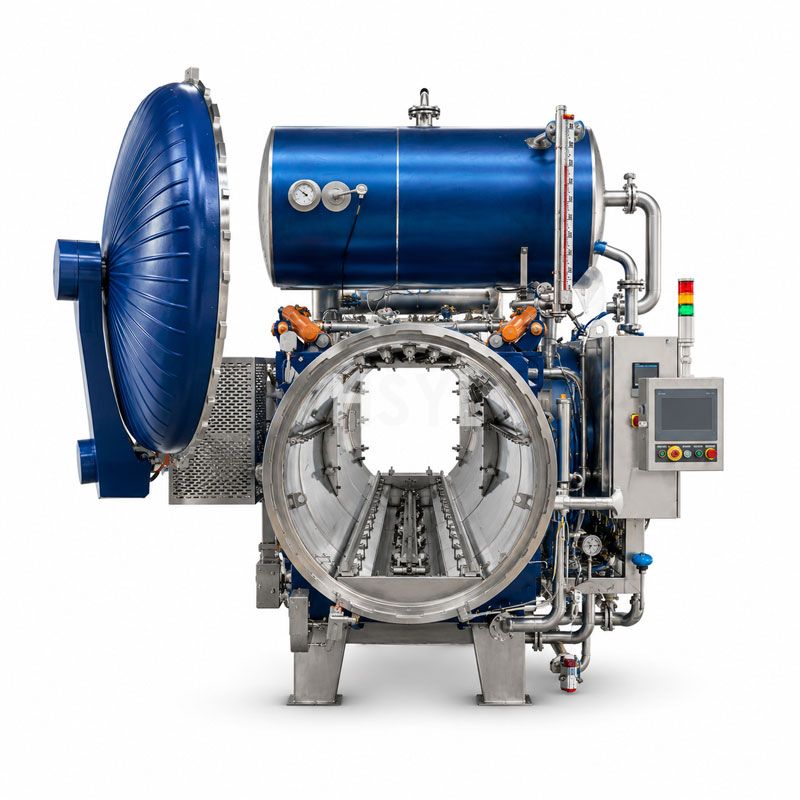
1. Industrial Food Retort Sterilizer Quotation Framework
Batch retort sterilizers represent the core thermal processing critical control point (CCP) in low-acid canned food (LACF) facilities. When evaluating retort sterilizer prices, plant engineers frequently encounter wide price variations that reflect substantial differences in pressure vessel certifications, thermal media circulation technology, and process automation.
An industrial food retort quotation must be analyzed through the lens of thermal kinetics, microbiological safety, and regulatory compliance. Units designed for high-capacity fish, meat, and vegetable canning, such as our retort sterilizers for canned fish processing, require heavy-duty pressure vessel engineering that goes far beyond standard atmospheric cooking equipment.
A rigorous quotation structure separates pressure vessel fabrication from dynamic thermal circulation pumps, modulating steam and overpressure manifolds, external heat exchangers, and CFR 21 Part 11 compliant control suites. Understanding each subsystem enables plant engineers to accurately identify where cost savings compromise thermal performance or food safety compliance.
2. ASME/PED Pressure Vessel Fabrication and Metallurgy Standards
The mechanical pressure vessel shell constitutes the single largest structural cost component of the sterilizer. Cost determinants include:
- Design Pressure Ratings: Standard steam retorts operate at design pressures of 0.35 to 0.40 MPa. High-overpressure retorts engineered for flexible pouches and aluminum trays operate at 0.50 to 0.60 MPa, requiring thicker vessel walls, forged flanged heads, and high-tensile safety locking door rings.
- Code Certifications: Vessels manufactured under American Society of Mechanical Engineers (ASME Section VIII Div 1) with 'U' stamp, or European Pressure Equipment Directive (PED 2014/68/EU) Module H/H1, require extensive non-destructive testing (X-ray weld inspection, ultrasonic shell thickness verification) and third-party inspection sign-offs.
- Corrosion Metallurgy: While external jackets and structural frames use AISI 304, high-chloride processing (e.g., canned tuna in brine, acidified vegetables) requires wetted shell contact surfaces fabricated from molybdenum-alloyed AISI 316L or 2205 Duplex stainless steel.
The choice of door actuation also drives structural costs: manual radial-arm swing doors represent the baseline price tier, whereas hydraulic power doors with pneumatic perimeter inflatable silicone seals eliminate manual operator strain and guarantee pressure containment across thousands of thermal cycles.
3. Process Heating Mode: Saturated Steam, Water Spray, or Full Immersion
The method used to transfer thermal enthalpy into sealed food containers dictates internal piping, valve manifolds, and secondary heat exchanger costs:
Saturated Steam Retorts: Feature the lowest mechanical complexity, requiring steam spreading manifolds and top vents. However, they lack dynamic overpressure control during cooling, making them suitable only for rigid tinplate cans.
Water Spray / Water Cascade Retorts: Utilize high-flow sanitary centrifugal pumps (120 to 220 m3/h) to circulate superheated water through top and lateral atomizing spray nozzles. This architecture allows precision air overpressure modulation (+-0.02 bar) throughout heat-up, holding, and cooling phases, protecting pouches, plastic bowls, and thin cans from deformation.
Full Water Immersion Retorts: Submerge containers completely in pressurized water, providing high thermal inertia and buoyancy for heavy glass jars, but requiring larger surge tanks, elevated steam boiler capacity, and structural floor reinforcement.
Water spray and cascade systems incorporate external sanitary plate heat exchangers (PHE) fabricated from titanium or AISI 316L plates. Indirect cooling through a PHE prevents non-potable river or cooling tower water from directly contacting hot container seams, eliminating post-process bacterial recontamination risks.
4. Automated Retort Basket Logistics, Transfer Shuttles, and Tracking
Handling ergonomics and labor optimization dictate the automation scope surrounding the retort vessel. As examined in our guide on retort basket and process design factors, material handling configurations vary widely:
- Manual Handling: Manual trolley loading with hand-pushed basket dollies; low initial investment, suitable for pilot plants or low-throughput lines.
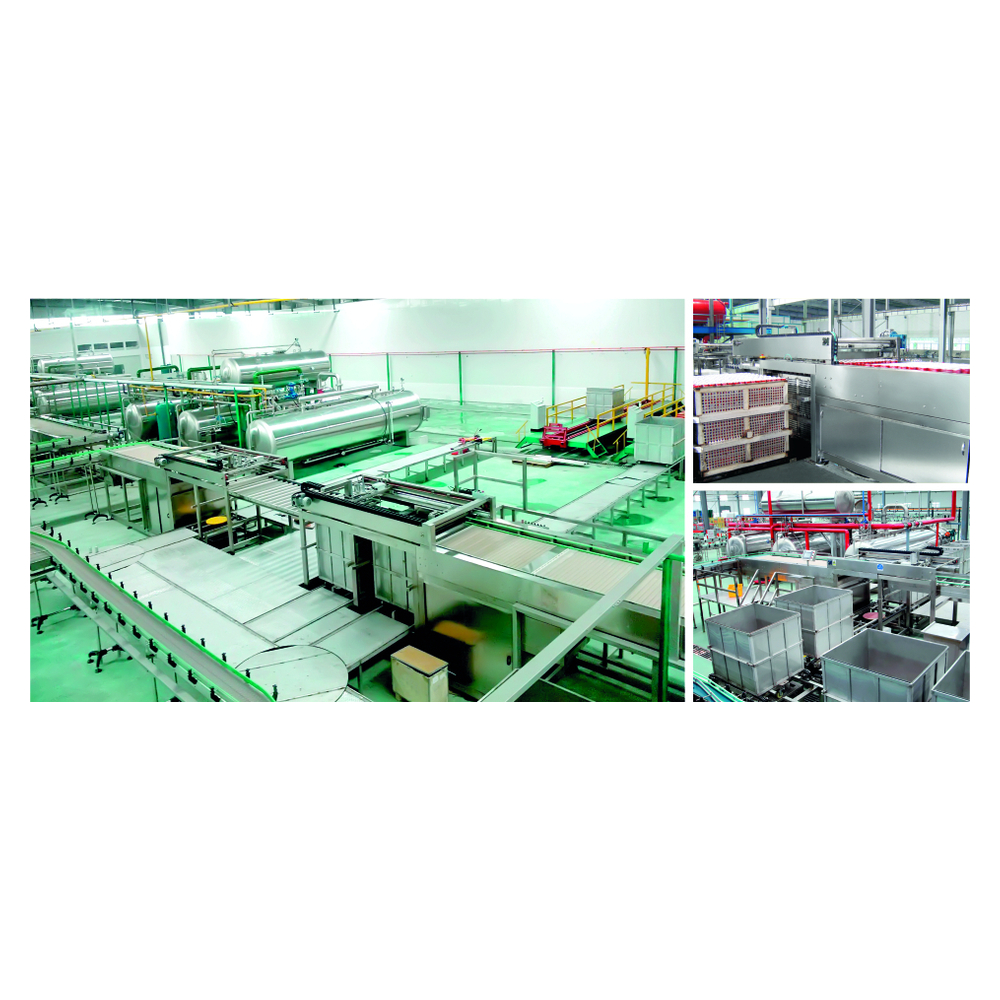
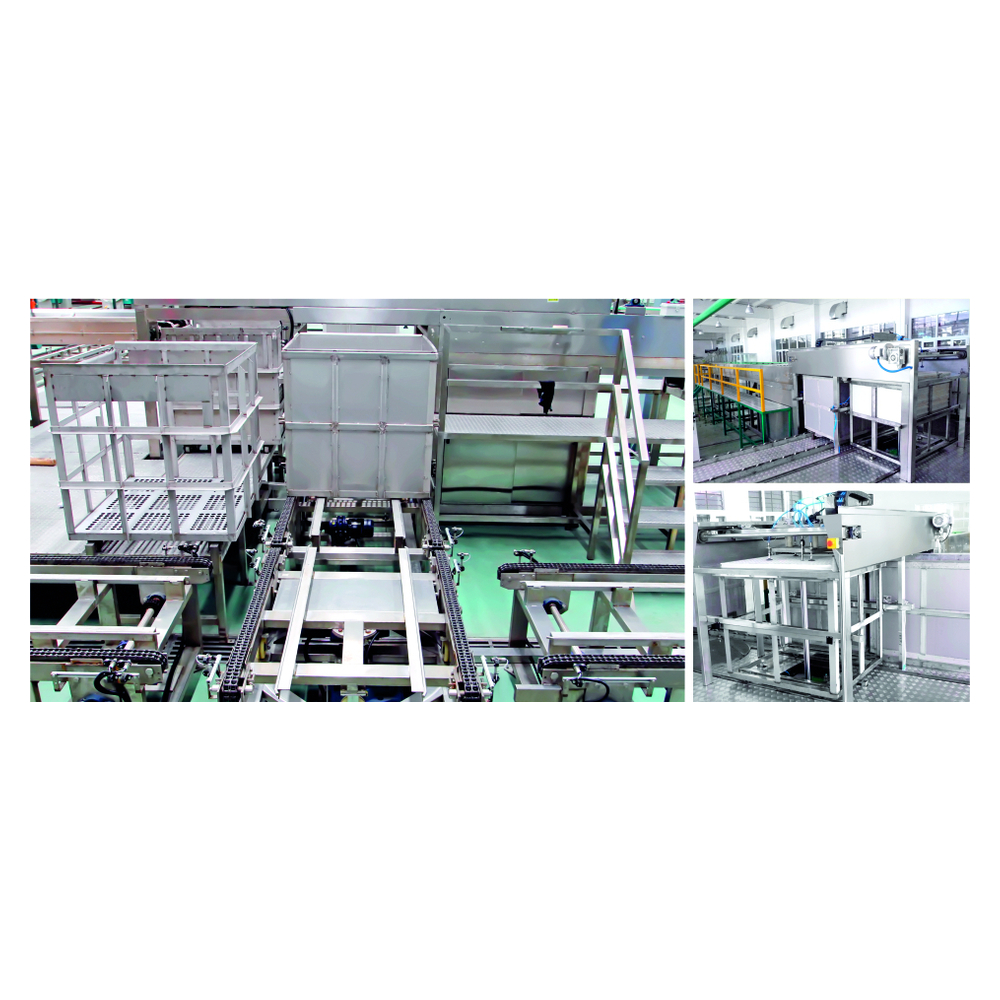
- Semi-Automated Transfer Cars: Floor-mounted motorized shuttles with pneumatic basket push-pull chain drives that index baskets into multiple retort vessels.
- Fully Automated Retort Room Systems (RRS): Automated Guided Vehicles (AGVs) or gantry shuttles integrated with automated basket loaders and unloaders, tracking container batch identity via RFID to eliminate human operator error.
Automated basket shuttle systems reduce cannery labor by 60% and eliminate the risk of unsterilized baskets inadvertently bypassing the retort room to enter the labeling and cartoning hall.
5. PLC Instrumentation, Dual RTD Redundancy, and FDA 21 CFR Part 11
Control systems are critical for food safety compliance. A compliant retort automation suite requires dual RTD Pt100 temperature sensors (Class A, calibrated to +-0.1 deg C), high-accuracy electronic pressure transmitters, and digital modulating control valves with pneumatic positioners.
For processors exporting to North America or Europe, the software package must support FDA 21 CFR Part 11, providing encrypted electronic record generation, multi-level user authentication, tamper-evident audit trails, and automated calculation of cumulative microbial lethality (F0 value).
Control architectures integrating industrial PC touchscreens with redundant Siemens S7-1500 or Rockwell ControlLogix processors command higher pricing than basic micro-controllers, but protect canners against catastrophic product recalls caused by unrecorded process deviations or temperature sensor drift.
6. Comprehensive Equipment Scope & Quotation Demarcation Table
When reviewing commercial proposals, verify whether the quoted price covers the complete functional skid or only bare hardware:
| System Component | Standard Basic Scope | Full Turnkey Industrial Scope | Quotation Impact |
|---|---|---|---|
| Pressure Vessel | Raw shell with manual swing door | Hydraulic/Pneumatic power door with safety interlocks | Vessel safety certification, automated actuation |
| Recirculation Skid | Standard industrial pump, mild steel pipe | Sanitary 316L pump, internal spray headers, sanitary valves | Food-grade compliance, spray distribution uniformity |
| Heat Exchanger | Direct steam injection spargers only | External sanitary plate heat exchanger (indirect cooling) | Prevents sterile cooling water contamination |
| Control Cabinet | Basic relay logic or low-cost PLC | Siemens S7-1500 / Allen-Bradley with IPC & CFR 21 Part 11 | Regulatory validation, remote telemetry, recipe management |
| Internal Tooling | Vessel floor track rails only | AISI 304 perforated baskets, divider trays, transfer cars | Container specific material handling capacity |
Transparent manufacturers provide detailed mechanical and electrical boundary drawings that define exact utility connection flanges (steam DN50-DN80, compressed air DN25, cooling water DN65-DN100, condensate drain DN80).
Retort MEP Utility Sizing: Steam, Water, and Air Enthalpy Balances
Engineering a retort installation requires precise facility utility balancing. Saturated steam consumption peaks during initial thermal venting (15 to 20 minutes), requiring 450 to 650 kg/h of dry saturated steam at 0.5 to 0.7 MPa per vessel. Compressed air demand during overpressure modulation requires dedicated oil-free screw compressors delivering instrument-grade air (dew point -40 deg C, 0.6 to 0.8 MPa) with an accumulator volume sized to prevent pressure sags during emergency cooling transitions.
Cooling water circuits must supply softened water (total hardness < 15 ppm CaCO3, chlorides < 50 ppm) at flow rates of 25 to 45 m3/h per basket during the rapid pull-down phase, discharging into continuous drain trenches capable of handling thermal effluent up to 90 deg C without vapor flashing.
Preventative Maintenance Schedule and Safety Inspection Intervals
To preserve ASME/PED vessel certification and prevent unexpected cannery downtime, plant maintenance teams must execute scheduled mechanical audits:
- Daily Inspection: Inspect door perimeter silicone gaskets for tears or compression set; check door safety interlock pin switches; verify condensate drain strainer clarity.
- Monthly Calibration: Validate RTD Pt100 temperature sensors against certified reference thermometers; test emergency pressure relief valves (PRV) for seat leakage and manual lifting lever action.
- Annual Certification: Perform full hydrostatic pressure vessel re-testing; replace circulation pump mechanical seals; inspect internal roller tracks and basket stop buffers for mechanical wear.
7. Site Installation, Commissioning, and Thermal Distribution Mapping
The final quotation dimension comprises manufacturer field service commitments. Turnkey contracts include on-site installation supervision, piping connection verification, pressure relief valve inspection, and comprehensive Temperature Distribution (TD) testing.
Thermal distribution mapping utilizing multi-channel data loggers is legally required by food safety authorities to verify that vessel cold spots receive sufficient thermal exposure before commercial canning production commences.
Process validation requires recording internal temperature profiles across at least 12 to 24 geometric points throughout the basket stack during both maximum venting and minimum steam supply scenarios. Including professional commissioning engineers and certified thermal process authorities in the contract guarantees smooth validation and rapid production permitting.
6. Retort MEP Utility Sizing: Steam, Water, and Air Enthalpy Balances
Engineering a retort installation requires precise facility utility balancing. Saturated steam consumption peaks during initial thermal venting (15 to 20 minutes), requiring 450 to 650 kg/h of dry saturated steam at 0.5 to 0.7 MPa per vessel. Compressed air demand during overpressure modulation requires dedicated oil-free screw compressors delivering instrument-grade air (dew point -40 deg C, 0.6 to 0.8 MPa) with an accumulator volume sized to prevent pressure sags during emergency cooling transitions.
Cooling water circuits must supply softened water (total hardness under 15 ppm CaCO3, chlorides under 50 ppm) at flow rates of 25 to 45 m3/h per basket during the rapid pull-down phase, discharging into continuous drain trenches capable of handling thermal effluent up to 90 deg C without vapor flashing.
7. Preventative Maintenance Schedule and Safety Inspection Intervals
To preserve ASME/PED vessel certification and prevent unexpected cannery downtime, plant maintenance teams must execute scheduled mechanical audits:
- Daily Inspection: Inspect door perimeter silicone gaskets for tears or compression set; check door safety interlock pin switches; verify condensate drain strainer clarity.
- Monthly Calibration: Validate RTD Pt100 temperature sensors against certified reference thermometers; test emergency pressure relief valves (PRV) for seat leakage and manual lifting lever action.
- Annual Certification: Perform full hydrostatic pressure vessel re-testing; replace circulation pump mechanical seals; inspect internal roller tracks and basket stop buffers for mechanical wear.
Related Articles
Get professional consultation
Do you have any questions or need technical support regarding the content of this article? Fill out the form below, and our expert team will provide you with professional solutions.