A commercial ice machine is the only equipment in your kitchen that manufactures its product directly from your water supply every minute of every operating day. When maintenance lapses, the consequence is not just reduced equipment lifespan — it is contaminated ice entering customer drinks, mineral scale destroying evaporator plates within months rather than years, and sudden production failure during the Friday dinner rush when ice demand peaks and alternative supply is unavailable. The maintenance investment required to prevent these outcomes is modest compared to the cost of premature equipment replacement, lost sales during unplanned downtime, or a food safety incident traceable to contaminated ice.
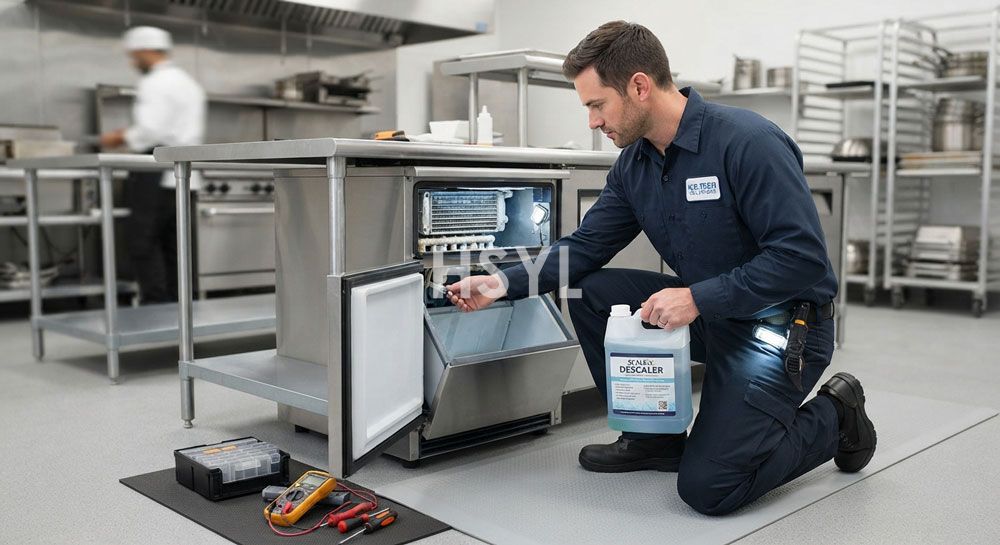
This guide covers the four maintenance domains that determine whether your commercial ice machine operates reliably for its expected 8 to 12 year service life or fails prematurely at 4 to 6 years requiring capital replacement years ahead of schedule. The framework applies to cube ice machines, flake ice machines, and nugget ice machines used in restaurants, hotels, cafes, hospitals, supermarkets, and convenience stores. Whether you operate a single under-counter unit producing 50 kilograms per day or a multi-machine installation producing several thousand kilograms daily across multiple locations, the maintenance principles remain consistent.
1. Understand Why Commercial Ice Machines Need More Maintenance Than Other Kitchen Equipment
Commercial ice machines occupy a unique maintenance category because they combine three failure-accelerating characteristics that no other kitchen equipment shares simultaneously. Recognizing these characteristics explains why ice machines cannot be treated like refrigerators, ovens, or other equipment that operates for years with minimal attention.
| Failure-Accelerating Characteristic | How It Affects Ice Machines Specifically | Maintenance Implication |
|---|---|---|
| Continuous Water Contact | Every ice production cycle flows water across the evaporator plate, through distribution tubes, over sensors, and into the water sump. Dissolved minerals in the water precipitate onto contact surfaces with each cycle, accumulating as scale deposits that reduce heat transfer efficiency and obstruct water flow paths. | Requires periodic descaling to remove accumulated mineral deposits. Frequency depends on water hardness — harder water accelerates scale formation proportionally. |
| Temperature Cycling Stress | Ice machines alternate between freezing temperatures (during ice formation on the evaporator) and harvest temperatures (warm gas defrost to release formed ice). This cycling creates thermal stress on components, promotes gasket fatigue, and accelerates wear on solenoid valves and harvest controls. | Requires periodic component inspection to detect fatigue before failure. Certain wear items (harvest solenoids, water valves) have predictable service lives that justify scheduled replacement rather than reactive repair. |
| Food-Contact Surface Status | Ice is classified as a food product by health regulatory authorities in most jurisdictions. Ice machine interior surfaces contacting water and ice are food-contact surfaces requiring sanitization at frequencies matching other food-contact equipment. | Requires periodic sanitization to control biofilm, mold, and bacterial growth. Cleaning alone is insufficient — sanitizing with food-safe chemicals at proper concentration and contact time is mandatory. |
Maintenance Reality: A commercial ice machine operating in a typical restaurant environment with hard water and no maintenance program will lose 25 to 40 percent of its rated production capacity within 18 months, develop visible scale deposits within the first 6 months, harbor detectable microbial contamination within 12 months, and require compressor or evaporator replacement within 4 to 6 years. The same machine with a disciplined maintenance program will maintain rated production capacity throughout its service life, show no significant component wear at 8 years, and typically achieve 10 to 14 years of reliable operation before major component replacement becomes necessary.
2. Water Quality: The Root Cause Variable Behind Most Maintenance Issues
Before discussing specific maintenance procedures, you must understand your incoming water quality because water quality determines the maintenance frequency required for your specific installation. Two identical ice machines installed in different locations with different water supplies will require dramatically different maintenance intervals to achieve equivalent reliability.
Water Hardness: The Primary Scale Driver
Water hardness measures dissolved calcium and magnesium mineral concentration, typically expressed in milligrams per liter (mg/L) of calcium carbonate equivalent or in grains per gallon (gpg). Hardness categories and their impact on ice machine maintenance frequency:
| Hardness Category | Calcium Carbonate Equivalent | Recommended Descaling Frequency | Typical Maintenance Profile |
|---|---|---|---|
| Soft Water | Below 60 mg/L (under 3.5 gpg) | Every 6 months | Minimal scale formation. Sanitizing and filter replacement dominate maintenance burden. |
| Moderately Hard Water | 61–120 mg/L (3.5–7 gpg) | Every 3–4 months | Visible scale accumulation begins between descaling cycles. Water filtration with scale inhibitor strongly recommended. |
| Hard Water | 121–180 mg/L (7–10.5 gpg) | Every 2 months | Significant scale accumulation requiring aggressive descaling. Scale inhibitor filtration mandatory. Production capacity begins degrading between cycles if maintenance lapses. |
| Very Hard Water | Above 180 mg/L (over 10.5 gpg) | Monthly | Severe scale challenge requiring water softening pretreatment in addition to filtration. Without pretreatment, equipment life shortened substantially regardless of descaling frequency. |
Other Water Quality Factors
Beyond hardness, three additional water characteristics affect ice machine maintenance:
- Chlorine and Chloramine Content: Municipal water supplies contain disinfectant residuals (typically 0.2–4.0 mg/L) that affect ice taste and odor if not removed by activated carbon filtration. Chloramines are particularly problematic because they pass through simple carbon filters more readily than chlorine and require specialized catalytic carbon filtration for adequate removal.
- Iron and Manganese Content: Dissolved iron above 0.3 mg/L or manganese above 0.05 mg/L causes reddish-brown or black deposits that stain ice machine components and produce discolored ice. These contaminants require specialized iron removal filtration upstream of the ice machine.
- Total Dissolved Solids (TDS): High TDS levels (above 500 mg/L) contribute to scale formation and affect ice clarity. Cloudy ice often indicates high TDS rather than equipment malfunction. Reverse osmosis pretreatment may be justified in high-TDS water environments.
Water Testing Protocol: Test your water supply at the ice machine location (not at the municipal entry point to the building — water quality changes as it passes through building plumbing) before establishing your maintenance schedule. Purchase a water test kit covering hardness, chlorine, pH, iron, and TDS, or contract a local water treatment service to perform the analysis. The $50 to $200 cost of a comprehensive water test returns many times over through properly calibrated maintenance intervals and appropriate filtration specification.
3. Water Filtration System: The First Line of Defense
Water filtration is the single most cost-effective maintenance investment for commercial ice machines. A properly specified filtration system reduces the frequency of descaling, protects internal components from sediment damage, improves ice taste and clarity, and extends overall equipment life. An improperly specified or maintained filtration system provides false confidence while allowing contaminants to pass through to the ice machine.
Three-Stage Filtration Architecture
Most commercial ice machine filtration systems use a three-stage architecture, with each stage addressing a specific contaminant category:
| Stage | Filter Type | Contaminants Removed | Replacement Frequency | Failure Indicators |
|---|---|---|---|---|
| Stage 1: Sediment Pre-Filter | Spun polypropylene or pleated polyester cartridge, 5–20 micron rating | Sand, silt, pipe scale, rust particles, particulate matter from building plumbing | Every 3–6 months depending on water conditions | Visible discoloration, reduced water flow to ice machine, pressure gauge reading above specification |
| Stage 2: Activated Carbon Filter | Activated carbon block or granular activated carbon cartridge | Chlorine, chloramines (with catalytic carbon), volatile organic compounds, taste and odor compounds, certain pesticides | Every 6 months maximum regardless of apparent condition | Chlorine taste in ice, musty odor, ice discoloration |
| Stage 3: Scale Inhibitor | Polyphosphate cartridge or alternative scale inhibitor media | Does not remove minerals — sequesters calcium and magnesium to prevent precipitation as scale on contact surfaces | Every 6–12 months depending on water hardness | Scale formation on ice machine components despite filtration, decreased ice production between descaling cycles |
Filter System Sizing and Specification
Filter system capacity must match your ice machine's daily water consumption. Under-sized filters exhaust their media capacity prematurely, requiring more frequent replacement and potentially allowing contaminants to bypass exhausted media. Over-sized filters represent unnecessary capital investment without operational benefit.
Calculate required filter capacity from your ice machine's rated production capacity: for every kilogram of ice produced, the machine typically consumes 1.5 to 3 liters of water (the excess beyond the 1:1 ratio accounts for purge water, cleaning cycles, and harvest water). A machine producing 200 kilograms of ice per day consumes approximately 300 to 600 liters of water daily, or 9,000 to 18,000 liters monthly. Select filter cartridges rated for at least 6 months of service at this flow rate — typically cartridges rated for 20,000 to 40,000 liter capacity for mid-size commercial machines.
Filter Replacement Discipline
Filter cartridge replacement is the maintenance task most frequently deferred or overlooked in commercial food service operations. The deferral is understandable — filters appear functional until they are completely exhausted, and exhausted filters provide no visible warning until water quality degradation becomes severe. Effective filter replacement discipline requires:
- Calendar-Based Replacement Schedule: Replace sediment filters every 3–6 months and carbon/scale inhibitor filters every 6 months regardless of apparent condition. The media may appear functional but has exhausted its adsorption or sequestration capacity.
- Written Replacement Log: Maintain a log recording filter replacement dates, cartridge specifications, and technician initials for every replacement event. The log creates accountability and enables trend analysis if water quality issues develop.
- Spare Filter Inventory: Keep at least one complete set of replacement filters on hand at all times. Ordering filters only when needed introduces delay during which exhausted filters remain in service, degrading water quality and ice machine performance.
- Quarterly Filter Inspection: Even between scheduled replacements, visually inspect filters quarterly for premature exhaustion or contamination. Sediment filters showing heavy discoloration before their scheduled replacement date may indicate upstream plumbing issues requiring investigation.
4. Descaling Procedure: Removing Accumulated Mineral Deposits
Descaling removes calcium and magnesium carbonate deposits that accumulate on the evaporator plate, water distribution system, and water sump during normal operation. The procedure uses acidic cleaning solutions that dissolve mineral deposits without damaging stainless steel or food-grade plastic components. Skipping or delaying descaling allows scale to accumulate to the point where heat transfer efficiency drops, ice production slows, and eventual component failure occurs.
Descaling Solution Selection
Use only descaling solutions specifically formulated for commercial ice machines. Generic descalers intended for coffee makers, dishwashers, or other equipment may contain acid concentrations or additives incompatible with ice machine components. Approved ice machine descalers typically use citric acid, sulfamic acid, or phosphoric acid at concentrations balanced for effective scale removal without metal corrosion. Nickel-safe formulations are required for ice machines with nickel-plated evaporators — using standard descaler on nickel surfaces causes irreversible plating damage.
Descaling Procedure: Step by Step
The following procedure applies to most commercial cube ice machines. Always consult your specific equipment's service manual for model-specific instructions before beginning, as procedures vary between manufacturers and between machine generations within the same manufacturer's product line.
- Shut down and isolate the machine: Turn the machine off using the master switch. Disconnect electrical power if the service manual requires it for the descaling procedure. Close the water supply shut-off valve to prevent fresh water from diluting the descaling solution during the cleaning cycle. Discard all ice currently in the storage bin — descaling solution residue contaminates stored ice and renders it unsuitable for consumption.
- Prepare descaling solution: Mix the descaling concentrate with warm water according to the manufacturer's dilution ratio — typically 50 to 100 milliliters of concentrate per liter of warm water. Warm water (35–45°C) accelerates scale dissolution compared to cold water. Hot water above 50°C can damage plastic components and should be avoided.
- Apply solution to the water distribution system: Pour the prepared solution into the water sump or distribution trough as specified by the service manual. For machines with accessible water distribution tubes, use a soft brush to apply solution directly to tube openings and the evaporator plate surface. Allow the solution to remain in contact with scaled surfaces for 15 to 30 minutes — the acid requires dwell time to dissolve mineral deposits thoroughly.
- Circulate solution through the system: Restore electrical power if it was disconnected. Initiate a cleaning cycle if the machine has a dedicated cleaning mode, or manually initiate a harvest cycle to circulate the solution through the water distribution system. Allow circulation for 15 to 20 minutes with the compressor disabled (consult manual for procedure — some machines require disconnecting specific components to prevent compressor operation during cleaning).
- Drain and rinse the system: Drain the descaling solution completely from the water sump. Rinse the sump, distribution trough, and accessible surfaces with clean water. Reconnect any disconnected components. Restore water supply. Run two complete ice production cycles with the produced ice discarded — this ensures all descaling solution residue is flushed from the system before returning the machine to service.
- Sanitize after descaling: Descaling removes mineral deposits but does not address microbial contamination. Follow descaling with a sanitizing cycle using food-safe sanitizer (sodium hypochlorite solution at 200 ppm concentration or proprietary ice machine sanitizer per manufacturer specification) to eliminate biofilm, mold, and bacteria exposed by the descaling process. The combination of descaling followed by sanitizing delivers complete cleaning.
- Return to service and verify production: After completing descaling and sanitizing, return the machine to normal operation. Monitor the first 24 hours of production for ice quality (clarity, taste, harvest timing). Production volume should return to rated capacity within the first few cycles. If production remains below rated capacity after descaling, the machine may have underlying component issues requiring professional service diagnosis.
Safety Note: Descaling solutions contain acids that can cause skin and eye irritation. Wear nitrile gloves and safety goggles during the descaling procedure. Ensure adequate ventilation in the work area. Never mix acidic descalers with chlorine-based sanitizers — the combination produces toxic chlorine gas. Complete the descaling procedure and rinse the system thoroughly before introducing any sanitizing solution.
5. Sanitizing Procedure: Controlling Microbial Contamination
Ice is a food product, and the interior surfaces of your ice machine are food-contact surfaces subject to the same microbial contamination risks as any other food preparation surface. Sanitizing reduces bacterial, mold, and yeast populations to safe levels and prevents biofilm formation that protects microbes from routine cleaning.
Sanitizing Frequency
Unlike descaling, which frequency depends on water hardness, sanitizing frequency is relatively consistent across installations:
- Bin sanitizing: Weekly for machines in constant operation. Empty the bin of all ice, then wipe interior surfaces with sanitizer solution (200 ppm sodium hypochlorite or proprietary food-safe sanitizer). Allow surfaces to air-dry completely before returning the bin to service.
- Complete machine sanitizing: Every 3–6 months depending on usage intensity and ambient conditions. Use the machine's built-in sanitizing cycle if equipped, or follow the manufacturer's manual sanitizing procedure covering the water distribution system, evaporator surface, water sump, and bin interior.
- Scoop and utensil sanitizing: Daily. Ice scoops should be sanitized between uses or stored in sanitizer solution between service periods. Never store the scoop inside the ice bin with the handle in contact with ice — this transfers contamination from operator hands to the ice supply.
Sanitizer Selection and Concentration
Use only sanitizers approved for food-contact surfaces. The most common options for ice machine sanitizing include:
| Sanitizer Type | Concentration | Contact Time | Advantages | Limitations |
|---|---|---|---|---|
| Sodium Hypochlorite (Bleach) | 200 ppm | 30 seconds minimum | Low cost, broad-spectrum effectiveness, readily available, fast-acting | Strong odor, can corrode metal components with prolonged contact, degrades in heat and sunlight, requires fresh solution preparation for each use |
| Quaternary Ammonium Compounds (Quats) | 200 ppm | 30 seconds minimum | Odorless, non-corrosive, residual effectiveness, stable in storage | Less effective against certain bacterial spores and viruses, inactivated by hard water or anionic detergents, requires thorough pre-cleaning to be effective |
| Proprietary Ice Machine Sanitizers | Per manufacturer specification | Per manufacturer specification | Formulated specifically for ice machine materials, often include scale prevention additives, may be required to maintain warranty coverage | Higher cost than generic sanitizers, availability may be limited to equipment manufacturer distribution channels |
6. Condenser Cleaning: The Often-Neglected Maintenance Task
The condenser coil rejects heat from the refrigeration system to the surrounding air. As the condenser accumulates dust, grease, and airborne particulates, heat transfer efficiency drops, compressor operating temperature rises, energy consumption increases, and compressor service life shortens. Condenser cleaning is the maintenance task most commonly overlooked because the condenser is often hidden behind access panels and its degradation is gradual rather than sudden.
Air-Cooled Condenser Cleaning Procedure
Air-cooled condensers — the most common type in commercial ice machines — require cleaning every 1 to 3 months depending on the airborne contamination level in the installation environment:
- Disconnect electrical power: Condenser cleaning requires access to fan blades and electrical components. Always disconnect power before opening access panels.
- Visually inspect the condenser: Use a flashlight to inspect the condenser fins from both the air entry and air exit sides. Visible dust, grease buildup, or fin damage indicates cleaning is overdue. Note any bent fins requiring straightening with a fin comb.
- Brush loose debris: Use a soft-bristle brush (nylon or natural fiber — not wire, which damages fins) to brush loose dust and debris from the condenser in the direction of the fins, not across them. Brush both sides of the condenser if accessible.
- Vacuum remaining debris: Use a shop vacuum with a brush attachment to remove loosened debris. Vacuum in the direction of the fins to avoid bending them.
- Apply coil cleaner if heavily soiled: For grease-contaminated condensers (common in kitchen installations), apply a foaming coil cleaner specifically formulated for refrigeration condensers. Allow the cleaner to dwell per manufacturer instructions, then rinse thoroughly with water. Use a garden sprayer or low-pressure water source — high pressure can damage fins.
- Straighten bent fins: Use a fin comb matching the fin spacing of your condenser to gently straighten any bent fins. Bent fins restrict airflow and reduce condenser efficiency.
- Reassemble and test: Replace access panels, restore electrical power, and verify proper fan operation by observing condenser fan startup during the next ice production cycle.
Water-Cooled Condenser Considerations
Water-cooled condensers used in some larger ice machines require different maintenance. Instead of air-side cleaning, water-cooled condensers require periodic inspection of the water regulating valve and cleaning of the water-side heat exchange surfaces. Scale accumulation in water-cooled condensers reduces heat transfer efficiency similarly to scale on the evaporator. Annual professional service including water-side cleaning is typically required for water-cooled machines.
Environmental Factor: Ice machines installed in commercial kitchens accumulate condenser contamination faster than machines installed in clean environments because kitchen air carries grease, smoke particles, and food particulates that adhere to condenser fins. If your ice machine is in a kitchen environment, schedule monthly condenser cleaning rather than the quarterly frequency that may suffice for machines installed in dedicated utility rooms or office environments.
7. The Complete Maintenance Schedule
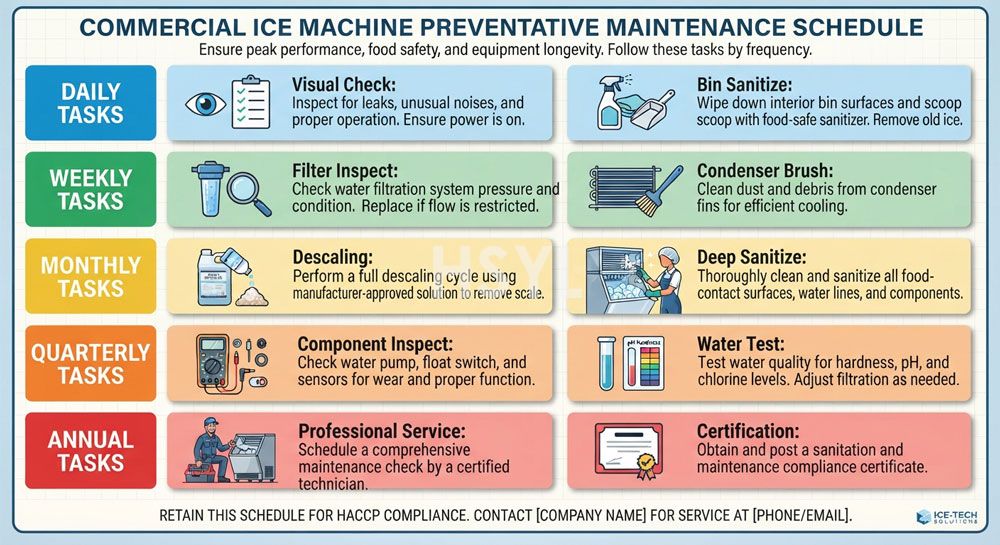
Combining all maintenance tasks into a coherent schedule ensures no task is overlooked and enables efficient batching of related activities. The following schedule represents the recommended maintenance frequency for commercial ice machines in typical food service installations. Adjust frequencies based on your specific water quality, usage intensity, and environmental conditions:
| Frequency | Maintenance Tasks | Estimated Time | Responsible Party |
|---|---|---|---|
| Daily | Visual inspection of ice production volume and quality; sanitize ice scoop and utensils; check bin cleanliness; verify machine is level and stable on mounting surface | 5–10 minutes | Assigned staff member (line cook, bar back, or kitchen supervisor) |
| Weekly | Empty and sanitize ice storage bin; inspect water filter pressure gauge (if equipped); check for unusual noise or vibration during operation; clean exterior surfaces with food-safe sanitizer | 20–30 minutes | Kitchen supervisor or designated cleaning shift |
| Monthly | Clean air-cooled condenser (kitchen installations); inspect water distribution system for scale or biofilm; check water supply line for leaks; verify proper bin door operation; inspect power cord and plug condition | 30–45 minutes | Trained maintenance staff or kitchen supervisor |
| Quarterly | Replace sediment pre-filter; descale evaporator and water system (hard water installations); perform complete sanitizing cycle; inspect and clean condenser (clean environment installations); document maintenance in service log | 1–2 hours | Maintenance technician or qualified in-house staff |
| Semi-Annually | Replace activated carbon filter and scale inhibitor cartridge; descale evaporator (moderate hardness water); complete component inspection per service manual; verify refrigerant charge through operational parameters (without connecting manifold gauges unless leakage suspected); inspect door gaskets and harvest mechanism | 2–3 hours | External service technician or qualified in-house maintenance |
| Annually | Professional preventive maintenance service; complete refrigerant system inspection; inspect and replace worn wear items (water valves, harvest solenoids as preventive replacement); water quality re-test; update maintenance log and review for trend analysis | 3–5 hours | Manufacturer-certified service partner |
8. Common Ice Machine Failure Modes and Their Maintenance Origins
Understanding the most common ice machine failure modes and their root causes helps diagnose emerging issues before they become production-stopping failures. The following table connects observed symptoms to the maintenance neglect that typically produces them:
| Observed Symptom | Likely Root Cause | Maintenance Response | Prevention Schedule |
|---|---|---|---|
| Reduced ice production volume (machine produces less ice than rated capacity) | Scale accumulation on evaporator plate reducing heat transfer efficiency; clogged water filter restricting water flow; dirty condenser elevating head pressure; worn water valve not filling reservoir completely | Descale evaporator; replace filter cartridges; clean condenser; inspect and replace water valve if defective | Quarterly descaling; semi-annual filter replacement; monthly condenser cleaning |
| Cloudy or milky ice cubes | High TDS water; exhausted carbon filter allowing chlorine and contaminants to pass; air in water distribution system; scale deposits disrupting water flow over evaporator | Test water quality; replace carbon filter; inspect water distribution system for blockages; descale if deposits visible | Semi-annual filter replacement; annual water quality test |
| Ice with off-taste or odor | Exhausted carbon filter not removing chlorine; biofilm or mold contamination in water system; sanitizing overdue; stored ice absorbing odors from nearby food in bin | Replace carbon filter; perform complete sanitizing cycle; verify bin is not used for temporary food storage; improve kitchen ventilation if ambient odors severe | Semi-annual filter replacement; weekly bin sanitizing; complete sanitizing every 3-6 months |
| Machine produces ice but does not harvest (ice sticks to evaporator) | Scale on evaporator preventing clean ice release during harvest; worn harvest solenoid or hot gas valve not delivering defrost heat; low refrigerant charge; defective thickness sensor | Descale evaporator; test and replace harvest solenoid or hot gas valve if defective; check refrigerant charge through operational parameters; test thickness sensor per service manual | Quarterly descaling; annual component inspection including harvest mechanism |
| Water leaking from machine | Damaged or aged water supply line; loose fitting at water valve connection; cracked water sump; overflowing reservoir due to misadjusted water level; clogged drain causing water backup | Inspect water supply line and replace if aged; tighten or replace fittings; inspect and repair water sump; adjust water level per service manual; clear drain blockage | Monthly inspection of water lines and fittings; annual sump and drain inspection |
| Unusual noise during operation | Fan motor bearing wear; compressor mount vibration; loose access panel; debris contacting fan blade; worn water pump bearing | Inspect fan motor and replace if bearing noise; tighten compressor mounts; secure access panels; clear debris from fan area; inspect and replace water pump if defective | Monthly noise and vibration check during operation; annual component inspection |
| Ice machine trips electrical breaker repeatedly | Compressor electrical fault; condenser fan motor short circuit; water ingress into electrical component; degraded wiring insulation; circuit overload from additional equipment on same circuit | Disconnect power immediately; do not reset breaker repeatedly; contact qualified service technician for electrical diagnosis and repair | Annual electrical system inspection; verify dedicated circuit per installation requirements |
9. When to Call Professional Service
While routine maintenance tasks can be performed by trained in-house staff, certain maintenance and diagnostic activities require professional service technicians with appropriate tools, refrigerant handling certification, and manufacturer-specific training. Recognizing when to call professional service prevents minor issues from becoming major failures and prevents unqualified intervention from causing additional damage.
Tasks Requiring Professional Service
- Refrigerant system service: Any task involving refrigerant recovery, recharge, or leak repair requires EPA certification (in the United States) or equivalent regulatory certification in other jurisdictions. Connecting manifold gauges to check refrigerant pressure should also be reserved for professional service — each gauge connection risks refrigerant loss and system contamination.
- Compressor diagnosis or replacement: Compressor failures require professional diagnosis to determine whether the failure is the compressor itself or an external cause (electrical fault, refrigerant leak, system contamination) that would damage a replacement compressor if not addressed first.
- Warranty-covered service: Attempting DIY repair on equipment under warranty often voids the warranty coverage. Always use manufacturer-authorized service for warranty repairs to preserve coverage benefits.
- Electrical component diagnosis beyond basic inspection: While visual inspection of wiring and connections is appropriate for in-house staff, diagnosis of electrical faults involving component testing, voltage measurement, or circuit analysis requires qualified electrical service personnel.
- Annual preventive maintenance: The annual service should be performed by a manufacturer-certified technician who can identify wear items before failure, verify refrigerant system integrity, and document service for warranty and food safety audit purposes.
Building a Service Relationship
Establish a relationship with a qualified service provider before emergency service is needed. A service provider familiar with your equipment, location, and operational pattern responds faster and diagnoses more accurately during emergency calls than a provider meeting your equipment for the first time during a failure event. Schedule annual preventive maintenance with the same provider to build this familiarity, and maintain service records documenting all maintenance activities for warranty and audit purposes.
10. Maintenance Records and Audit Trail
Maintaining comprehensive maintenance records is not optional for commercial food service operations — it is a regulatory requirement in most jurisdictions and a practical necessity for warranty preservation, audit compliance, and trend analysis. A complete maintenance record should include:
| Record Element | Purpose | Retention Period |
|---|---|---|
| Maintenance schedule document | Defines the planned maintenance frequency and assigned responsibilities for each task | Current version plus previous version |
| Completed maintenance logs | Records actual completion of each scheduled task with date, technician initials, and notes on observed conditions | Minimum 3 years; 7 years recommended for audit compliance |
| Water test results | Documents incoming water quality and justifies maintenance frequency calibration | Most recent 3 test results minimum |
| Filter replacement records | Verifies filter replacement discipline for food safety audit and warranty purposes | Minimum 3 years |
| Professional service reports | Documents annual preventive maintenance and any corrective service for warranty and audit compliance | Equipment lifetime plus 3 years |
| Parts replacement records | Tracks component replacement history supporting trend analysis and future service planning | Equipment lifetime |
For HSYL ice machine customers seeking coordinated equipment specification and ongoing maintenance planning, the commercial kitchen equipment portfolio overview provides context for how ice machine maintenance integrates with broader kitchen equipment care programs. Maintaining consistent maintenance discipline across all refrigeration and food preparation equipment reduces overall maintenance burden through shared scheduling, common spare parts inventory, and unified service relationships.
Related Equipment and Resources
The following equipment categories and planning resources connect directly to commercial ice machine selection and maintenance:
- SD Square Ice Series Upright Ice Makers — HSYL's compact ice maker lineup covering 15 to 70 kilograms daily production. These under-counter machines are commonly installed in cafes, small restaurants, and bar stations where space-efficient ice production with manageable maintenance requirements is essential.
- SD-3000 / SD-4000 Commercial Cube Ice Makers — Higher capacity floor-standing ice makers producing 1,360 to 1,800 kilograms per day for large restaurants, hotels, hospitals, and supermarket applications. These machines require the maintenance discipline described in this guide scaled to their larger water throughput and longer daily operating hours.
- How to Choose Commercial Kitchen Equipment for Central Kitchens — Equipment selection methodology including capacity calculation, vendor evaluation, and maintenance planning applicable to central kitchen facilities managing multiple ice machines and other refrigeration equipment across distributed service points.
- Commercial Kitchen and Food Processing Solutions Overview — Integrated equipment solutions covering ice production, refrigeration, cooking, and food preparation equipment with coordinated maintenance planning support across the complete kitchen equipment ecosystem.
Frequently Asked Questions
How often should I descale my commercial ice machine?
What type of water filter does my commercial ice machine need?
Can I use regular bleach to sanitize my ice machine?
Why does my ice machine produce less ice than it used to?
How do I know if my ice machine has scale buildup?
What is the difference between cleaning and sanitizing an ice machine?
How often should I replace my ice machine water filter?
Can I clean my ice machine condenser myself or do I need a technician?
What water test should I perform for my ice machine maintenance planning?
How long should a commercial ice machine last with proper maintenance?
Related Articles


Get professional consultation
Do you have any questions or need technical support regarding the content of this article? Fill out the form below, and our expert team will provide you with professional solutions.