Stainless steel is the default material for commercial kitchen equipment, but not all stainless steel is equivalent. A steam cabinet fabricated from grade 304 will deliver 12 to 15 years of reliable service under typical commercial kitchen conditions. The same cabinet fabricated from grade 201 may show surface rust within 18 months, develop pinhole corrosion through the inner liner within 4 years, and require complete replacement by year 6 — while costing only 15 to 25 percent less at initial purchase. The grade selection decision affects equipment lifespan, food safety compliance, maintenance burden, and total cost of ownership more than virtually any other specification choice.
This guide covers the four stainless steel grades most commonly encountered in commercial kitchen equipment specification — SUS304, SUS316, SUS201, and SUS430 — explaining their metallurgical differences, performance characteristics, appropriate applications, and warning signs of improper grade substitution. The framework applies to cooking equipment, refrigeration, preparation tables, sinks, shelving, hand trucks, and any other stainless steel equipment specified for commercial food service operations.
1. Understand Why Stainless Steel Resists Corrosion (And When It Does Not)
Stainless steel is not a single material but a family of iron-based alloys containing minimum 10.5 percent chromium. The chromium content is what makes stainless steel stainless — chromium reacts with oxygen in the environment to form a passive chromium oxide layer on the surface that prevents further oxidation. This passive layer is self-healing when scratched or damaged, provided sufficient oxygen is available to reform the protective oxide.
The passive layer's effectiveness depends on alloy composition. Chromium alone provides basic corrosion resistance but is vulnerable to chloride attack. Nickel added to the alloy stabilizes the austenitic crystal structure and enhances corrosion resistance across a broader range of environments. Molybdenum further improves resistance to pitting corrosion specifically caused by chloride ions. Manganese can substitute for some nickel content to reduce cost but with measurable performance trade-offs.
| Alloying Element | Primary Function in Stainless Steel | Impact on Kitchen Equipment Performance |
|---|---|---|
| Chromium (Cr) | Forms passive oxide layer providing basic corrosion resistance | Higher chromium content improves general corrosion resistance and passive layer stability. Minimum 18% required for food-contact grades. |
| Nickel (Ni) | Stabilizes austenitic crystal structure, enhances corrosion resistance and formability | Higher nickel content improves weldability, deep drawing capability, and resistance to acidic food environments. Nickel content is the primary cost driver in stainless steel pricing. |
| Molybdenum (Mo) | Specifically enhances resistance to pitting and crevice corrosion from chloride exposure | Critical for equipment exposed to salt water, brine solutions, marine environments, or chloride-containing cleaning chemicals. Even small additions (2-3%) dramatically improve pitting resistance. |
| Manganese (Mn) | Partial substitute for nickel to reduce cost, also improves work hardening | Used in 200-series alloys to lower cost. Reduces corrosion resistance compared to equivalent nickel-stabilized grades. Can cause magnetic properties in austenitic alloys. |
| Carbon (C) | Increases strength and hardness but reduces corrosion resistance through chromium carbide precipitation | Low carbon variants (designated with L suffix, e.g., 304L) preferred for welded applications to prevent sensitization and intergranular corrosion at welds. |
Corrosion Reality: Stainless steel is not stain-proof steel — it stains less than carbon steel. All stainless steel grades will corrode under specific environmental conditions. The question is not whether corrosion will occur but how rapidly and under what exposure conditions. Selecting a grade appropriate for your specific kitchen environment prevents premature failure. Selecting an inadequate grade to save capital cost guarantees accelerated corrosion and premature equipment replacement.
2. The Four Common Grades: Composition and Characteristics
Commercial kitchen equipment is fabricated primarily from four stainless steel grades. Each grade occupies a specific position in the cost-versus-performance spectrum, and understanding the trade-offs enables informed specification decisions.
SUS304 (AISI 304, 18/8 Stainless) — The Food Service Standard
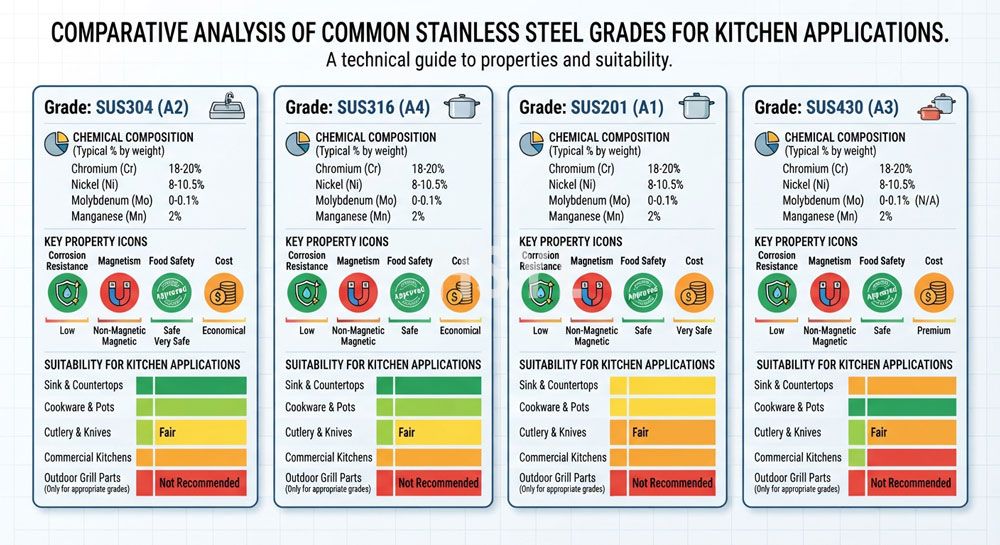
SUS304 is the dominant grade in commercial kitchen equipment, representing approximately 70 to 80 percent of all stainless steel used in food service fabrication globally. The designation "18/8" refers to its composition: approximately 18 percent chromium and 8 percent nickel. This composition provides excellent general corrosion resistance, good formability for complex fabrication, excellent weldability, and well-understood food safety compliance.
- Composition: 18-20% chromium, 8-10.5% nickel, maximum 2% manganese, maximum 0.08% carbon (0.03% for 304L low-carbon variant)
- Corrosion resistance: Excellent in most food service environments including exposure to mild acids (fruit juices, vinegar), alkalis (cleaning solutions), and moderate chloride exposure
- Magnetism: Non-magnetic in annealed condition. May become slightly magnetic after cold working (bending, forming)
- Food safety: Approved by FDA, EFSA, and equivalent regulatory bodies for food contact applications. Widely specified in HACCP-compliant facility designs.
- Cost: Baseline reference point — other grades compared against SUS304 cost
- Typical applications: Cooking range bodies, steamer cabinets, preparation tables, sinks, shelving, refrigeration interiors, hood systems, general food contact surfaces
SUS316 (AISI 316, Marine Grade) — For Aggressive Environments
SUS316 adds 2 to 3 percent molybdenum to the SUS304 composition, significantly improving resistance to pitting corrosion caused by chloride exposure. The grade is often called marine grade due to its common use in coastal and marine applications where salt spray and saltwater exposure would rapidly degrade SUS304.
- Composition: 16-18.5% chromium, 10-14% nickel, 2-3% molybdenum, maximum 2% manganese, maximum 0.08% carbon (0.03% for 316L)
- Corrosion resistance: Superior to SUS304 in chloride environments. Essential for equipment exposed to saltwater, brine solutions used in fish processing, marine atmosphere, or aggressive chloride-containing sanitizers
- Magnetism: Non-magnetic in annealed condition, similar to SUS304
- Food safety: Full food contact approval with enhanced performance in salt-rich food applications including seafood processing, brined meat production, and soy sauce manufacturing
- Cost: Approximately 1.4 to 1.7 times SUS304 cost due to higher nickel and molybdenum content
- Typical applications: Seafood processing equipment, brining tanks, coastal kitchen installations, equipment cleaned with chloride-based sanitizers, medical and pharmaceutical food preparation where maximum corrosion resistance is required
SUS201 (AISI 201, Low-Nickel Austenitic) — The Economy Alternative
SUS201 was developed during periods of high nickel prices as a lower-cost alternative to SUS304. The alloy substitutes manganese and nitrogen for a portion of the nickel content, reducing raw material cost while maintaining the austenitic crystal structure. The performance trade-offs are significant and must be understood before specifying SUS201 for any commercial kitchen application.
- Composition: 16-18% chromium, 3.5-5.5% nickel, 5.5-7.5% manganese, maximum 0.15% carbon, nitrogen added for austenite stabilization
- Corrosion resistance: Lower than SUS304 across all exposure conditions. Particularly vulnerable to pitting corrosion in chloride environments and stress corrosion cracking in humid conditions
- Magnetism: Generally non-magnetic but may exhibit more magnetic response than SUS304 due to manganese-induced ferrite formation
- Food safety: Approved for food contact in most jurisdictions but with performance caveats — not recommended for prolonged contact with acidic foods or chloride-rich environments
- Cost: Approximately 0.65 to 0.80 times SUS304 cost, making it attractive for cost-sensitive projects
- Typical applications: Equipment exterior panels where food contact does not occur, structural components in dry environments, equipment destined for markets where purchase price is the dominant decision factor. Should not be specified for food contact surfaces, wet environments, or equipment expected to achieve full service life
SUS430 (AISI 430, Ferritic) — For Non-Contact Applications
SUS430 is a ferritic stainless steel containing chromium but no nickel. The absence of nickel reduces cost but also limits corrosion resistance, formability, and weldability compared to austenitic grades. The grade is magnetic — a useful identification feature distinguishing it from austenitic grades.
- Composition: 16-18% chromium, maximum 0.5% nickel, maximum 1% manganese, maximum 0.12% carbon
- Corrosion resistance: Lower than SUS304 but adequate for dry indoor environments. Vulnerable to staining and pitting in humid or chloride environments
- Magnetism: Magnetic — will attract a permanent magnet strongly
- Food safety: Approved for food contact but not recommended for prolonged contact with acidic or saline foods
- Cost: Approximately 0.55 to 0.70 times SUS304 cost
- Typical applications: Equipment decorative panels, range hoods exterior panels, splash backs in dry areas, budget equipment destined for light-duty residential or low-volume commercial use. Not appropriate for food contact surfaces, sinks, wet preparation zones, or equipment requiring fabrication involving deep drawing or complex welding
3. Performance Comparison Matrix for Kitchen Applications
Translating metallurgical specifications into practical kitchen equipment selection requires comparing grades across the performance dimensions that matter operationally. The following matrix summarizes relative performance across seven critical factors:
| Performance Factor | SUS316 | SUS304 | SUS201 | SUS430 |
|---|---|---|---|---|
| General corrosion resistance | Excellent | Very Good | Moderate | Moderate |
| Chloride pitting resistance | Excellent | Moderate | Poor | Poor |
| Acidic food contact suitability | Excellent | Very Good | Moderate | Fair |
| Weldability | Excellent | Excellent | Good | Fair |
| Formability (deep drawing) | Excellent | Excellent | Good | Poor |
| Magnetism | Non-magnetic | Non-magnetic | Mostly non-magnetic | Magnetic |
| Relative cost (vs SUS304 = 1.0) | 1.4-1.7 | 1.0 | 0.65-0.80 | 0.55-0.70 |
| Typical service life in commercial kitchen | 15-20 years | 10-15 years | 4-7 years | 3-6 years |
Total Cost Reality: When initial capital cost is amortized over actual equipment service life, the apparent cost savings of lower grades often disappear or reverse. A SUS304 cabinet costing $3,000 and lasting 12 years has annual ownership cost of $250. A SUS201 cabinet costing $2,400 (20% less) but requiring replacement after 6 years has annual ownership cost of $400 — 60 percent higher despite lower initial investment. Add maintenance burden (rust treatment, premature component replacement, food safety audit risk) and the total cost of ownership gap widens further.
4. Match Grade to Kitchen Zone and Equipment Function
Within a single commercial kitchen, different zones and equipment types experience dramatically different exposure conditions. Optimal material specification matches grade selection to the specific exposure environment of each equipment category rather than applying a single grade uniformly across all equipment.
Wet Preparation Zone (Sinks, Prep Tables with Water Contact)
Wet preparation zones experience constant water exposure, frequent contact with food acids and salts, and regular cleaning with potentially chloride-containing sanitizers. These conditions represent the most aggressive corrosion environment in most commercial kitchens.
- Recommended grade: SUS304 minimum. SUS316 justified for seafood preparation areas with sustained brine exposure.
- Critical surfaces: Sink bowls, drain boards, preparation table tops, splash zones behind sinks
- Common failure mode if underspecified: Pitting corrosion at welds and crevices within 2-4 years, rust staining requiring replacement, food safety audit findings for corroded food-contact surfaces
Main Cooking Zone (Ranges, Steamers, Ovens, Griddles)
Cooking equipment experiences thermal cycling, food spills, grease accumulation, and exposure to cleaning chemicals. The combination of heat, moisture, and food acids creates demanding but manageable conditions for appropriate grades.
- Recommended grade: SUS304 for food-contact components (cooking chambers, griddle plates, steam cabinet interiors). SUS201 acceptable for exterior panels in dry-adjacent areas. SUS430 acceptable for decorative trim and panels not subject to moisture exposure.
- Critical surfaces: Cooking chamber interiors, food contact grates, steam distribution components, drip trays, grease collection surfaces
- Common failure mode if underspecified: Internal corrosion of steam cabinets, rust-through on griddle undersides, weld failure at high-stress joints
Refrigeration and Cold Storage Zone
Refrigeration interiors experience condensation cycles, exposure to food products at varying temperatures, and cleaning with cold-temperature sanitizers that may have different chemical behavior than at room temperature.
- Recommended grade: SUS304 for interior shelving, door liners, and food contact surfaces. SUS201 acceptable for exterior panels if kept dry. Magnetic door gaskets compatible with both austenitic and ferritic grades.
- Critical surfaces: Interior shelves, door liners, evaporator covers, drain pans
- Common failure mode if underspecified: Condensation-induced corrosion on interior surfaces, food contamination from rust deposits, premature shelf failure under load
Dry Storage and Display Zone
Dry storage shelving and display equipment experience minimal moisture exposure but may encounter food contact, cleaning chemicals, and aesthetic requirements for visible surfaces.
- Recommended grade: SUS304 for premium installations and food-contact shelving. SUS201 acceptable for dry storage shelving in budget projects. SUS430 acceptable for decorative display panels where appearance matters more than corrosion resistance.
- Critical surfaces: Food contact shelving, display case interiors visible to customers
- Common failure mode if underspecified: Surface staining from spills, edge corrosion at cut edges, aesthetic degradation in customer-visible areas
Dishwashing and Sanitation Zone
Dishwashing areas combine high temperature, sustained moisture, detergents, sanitizers, and food residue — the most aggressive combination of corrosion factors in most commercial kitchens.
- Recommended grade: SUS316 preferred for sustained chloride sanitizer exposure. SUS304 minimum acceptable for general dishwashing equipment. SUS201 and SUS430 not recommended for any dishwashing zone application.
- Critical surfaces: Dish table surfaces, sink basins, splash walls, dishwasher interior panels, chemical dispenser housings
- Common failure mode if underspecified: Rapid pitting corrosion from chlorine sanitizers, weld failure at sink-table joints, rust-through within 2-3 years requiring complete replacement
5. Equipment-Specific Grade Recommendations
Translating zone-level guidance into specific equipment specifications requires understanding which components of each equipment type demand food-grade material and which can tolerate economy grades without compromising function or safety.
| Equipment Category | Food-Contact Components (Grade) | Structural Components (Grade) | Exterior/Decorative (Grade) | Notes |
|---|---|---|---|---|
| Steamer Cabinet | SUS304 (cooking chamber, trays, steam distribution) | SUS304 (body frame, door) | SUS201 acceptable (side panels only) | Internal steam environment demands austenitic grade throughout wetted components |
| Cooking Range | SUS304 (cooktop, griddle plate, oven interior) | SUS304 (frame, body) | SUS201 or SUS430 (side panels, control panel trim) | Heat exposure accelerates corrosion of underspecified grades |
| Preparation Table | SUS304 (work surface, backsplash) | SUS304 (undershelf supports, legs) | SUS201 acceptable (undershelf if dry) | Work surface must be SUS304 for food safety compliance |
| Sink Unit | SUS304 (bowls, drainboards) | SUS304 (legs, framework) | SUS304 (backsplash) | No economy grade acceptable for any sink component |
| Refrigeration | SUS304 (interior shelves, door liners) | SUS201 acceptable (cabinet exterior if dry) | SUS430 acceptable (decorative trim) | Interior condensation makes economy grades unsuitable for interior use |
| Dishwashing Table | SUS316 preferred (table surface, splash) | SUS304 minimum (frame, legs) | SUS304 (visible panels) | Chloride sanitizer exposure justifies SUS316 upgrade |
| Wall Shelving (Dry) | SUS304 (food contact shelves) | SUS201 acceptable (wall brackets) | SUS201 acceptable (shelf surfaces if dry) | Dry environment allows cost savings on non-food-contact components |
| Hand Truck / Cart | SUS304 (food contact surfaces) | SUS304 (frame, handles) | SUS201 acceptable (non-contact panels) | Mobile equipment subject to physical damage requiring durable grade |
6. Material Certification and Verification
Specifying a stainless steel grade on a purchase order does not guarantee that the delivered equipment matches the specification. Material substitution — whether intentional cost reduction or unintentional supply chain confusion — represents a significant risk in commercial kitchen equipment procurement. Verification requires understanding the certification documents and inspection methods available.
Material Test Reports (MTR)
A Material Test Report, also called Mill Test Certificate or Certificate of Origin, documents the chemical composition and mechanical properties of a specific heat (batch) of stainless steel. Reputable equipment manufacturers can provide MTRs for the material used in fabrication. The MTR should show:
- Heat number: Unique identifier allowing traceability back to the original steel mill production batch
- Chemical composition: Actual measured percentages of chromium, nickel, molybdenum, manganese, carbon, and other elements compared to specification tolerances
- Mechanical properties: Tensile strength, yield strength, elongation, hardness
- Specification reference: Applicable ASTM, EN, JIS, or GB standard designation
- Mill identification: Name and location of producing steel mill
Positive Material Identification (PMI)
For critical applications or when material identity is in question, Positive Material Identification uses handheld X-ray fluorescence (XRF) analyzers to verify alloy composition non-destructively. The instrument measures elemental composition at the surface within seconds, providing verification that delivered material matches specified grade. PMI testing costs $200 to $600 per equipment batch when performed by independent testing services — modest compared to the cost of discovering material substitution after installation.
Magnet Test — Quick but Limited
A simple magnet test provides rough differentiation between austenitic grades (SUS304, SUS316, SUS201 — generally non-magnetic) and ferritic grades (SUS430 — magnetic). However, the magnet test has important limitations:
- Cold-worked austenitic grades may become slightly magnetic, particularly at bends, welds, and formed areas
- SUS201 with high manganese content may exhibit more magnetic response than SUS304
- The magnet test cannot distinguish between SUS304 and SUS316 (both non-magnetic austenitic)
- The magnet test cannot distinguish between SUS304 and SUS201 (both generally non-magnetic austenitic)
Use the magnet test as a quick screening tool for obvious ferritic substitution but do not rely on it for definitive grade verification. Chemical verification through MTR or PMI is required for confident material confirmation.
Procurement Specification Note: When issuing purchase orders for commercial kitchen equipment, specify material grade explicitly including applicable standard designation (e.g., "SUS304 per JIS G4305" or "Type 304 per ASTM A240"). Require MTR submission as part of delivery documentation for equipment above a threshold value (typically $5,000 or above). For high-value installations, consider third-party PMI verification before accepting delivery. The cost of verification is small compared to the cost of post-installation discovery that specified material was substituted with inferior grade.
7. Surface Finish and Its Effect on Corrosion Performance
Beyond grade selection, surface finish affects both appearance and corrosion performance. Rougher finishes trap contaminants more readily and provide initiation sites for corrosion. Smoother finishes are easier to clean and more corrosion-resistant but show scratches more visibly and cost more to produce.
| Finish Designation | Description | Typical Application | Corrosion Performance |
|---|---|---|---|
| 2B (Mill Finish) | Cold rolled, annealed, pickled, skin-passed. Smooth but dull gray appearance. | Hidden components, interior surfaces not visible to users | Good — smooth enough to resist contamination, economical to produce |
| 4 (Brushed) | Mechanically polished with abrasive belt producing uniform linear brush lines. Most common commercial kitchen finish. | Visible exterior surfaces, food contact surfaces, general equipment | Very Good — smooth surface easy to clean, brush lines provide consistent appearance that masks minor scratches |
| 8 (Mirror) | Polished to mirror-like reflective finish using progressively finer abrasives | Display equipment, decorative panels, customer-visible premium surfaces | Excellent corrosion resistance but scratches become very visible, requires regular polishing maintenance |
| BA (Bright Annealed) | Annealed in protective atmosphere producing bright reflective surface without mechanical polishing | Decorative panels, equipment requiring uniform bright appearance | Excellent — smooth bright surface with good corrosion resistance |
| HL (Hairline) | Continuous polishing producing fine linear pattern, similar to but finer than No. 4 finish | Premium equipment exteriors, architectural panels | Very Good — appearance more consistent than No. 4, easier to maintain than mirror finish |
For commercial kitchen equipment food-contact surfaces, No. 4 brushed finish represents the optimal balance of cleanability, durability, appearance, and cost. Mirror finishes (No. 8) are appropriate for display and decorative surfaces but are impractical for food-contact surfaces due to scratch visibility. Mill finish (2B) is acceptable for hidden components but should not be used for food-contact surfaces where cleanability matters.
8. Common Substitution and Misrepresentation Risks
Material substitution is a persistent problem in commercial kitchen equipment supply chains. Understanding common substitution patterns helps procurement teams identify suspicious quotations and verify material claims before commitment.
Substitution Pattern 1: SUS201 Substituted for SUS304
The most common substitution. SUS201 costs 20 to 35 percent less than SUS304 and is visually indistinguishable without testing. Suppliers seeking to win price-competitive bids may substitute SUS201 for SUS304 in non-food-contact components or even in food-contact components if they believe the buyer will not verify material.
Identification approach: MTR verification, PMI testing for high-value purchases, performance observation over time (SUS201 will show surface staining and pitting within 12-24 months in wet environments where SUS304 would remain pristine).
Substitution Pattern 2: SUS430 Substituted for SUS304
Less common in food-contact applications because SUS430 is magnetic and easily identified by buyers, but still encountered in decorative panels and exterior trim where the substitution may go unnoticed until corrosion appears.
Identification approach: Magnet test identifies ferritic SUS430 from austenitic SUS304 quickly and inexpensively. Verify magnet response on all specified austenitic surfaces during acceptance inspection.
Substitution Pattern 3: Mixed-Grade Fabrication
Some fabricators use SUS304 for visible food-contact surfaces (where buyers inspect) and SUS201 for hidden structural components (where buyers do not inspect). The visible surfaces test correctly as SUS304, but hidden components corrode prematurely. This substitution pattern is particularly difficult to detect without disassembly.
Identification approach: Require complete material specification covering all components including hidden structural parts. Specify that hidden components must meet same grade as food-contact components for wet-zone equipment. PMI testing on accessible surfaces of hidden components during manufacturing or acceptance.
Substitution Pattern 4: Misrepresented Thickness
Steel thickness directly affects equipment durability and cost. Substandard fabricators may use thinner gauge material than specified, particularly for hidden panels and structural components. The material may be the correct grade but undersized for the structural application.
Identification approach: Verify material thickness using calipers or ultrasonic thickness gauge at multiple locations on delivered equipment. Compare to specified thickness. Under-gauge material compromises structural integrity and dent resistance even when grade is correct.
Risk Mitigation: The single most effective defense against material substitution is purchasing from reputable manufacturers with established quality systems and traceable supply chains. Established manufacturers maintain MTR documentation for all material lots, perform incoming material verification, and stand behind their material specifications with warranty coverage. The lowest-cost supplier quotation often reflects material substitution rather than legitimate cost advantage. When quotations differ by more than 20 to 25 percent for apparently equivalent equipment, treat the low quotation with suspicion and require material verification before commitment.
9. Long-Term Cost Perspective: Total Cost of Ownership
The decision to specify SUS304 versus lower-cost alternatives should be evaluated on total cost of ownership over the expected equipment service life rather than initial purchase price alone. Total cost of ownership includes initial capital, maintenance burden, food safety risk, premature replacement cost, and disposal cost at end of life.
| Cost Component | SUS316 Equipment | SUS304 Equipment | SUS201 Equipment | SUS430 Equipment |
|---|---|---|---|---|
| Initial capital (relative) | 1.4-1.7x | 1.0x (baseline) | 0.65-0.80x | 0.55-0.70x |
| Annual maintenance cost | Very Low | Low | Moderate-High | High |
| Expected service life | 15-20 years | 10-15 years | 4-7 years | 3-6 years |
| Replacement cycles in 15 years | 0 | 0-1 | 2-3 | 2-4 |
| 15-year total ownership cost | 1.4-1.7x | 1.0-1.3x | 1.8-2.5x | 1.6-2.4x |
| Food safety audit risk | Very Low | Low | Moderate | Moderate-High |
The cost comparison reveals that SUS304 typically delivers the lowest 15-year total ownership cost for commercial kitchen equipment in typical food service environments. SUS316 justifies its premium only in chloride-rich environments (seafood processing, coastal installations, chloride sanitizer exposure). SUS201 and SUS430 deliver apparent initial savings that translate into higher long-term costs through premature replacement and maintenance burden.
10. Maintenance Considerations Affecting Grade Selection
Even corrosion-resistant stainless steel requires appropriate maintenance to perform as specified. Grade selection should account for the maintenance regime the equipment will actually receive, not the maintenance regime that should theoretically be performed. Equipment in facilities with disciplined cleaning programs can use grades optimized for corrosion resistance. Equipment in facilities with inconsistent maintenance benefits from grades with greater corrosion margin to absorb neglect.
Recommended Maintenance for All Grades
- Daily cleaning: Wipe food contact surfaces with food-safe sanitizer after each use. Remove food residue promptly to prevent acidic or saline contact damage.
- Weekly deep clean: Use non-abrasive stainless steel cleaner on visible surfaces. Avoid chloride-containing cleaners (bleach-based products) on austenitic grades to prevent pitting initiation.
- Monthly inspection: Check for early corrosion signs — surface staining, rust spots at welds, pitting initiation. Address immediately to prevent progression.
- Annual professional cleaning: Deep clean including removal of scale deposits, treatment of minor corrosion, polishing of visible surfaces to maintain passive layer.
Grade-Specific Maintenance Concerns
SUS201 and SUS430 require more aggressive maintenance discipline than SUS304 and SUS316 to achieve even their reduced service life expectations. Facilities without disciplined maintenance programs should not specify these grades regardless of initial cost pressure — the equipment will fail even faster than expected under neglected conditions. Facilities with strong maintenance programs can achieve reasonable service from SUS304 and SUS316 equipment with the standard maintenance regime described above.
For facility-wide equipment planning including grade specification across multiple equipment categories, HSYL's commercial kitchen and food processing equipment solutions overview provides coordinated specification guidance ensuring consistent material quality across the complete equipment installation.
Related Equipment and Specification Resources
The following equipment categories and specification resources connect directly to stainless steel grade selection decisions:
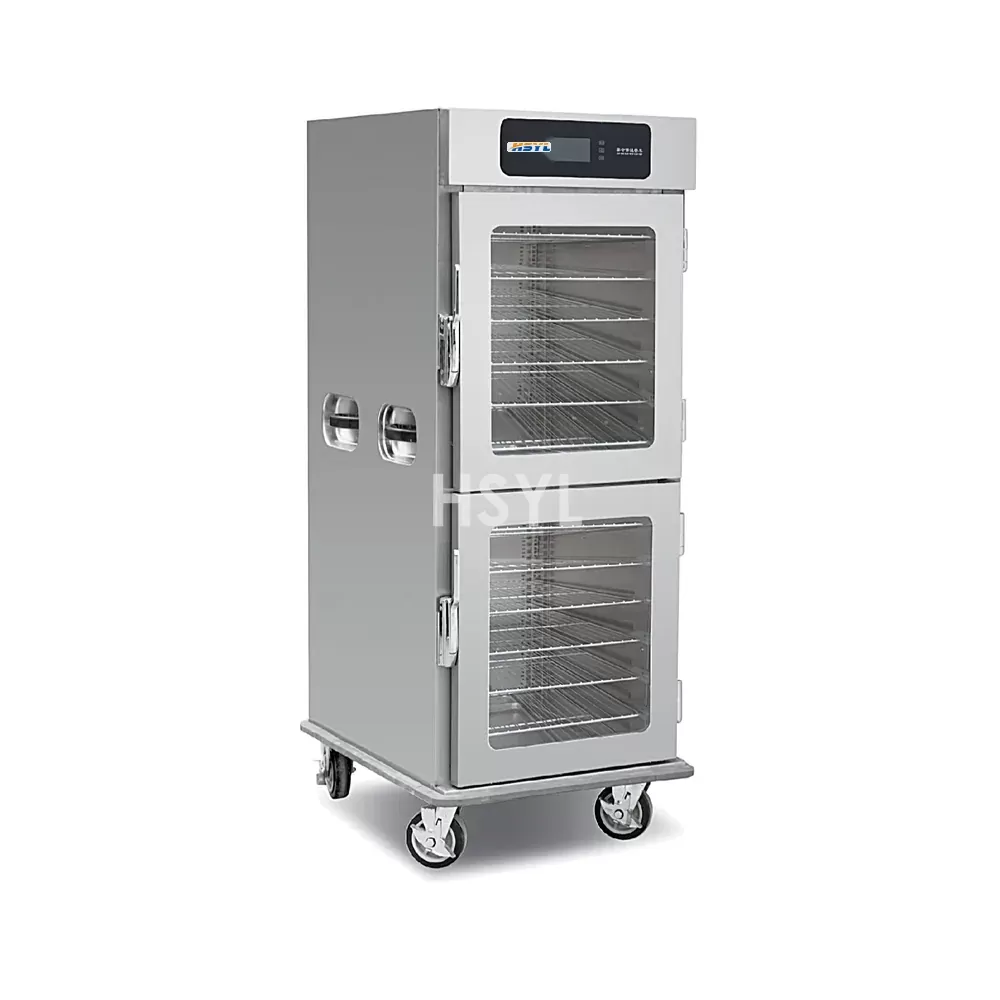
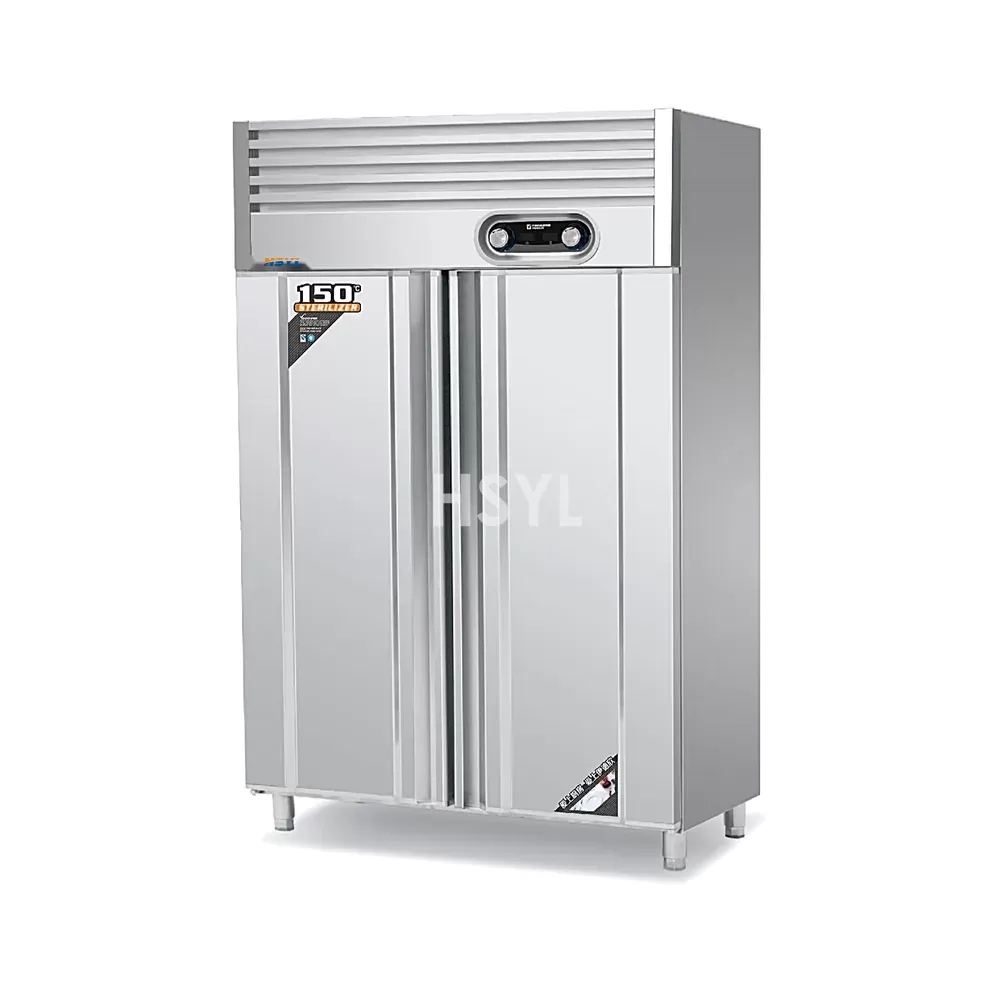
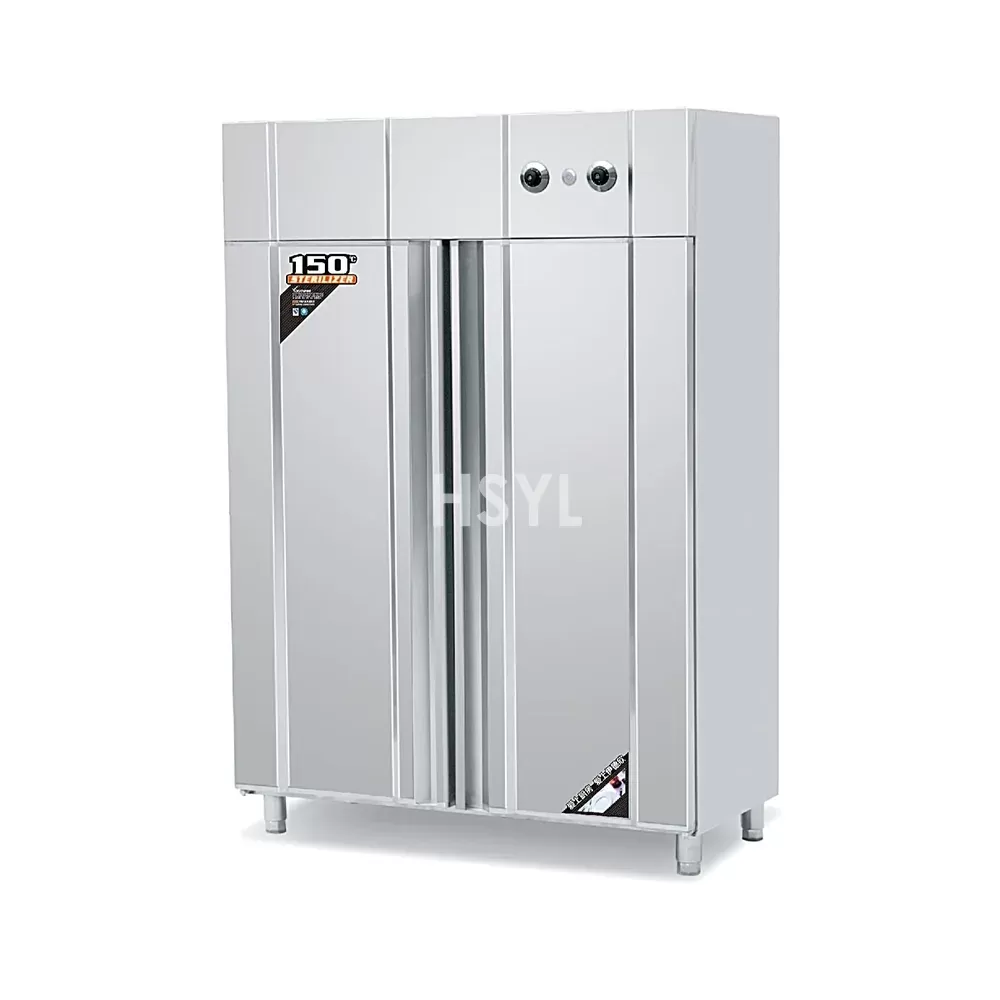
- Automatic Steamer Cabinets — Steam cooking equipment where internal chamber material grade directly affects equipment life under sustained steam exposure. SUS304 construction throughout food-contact and steam-contact components is essential for achieving expected service life.
- Engineering Automatic Steamer Cabinets — Heavy-duty steam cooking equipment designed for industrial applications requiring robust construction. Engineering-grade equipment typically specifies full SUS304 construction including structural components that lighter commercial equipment might fabricate from economy grades.
- How to Choose Commercial Kitchen Equipment for Central Kitchens — Equipment selection methodology including material specification, vendor evaluation, and total cost of ownership analysis applicable to central kitchen facilities specifying multiple equipment categories simultaneously.
- Food Factory Engineering Layout and Cost Guide — Facility-level planning resource addressing material specification, equipment selection criteria, and capital budgeting considerations for food processing facility development including stainless steel grade specification across equipment categories.
Frequently Asked Questions
What is the difference between SUS304 and SUS316 stainless steel for commercial kitchen equipment?
Can SUS201 stainless steel be used for food contact surfaces in commercial kitchens?
How can I tell if my commercial kitchen equipment is actually made from the specified stainless steel grade?
Is SUS430 stainless steel suitable for commercial kitchen sinks?
What stainless steel grade is best for seafood processing equipment?
Does stainless steel grade affect food safety in commercial kitchens?
What is the most common mistake in stainless steel grade selection for commercial kitchen equipment?
How does stainless steel surface finish affect corrosion resistance in commercial kitchen equipment?
Can I use a magnet to identify stainless steel grade in commercial kitchen equipment?
What stainless steel thickness should I specify for commercial kitchen equipment?
Related Articles


Get professional consultation
Do you have any questions or need technical support regarding the content of this article? Fill out the form below, and our expert team will provide you with professional solutions.