Executive Summary
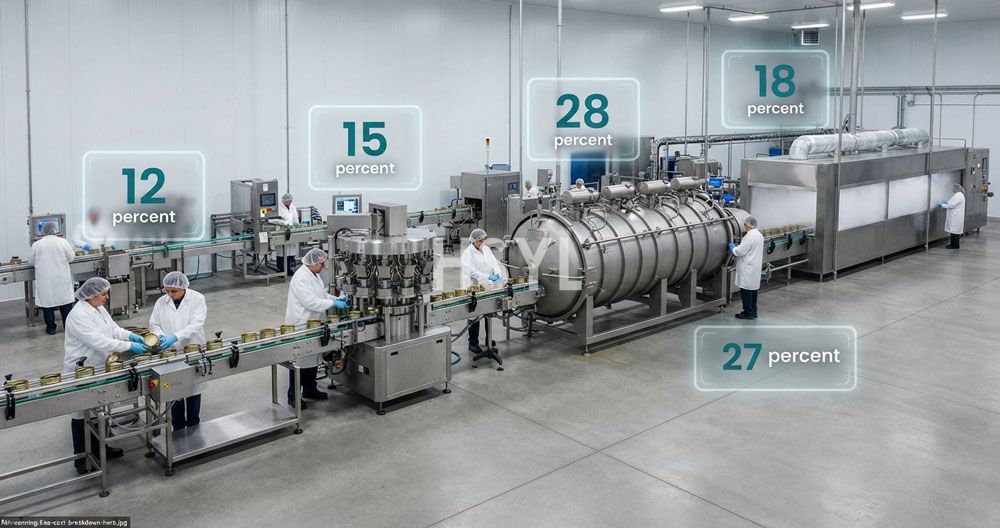
Building a food factory is a multidisciplinary engineering challenge that blends process science, mechanical design, hygienic architecture, and operational economics into a single integrated system. Unlike general manufacturing plants, food production facilities must maintain strict biological control while delivering industrial-scale throughput. The facility must function simultaneously as a processing plant, a sanitation-controlled environment, and a logistics hub.

In real-world projects, most failures occur not during equipment installation, but during early planning. Investors frequently start with civil construction or architectural drawings before defining the process flow. This results in misaligned equipment spacing, inefficient material handling, and expensive retrofits. A poorly planned plant can lose 10–20% of theoretical capacity due to workflow inefficiencies alone.
Operational consequences of inadequate design include:
Yield losses caused by product damage or reprocessing
Excess labor requirements due to manual transfer steps
Energy waste from improperly sized thermal systems
Increased contamination risk from intersecting personnel and material flows
Maintenance access constraints leading to prolonged downtime
Regulatory non-compliance requiring structural modification
A properly engineered food factory is designed around process physics and hygienic zoning, not aesthetics or building symmetry. Every meter of space must support controlled product movement, temperature management, and cleanability.
This guide explains how to build a food factory using proven industrial methodology. It focuses on translating product strategy into physical infrastructure, calculating real production capacity, integrating utilities, and designing a facility that meets both current production needs and future expansion requirements. The objective is not merely to construct a building, but to create a stable, efficient manufacturing ecosystem capable of operating continuously for decades.
Engineering Deep Dive: What It Is & How It Works
A food factory is fundamentally a material transformation system where biological raw materials are converted into stable, safe consumer products through mechanical, thermal, and environmental control processes.
Mechanics of Food Production Systems
Every food production facility performs three primary physical operations:
Material Conversion:
Cutting, mixing, grinding, or forming changes structure using controlled mechanical energy. Equipment must deliver consistent torque and shear forces to avoid product variability.
Thermal Processing:
Heating or cooling modifies microbial activity and product stability. This involves precise control of heat transfer coefficients, residence time, and pressure differentials.
Mass Flow Management:
Materials move continuously between stages. Flow rate must match downstream capacity to avoid accumulation or starvation.
Engineering success depends on balancing these variables:
Throughput velocity must align with thermal dwell time.
Mechanical stress must remain within product tolerance limits.
Pressure gradients must prevent contamination migration.
Core Sub-Components of a Food Factory
Processing Equipment Layer
This includes mixers, cookers, fillers, and conveyors. Their role is controlled transformation. Equipment must withstand continuous washdown environments and fluctuating loads.
Automation and Control Layer
PLC-driven systems synchronize machine cycles, regulate temperature curves, and log traceability data. Automation ensures repeatability and minimizes operator dependency.
Utility Infrastructure Layer
Steam, chilled water, compressed air, and electricity provide the energy backbone. Utility design must consider load diversity rather than peak assumptions.
Hygienic Structural Layer
Walls, floors, and drainage are engineered for cleanability. Sloped surfaces, sealed joints, and non-porous materials eliminate microbial harborage points.
Environmental Management Layer
Air handling systems maintain positive or negative pressure zones to control contamination pathways.
These layers must operate as a unified system. If one is improperly designed, the entire production chain becomes unstable.
Critical Industry Challenges & Solutions
Challenge 1: Inefficient Material Flow
Many factories rely on fragmented layouts that require manual transport between stages. This introduces delays, increases contamination exposure, and adds labor costs.
Solution:
Implement linear production architecture using synchronized conveyors and buffer control. This ensures continuous flow while preventing bottlenecks.
Challenge 2: Temperature Control Variability
Inconsistent heating or cooling leads to quality deviation and safety risks. Uneven thermal penetration is often caused by improper equipment sizing or poor circulation design.
Solution:
Use engineered heat exchange systems with validated thermal distribution modeling. Accurate residence time control ensures uniform processing.
Challenge 3: Cleaning and Sanitation Downtime
Facilities not designed for clean-in-place operations require disassembly for sanitation, resulting in long production interruptions.
Solution:
Integrate automated CIP systems with dedicated piping circuits and validated cleaning cycles. This reduces sanitation time while improving repeatability.
Key Features & Technical Advantages
Hygienic Zoning Architecture
Separate raw and finished product environments using controlled access and airflow management → Prevents cross-contamination and simplifies compliance audits.
Stainless Structural Integration
Food-grade stainless contact surfaces resist corrosion from acids, salts, and cleaning chemicals → Extends equipment life and reduces maintenance costs.
Energy Recovery Systems
Recovered heat from cooking or sterilization is reused for preheating → Improves thermal efficiency and lowers operating expenses.
Automated Process Synchronization
Servo-controlled drives maintain constant production rhythm → Eliminates micro-stoppages and improves throughput consistency.
Modular Equipment Configuration
Independent production modules allow maintenance without shutting down the entire line → Enhances operational resilience.
Selection Criteria & Capacity Planning
Capacity Sizing Methodology
Capacity must be determined using actual sales demand rather than theoretical machine ratings.
Capacity Calculation Formula:
Required Output =
Annual Demand ÷ (Operating Days × Hours × Efficiency Factor)
Where efficiency factor accounts for:
Planned maintenance
Changeover time
Minor stoppages
Quality losses
Typical real-world efficiency ranges between 65% and 75%.
Layout Engineering Considerations
Effective layouts prioritize unidirectional movement:
Receiving → Processing → Packaging → Storage
Key rules:
Avoid intersecting raw and cooked product paths
Provide maintenance clearance around all machines
Separate personnel walkways from material transport
Design drainage aligned with cleaning flow
Utility Integration Requirements
Typical medium-scale facility demands include:
Steam generation sized to continuous load
Chilled water loops with redundancy
Stable compressed air supply with filtration
Electrical infrastructure designed for harmonics control
Utilities should be designed with expansion capacity of at least 25%.
Future-Proofing Strategy
Growth should not require rebuilding. Include:
Reserved floor space for additional lines
Oversized utility headers
Scalable automation platforms
Expandable cold storage infrastructure
Factories designed for scalability achieve significantly lower lifecycle costs.
Standards, Compliance & Safety
Food factories operate under strict regulatory oversight to ensure consumer safety and worker protection. Compliance frameworks dictate facility design, material selection, and operational procedures.
Key compliance considerations include:
Hygienic design aligned with food safety management principles
Traceability systems documenting every production batch
Equipment safeguards preventing mechanical hazards
Environmental monitoring for air, water, and surface cleanliness
Worker safety planning including lockout procedures and ergonomic layout
Regulatory approval depends not only on documentation but on physical design elements such as drainage geometry, surface finish quality, and zoning barriers. Facilities designed with compliance in mind experience faster certification and fewer operational interruptions.
Conclusion & Call to Action
Building a food factory requires far more than installing equipment inside a building. It is an engineering-driven process that integrates production science, hygienic infrastructure, and long-term operational economics. Facilities designed around process logic achieve higher efficiency, safer production environments, and significantly lower lifecycle costs.
The most successful projects begin with a detailed evaluation of product requirements, throughput targets, and infrastructure demands before any construction begins. When planning aligns with engineering realities, factories operate smoothly, pass regulatory inspections faster, and maintain stable production performance for decades.
If you are considering how to build a food factory, the next step is conducting a structured process assessment and capacity analysis. This ensures that your facility is designed not only to start production, but to sustain profitability, adapt to market changes, and scale efficiently as demand grows.
A well-engineered food factory is an operational asset—not just a construction project—and its success is determined long before the first machine is installed.
Frequently Asked Questions
What is the first step in building a food factory?
How is production capacity accurately determined?
What causes the most cost overruns?
How important is zoning in factory design?
What utilities must be prioritized during planning?
How can downtime be minimized in design phase?
What lifespan should be expected from core equipment?
Why is automation essential for modern plants?
What percentage of project cost is usually utilities infrastructure?
How can factories prepare for future expansion?
Related Articles

Get professional consultation
Do you have any questions or need technical support regarding the content of this article? Fill out the form below, and our expert team will provide you with professional solutions.