Executive Summary
When investors or food manufacturers ask, “How much does a fruit canning production line cost?”, they are often expecting a simple equipment price. In reality, the answer is far more complex. A fruit canning line is not a single machine—it is an integrated thermal processing system combining preparation, filling, sealing, sterilization, utilities, and automation into one synchronized manufacturing environment.For complete autoclave batch scheduling and facility sanitation planning, refer to our engineering overview on top china canned beef production.
In modern food factories, canned fruit must meet strict expectations:
Shelf stability of 24–36 months
Consistent texture and color retention
Verified commercial sterility
High throughput during short harvest seasons
Compliance with global food safety regulations
Many processors underestimate the hidden engineering factors that influence cost. Poorly planned installations frequently suffer from:
30–40% underutilized capacity due to bottlenecks
Energy overspending caused by undersized steam systems
Product loss from improper blanching control
Expensive retrofits to meet export compliance
Downtime during peak harvest because of manual handling
A fruit canning line must process highly variable raw material—soft peaches, fibrous pineapples, delicate berries—while maintaining repeatable thermal lethality without damaging structure. That requires precise mechanical handling, thermal modeling, and hygienic system integration.

This article provides a real-world cost framework based on engineering scope, automation level, plant size, and lifecycle economics. Instead of quoting a generic price, we break down what actually drives capital expenditure (CAPEX) and operating expenditure (OPEX), helping processors design a system aligned with both production demand and financial return.
Engineering Deep Dive: What It Is & How It Works
A fruit canning production line is fundamentally a controlled heat-transfer and mass-handling system designed to stabilize biological material through hermetic sealing and sterilization.
Unlike dry food packaging, fruit canning must manage:
Enzymatic degradation
Osmotic sugar migration
Texture softening under heat
Air removal to prevent oxidation
Process Mechanics
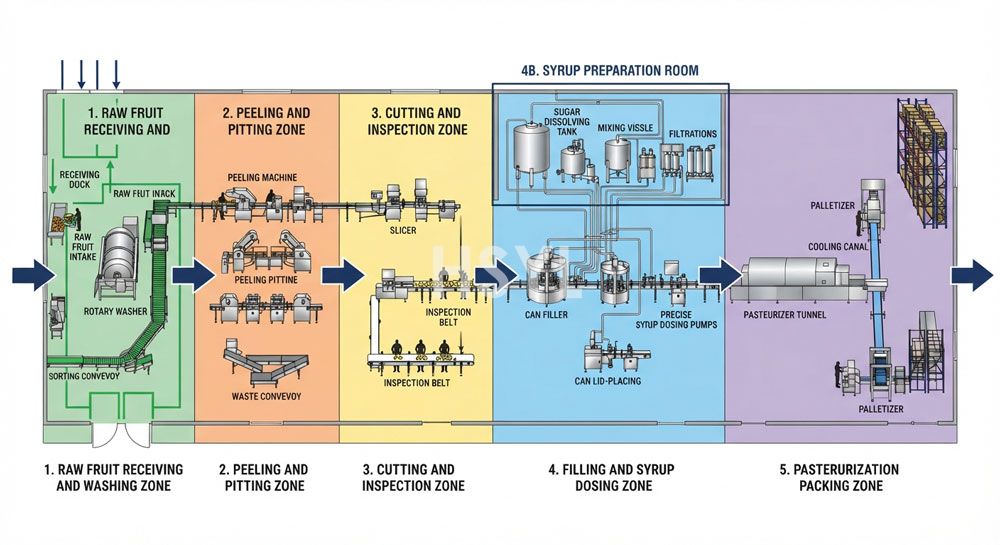
The typical process flow includes:
Raw Fruit Reception and Sorting
Washing and Surface Sanitization
Peeling, Pitting, or Cutting
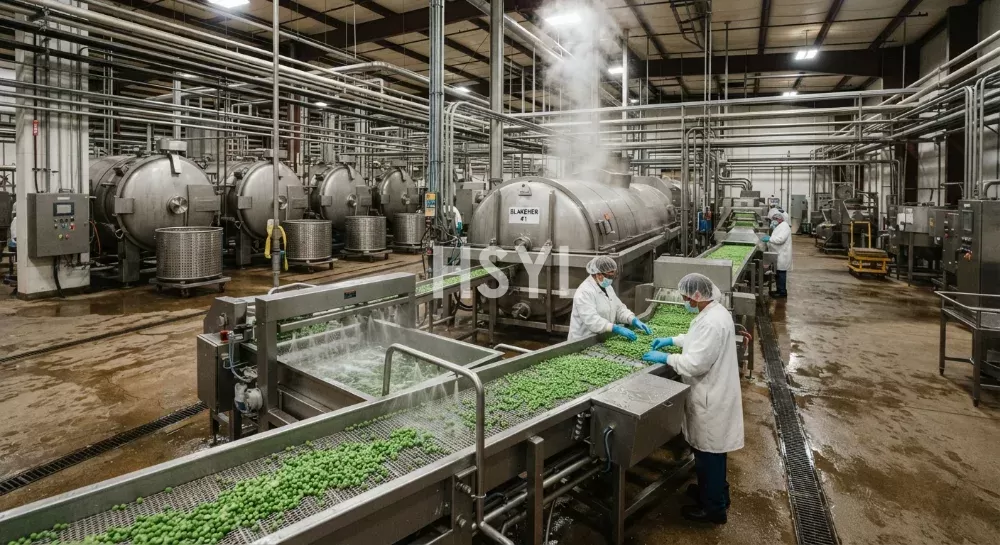
Blanching (enzyme deactivation)
Can Filling with Syrup or Juice
Exhausting / Vacuum Creation
Double Seaming
Retort Sterilization
Cooling and Drying
Coding, Packing, and Palletizing
Each step must synchronize flow rate, dwell time, and thermal exposure to avoid structural collapse of the fruit matrix.
Thermal Physics in Fruit Canning
Fruits behave differently from proteins. Their high moisture and sugar content promote faster heat transfer but also increase the risk of:
Over-softening from excessive thermal load
Color degradation due to oxidation
Soluble solids loss into syrup
Modern lines control this through:
Continuous blanchers regulating enzyme inactivation
Precise syrup dosing to stabilize osmotic balance
Retorts using overpressure water spray systems to prevent container deformation while ensuring uniform heating
Major Subsystems and Their Cost Impact
Raw Material Handling System
Gentle conveyors and water flumes reduce bruising. Mechanical damage directly translates into downgraded product classification.
Preparation Equipment
Peelers, slicers, and corers must match fruit geometry. Improper cutting tolerances create inconsistent fill weights and poor heat penetration.
Filling and Syruping Units
Flow-meter-controlled dosing ensures accurate fruit-to-liquid ratios required for labeling compliance.
Seaming Machines
Hermetic sealing is critical. Even micron-level seam defects can lead to microbial ingress during cooling.
Retort Sterilization System
The most capital-intensive component. It defines:
Batch size
Energy consumption
Microbial lethality validation
Overall plant throughput
Critical Industry Challenges & Solutions
Challenge 1: Seasonal Production Pressure
Fruit processing is highly seasonal. A peach processor may have only 8–10 weeks annually to run at full capacity. Any inefficiency during this window directly reduces annual revenue.
Solution: High-throughput automated lines sized for peak harvest allow processors to maximize utilization during short production cycles while minimizing labor dependency.
Challenge 2: Raw Material Variability
Unlike uniform industrial inputs, fruit varies in size, ripeness, and sugar content. This variability affects peeling efficiency, fill density, and thermal response.
Solution: Adaptive processing equipment with adjustable mechanical tolerances and programmable recipes ensures consistent output despite agricultural variation.
Challenge 3: Energy Consumption in Sterilization
Thermal processing can account for over 60% of total plant energy usage. Inefficient retorts dramatically inflate operating costs.
Solution: Modern retorts integrate heat recovery and optimized come-up cycles, reducing steam demand while maintaining validated lethality.
Key Features & Technical Advantages
Hygienic Washdown Construction
Sanitary stainless fabrication → Prevents microbial harborage → Enables high-frequency cleaning without corrosion risk.
Continuous Blanching Technology
Controlled enzyme deactivation → Stabilizes color and texture → Reduces product degradation during storage.
Precision Syrup Ratio Control
Mass-flow metering → Maintains Brix consistency → Ensures regulatory compliance and repeatable taste profile.
Automated Container Handling
Servo-driven conveyance → Eliminates manual loading damage → Improves yield and reduces labor cost.
Smart Retort Thermal Mapping
Distributed temperature sensing → Identifies cold spots → Guarantees sterilization reliability without overprocessing.
Selection Criteria & Capacity Planning
Step 1: Define Required Throughput
Capacity must align with harvest volume rather than daily sales.
Capacity Formula:
Required Hourly Output =
Total Seasonal Volume ÷ Available Processing Hours
Example:
12,000 tons fruit/year
60 processing days
16-hour operation
Required throughput ≈ 12.5 tons/hour.
Step 2: Match Equipment Size to Thermal Limits
Oversizing fillers without increasing retort capacity creates bottlenecks. Sterilization must dictate line speed.
Step 3: Utility Infrastructure Budgeting
Typical mid-scale plant requirements:
Steam: 2–3 tons/hour
Water: 15–25 m³/hour
Electrical: 400–600 kW connected load
Compressed Air: 6–8 bar stable supply
Utilities can represent 20–30% of total project cost, often overlooked during early budgeting.
Step 4: Layout Engineering
Efficient layouts must:
Separate raw and cooked zones
Maintain linear product flow
Allow sanitation access
Prevent cross-contamination pathways
Step 5: Plan for Future Expansion
Smart investors design plants with:
Additional retort foundations
Expandable conveyor architecture
PLC scalability for new SKUs
Expansion-ready infrastructure costs slightly more initially but prevents expensive shutdown retrofits.
What Does a Fruit Canning Line Actually Cost?
Typical Investment Ranges (Turnkey)
| Plant Scale | Capacity | Estimated Investment |
|---|---|---|
| Small Operation | 2–5 tons/hour | $1.2M – $2.5M |
| Medium Industrial | 6–12 tons/hour | $3M – $6M |
| Large Export Facility | 15–25 tons/hour | $7M – $12M+ |
Cost Distribution Breakdown
| Component | % of Total Cost |
|---|---|
| Preparation & Cutting | 15% |
| Filling & Seaming | 20% |
| Retort System | 25–35% |
| Utilities & Boilers | 15% |
| Automation & Controls | 8–12% |
| Installation & Commissioning | 10% |
The sterilization system is typically the single largest investment because it defines food safety validation.
ROI Considerations: Where the Money Is Recovered
Automation improves profitability through:
Reduced labor (20–40% savings)
Lower product loss (3–6% yield gain)
Energy optimization (10–18% savings)
Higher throughput during harvest
Export-grade compliance enabling premium pricing
Most facilities achieve payback within 2–4 years, depending on utilization.
Standards, Compliance & Safety
Fruit canning operations must comply with internationally recognized frameworks to ensure product safety and export eligibility.
Key governing bodies include:
International Organization for Standardization for quality management and hygienic engineering design
U.S. Food and Drug Administration regulations governing low-acid and acidified canned foods
Occupational Safety and Health Administration safety requirements for pressure vessels and plant operations
Compliance ensures validated sterilization processes, reduced liability exposure, and smoother certification during audits by global retailers.
Conclusion & Call to Action
Determining how much a fruit canning production line costs requires evaluating far more than equipment pricing. True project value depends on process engineering, thermal validation, automation level, and infrastructure readiness. A properly designed system balances capital investment with operational efficiency, ensuring consistent product quality while maximizing throughput during critical harvest windows.
Manufacturers that treat canning as an integrated process rather than a collection of machines achieve measurable advantages: lower energy consumption, higher yields, and reliable compliance with international food safety expectations.
If you are planning a new facility or upgrading an existing one, the most effective next step is a Process Audit or Capacity Calculation tailored to your raw material profile, seasonal volume, and market goals. A well-engineered fruit canning production line is not simply an expense—it is a long-term production asset that defines profitability, scalability, and brand reliability.
Frequently Asked Questions
What is the biggest cost driver in a fruit canning line?
Can small processors start with semi-automatic systems?
How long does installation take?
What determines retort size selection?
How much energy does a typical line consume?
How frequently must seams be inspected?
Can the same line process multiple fruits?
What maintenance most affects uptime?
Is water quality important for processing?
How long is the typical equipment lifespan?
Related Articles




Get professional consultation
Do you have any questions or need technical support regarding the content of this article? Fill out the form below, and our expert team will provide you with professional solutions.