The Realities of Sourcing Canned Fish Production Lines from China
For plant managers, technical buyers, and engineering directors in the B2B seafood processing sector, procuring a complete canned fish line represents a significant capital expenditure (CapEx) decision. While Chinese manufacturers offer highly competitive pricing, the purchasing process is often fraught with technical ambiguities and execution risks. Standalone machine purchases can lead to integration bottlenecks, mismatched line speeds, and severe sanitation headaches on the plant floor. To secure a high-performing system, buyers must transition from evaluating simple quotes to performing rigorous technical audits of a manufacturer's engineering standards, material choices, and controls integration.To maintain hermetic seal integrity and high-speed canning output, configure this stage with our industrial magnetic can washing machine.

At HSYL (Hongsheng Yuanlin), we approach this from a shop-floor engineering perspective. Developing a high-yield, high-efficiency canning system is not just about mounting a series of conveyor belts between a washer and a retort. It is a precise science of mechanical alignment, heat transfer calculations, and microbiology control. When you are processing high-brine pelagic species like sardines, or massive scombroids like tuna, every stage of the line must be balanced to protect raw materials, optimize yield, and ensure absolute biological safety.
Understanding these challenges helps operations managers avoid costly retrofits and prolonged commissioning phases. This technical analysis outlines the core engineering considerations when sourcing an automatic fish canning production line from China, highlighting the differences between standard standalone machinery and an engineered, balanced turnkey solution.
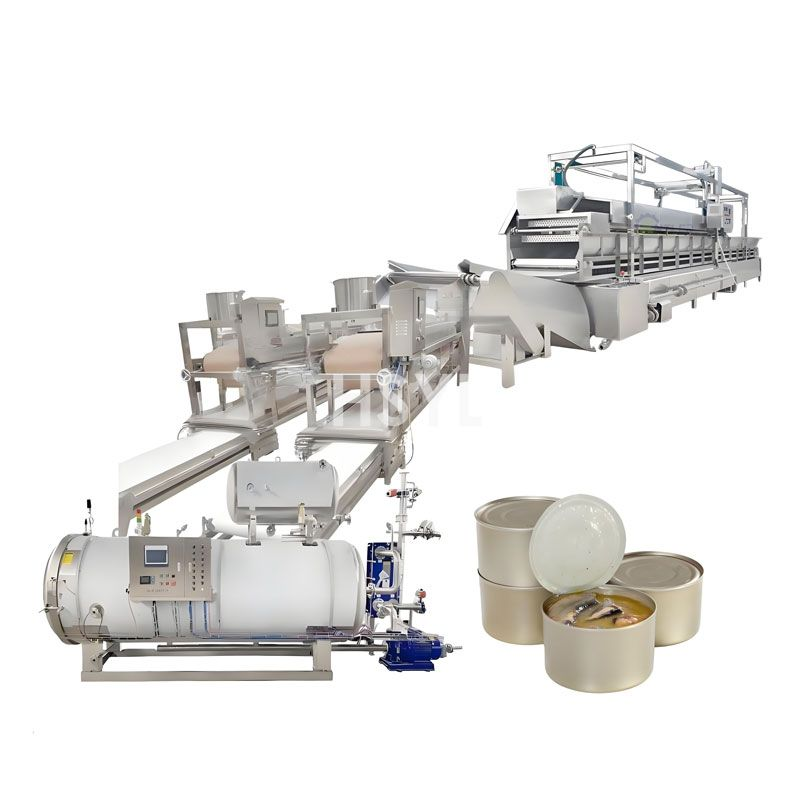
[Insert image: Turnkey sardine and tuna canning production line showing high-speed conveyor systems and automated cleaning stations]
Line Balancing: The Heart of Seafood Processing Yield
The most common operational failure in commercial canning facilities is a lack of line balance. Many plants purchase a fast filling machine only to find that their upstream scaling and gutting area cannot feed the line, or that their downstream retort capacity creates a massive bottleneck. When fish sit on the line waiting for the next step, histamine levels rise, yield drops due to drip loss, and product quality deteriorates rapidly. The line must flow as a single, continuous machine.
In a typical sardine or mackerel canning line, the process is divided into several main stages, each with specific velocity profiles:
- Raw Material Preparation: Defrosting, sorting, scaling, head-and-tail cutting, and gutting. Standard manual lines are highly labor-dependent, whereas modern lines integrate automated sizing and rotary head/gutting units.
- Brining and Pre-cooking: Salt integration and moisture reduction. Pre-cooking must be tightly calibrated to reduce moisture by 15% to 20% to prevent watery liquid in the finished can.
- Filling and Liquid Dosing: Placing the fish in the cans (either manually or using pocket fillers) and adding oil, sauce, or brine.
- Seaming: The most critical mechanical step where a double seam is formed to create a hermetic seal.
- Thermal Processing (Sterilization): Overpressure retorting to achieve the target F0 sterilization value.
An experienced engineer calculates the throughput of the line starting from the bottleneck—which is typically the seamer or the retort system—and works backward to size the upstream equipment. For instance, if your retort cycle takes 60 minutes (including heating, holding, and cooling) and your target capacity is 120 cans per minute, your conveyor accumulations and buffer zones must accommodate thousands of cans without causing physical crowding or thermal stress. HSYL solves this by integrating dynamic accumulation tables and speed-adjusting conveyors controlled by decentralized variable frequency drives (VFDs) that communicate with a central PLC.
Metallurgical Choices and Sanitary Engineering Standards
Seafood processing is an exceptionally harsh environment. Saltwater, organic acids, and aggressive chemical cleanings (using caustic soda and chlorine) will destroy substandard metals within months. When auditing a Chinese manufacturer, technical buyers must look past broad claims of "stainless steel construction" and demand exact material specifications for every component.
Direct product-contact surfaces—such as filling pockets, cutting blades, salt-brining tanks, and saucing nozzles—must be constructed from SUS316L stainless steel. This low-carbon molybdenum alloy offers superior resistance to chloride-induced pitting corrosion. Non-product contact zones, structural frames, and support braces can use SUS304, but these must be fully passivated after welding to maintain their corrosion resistance. Beware of manufacturers using lower-grade stainless steel like 201 or 301 on wet-zone frames; these will rust quickly under daily washdown cycles.
Sanitation design must also extend to the physical layout of the machines. Look for the following engineering details during your plant audit:
| Design Element | Standard Chinese Standalone Machine | HSYL Engineering sanitary Design |
|---|---|---|
| Welding Standards | Spot-welded or continuous structural welds with visible crevices and discoloration. | Continuous TIG welding, ground smooth, polished, and fully passivated (crevice-free). |
| Frame Design | Hollow square tubing with plastic end caps, creating water traps and bacterial harbors. | Open-profile solid round bars or angled steel frames designed to shed water naturally. |
| Conveyor Belts | Standard flat PVC belts with tight rollers that are difficult to clean underneath. | Modular plastic blue belts with quick-release washdown lifters for full access. |
| Motor & Electrical Protection | IP65-rated motors with simple sheet metal covers, highly susceptible to water ingress. | IP69K stainless steel washdown motors, hygienic cable glands, and sloped electrical enclosures. |
A true commercial manufacturer will also integrate Clean-in-Place (CIP) spray balls and automated belt-washing systems. This reduces downtime during sanitation cycles and ensures compliance with strict food safety bodies like the FDA, USDA, and CE.
Thermal Processing Validation: The F0 Safety Line
No canned fish manufacturer can sell to international markets without absolute validation of their thermal sterilization process. Low-acid foods (with a pH greater than 4.6), such as tuna, sardines, and mackerel, are ideal environments for the growth of Clostridium botulinum. The sterilization retort is the literal wall between product safety and a catastrophic recall.
When selecting a supplier, verify their understanding of retort thermodynamics. Whether utilizing steam-water spray, water immersion, or direct steam systems, the retort must achieve uniform temperature distribution throughout the vessel. A variance of even 0.5 degrees Celsius in a "cold spot" can lead to under-processed cans and bacterial survival.
Your technical team must confirm that the supplier provides retorts with multi-point temperature and pressure recording systems that comply with the FDA's guidelines for low-acid canned foods. The retort control system must utilize high-accuracy RTD sensors (resistance temperature detectors) and digital pressure transducers integrated with a dedicated PLC controller. This ensures that the counter-pressure during the cooling phase is precisely balanced to prevent can buckling or paneled walls—a common defect in high-speed operations.
[Insert image: Horizontal overpressure water spray retort autoclave with computerized temperature profiling screen]
The Seamer: Double Seam Quality Control
An old saying among food processing engineers is that "a canning line is only as good as its seamer." The seaming machine must execute a high-speed, continuous micro-deformation process that folds the can flange and the end curl together, compressing the sealing compound to form a hermetic barrier. If the seam is too tight, it will fracture; if too loose, it will leak and spoil.
When purchasing from China, focus heavily on the seaming head design. Top-tier manufacturers utilize imported or highly specialized chucks and rollers made of hardened stainless steel or titanium-coated tool steels. These parts must resist wear and maintain micro-millimeter tolerances over millions of cycles. The seamer must also feature automated lubrication systems to prevent oil contamination in the food zone while keeping the high-speed bearings running smoothly.
Additionally, ask the manufacturer about their oxygen removal system. For premium products, a steam vacuum seamer or a nitrogen flushing gas-injection system is necessary to replace the headspace oxygen inside the can before sealing. This prevents product oxidation, extends shelf life, and maintains the sensory profile of delicate fish oils.
Actionable Steps for Plant Managers Prior to Supplier Sign-off
To transition from a quotation to a successful deployment, engineering teams should implement these three shop-floor protocols during the procurement process:
- Conduct a "Dry-Run" Factory Acceptance Test (FAT) with Real Cans and Product: Do not accept an empty-machine FAT. Require the supplier to run at least 5,000 cans of your target fish size and sauce viscosity at full operational speed. This reveals hidden transfer bottlenecks, belt slippage, and seamer adjustment defects.
- Audit the PLC Source Code and Component Origin: Many low-cost suppliers lock the HMI and PLC code, forcing you to pay for expensive overseas service trips for simple timing adjustments. Demand unlocked PLC programs (e.g., Siemens TIA Portal or Allen-Bradley Studio 5000) and ensure that all electrical, pneumatic, and hydraulic components are sourced from globally available brands (like Festo, SMC, Schneider Electric, or SEW-Eurodrive) so that you can source spare parts locally.
- Verify the Spares Pack and Wear-and-Tear Inventory: Ensure the capital contract includes a robust two-year spare parts package. This must include seaming rollers, cutting blades, VFD units, heating elements, high-temperature gaskets, and proximity sensors. A line down for a five-dollar sensor is a massive operational failure.
Following these steps ensures that your investment yields high OEE (Overall Equipment Effectiveness) and low long-term maintenance costs. For a real-world look at how this integration works at scale, review the project parameters from HSYL's fully automatic fish canning line in Algeria, which processes high-speed 125g club cans under challenging environmental conditions.
Related Resources
- Automatic Fish Canning Production Line Solutions
- Algeria Fish Canning Line Case Study
- Sardine Canning Production Systems
Call to Action:
Partner with HSYL for Turnkey Seafood Processing Engineering
If you are planning to expand your seafood processing facility or replace an outdated, labor-intensive canning line, you need more than a machinery supplier—you need an engineering partner. Contact HSYL’s technical team today to discuss your floor plan, utility requirements, capacity targets, and raw material characteristics. Let us design a balanced, hygienic, and highly efficient production system tailored to your specific operational goals.
Frequently Asked Questions
What is the standard lead time for a complete turnkey canned fish line?
Can the same line process both sardines in club cans and tuna in round cans?
What grade of stainless steel does HSYL use for brine-filled cans?
Do you support on-site installation and commission globally?
How does HSYL ensure retort temperature uniformity?
Related Articles
Get professional consultation
Do you have any questions or need technical support regarding the content of this article? Fill out the form below, and our expert team will provide you with professional solutions.