1. Introduction: The "Low Bid" Trap and the OEE Black Hole
In my twenty years in the food and beverage processing industry, I have participated in countless production line planning and tendering projects. The most painful scenario I witness isn't a factory lacking budget, but rather misallocated budget.For complete autoclave batch scheduling and facility sanitation planning, refer to our engineering overview on do canned mushrooms turn brown.
There is often a massive disconnect in the decision-making chain: Procurement departments are KPI-driven to reduce CAPEX (Capital Expenditure), striving to drive down the purchase price of equipment. Meanwhile, the Production and Maintenance departments are left to foot the bill for exorbitant OPEX (Operating Expenditure) over the next decade.

We must be clear: The true cost of a canning line is only 20% visible on the purchase contract. The remaining 80% is hidden in the operations of the next 10-15 years.
What constitutes this hidden 80%?
Low OEE (Overall Equipment Effectiveness): Theoretical capacity is 1000 CPM, but reality is 800 CPM with constant micro-stops.
Product Giveaway: Formulation waste due to poor filling accuracy.
Changeover Losses: Excessive downtime for SKU transitions.
2. Core Process I: Filling Technology — The Balance of Rheology and Accuracy
The Filler is the "stomach" of the production line. A successful selection isn't about how fast it runs empty, but how much it respects the Product Rheology.
2.1 High Viscosity & Pastes: The Pitfalls of Piston Filling
For products like tomato paste, luncheon meat, or pet food, Piston Filling is the standard. However, the gap between low-end and high-end is massive:
Rotary Valve Dead Spots: You must verify if the valve body flow path complies with EHEDG standards.
Seal Lifespan: Low-end equipment uses generic rubber seals. High-end equipment uses PEEK or Teflon composites with self-lubrication and thermal expansion compensation. This directly impacts weight accuracy (CPK).

2.2 Particulates: Reducing Shear Force
For suspended solids like peach chunks or orange sacs, traditional volumetric fillers often rely on valve cores that shear the product. Modern high-end processes recommend Telescopic Pocket Fillers combined with large-radius flow paths to preserve fruit integrity.
2.3 Carbonated & Sensitive Beverages: The War on Foam
For CSD (Carbonated Soft Drinks), the design of the Vent Tube dictates fill-level accuracy. Superior valve design utilizes specific geometries to manipulate fluid dynamics under high-speed rotation, stabilizing the meniscus and minimizing foaming.
3. Core Process II: The Seamer — The "Double Seam" Lifeline
If the filler dictates cost (waste), the Seamer dictates survival (food safety).
3.1 Redefining the "Double Seam"
When procuring a Seamer, do not just ask "How many cans per minute?". You need to discuss the capability (Cmk > 1.67) of the following parameters:

Body Hook & Cover Hook: Precise length and curvature.
Overlap: The critical indicator. Usually requires ≥50%, forming a labyrinth seal.
Tightness: Internal wrinkle rating must be controlled within Grade 2.
3.2 Hardware Materials: Rejecting "Soft" Steel
At high speeds (e.g., 600-1200 CPM), Seaming Rolls endure immense stress.
The Trap: Cheap equipment uses standard tool steel.
The Standard: Demand Stellite (Cobalt-Chromium Alloy) or TiN Coatings. This prevents metal flaking, which contaminates food and causes seam dimensions to drift over time.
4. Integration: Breaking the "Island" Mentality
Many factories possess world-class standalone machines, yet the Line Efficiency is abysmal. The culprit is poor Line Integration.
4.1 Line Balancing & The V-Graph Theory
An excellent line must follow a "V-Curve" efficiency model:
Bottleneck (Filler/Seamer): Set at 100% speed.
Upstream (Depalletizer): Must have 110%-115% over-speed capability to flood the filler after stops.
Downstream (Packaging): Must have 110%-120% capacity to pull product away and prevent blocking the seamer.

4.2 Accumulation Systems: The "Lungs" of the Line
Dynamic Accumulation: Between Filling and Labeling/Retorting, you must calculate buffer capacity based on the downstream machine's MTTR (Mean Time To Repair).
FIFO (First-In-First-Out): Crucial for hot-fill products. Avoid random accumulation tables where cans might linger, causing temperature drops below sterilization safety limits.

5. Sterilization: The Final Defense
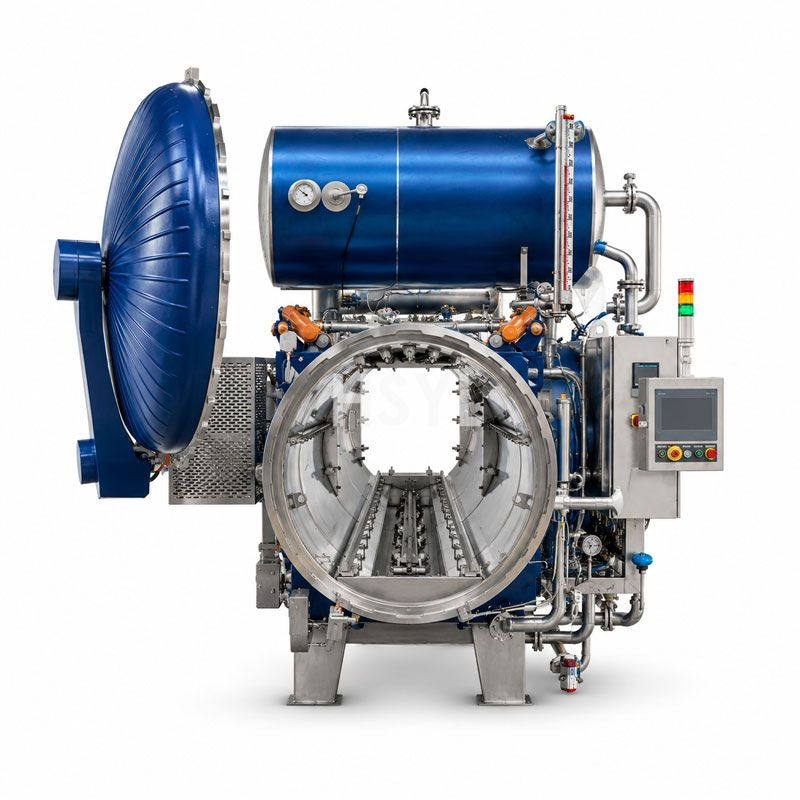
There is zero margin for error in Retorting.
Heat Distribution: The acceptance criteria is not how fast it heats up, but the Uniformity of Heat Distribution. Demand a "Load Distribution Study" (fully loaded crates).
Pressure Control: For thin-wall 2-piece aluminum cans, back-pressure control must be precise to ±0.01 bar during cooling to prevent Paneling (collapsing) or Peaking (buckling).

6. Avoiding Pitfalls: Procurement Strategy & FAT
6.1 The Real FAT (Factory Acceptance Test)
Many vendors only demonstrate a "Dry Cycle" (running empty).
My Advice:
Wet Cycle: Must use actual product and packaging materials.
CPK Validation: Continuous run for 4+ hours. Analyze statistical stability of critical quality attributes (Fill weight, Seam height).

6.2 Conclusion: The Victory of TCO
The expert perspective is to build a TCO Model. Investing an extra 20% upfront for high-precision Double Seaming technology, hygienic filling valves, and smart integration often pays for itself within the first two years through higher efficiency and reduced waste.
In the era of Industry 4.0, let us use data and engineering logic to build true manufacturing competitiveness.
Frequently Asked Questions
Why shouldn't I focus solely on the equipment purchase price (CAPEX)?
What are the most critical technical indicators when evaluating a Can Seamer?
What is "Line Balancing" and why is it crucial for production efficiency?
Is a "Dry Cycle" (running empty) sufficient for the Factory Acceptance Test (FAT)?
How do I select the right filling machine for high-viscosity products (e.g., tomato paste, luncheon meat)?
Why is Stellite material recommended for Seaming Rolls?
Related Articles


Get professional consultation
Do you have any questions or need technical support regarding the content of this article? Fill out the form below, and our expert team will provide you with professional solutions.