Gain in-depth insights into Three Temperature Disinfection Cabinet — 120°C/80°C/60°C Triple-Setting Far Infrared Disinfection Unit equipment’s working principles, application scenarios, and technical highlights.
One Machine, Three Thermal Modes, Zero Chemical Residue
University dining halls where metal cutlery requires aggressive bacterial elimination but plastic serving trays would deform under that same treatment. Hotel banquet operations needing 120 degree Celsius pathogen kill for dinner service glassware while simultaneously warming breakfast pastries at 60 degrees for early-morning buffet setup. Food processing plants where production tool surfaces demand maximum sterilization intensity but packaging materials and employee personal items require gentler handling. Central kitchens managing diverse inventory spanning fine china, polycarbonate containers, wooden cutting boards, silicone tools, and stainless steel prep equipment within a single sanitization workflow.
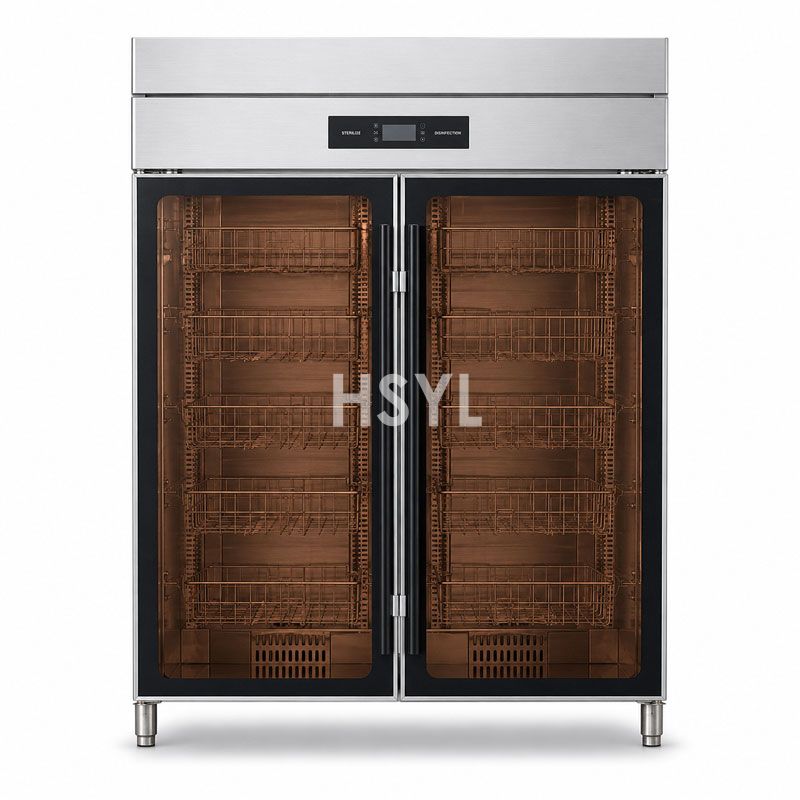
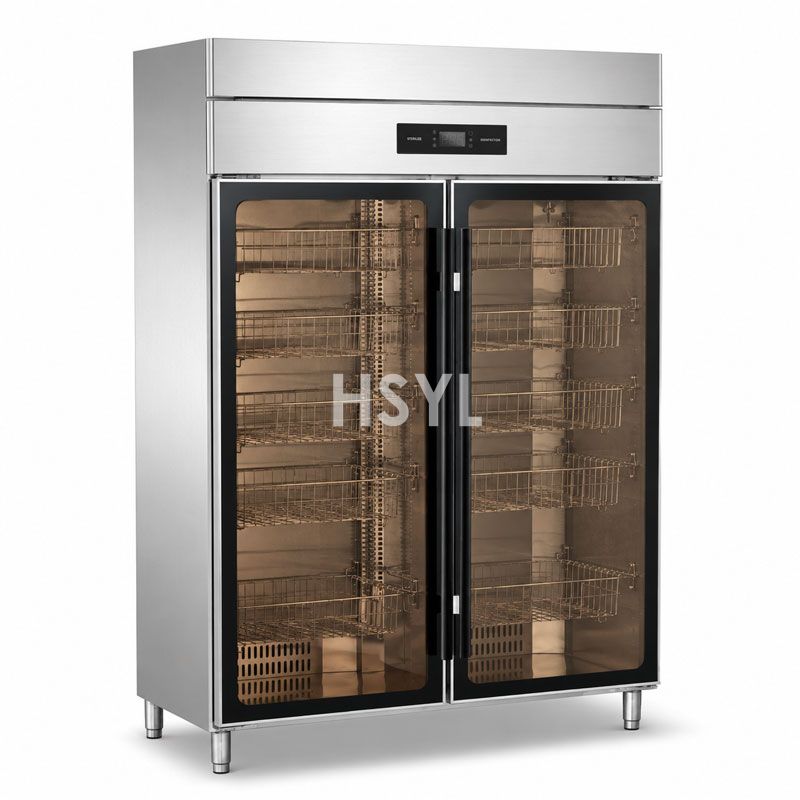
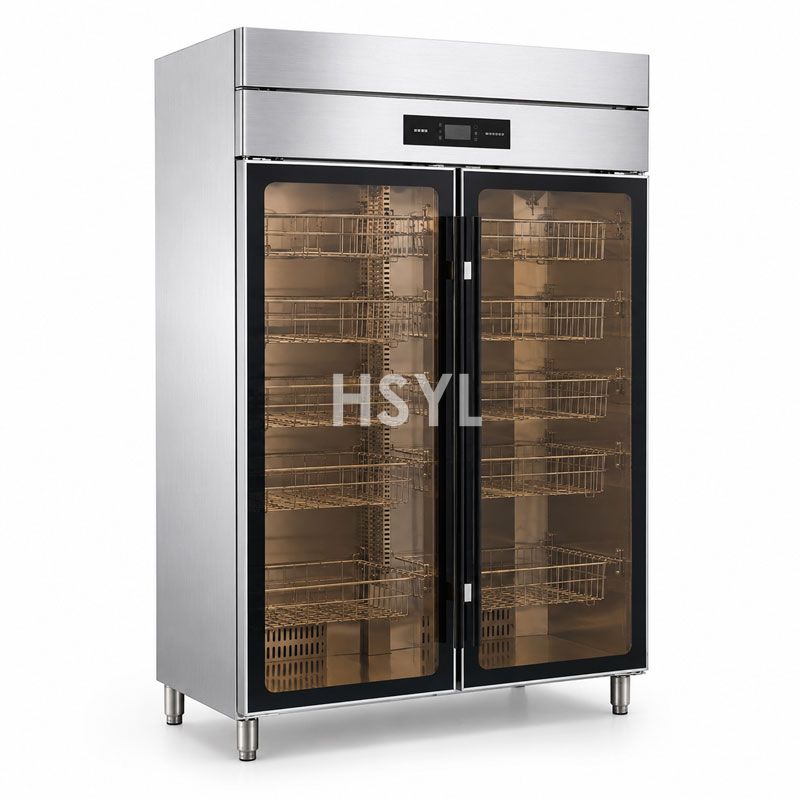
The HSYL Three Temperature Disinfection Cabinet addresses these mixed-inventory realities through an approach no other unit in the HSYL product line can provide: three independently selectable operating temperatures within a single 720 liter chamber. Set the unit to 120 degrees Celsius for cycles targeting bacteria, viruses, parasites, yeasts, and thermally tolerant organisms requiring maximum lethality assurance on metal, ceramic, glass, and heat-resistant polymer items. Switch to 80 degrees Celsius for moderate sanitization cycles handling heat-sensitive materials including certain thin-walled plastics, composite containers, and items with adhesive labels or printed graphics that degrade at higher temperatures. Select 60 degrees Celsius for pure warming and drying applications keeping prepared items at safe serving temperature during holding periods, driving residual moisture out of cleaned items after washing, or gently defrosting frozen components before preparation.
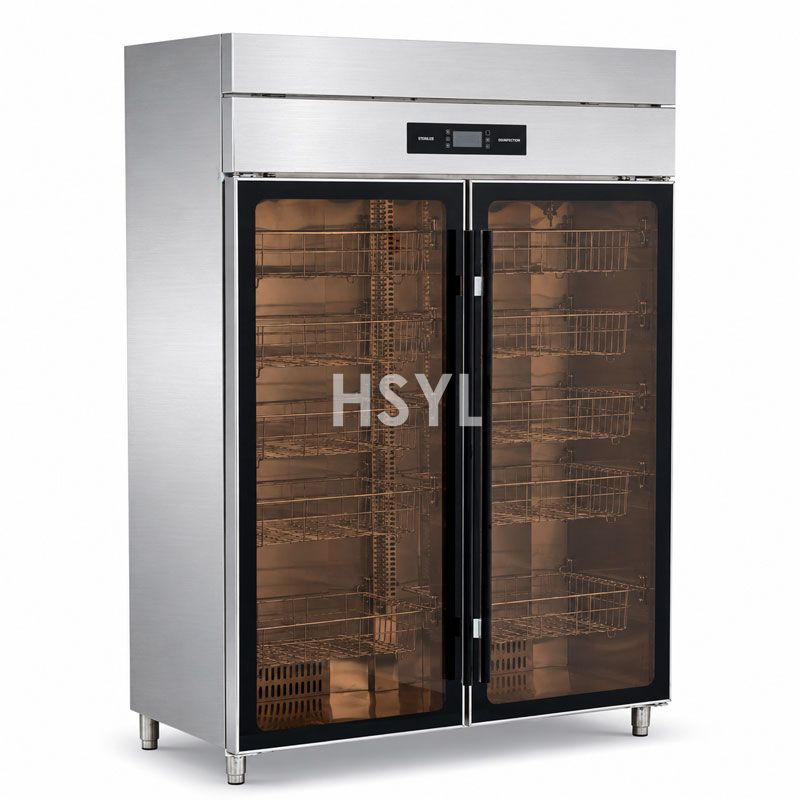
Beyond its signature three-temperature capability, this cabinet delivers the largest single-unit disinfection volume available in the HSYL sanitation equipment portfolio at 720 liters distributed across 10 configurable layer positions within a wide-body 1310 by 660 by 1960 millimeter cabinet envelope. The far infrared heating tube system generates thermal energy exceeding 125 degrees Celsius peak output ensuring the 120 degree Celsius setpoint achieves actual chamber saturation with margin for load-induced depression. The 360-degree stereoscopic hot air circulation pattern delivers that thermal energy to every internal surface including shadowed recesses, stacked-item interfaces, and interior corners where static-heat alternatives develop dangerous cold zones. Full SUS201 stainless steel construction throughout the exterior shell, interior chamber walls, shelf assemblies, and structural frame provides corrosion resistance suited to wet kitchen environments, chemical cleaning agent exposure, and long-term durability under repeated heating cycle stress.
Technical Specifications
| Parameter | 720JD210-3 |
|
|---|
| Model | 720JD210-3 |
|
| Cabinet Size (W x D x H) | 1310 x 660 x 1960 mm |
|
| Shelf Size (per position) | 560 x 395 x 260 mm (6 shelves x 10 layer positions) |
|
| Total Layers | 10 Layers |
|
| Capacity | 720 Liters |
|
| Rated Power | 4.4 kW |
|
| Voltage | 220V (single-phase) |
| Temperature Range | 30 - 120 degrees Celsius |
| Sterilization Temperatures | 120C / 80C / 60C (three selectable modes) |
| Insulation Layer Thickness | 3 cm (overall foaming) |
| Caster Height | 12 cm |
| Construction Material | SUS201 Stainless Steel (interior + exterior) |
| Heating System | Far infrared electric heating tubes (max output exceeds 125C) |
| Air Circulation | 360-degree stereoscopic high-temp hot air circulation |
| Net Weight | 142 kg |
| Customization | Available per customer specification |
Operation Process
- Select Temperature Mode & Load Chamber. Identify the appropriate temperature mode for the current load composition: 120 degrees Celsius for metal, ceramic, glassware, and heat-stable items requiring maximum pathogen elimination; 80 degrees Celsius for moderately heat-sensitive materials including select plastics, composites, and items with decorative finishes; 60 degrees Celsius for warming, drying, moisture removal, or defrosting applications where minimal thermal exposure is preferred. Pre-wash all items using your primary washing system removing visible residue. Arrange items across the 10 layer positions utilizing the 560 by 395 millimeter shelf area efficiently while maintaining spacing between adjacent items allowing the 360-degree circulating air to reach all surfaces. With 10 layers available, organize items by material type if running mixed-mode batches placing heat-tolerant items on lower levels where air circulation is typically strongest and more sensitive items on upper positions if needed.
- Close Door & Initiate Cycle. Pull the door closed firmly engaging the latch mechanism sealing the 720 liter chamber. Confirm the control panel displays your selected temperature setting (120C, 80C, or 60C mode) and initiate the cycle. The far infrared tubes begin generating thermal energy immediately while the circulation fan establishes stereoscopic airflow distributing heated air throughout the expanded 1310 millimeter wide internal volume. Cycle duration varies by selected temperature and load density: 120C cycles typically run 25 to 45 minutes for full sterilization, 80C cycles run 15 to 30 minutes for moderate sanitization, and 60C cycles run 10 to 20 minutes depending on warming or drying objectives.
- Monitor & Verify Completion. Observe the control panel confirming the unit reaches and sustains the target temperature throughout the programmed duration. The 3 centimeter insulation layer minimizes external heat radiation maintaining safe surface temperatures around the wide cabinet body even during 120C operation. When the cycle completes, allow appropriate cooldown time before opening: 3 to 5 minutes for 80C and 60C cycles, 5 to 8 minutes for 120C cycles involving glassware or ceramics susceptible to thermal shock cracking. The wide-body design means the door opens across a larger horizontal arc than narrower cabinets — ensure adequate clearance in front of the unit (minimum 800 millimeters recommended) for safe door swing access and personnel working room.
- Unload, Sort & Reset. Open the door carefully directing any residual hot air away from personnel. Remove items by layer position starting from upper levels working downward to prevent drips or condensation falling onto lower-shelf contents still awaiting removal. Transfer items to designated areas sorted by post-treatment category: fully-sterilized 120C items proceed directly to sanitized storage or active service zones; 80C sanitized items go to clean-dish staging; 60C warmed items may proceed immediately to serving lines or buffet stations if at target presentation temperature. Close the empty door to maintain internal cleanliness. If switching to a different temperature mode for the next batch, allow brief chamber equilibration before initiating the new cycle to avoid thermal shock to the heating elements from rapid setpoint changes.
Applications & Use Cases
Item-to-Temperature Matching Guide
| Temperature | Suitable Items | Avoid These Items |
|---|
| 120 degrees Celsius | Metal cutlery, ceramic plates/bowls, glassware, stainless steel containers, silicone tools, wooden cutting boards, porcelain | Thin plastics, foam items, adhesives, low-melt polymers, battery-powered devices |
| 80 degrees Celsius | Durable plastics rated for dishwasher use, composites, items with printed graphics, some coated metals | Foam, pressure containers, flammable materials, extremely delicate finishes |
| 60 degrees Celsius | Warming hold for prepared foods, drying washed items, gentle defrosting, preheating serving ware | Items requiring actual sterilization (use higher temp instead) |
Sterilization Mechanism Across Temperature Tiers
Each temperature setting operates through identical physical mechanisms (far infrared radiant heating plus 360-degree convective circulation) but achieves different biological outcomes corresponding to thermal dose delivered to target microorganisms. At 120 degrees Celsius, sustained exposure disrupts cellular membranes, denatures essential proteins, and damages DNA helix structures in bacteria, viruses, yeasts, parasites, and bacterial endospores — achieving irreversible organism death suitable for regulatory compliance documentation. At 80 degrees Celsius, the thermal dose reduces most vegetative bacteria populations effectively and inactivates many common foodborne pathogens, though thermally tolerant spore forms may survive incomplete exposure — adequate for routine sanitization of items not entering direct contact with raw protein products. At 60 degrees Celsius, the thermal level falls below effective sterilization thresholds for most microorganisms but provides genuine value for moisture removal (drying cleaned items preventing bacterial regrowth in damp environments), warming prepared items to serving temperatures, and gentle pre-conditioning reducing subsequent thermal shock when items are later transferred to higher-temperature processes.
Target Environment Profiles
- University & Institutional Dining Halls (2000+ meals/day). Mixed inventory diversity drives three-temperature value: metal cafeteria trays and stainless serving vessels at 120C, polycarbonate beverage cups and disposable-container alternatives at 80C, bread baskets and pastry display ware at 60C warming during breakfast service. The 720 liter 10-layer capacity handles inter-meal volume surges without bottlenecking the dishroom during transition periods between breakfast, lunch, and dinner services.
- Hotel Groups with Diverse F&B Operations. Different hotel outlets generate different tableware mixes: banquet departments need 120C for formal china and crystal glass, casual restaurants need 80C for mixed-material casual ware, room service and minibar operations need 60C warming for amenity items. One unit serving multiple outlets or one unit per large property covers the full spectrum where purchasing separate single-temperature cabinets for each thermal tier would multiply capital investment and floor space consumption.
- Food Processing Plants with HACCP Compliance Requirements. Production tool surfaces and packaging-contact items require documented 120C thermal kill-step verification. Employee breakroom utensils and personal containers function adequately at 80C sanitization. Holding and staging areas benefit from 60C warming keeping items at controlled temperatures between process steps. One machine serving these distinct plant zones reduces equipment count, simplifies maintenance scheduling, and consolidates utility connections to a single 4.4 kilowatt circuit.
- Large Banquet & Event Catering Facilities. Pre-event staging benefits enormously from 60C warming capability holding hundreds of pre-plated items at optimal presentation temperature for hours before service. Post-event cleanup uses 120C for thorough sterilization of all returned items regardless of material type distribution. Mid-operation replenishment cycles might use 80C for quick turnaround of mixed-material items arriving mid-service. The 720 liter capacity accommodates complete event inventories in fewer cycles than smaller cabinets.
- Central Commissary & Distribution Kitchens. Satellite facility support often includes delivering pre-sanitized items to remote locations. The three-temperature unit produces output at whatever thermal level each receiving location requires: 120C-sterilized main service items, 80C-sanitized secondary ware, or 60C-warmed ready-to-serve components. This output flexibility from a single production asset streamlines commissary-to-satellite logistics compared to maintaining parallel single-temperature production lines.
Advantages of the Three Temperature Disinfection Cabinet
- Three Independent Temperature Modes in One Chamber. No other HSYL disinfection cabinet offers selectable 120C, 80C, and 60C operating modes. This tri-modal capability eliminates the operational compromise forced by single-temperature units where operators must either over-expose sensitive items to excessive heat risking damage, or under-expose robust items to insufficient heat leaving pathogens viable. Selecting the appropriate thermal tier for each batch composition optimizes the trade-off between sterilization assurance and material preservation automatically rather than requiring manual workarounds such as partial loading, reduced cycle times, or supplementary chemical treatments that undermine the purpose of investing in thermal-only equipment.
- 720 Liter Maximum Single-Cabinet Volume. At 720 liters of usable internal chamber volume across 10 configurable layer positions, this unit delivers the highest single-machine throughput capacity in the HSYL sanitation equipment portfolio. For facilities evaluating whether to deploy one 720-liter unit versus two or more smaller cabinets, the consolidated approach reduces total floor area allocation (one 1310 by 660 millimeter footprint versus multiple smaller footprints), simplifies utility management to one 4.4 kilowatt connection point, concentrates all maintenance touchpoints into a single serviceable assembly, and leverages the 3 centimeter uniform insulation across the entire 720-liter volume rather than fragmenting thermal efficiency across multiple thinner-insulated smaller bodies.
- Wide-Body 1310 Millimeter Form Factor. The 1310 millimeter cabinet width approximately doubles the 645 millimeter width of standard flat-door disinfection cabinets. This wider envelope accommodates either longer shelf spans supporting larger-diameter items such as platters, trays, and extended cutting boards that cannot fit in narrower chambers, or dual-column rack configurations effectively doubling the linear shelf-frontage accessible to operators during loading and unloading operations. The wider frontage also distributes the 142 kilogram gross weight across a larger base improving stability on uneven floors and reducing tipping risk when heavily loaded on upper shelf positions. For facilities with adequate floor width availability, the wide-body design converts horizontal space into productive loading convenience that narrow cabinets cannot provide regardless of their height or depth dimensions.
- Far Infrared Plus 360-Degree Circulation in Expanded Volume. Delivering uniform temperature throughout a 720 liter chamber with 10 layers of loaded items presents significantly greater airflow challenge than smaller-volume units. The far infrared heating tube system addresses this by radiating thermal energy directly to solid surfaces independent of intervening air conduction paths, while the 360-degree stereoscopic fan-driven circulation ensures heated air reaches every cubic centimeter of the enlarged internal volume including deep interior corners behind dense load arrangements on lower shelf positions. This dual-pathway heating becomes proportionally more valuable as chamber volume increases because purely convective systems develop increasingly severe temperature stratification gradients in larger enclosures whereas direct infrared absorption partially compensates for convection limitations.
- Economic Efficiency Through Equipment Consolidation. Purchasing one three-temperature 720-liter unit frequently costs less than purchasing two or three single-temperature units whose combined capacities equal or exceed the 720-liter benchmark. Beyond initial capital savings, consolidation reduces ongoing electrical infrastructure requirements to one 4.4 kilowatt circuit instead of multiple smaller circuits, eliminates redundant safety clearances around multiple machine footprints, reduces cumulative annual maintenance costs proportional to the number of serviceable assemblies, and simplifies staff training to one operating procedure covering all thermal tiers. For facilities with variable demand profiles where peak periods justify 720-liter capacity but average periods could operate adequately with smaller equipment, the single large unit runs at partial load efficiently during off-peak periods without the idle-equipment penalty of owning multiple smaller units sitting completely unused during low-demand intervals.
Complete Your Multi-Temperature Sanitation Line
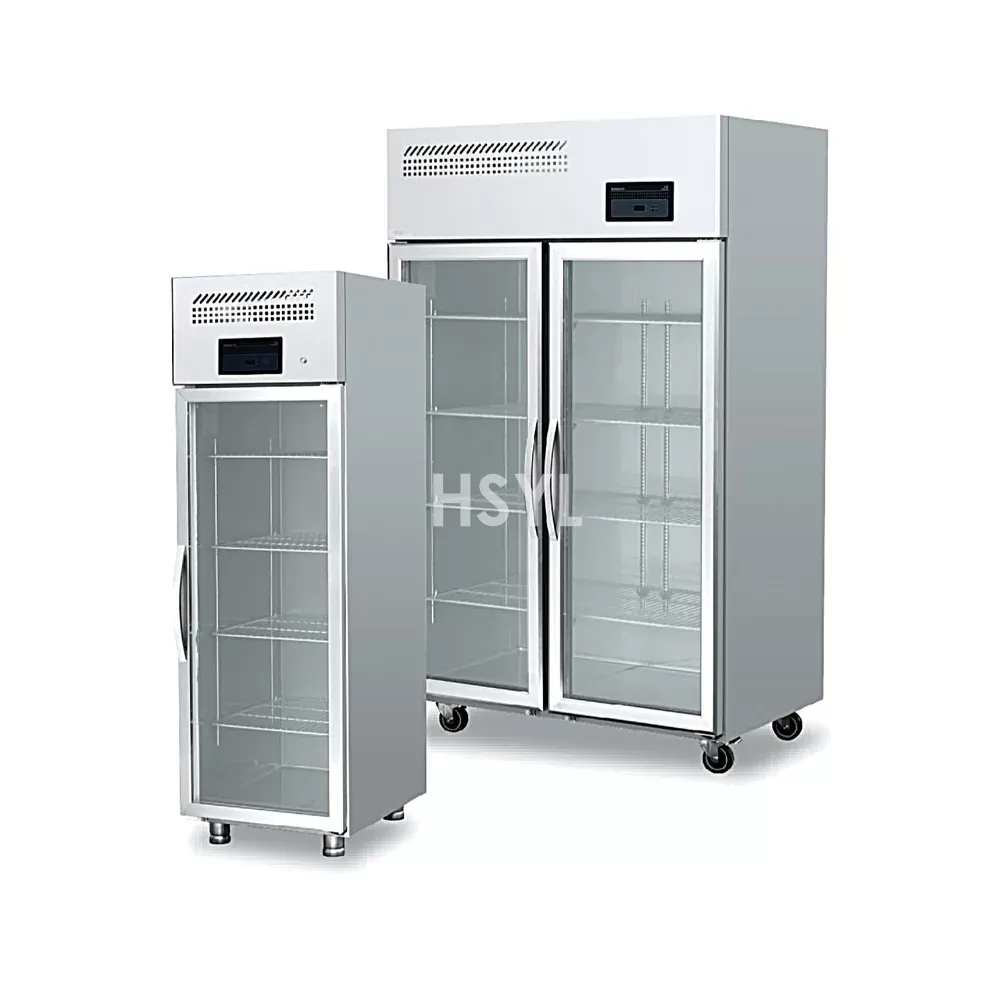
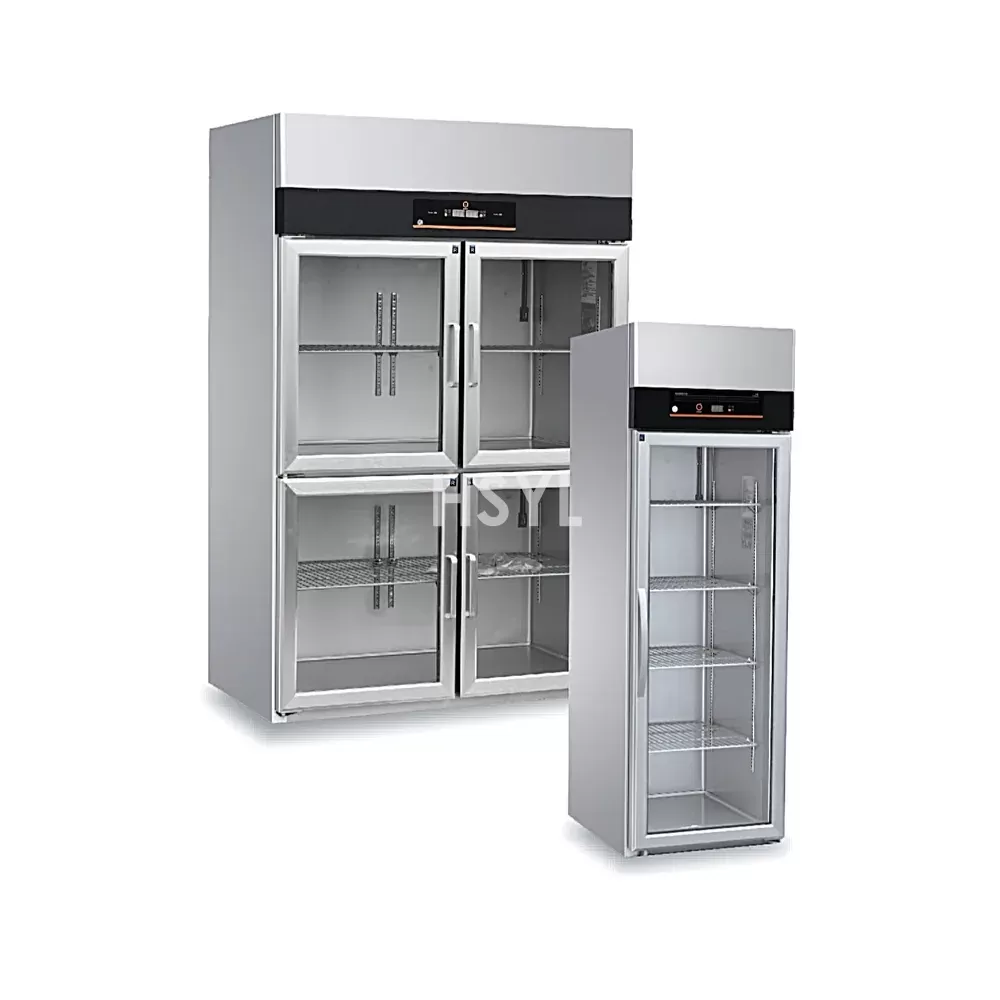
- Flat-Door A Sterilizer Cabinet — Compact alternative with 348L/740L options and single 125C temperature setting: ideal for facilities prioritizing footprint minimization or requiring a secondary dedicated sterilization station alongside the primary three-temperature unit for overflow capacity or physically separated work zones.
- Commercial Washing & Cleaning Machines — Essential upstream pre-cleaning step: HSYL washing machines remove visible food residue, grease film, and organic soil from items before they enter the disinfection chamber, dramatically improving final hygiene outcomes and reducing soil accumulation inside the sterilizer that would otherwise accelerate maintenance intervals.
- Commercial Kitchen Solutions — Comprehensive workflow planning guidance integrating the three-temperature disinfection cabinet into complete kitchen hygiene zone designs addressing layout optimization for wash-rinze-sanitize-warm sequences, 4.4 kilowatt utility coordination, personnel flow patterns minimizing cross-contamination, and spatial allocation for the 1310 by 660 millimeter wide-body footprint within overall kitchen geometry.
- Food Factory Layout & Cost Guide — Infrastructure reference for facilities deploying 720-liter 4.4 kilowatt thermal equipment: ventilation sizing for the elevated heat dissipation output of a 720-liter chamber at 120C operation, electrical panel and conductor gauge recommendations for 20 ampere continuous 220V loads, drainage coordination for condensate discharge, and spatial planning for the 1310 millimeter width dimension within hygiene zone layouts.
Request Three-Temperature Disinfection Cabinet Specification & Pricing
The 720JD210-3 Three Temperature Disinfection Cabinet delivers 120 degree Celsius, 80 degree Celsius, and 60 degree Celsius selectable operating modes within a single 720 liter, 10-layer, wide-body far infrared circulation chamber constructed entirely from SUS201 stainless steel. Designed specifically for high-throughput facilities managing diverse material inventories requiring tiered thermal treatment — from aggressive pathogen elimination through moderate sanitization to gentle warming — in one consolidated piece of equipment replacing multiple single-purpose alternatives. With 220V single-phase compatibility, integrated 12 centimeter caster mobility, and full customizability available for specialized dimensional or feature requirements, the unit adapts to demanding installation environments from institutional central kitchens to hotel group multi-outlet operations.
Contact HSYL today for detailed technical specifications, current pricing, customization options for specialized configurations, application guidance on temperature-mode selection strategies for your specific item mix profile, and logistical planning support for the 142 kilogram shipping weight and 1310 by 660 millimeter installation footprint requirements.