Central kitchen operators rarely question whether to automate — the question is where to start. A typical central kitchen has eight to twelve distinct equipment categories, all of them candidates for some level of automation, and almost no operator has the capital or operational bandwidth to upgrade everything at once. The decision that determines whether an automation program succeeds or stalls is not which equipment ultimately gets automated, but which equipment gets automated first. Upgrade the wrong category first and the capital is spent without measurable throughput gain, the management team loses confidence in the program, and the remaining upgrades never get funded. Upgrade the right category first and the payback funds the next upgrade, creating a self-reinforcing cycle that carries the kitchen toward full automation over 18 to 36 months.
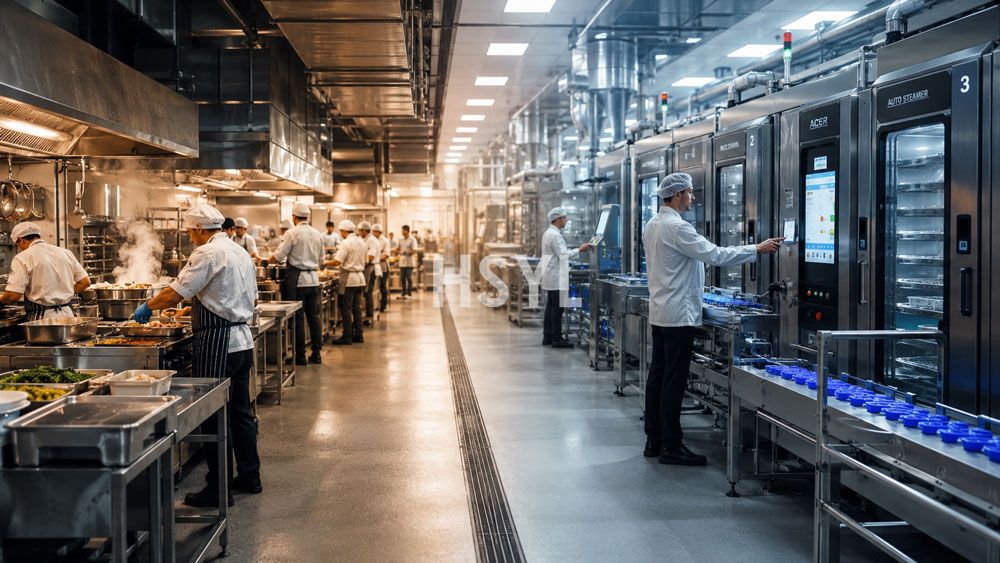
This guide walks through a five-step prioritization framework for sequencing central kitchen automation upgrades — from screening candidate equipment, to scoring each candidate on five ROI dimensions, to phasing the upgrades in a sequence that maximizes cumulative payback. The framework is built around a single principle: automate what delivers the fastest measurable payback first, not what is most technologically impressive or easiest to specify. For the broader context of how standalone machines evolve into an integrated smart factory over time, see the companion guide on how central kitchens can gradually achieve automation.
If your central kitchen is still in the planning phase rather than already operating, the complete kitchen equipment solutions overview covers the initial equipment specification workflow that precedes automation upgrade planning.
Why Sequencing Matters More Than Selection
Most central kitchen automation programs fail not because the wrong equipment was chosen but because the right equipment was chosen in the wrong order. Consider a common scenario: a central kitchen operator decides to automate the cooking range first because it is the most visible equipment and the most labor-intensive station. The upgrade costs $80,000, requires six weeks of installation downtime, disrupts service to multiple outlets during commissioning, and produces a measurable but modest 15% throughput improvement. Eighteen months later, when the operator proposes automating the washing station — which would have cost $35,000, required two weeks of downtime, and produced a 40% labor reduction — the management team has lost appetite for further automation investment because the first upgrade did not deliver the dramatic results they expected.
The washing station, had it been automated first, would have produced a faster payback, freed up labor capacity to absorb the cooking range upgrade downtime later, and built management confidence to fund the more complex cooking range automation. The same two upgrades, sequenced differently, produce opposite outcomes. This is why sequencing matters more than selection — and why a structured prioritization framework is essential before any automation capital is committed.
Practical Note: A useful rule of thumb: the first automation upgrade in a central kitchen should produce visible, measurable operational improvement within 90 days of installation, and full payback within 18 months. If the candidate upgrade cannot meet both thresholds, it is not the right first upgrade — regardless of how desirable it is in isolation. Save that upgrade for phase 2 or 3, when earlier successes have built the operational and financial momentum to support longer-payback investments.
Step 1: Screen Equipment Categories Against Five Automation Criteria
Before scoring specific equipment, screen every category in the central kitchen against five criteria that determine whether automation is even viable for that category. Equipment that fails two or more of these criteria should be deferred — it may eventually be automated, but not in the early phases of the program.
| Screening Criterion | What It Measures | Pass Threshold | Typical Fail Example |
|---|---|---|---|
| 1. Repetition frequency | How often the same task is performed identically | >20 identical cycles per shift | Custom-order cooking where every batch differs |
| 2. Labor intensity | Labor hours consumed per unit of output | >2 labor hours per 100 units output | Occasional-use specialty equipment |
| 3. Task standardization | Whether the task has defined inputs, outputs, and process steps | Written SOP with measurable parameters | Recipe development and testing stations |
| 4. Failure cost | Cost of a single task failure (rework, discard, compliance) | >$5 per failure incident | Low-value prep where mistakes are trivial |
| 5. Technology maturity | Whether proven commercial automation solutions exist | Multiple vendors with installed base | Experimental or custom-engineered processes |
Equipment that passes all five criteria moves to the scoring stage. Equipment that fails one criterion is a borderline candidate — score it but flag the concern. Equipment that fails two or more criteria should be excluded from the initial automation program and revisited only after phases 1 and 2 are complete.
Step 2: Score Each Candidate on Five ROI Dimensions
For equipment that passes the screening, score each candidate on five ROI dimensions using a 1-5 scale. The scoring is necessarily judgment-based — there is no universal database of automation ROI by equipment type — but the discipline of forcing explicit scores prevents the common error of choosing upgrades based on gut feel rather than structured comparison.
Dimension 1: Labor Reduction Potential
How much labor does the current manual operation consume, and what percentage of that labor can the automation eliminate? A category that consumes 40 labor hours per day with potential to eliminate 30 hours scores high (6 of 8 hours per worker freed); a category that consumes 4 labor hours per day with potential to eliminate 2 hours scores low. Score 1 for minimal labor reduction, 5 for transformational labor reduction.
Dimension 2: Throughput Gain Potential
How much does automation increase output capacity per unit of time? Some categories produce dramatic throughput gains (a manual washing station processing 200 pans per hour becomes an automated conveyor processing 800 pans per hour — 4x gain); others produce modest gains (a manual cooking range producing 100 meals per hour becomes a semi-automated range producing 130 meals per hour — 1.3x gain). Score 1 for negligible throughput gain, 5 for 3x or greater gain.
Dimension 3: Consistency Improvement
How much does automation reduce batch-to-batch variability? Categories where consistency is a major operational or compliance problem score high; categories where manual operation already produces consistent results score low. A steamer cabinet with programmable cycles eliminates the variability introduced by different operators setting different temperatures and times — high consistency gain. A refrigerator with IoT monitoring eliminates temperature excursions that occur when staff leave doors open — moderate consistency gain. Score 1 for no consistency change, 5 for eliminating a major consistency problem.
Dimension 4: Compliance Lift
Does the automation directly address a regulatory or audit requirement? Categories that produce compliance documentation automatically, eliminate a documented food safety risk, or satisfy a specific HACCP critical control point score high. A pass-through sterilizer with automated cycle logging directly supports HACCP compliance — high compliance lift. An automated slicer that improves portion consistency but does not affect compliance scores low. Score 1 for no compliance impact, 5 for directly resolving a compliance gap.
Dimension 5: Payback Speed
How quickly does the automation investment pay back through labor savings, throughput gains, and waste reduction? This dimension captures the financial reality that a $30,000 upgrade producing $20,000 in annual savings (18-month payback) is preferable to a $100,000 upgrade producing $25,000 in annual savings (48-month payback) for a first-phase upgrade, even though the second upgrade has higher absolute savings. Score 1 for payback over 48 months, 5 for payback under 12 months.
Composite Scoring and Ranking
Sum the five dimension scores for each candidate equipment category. The composite score ranges from 5 to 25, with higher scores indicating stronger automation upgrade candidates. The table below shows a typical scoring result for a mid-sized central kitchen producing 3,000 meals per day:
| Equipment Category | Labor Reduction | Throughput Gain | Consistency | Compliance | Payback Speed | Composite Score | Priority Rank |
|---|---|---|---|---|---|---|---|
| Washing (pot, pan, utensil) | 5 | 4 | 3 | 4 | 5 | 21 | 1 |
| Steaming (batch) | 4 | 3 | 5 | 3 | 4 | 19 | 2 |
| Ice production | 3 | 4 | 3 | 2 | 5 | 17 | 3 |
| Sterilization (pass-through) | 2 | 2 | 4 | 5 | 3 | 16 | 4 |
| Packaging (portioning) | 4 | 3 | 4 | 2 | 2 | 15 | 5 |
| Refrigeration monitoring | 1 | 1 | 4 | 4 | 4 | 14 | 6 |
| Preparation (slicing, mixing) | 3 | 2 | 3 | 1 | 3 | 12 | 7 |
| Cooking range (wok, griddle) | 2 | 2 | 3 | 1 | 1 | 9 | 8 |
Engineering Note: The ranking above is illustrative — actual scores vary based on your kitchen's specific labor costs, current equipment condition, menu mix, and regulatory environment. A central kitchen in a high-labor-cost market may score washing even higher because labor savings translate to greater dollar value; a central kitchen in a market with strict HACCP documentation requirements may score sterilization higher because compliance lift carries more operational weight. Run the scoring exercise with your own operational data rather than using the illustrative scores as a template.
Step 3: Validate the Top Three Candidates Against Operational Constraints
The composite scoring produces a ranked list, but the top-ranked candidate is not always the right first upgrade. Three operational constraints can shift the priority:
Constraint 1: Installation Downtime Tolerance
Some equipment categories cannot be taken offline for the installation period without disrupting service to downstream outlets. The cooking range is the extreme example — taking it offline for four weeks means the central kitchen cannot produce hot meals for four weeks, which is operationally unacceptable for most facilities. Washing stations, by contrast, can often be upgraded in phases (one of three washing lines upgraded at a time) or during scheduled shutdown periods, making installation downtime tolerable. If the top-ranked candidate requires unacceptable downtime, defer it to a phase when installation timing can be planned around a scheduled shutdown.
Constraint 2: Staff Training Capacity
Each automation upgrade requires staff training — on the new equipment operation, on the changed workflow around the equipment, and on the new monitoring and maintenance tasks. Training capacity is finite, especially in central kitchens with high staff turnover or limited management bandwidth. If two upgrades would compete for the same training window, sequence them so the higher-priority upgrade goes first and the second upgrade waits until the first is fully integrated into operations.
Constraint 3: Workflow Interdependency
Some equipment categories are upstream or downstream of each other in ways that affect upgrade sequencing. Automating the washing station increases the volume of clean pans returning to the cooking line — if the cooking line cannot absorb the increased pan turnover, the washing automation benefit is partially lost. In this case, the cooking line may need a smaller preparatory upgrade (additional burner capacity or workflow reconfiguration) before the washing automation delivers full benefit. Map the workflow interdependencies before finalizing the sequence.
Step 4: Phase the Upgrades in a Self-Funding Sequence
With the validated priority list, structure the upgrades into phases that allow early successes to fund later phases. A typical phased automation roadmap for a mid-sized central kitchen spans 18 to 36 months:
| Phase | Timeline | Equipment Upgraded | Capital Range | Expected Cumulative Payback | Phase Gate Criteria |
|---|---|---|---|---|---|
| Phase 1: Foundation | Months 1-6 | Washing automation, ice production upgrade | $30k-$80k | 15-25% of phase capital | Labor reduction verified; staff transitioned to higher-value tasks; no service disruption |
| Phase 2: Process | Months 7-12 | Steaming automation, holding and warming automation | $50k-$120k | 40-60% of cumulative capital | Throughput gain verified; consistency variance reduced; Phase 1 payback on track |
| Phase 3: Integration | Months 13-18 | Cooking range partial automation, packaging automation, sterilizer upgrade | $80k-$200k | 60-80% of cumulative capital | Workflow integration verified; Phase 1 and 2 upgrades operating at design capacity |
| Phase 4: Intelligence | Months 19-36 | IoT monitoring, predictive maintenance, production analytics, recipe management system | $40k-$150k | Full program payback approaching | Data infrastructure in place; management reporting automated; program ROI validated |
The phase gate criteria are critical — each phase must demonstrate measurable success before the next phase is funded. If Phase 1 does not produce the expected labor reduction and payback trajectory, do not proceed to Phase 2 on schedule. Instead, diagnose what went wrong (often it is a workflow integration issue rather than an equipment performance issue), correct it, and re-baseline the Phase 2 timeline.
Step 5: Measure Post-Upgrade ROI and Adjust the Roadmap
The final step in the prioritization framework is measurement — without which the phased roadmap becomes a static plan rather than a dynamic program. Five metrics should be tracked from before the first upgrade and continuously thereafter:
| Metric | What It Measures | Measurement Frequency | Target Trajectory |
|---|---|---|---|
| Labor cost per meal | Total labor cost divided by meals produced | Weekly | 15-30% decline over 24 months |
| Throughput per labor hour | Meals produced divided by labor hours | Weekly | 25-50% increase over 24 months |
| Batch consistency variance | Standard deviation of key product parameters | Monthly | 40-60% reduction over 24 months |
| Compliance audit score | Internal or third-party audit results | Quarterly | Maintenance or improvement, no regressions |
| Cumulative payback percentage | Cumulative savings divided by cumulative capital | Monthly | 100% within 24-36 months of program start |
If any metric fails to track toward its target trajectory, the roadmap should be adjusted — either by changing the next-phase equipment selection, modifying the upgrade sequence, or pausing to address integration issues before proceeding. Automation programs that ignore unfavorable measurement data and proceed on schedule tend to produce compounding problems; programs that adjust based on measurement data tend to recover and achieve full program ROI.
Value Angle: The single most common reason central kitchen automation programs underperform is that measurement stops at equipment installation. The upgrade is installed, the supplier commissioning report is filed, and the operational metrics are never re-baselined against the pre-upgrade state. Without continuous measurement, there is no way to know whether the upgrade delivered the expected ROI — and no way to make informed decisions about subsequent phases. Build the measurement infrastructure before the first equipment upgrade is installed, not after.
Common Prioritization Mistakes to Avoid
Before finalizing your automation upgrade sequence, review these common mistakes that the five-step framework is designed to prevent:
- Mistake 1: Automating the most visible equipment first. Cooking ranges and primary ovens are the most visible equipment in a central kitchen and often the first candidates for automation. They are also among the most expensive and slowest-payback upgrades. Visibility is not a valid prioritization criterion — ROI is.
- Mistake 2: Automating the cheapest equipment first. The mirror-image mistake is choosing the lowest-capital upgrades first to minimize risk. Low-capital upgrades often produce low labor savings and low throughput gains, meaning the payback is slow relative to the operational disruption. Payback speed, not capital amount, should drive sequencing.
- Mistake 3: Automating based on supplier recommendations. Equipment suppliers naturally recommend automating their own product category first. A washing equipment supplier will recommend washing automation; a cooking range supplier will recommend cooking range automation. The prioritization framework must be run internally with operational data, not delegated to suppliers with inherent category bias.
- Mistake 4: Skipping the screening step. Some equipment categories are poor automation candidates regardless of how they score on ROI dimensions — they fail one or more of the screening criteria. Forcing automation onto a category that is not repetitive, not labor-intensive, or not standardized produces upgrades that never deliver expected benefits and undermine the program.
- Mistake 5: Treating the roadmap as fixed. The phased roadmap is a plan, not a commitment. Operational data from Phase 1 should inform Phase 2 decisions; Phase 2 data should inform Phase 3. Programs that proceed on the original schedule regardless of measurement data tend to fail; programs that adjust based on data tend to succeed.
Resources for Central Kitchen Automation Planning
Once you have worked through the five-step prioritization framework, the following resources support the detailed equipment specification and broader central kitchen planning that surrounds an automation upgrade program:
- How central kitchens can gradually achieve automation — Companion guide covering the broader progression from standalone manual equipment to integrated smart factory operation, providing the strategic context within which individual upgrade sequencing decisions are made.
- Complete kitchen equipment solutions overview — How individual automated equipment categories integrate into a complete central kitchen workflow, with configuration examples for different production scales and automation maturity levels.
- Automatic Steamer Cabinet specifications — Example of a high-priority Phase 2 automation upgrade candidate, with automation features that reduce per-cycle operator tasks and improve batch consistency for high-volume steaming operations.
- Food factory engineering layout and cost guide — Layout planning and cost allocation methodology that supports the phased automation roadmap, including utility infrastructure sizing for future automation equipment and floor space reservation for Phase 3 and 4 upgrades.
- How to start a food product line — Business planning framework applicable to central kitchen operators evaluating automation investment as part of broader production line expansion or new product launch decisions.
Frequently Asked Questions
Which equipment should be automated first in a central kitchen?
How do I calculate ROI for kitchen equipment automation?
What is the typical payback period for central kitchen automation upgrades?
Should I automate the cooking range first in a central kitchen?
How do I phase central kitchen automation upgrades?
What are the screening criteria for kitchen equipment automation candidates?
How much labor does central kitchen automation save?
How do I measure central kitchen automation success?
Related Articles



Get professional consultation
Do you have any questions or need technical support regarding the content of this article? Fill out the form below, and our expert team will provide you with professional solutions.