Hotel breakfast service is one of the most demanding operational windows in commercial food service. A 150-room hotel can see 200 or more guests move through the breakfast room between 6:30 AM and 9:30 AM — a three-hour service window in which the kitchen must produce eggs to order, maintain a buffet line of 20 to 30 hot and cold items, replenish pastries faster than they are consumed, and keep coffee and juice flowing without interruption. Unlike a restaurant that can pace covers across a six-hour dinner service, the hotel breakfast kitchen must hit peak output within the first 90 minutes of operation and sustain it without visible strain.
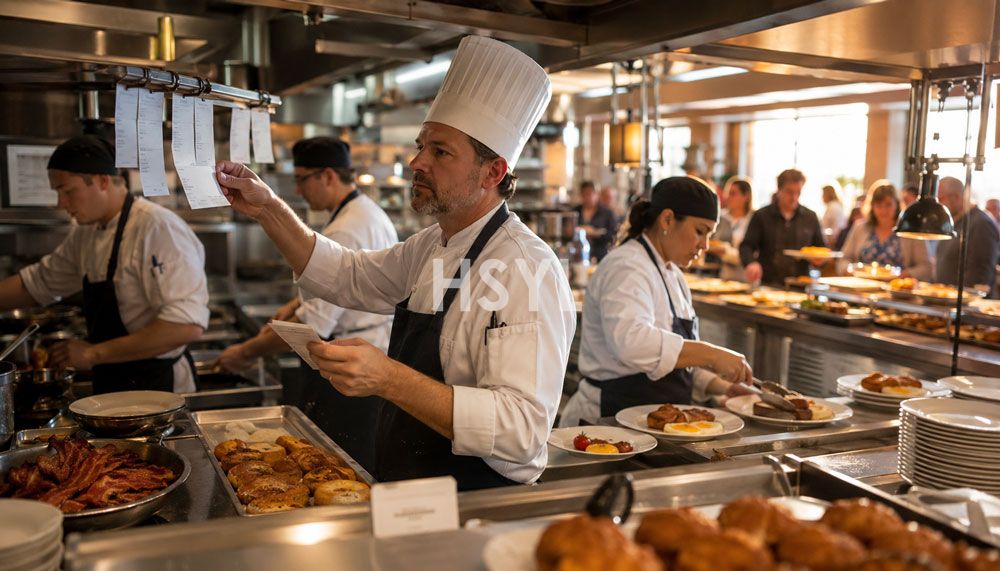
This guide covers how to plan a hotel kitchen equipment package specifically for breakfast service, from calculating peak-hour demand based on guest count and occupancy patterns, to sequencing buffet and à la carte station equipment, to designing the kitchen zoning that allows simultaneous service without staff congestion. The framework applies whether you are equipping a 60-room limited-service hotel with continental breakfast or a 400-room full-service property with buffet, à la carte, and room service breakfast operations running in parallel.
If your hotel project involves broader kitchen infrastructure beyond breakfast service — including banquet operations, all-day dining, or a central commissary supporting multiple outlets — the complete kitchen equipment solutions overview covers the integrated workflow planning required at that scale.
Step 1: Calculate Peak-Hour Demand Based on Guest Count and Service Window
The first step in planning any hotel breakfast kitchen equipment package is understanding the actual demand the kitchen must meet during peak service. Many hotel operators make the mistake of calculating demand based on average occupancy across the full breakfast window, then discovering that the kitchen cannot keep up when 60% of guests arrive between 7:30 AM and 8:30 AM.
Peak-Hour Demand Calculation
The calculation starts with four inputs that every hotel operator already tracks:
| Input | How to Determine | Example (150-room hotel) |
|---|---|---|
| Total room count | Hotel property data | 150 rooms |
| Average occupancy rate | Historical occupancy data for the property | 75% (113 rooms occupied on average) |
| Average guests per room | Guest demographic data (business vs. leisure mix) | 1.6 guests/room (180 guests on average) |
| Breakfast participation rate | Percentage of in-house guests who eat breakfast at the hotel (depends on whether breakfast is included in room rate) | 70% (126 breakfast guests on average) |
Once the average breakfast guest count is established (126 guests in the example), the next step is distributing those guests across the service window. Hotel breakfast demand typically follows a predictable bell curve with peak between 7:30 AM and 8:30 AM on weekdays (business travelers heading to meetings) and 8:30 AM to 9:30 AM on weekends (leisure travelers sleeping in). The peak hour typically absorbs 40-55% of total breakfast guest volume.
| Time Window | Weekday Guest Distribution | Weekend Guest Distribution | Implication for Kitchen |
|---|---|---|---|
| 6:00-6:59 AM | 15% of guests | 8% of guests | Low-intensity warmup; batch cooking for first replenishment |
| 7:00-7:59 AM | 30% of guests | 18% of guests | Ramp-up; first major replenishment cycle |
| 8:00-8:59 AM (peak) | 40% of guests | 32% of guests | Full output; continuous replenishment; à la carte orders stack |
| 9:00-9:59 AM | 12% of guests | 30% of guests | Sustained output on weekends; wind-down on weekdays |
| 10:00-10:30 AM | 3% of guests | 12% of guests | Final service; buffet breakdown begins |
Practical Note: The 40-55% peak-hour concentration is the single most important number in hotel breakfast kitchen planning. A 150-room hotel averaging 126 breakfast guests per day will see 50-70 guests arrive during the peak hour. The kitchen equipment package must be sized to serve 50-70 covers in that hour — not 126 covers spread across four hours. Every equipment decision in the following steps flows from this peak-hour number.
Step 2: Choose the Service Format: Buffet, À La Carte, or Hybrid
The equipment package depends fundamentally on the service format the hotel offers. Three primary formats exist, each with different equipment requirements:
Format 1: Buffet-Only Service
The most common format for mid-scale and limited-service hotels. Guests serve themselves from a buffet line; kitchen staff focus on cooking in batches and replenishing buffet pans rather than cooking to order. Equipment emphasis is on:
- Batch cooking capacity — large-capacity steamers, ovens, and griddles that can produce 50+ portions per batch
- Hot holding equipment — chafing dishes, bain-marie warmers, and heat lamps that maintain food at safe serving temperature (above 60°C) during the 30-60 minutes it sits on the buffet line
- Cold display refrigeration — refrigerated buffet tables for fruit, yogurt, juice, and cold cuts maintained at 4°C or below
- Rapid replenishment workflow — kitchen layout that allows staff to move cooked food from kitchen to buffet in under 60 seconds
Format 2: À La Carte Service
Common in upscale and luxury hotels where guests order from a menu and receive plated breakfast. Kitchen staff cook to order rather than batch cooking. Equipment emphasis shifts to:
- Cook-to-order capacity — multiple smaller griddles, ranges, and egg stations that allow simultaneous cooking of different orders
- Ticket management system — point-of-sale integration that routes orders to the correct station and tracks completion
- Plating area — dedicated assembly space where multiple plates can be finished simultaneously
- Faster preheat equipment — equipment that reaches operating temperature quickly to handle order spikes without lag
Format 3: Hybrid Service (Buffet Plus À La Carte)
The most operationally demanding format, common in full-service hotels where guests can choose buffet or order from a menu. The kitchen must handle both batch cooking for buffet replenishment and cook-to-order for à la carte tickets simultaneously. Equipment requirements include both the buffet-format batch capacity and the à la carte-format cook-to-order agility, plus clear physical separation between the two workflows to prevent congestion.
Engineering Note: Hybrid service is the most expensive format to equip because it requires approximately 1.5x the equipment of either single-format approach. Many hotels underestimate this and end up with a kitchen that handles neither format well — the buffet runs out of hot items while the à la carte tickets back up because the same cooking equipment is being used for both. If your hotel commits to hybrid service, budget for two parallel cooking workflows: one batch-oriented for buffet and one order-oriented for à la carte.
Step 3: Specify Equipment by Breakfast Station
Hotel breakfast service organizes into six functional stations, each with distinct equipment requirements. The equipment package should be specified station by station rather than as a single undifferentiated list, because each station's output must match its specific peak-hour demand.
Station 1: Egg and Omelet Station
The highest-traffic station in most hotel breakfast kitchens. Eggs cook quickly but require constant attention, making this station the bottleneck that limits total kitchen throughput if under-equipped.
- Commercial griddle — 600-900 mm width for buffet batch cooking (scrambled eggs, fried eggs); 900-1200 mm for à la carte omelet cooking. The Cooking Range 700 Series with integrated griddle workstation suits most hotel egg stations.
- Under-counter egg refrigerator — holds 200-500 eggs within arm's reach of the griddle to prevent trips to walk-in during peak service.
- Whip and bowl station — for scrambled egg batter preparation; commercial mixer for high-volume properties.
- Heat lamp or holding warmer — for holding finished scrambled eggs at safe temperature during buffet service.
Station 2: Bacon, Sausage, and Hot Protein Station
Batch-cooking station that produces bacon, sausage links, breakfast potatoes, and sometimes ham steaks. Equipment must handle high-volume batch cooking and grease management.
- Commercial convection oven — preferred over griddle for bacon batch cooking because it handles larger quantities with less grease splatter. The Full-View Electric Oven with 2-4 deck configurations suits most hotel protein stations.
- Flat-top griddle — for sausage links and breakfast potatoes that benefit from direct contact heat.
- Grease management system — grease tray, disposal container, and ventilation hood sized for the grease load.
- Holding warmer — for maintaining cooked bacon and sausage at serving temperature on the buffet line.
Station 3: Pancake, Waffle, and Hot Grain Station
Specialized station for made-to-order pancakes, waffles, and hot cereals. In buffet formats, this often becomes a guest-facing action station where guests watch the cook prepare items to order.
- Waffle iron — single or double unit depending on volume; Belgian waffle irons most common in hotel settings.
- Pancake griddle — dedicated section of griddle for pancake cooking; 300-600 mm width sufficient for most properties.
- Oatmeal and hot cereal warmer — bain-marie or steam table pan for holding hot cereals at serving temperature.
- Batter refrigerator — small under-counter unit for holding prepared pancake and waffle batter at safe temperature.
Station 4: Steamed Item and Asian Breakfast Station
Essential for hotels serving international guests or in Asian markets where steamed dim sum, bao, congee, and steamed vegetables are expected breakfast items. Even hotels in Western markets increasingly include a steamer for oatmeal, hard-boiled eggs, and steamed vegetables.
- Commercial steamer cabinet — sized to property volume. For most hotels serving 100-200 breakfast guests, a 12-tray automatic steamer cabinet handles typical steamed item volume; properties with larger international guest populations may require 24-tray capacity.
- Congee or porridge warmer — separate holding equipment for rice porridge, maintained at serving temperature throughout service.
- Steamed bun proofing and holding — for properties serving bao or steamed dim sum, proofing cabinet for frozen items and warmer for finished product.
Station 5: Pastry, Toast, and Bakery Station
Handles bread, pastries, croissants, muffins, and toast. This station generates high guest traffic but relatively low kitchen cooking load — most items are baked off from frozen or par-baked and finished on-site.
- Commercial toaster — conveyor toaster for buffet service (200-400 slices per hour capacity) or pop-up toasters for lower-volume properties.
- Convection oven — for finishing croissants, pastries, and muffins from frozen or par-baked. The same oven used for the protein station can often handle pastry finishing if scheduled properly.
- Pastry display and holding — room-temperature display for items best served at ambient temperature; heated display for items served warm.
- Bread slicer — for properties slicing whole loaves on-site.
Station 6: Beverage Station
Often the highest-traffic station in the breakfast room. Coffee, juice, and hot tea service must keep pace with guest arrival without lines forming.
- Commercial coffee maker — airpot brewers for lower-volume properties; thermal server or satellite brewers for higher-volume; espresso machine for upscale properties.
- Juice dispenser — refrigerated multi-flavor dispenser for orange, apple, and grapefruit juice.
- Hot water dispenser — for tea and instant oatmeal; separate from coffee equipment to prevent flavor transfer.
- Ice maker — for properties offering iced beverages or where breakfast transitions to all-day dining. A mid-capacity cube ice maker typically covers breakfast beverage demand.
Step 4: Design Kitchen Zoning for Simultaneous Service
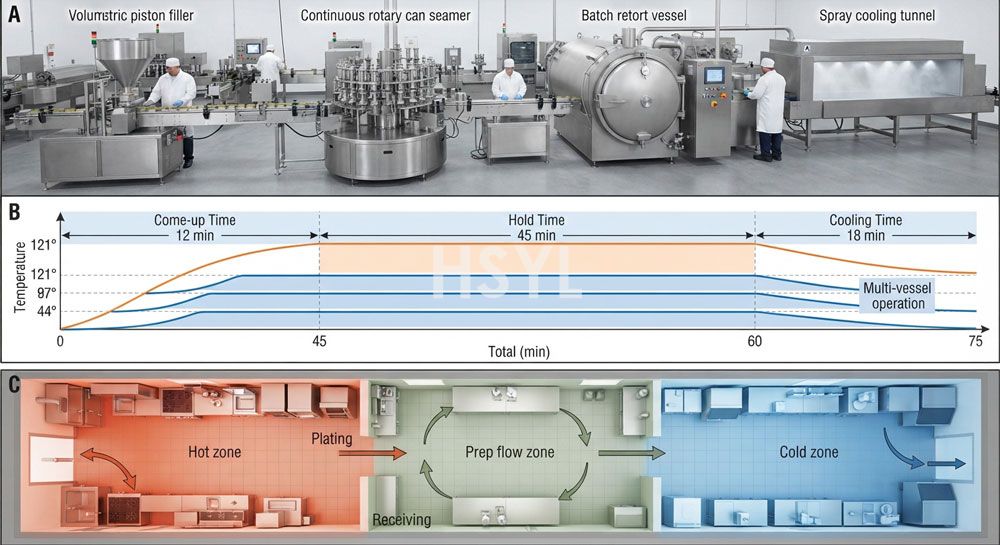
Once the equipment is specified by station, the next step is arranging the stations into a kitchen layout that allows simultaneous service without staff congestion. Hotel breakfast kitchens typically organize into five zones:
| Zone | Stations Included | Location Principle | Typical Footprint Share |
|---|---|---|---|
| Hot Cooking Zone | Egg, Protein, Pancake, Steamed Item | Central, near exhaust hoods and utility connections | 35-40% of kitchen area |
| Cold Prep Zone | Fruit prep, juice prep, cold plate assembly | Away from hot zone to prevent heat load on refrigeration | 15-20% of kitchen area |
| Pastry and Bakery Zone | Pastry finishing, toasting, bread slicing | Adjacent to service pass for fast buffet replenishment | 10-15% of kitchen area |
| Beverage Zone | Coffee, juice, hot water, ice | Often front-of-house or at service pass for guest access | 10-15% of kitchen area |
| Plating and Assembly Zone | Buffet pan filling, à la carte plating | Between hot cooking zone and service pass | 15-20% of kitchen area |
The key zoning principle is that staff movement between zones should follow a linear or U-shaped flow rather than crossing back and forth. A line cook working the egg station should be able to pass finished eggs directly to the plating zone without crossing the path of the pastry cook or the beverage attendant. Cross-traffic during peak service is the primary cause of slowdowns and accidents in hotel breakfast kitchens.
Practical Tip: Before finalizing the kitchen layout, simulate a peak-service scenario with all stations operating simultaneously. Walk through the kitchen as each station's cook would — from ingredient retrieval at the refrigerator, to cooking at the station, to plating at the assembly zone, to delivery at the service pass. If any path crosses another cook's path more than once per cycle, the layout needs adjustment. This simulation takes 30 minutes and prevents layout problems that would otherwise surface on the first busy morning of operation.
Step 5: Plan Pre-Service Setup and Replenishment Workflow
Hotel breakfast kitchen equipment must support not just the peak service window but the pre-service setup that precedes it and the replenishment cycles that sustain it. A common planning mistake is to focus entirely on peak-hour cooking capacity and ignore the setup workflow that determines whether the kitchen is ready when the first guest arrives.
Pre-Service Setup Sequence
A typical hotel breakfast kitchen pre-service setup follows a 90-120 minute sequence before the first guest is served:
- Equipment power-on and preheat (60-90 minutes before service) — ovens, griddles, steamers, and warmers brought to operating temperature. Coffee brewers started and first batch brewed.
- Cold prep and ingredient pull (45-60 minutes before service) — fruit washed and cut, juice prepared, cold plates assembled, refrigerators stocked with service-day ingredients.
- Initial batch cooking (30-45 minutes before service) — first batches of bacon, sausage, scrambled eggs, and steamed items prepared for buffet line opening. Pastries finished in oven.
- Buffet line setup (15-30 minutes before service) — buffet pans filled, chafing dishes lit, beverage dispensers filled, plates and utensils staged.
- Final check and service start (5-15 minutes before service) — temperature checks on all hot and cold items, staff briefing on menu and any special items, doors open for first guest.
Replenishment Cycle Planning
During peak service, the kitchen must replenish buffet items on a continuous cycle rather than waiting for items to run out before cooking more. A typical replenishment cycle for a 150-room hotel during peak hour:
| Buffet Item | Initial Batch Size | Replenishment Trigger | Replenishment Cook Time |
|---|---|---|---|
| Scrambled eggs | 50 portions | When 30% remains (15 portions left) | 8-10 minutes per batch |
| Bacon | 40 portions | When 25% remains (10 portions left) | 15-18 minutes per batch in convection oven |
| Sausage links | 50 portions | When 25% remains | 12-15 minutes per batch |
| Breakfast potatoes | 60 portions | When 30% remains | 20-25 minutes per batch in oven |
| Pancakes | 30 portions | When 40% remains (faster turnover) | 5-7 minutes per batch on griddle |
| Steamed dim sum | 40 portions | When 30% remains | 10-12 minutes per batch in steamer |
The replenishment cycle reveals an important equipment planning principle: batch cook time must be shorter than the time it takes guests to consume the remaining inventory. If scrambled eggs take 10 minutes to cook a new batch but guests consume the remaining 15 portions in 5 minutes, the buffet will run empty before the next batch is ready. Either increase initial batch size, add a second griddle for parallel batch cooking, or accept periodic empty buffet pans during peak — none of which is acceptable in a well-run hotel breakfast operation.
Step 6: Coordinate with Hotel Operations and Front Desk
The kitchen equipment package is only one component of a successful hotel breakfast operation. The kitchen must coordinate with hotel front desk and operations to anticipate demand and prepare accordingly:
- Daily occupancy forecast — front desk should provide the kitchen with next-day occupancy and expected breakfast guest count by 8 PM the previous evening, allowing the kitchen to scale prep and batch cooking accordingly.
- Group and convention notification — when large groups or conventions are in-house, breakfast demand can spike 50-100% above normal occupancy. Front desk should notify the kitchen 24-48 hours in advance so additional staff and ingredient inventory can be arranged.
- Room service breakfast coordination — if the hotel offers room service breakfast, the kitchen must handle room service tickets simultaneously with buffet and à la carte service. Room service orders typically peak 30-60 minutes before buffet peak as business travelers eat early before meetings.
- Special dietary request communication — front desk should collect and communicate special dietary requirements (gluten-free, vegan, kosher, halal, allergies) at check-in so the kitchen can prepare appropriate items in advance rather than improvising during peak service.
Resources for Hotel Kitchen Equipment Planning
Once you have worked through the six-step planning framework, the following resources support detailed equipment specification and broader hotel kitchen project planning:
- Complete commercial kitchen equipment solutions overview — How hotel breakfast kitchen equipment integrates into the broader hotel kitchen operation including all-day dining, banquet service, and room service support.
- Cooking Range 700 Series specifications — Reference hot cooking equipment configuration for hotel egg and protein stations, with model-by-model capacity data for matching equipment to guest count.
- Automatic Steamer Cabinet specifications — Steamer cabinet sizing for steamed breakfast items, dim sum, and congee holding, with automation features that reduce per-cycle operator tasks during peak breakfast service.
- How to start a food product line — Business planning framework applicable to hotel operators evaluating new breakfast concepts, in-house bakery production, or expanded grab-and-go breakfast service.
Frequently Asked Questions
How many guests can a hotel breakfast kitchen serve per hour?
What equipment does a hotel breakfast kitchen need at minimum?
How do I size a hotel breakfast kitchen for a 200-room property?
Should a hotel breakfast be buffet or à la carte?
How early should hotel breakfast kitchen staff start prep?
What is the peak hour for hotel breakfast service?
How do I prevent buffet items from running out during peak service?
How does room service breakfast coordinate with buffet service?
Related Articles


Get professional consultation
Do you have any questions or need technical support regarding the content of this article? Fill out the form below, and our expert team will provide you with professional solutions.