Starting a food product line sounds exciting. When I first got involved in food manufacturing projects, I honestly thought it was mostly about having a good recipe and buying a few machines. But after years of working directly with food processing factories — especially companies trying to start or upgrade their production lines — I can confidently say this:
Starting a food product line is not about food alone. It is about systems, numbers, and long-term decisions.
In this article, I want to share how I actually approach starting a food product line today, based on real production line projects, real capacity targets, and real mistakes that I have seen (and sometimes made myself). This is not theory. This is what happens on the factory floor.

Why Most People Underestimate How Hard It Is to Start a Food Product Line
From the outside, food manufacturing looks simple. You see finished products on supermarket shelves and assume the process behind them must be straightforward. That assumption is one of the biggest reasons new food product lines fail or struggle.
When people talk to me for the first time, they usually focus on:
The product flavor
The packaging design
The selling price
Very few people initially talk about:
Line stability
Real hourly capacity
Downtime and maintenance
Food safety control points
Operator dependency
I used to underestimate these factors too.
What surprised me most was how quickly small technical problems can turn into big business problems. A minor filling inconsistency, a sterilization bottleneck, or an unreliable seaming machine can destroy daily output targets and customer trust at the same time.
That is when I learned a hard truth:
In food manufacturing, stability matters more than speed, and systems matter more than individual machines.
My Real Experience: Upgrading an Old Canned Fish Production Line in Algeria
One of the most memorable projects I worked on involved a canned fish manufacturer in Algeria. This case completely changed how I think about starting a food product line.
The Initial Situation
The client already had a production line — but it was a patchwork of old, second-hand equipment sourced from different suppliers over many years. On paper, the line was supposed to handle their production needs. In reality, it was a constant struggle.
Key parameters were very clear:
Product: canned fish
Can size: 125 g
Target capacity: 8,000 cans per hour
At the beginning, the client’s idea was simple:
“Can we just repair the old machines, add a few missing parts, and keep running?”
From a distance, that seemed reasonable. But once we looked deeper, the problems became obvious.
The Real Problems with Old Equipment
The issues were not dramatic breakdowns. They were worse — small, recurring problems:
Frequent unplanned stoppages
Inconsistent filling weight
Unstable sterilization results
High manual labor dependence
Difficult sanitation and cleaning
Every hour of downtime meant lost output. Every unstable batch meant risk. And every “temporary fix” added more uncertainty to the system.
At one point, I realized something uncomfortable:
They were spending more money maintaining problems than producing products.
Repairing Old Equipment vs. Building a New Food Product Line
This is a question almost every food manufacturer faces at some stage:
Should we repair and upgrade what we have, or should we invest in a new production line?
In this Algerian project, we compared both options carefully.
Repairing the Old Line Looked Cheaper — at First
Repairing old machines usually feels like the safer option:
Lower upfront investment
Familiar equipment
No major layout changes
But when we calculated the hidden costs, the picture changed:
Spare parts were harder to source
Downtime was unpredictable
Capacity could not be guaranteed
Automation was limited
Food safety compliance was harder to document
Building a New Production Line Was the Turning Point
For a target of 8,000 cans per hour, a fully integrated new canned fish production line made more sense:
All machines designed to work as one system
Stable, designed capacity instead of theoretical numbers
Modern PLC control and automation
Easier compliance with food safety standards
Lower long-term operating cost
My conclusion was clear:
For medium-to-high capacity food production, repairing old equipment is often the most expensive option in the long run.
That is why the client ultimately decided to purchase a brand-new canned fish production line, designed specifically for their product and capacity.
How I Actually Start a Food Product Line Today (Step by Step)
Over time, my approach to starting a food product line has become much more structured. I no longer start with machines. I start with clarity.
Step 1: Define the Product in Detail
I always begin by locking down the basics:
Product type
Packaging format
Net weight
Shelf life requirements
For example, “canned fish” is not specific enough.
“125 g canned fish with oil, sterilized, shelf-stable” is.
This definition affects everything downstream.
Step 2: Calculate Realistic Production Capacity
One of the biggest mistakes I see is confusing theoretical capacity with real output.
If a client tells me they want:
8,000 cans per hour
I immediately ask:
How many shifts per day?
Planned downtime?
Cleaning and changeover time?
Maintenance windows?
In most factories, real effective capacity is 70–80% of theoretical capacity. Once people see the real numbers, expectations become more realistic — and planning becomes more accurate.
Step 3: Design the Entire Process Flow, Not Individual Machines
A food product line is only as strong as its weakest point.
I map the full process:
Raw material handling
Pre-processing
Filling
Seaming
Sterilization
Cooling
Drying
Packing
If one machine cannot match the rhythm of the rest, the entire line suffers. Designing the line as a complete system is critical.
Step 4: Match Equipment to Food Safety Standards
Food safety is not optional. It is a design requirement.
I look at:
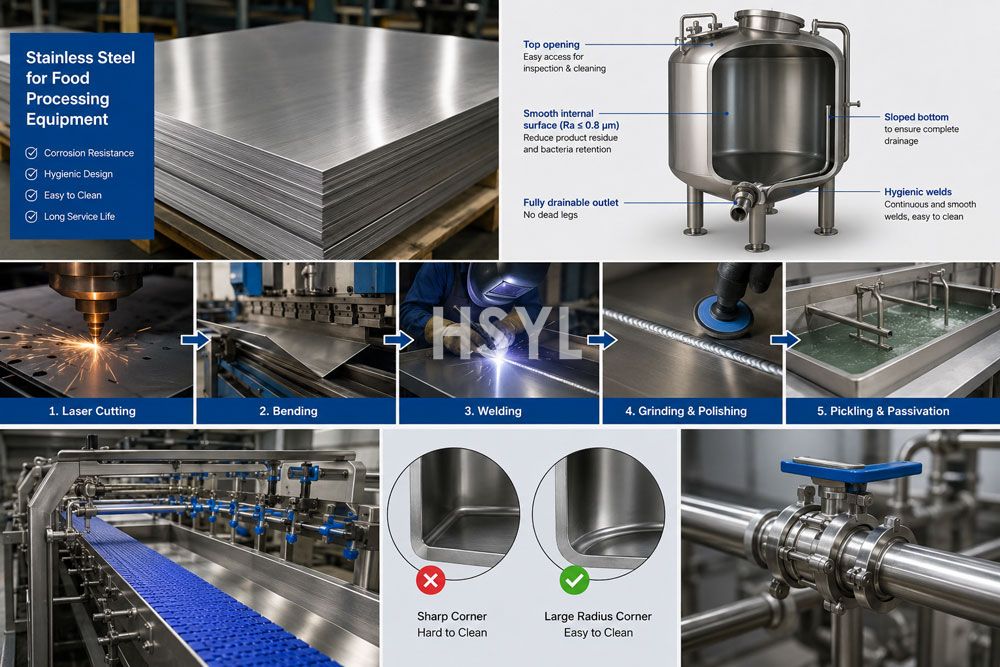
Stainless steel grades (SUS304 or SUS316)
Hygienic design
CIP compatibility
Temperature and pressure control
Data recording and traceability
Retrofitting food safety later is always harder and more expensive than designing for it from the start.
Step 5: Balance Automation and Labor Cost
Automation is not about replacing people. It is about reducing risk and variability.
In regions where labor costs are rising or skilled operators are hard to find, automation provides:
More consistent quality
Lower training dependency
Higher repeatability
In the Algerian project, increasing automation significantly reduced operator-related errors and improved daily output stability.
Step 6: Leave Room for Future Expansion
I always design food product lines with the future in mind:
Can capacity be increased later?
Can packaging formats change?
Is layout flexible?
Starting a food product line is not just about today’s market. It is about what happens two or five years later.
The Real Numbers People Rarely Talk About
This is the part many brochures avoid.
8,000 cans/hour does not mean 64,000 cans/day automatically
Cleaning time matters
Maintenance matters
Human factors matter
When we ran the numbers honestly in the Algerian project, the difference between theoretical and real output was eye-opening.
But that transparency helped the client plan inventory, staffing, and sales targets much more realistically.
What I Look for in Food Processing Equipment Today
After seeing many factories struggle with “cheap solutions,” my criteria are very clear.
I prioritize:
Equipment reliability
Process consistency
Supplier experience in similar projects
After-sales support
Long-term spare parts availability
One strong belief guides me:
Cheap equipment is often the most expensive choice over time.
Common Mistakes When Starting a Food Product Line
From my experience, these mistakes repeat again and again:
Buying machines separately without system integration
Ignoring downtime and maintenance planning
Overestimating initial capacity
Choosing price over reliability
Delaying food safety considerations
Avoiding these mistakes can save months — sometimes years — of frustration.
My Final Advice to Anyone Starting a Food Product Line
If I had to summarize everything I have learned, it would be this:
Do not think in machines — think in systems
Do not chase the lowest price — chase stability
Do not plan for “perfect days” — plan for real operations
Starting a food product line is challenging, but when done correctly, it is also incredibly rewarding.
If I could start over, knowing what I know now, I would invest in a complete, well-designed production line from day one, rather than trying to fix problems later.
That mindset has made all the difference.
Why This Matters for You
Whether you are:
Launching your first food product
Upgrading an old factory
Expanding capacity for new markets
The decisions you make at the beginning will define your success far more than most people realize.
And from everything I have seen so far, clarity, planning, and system-level thinking are what truly separate struggling food factories from sustainable ones.
Related Articles



Get professional consultation
Do you have any questions or need technical support regarding the content of this article? Fill out the form below, and our expert team will provide you with professional solutions.