Tube heat exchangers are among the most widely deployed thermal processing devices in commercial food production, yet they are also among the most frequently mis-specified. A food manufacturer ordering a heat exchanger for tomato paste processing faces materially different requirements from one ordering a unit for HTST milk pasteurization — and a unit that performs flawlessly in one application may foul, corrode, or underperform catastrophically in the other. The selection mistake is rarely a question of brand or price; it is almost always a question of matching tube geometry, material, flow configuration, and sanitation design to the specific food product and process conditions.
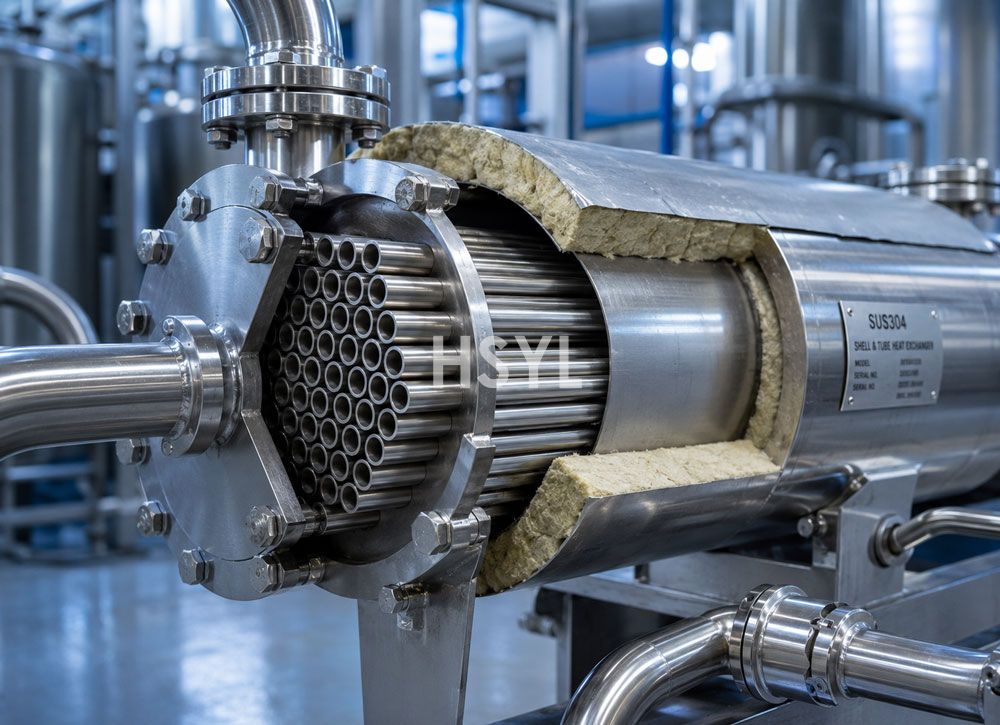
This guide covers the four primary use cases where tube heat exchangers dominate food processing — pasteurization, sterilization, cooking, and cooling — and the six selection factors that determine whether a chosen unit will perform reliably across years of service or become a recurring maintenance burden. The focus is practical: how to think about the decision, what to ask suppliers, and how to integrate the heat exchanger into a complete food production line rather than treating it as an isolated component.
If your project involves building a complete food production facility rather than specifying a single heat exchanger, the food factory engineering layout and cost guide covers the broader planning context including utility infrastructure, hygienic zoning, and equipment sequencing.
What a Tube Heat Exchanger Actually Does in Food Processing
A tube heat exchanger transfers thermal energy between two fluids without allowing them to mix — one fluid (the process medium, typically the food product) flows inside the tubes, and the other fluid (the service medium, typically hot water, steam, cold water, or glycol) flows around the tubes inside a sealed shell. Heat moves through the tube wall from the hotter fluid to the colder fluid, raising or lowering the temperature of the process medium to the target setpoint required for that stage of production.
The reason tube heat exchangers are preferred over plate heat exchangers in many food applications comes down to three characteristics: tube geometry handles viscous and particulate-laden fluids (like fruit purees, sauces, and soups) without the clogging risk that plate gaps create; tube bundles tolerate mechanical cleaning and pigging more readily than delicate plate packs; and tube heat exchangers can be designed for higher pressures and temperatures than plate units, which matters for sterilization and UHT applications. Plate heat exchangers remain preferable for low-viscosity clean fluids like milk and juice, but the moment viscosity rises or particulates appear, tube geometry becomes the default choice.
Engineering Note: The choice between tube and plate heat exchanger is often the first decision point in food processing thermal design. A useful rule of thumb: if the product pours like water and contains no particles, plate heat exchangers offer better heat transfer per unit cost. If the product pours like syrup, contains fruit pieces or meat particles, or tends to leave residue on heated surfaces, tube heat exchangers are the safer engineering choice. Confirm with the supplier based on your specific product rheology.
The Four Primary Use Cases in Food Processing
Tube heat exchangers serve four broad use cases in food production. Each use case imposes different requirements on the heat exchanger's design, materials, and operating parameters — which is why a unit built for one use case cannot simply be redeployed to another.
| Use Case | Typical Process Conditions | Common Food Products | Key Heat Exchanger Requirements |
|---|---|---|---|
| 1. Pasteurization | 72-90°C for 15-30 seconds (HTST); 63-66°C for 30 minutes (LTLT) | Milk, juice, beer, liquid eggs, honey | Fast heat transfer, precise temperature control, sanitary design, easy CIP cleaning |
| 2. Sterilization (UHT and retort) | 135-150°C for 2-8 seconds (UHT); 115-125°C for 20-60 minutes (retort) | UHT milk, shelf-stable soups and sauces, canned foods, baby formula | High pressure rating, high temperature tolerance, robust tube material, fail-safe safety systems |
| 3. Cooking and heating | 80-110°C batch or continuous | Soups, sauces, gravies, jams, confectionery, starch slurries | Handles viscosity, resists fouling, accommodates particulates, uniform heating |
| 4. Cooling and chilling | Cooling from process temperature to 4°C or below | Post-pasteurization cooling, post-cooking cooling, wort cooling, gelatin setting | Efficient heat removal, precise temperature targeting, prevents thermal shock to product |
Use Case 1: Pasteurization
Pasteurization is the most common tube heat exchanger application in liquid food processing. The goal is to reduce pathogen and spoilage organism counts to safe levels while preserving the product's flavor, color, and nutritional qualities. HTST (High Temperature Short Time) pasteurization holds the product at 72-90°C for 15-30 seconds — long enough to achieve the required log reduction, short enough to avoid cooked flavors. Tube heat exchangers are favored for viscous pasteurization applications (fruit juices with pulp, cream, liquid egg) where plate units would foul or clog.
Use Case 2: Sterilization (UHT and Retort)
Sterilization extends shelf life dramatically by achieving commercial sterility — typically holding the product at 135-150°C for 2-8 seconds in UHT (Ultra-High Temperature) processing, or 115-125°C for 20-60 minutes in retort processing. The higher temperatures and pressures require heat exchangers built with thicker tube walls, higher-grade materials (often SUS316L rather than SUS304), and more robust gasket and seal designs. UHT systems frequently use tube heat exchangers in helical coil or triple-tube configurations to achieve the heat transfer rates required for 2-second holding times.
Use Case 3: Cooking and Heating
Tube heat exchangers used for cooking face the most demanding operating conditions because the product often contains starches, proteins, and sugars that deposit on heated surfaces as the product thickens. Soup production, sauce manufacturing, jam and marmalade cooking, and starch slurry gelatinization all rely on tube heat exchangers designed for viscous, fouling-prone fluids. These units typically feature larger tube diameters, smoother internal surfaces, and clean-in-place (CIP) compatibility as a core design requirement rather than an afterthought.
Use Case 4: Cooling and Chilling
Cooling applications reverse the heat transfer direction — the hot product gives up heat to a cold service medium (typically chilled water or glycol). Post-pasteurization cooling must be rapid enough to bring the product through the bacterial growth danger zone (typically 60°C down to 4°C) within minutes to prevent thermophilic bacteria proliferation. Cooling tube heat exchangers often pair with the heating unit in a regenerative configuration, where the hot incoming product pre-heats the cold outgoing product, capturing energy that would otherwise be wasted.
The Six Selection Factors That Determine Performance
Once the use case is clear, the heat exchanger specification comes down to six selection factors. Getting any one of these wrong can compromise performance, food safety, or equipment lifespan — and the mistakes are often invisible until the unit has been in service for months.
Factor 1: Tube Type and Geometry
Tube heat exchangers come in several geometric configurations, each suited to different product types and process conditions. The three most common in food processing are:
- Shell-and-tube (straight tube) — the classic configuration with straight tubes inside a cylindrical shell. Easiest to clean mechanically, suitable for most medium-viscosity products, widely used in pasteurization and cooling applications.
- Helical coil — tubes wound in a helix inside the shell. Compact footprint for the heat transfer area, handles thermal expansion naturally, commonly used in UHT sterilization where space is constrained and high heat transfer rates are required.
- Triple-tube (annular flow) — product flows through the annular space between two concentric tubes, with service medium in both the inner tube and outside the outer tube. Maximizes heat transfer area per unit length, ideal for viscous products and products with particulates that would settle in conventional tubes.
The tube diameter choice involves a tradeoff between heat transfer efficiency (smaller diameter = higher velocity = better heat transfer but higher pressure drop and clogging risk) and product handling (larger diameter = lower velocity = handles particulates and viscous products but requires more surface area for the same heat duty). For most food applications, tube inner diameters range from 12 mm (clean low-viscosity fluids) to 50 mm (particulate-laden sauces and purees).
Factor 2: Material Selection
Material choice affects thermal performance, corrosion resistance, food safety compliance, and total cost. The three materials commonly used in food-grade tube heat exchangers are:
| Material | Corrosion Resistance | Thermal Conductivity | Relative Cost | Best Suited For |
|---|---|---|---|---|
| SUS304 stainless steel | Good for most neutral and mildly acidic foods | ~16 W/m·K | Baseline (1x) | Milk, juice, beer, neutral pH sauces, pasteurization of standard products |
| SUS316L stainless steel | Excellent for acidic and chloride-containing foods | ~16 W/m·K | 1.4-1.8x | Tomato products, citrus juices, salted sauces, UHT sterilization, marine environment installations |
| Titanium | Outstanding for highly corrosive environments | ~22 W/m·K | 5-8x | High-salt brines, extreme pH applications, seafood processing, specialized cooling applications |
Practical Note: SUS304 is sufficient for most general food processing, but any product with pH below 4.5 or chloride content above 200 ppm should use SUS316L to prevent pitting corrosion. The cost difference between SUS304 and SUS316L is modest compared to the cost of replacing a corroded heat exchanger after 18 months of service, and the upgrade is particularly important for tomato-based products, citrus juices, and any product containing sea salt or brine.
Factor 3: Flow Configuration
The direction of fluid flow through the heat exchanger affects heat transfer efficiency and the achievable temperature approach (the difference between the hot and cold outlet temperatures). Three primary configurations exist:
- Counter-flow — hot and cold fluids flow in opposite directions. Most efficient configuration; achieves the closest temperature approach; standard for most food processing applications.
- Parallel flow — hot and cold fluids flow in the same direction. Less efficient than counter-flow; used when temperature crossing is not required or when thermal shock to the product must be minimized.
- Cross-flow — one fluid flows perpendicular to the other. Common in air-to-liquid exchangers; less common in liquid-to-liquid food applications but used in some specialized cooling configurations.
For food processing liquid-to-liquid heat exchangers, counter-flow is the default choice unless specific process constraints dictate otherwise. The efficiency advantage of counter-flow typically translates to 15-25% less heat transfer area required for the same duty compared to parallel flow, which directly reduces equipment cost.
Factor 4: Sanitation and CIP Compatibility
Sanitation design is non-negotiable in food processing heat exchangers. The unit must be cleanable to food-grade standards without disassembly, typically through Clean-in-Place (CIP) protocols. Sanitation design considerations include:
- Tube surface finish — internal tube surfaces should be polished to Ra ≤ 0.8 μm roughness to prevent product residue adhesion and bacterial colonization. Electropolishing provides even better cleanability for highly sensitive applications.
- No dead legs — piping connections should avoid dead zones where product can stagnate and resist CIP cleaning. Dead legs longer than 3x the pipe diameter are typically prohibited by hygienic design standards.
- Drainability — the heat exchanger should drain completely by gravity, with no low points where water or product can pool between production runs.
- CIP compatibility — the unit should be designed to withstand repeated CIP cycles using caustic (typically 1-2% NaOH at 75-85°C), acid (typically 1-2% nitric or phosphoric acid at 60-70°C), and final rinse water without material degradation or gasket failure.
- Gasket material — gaskets must be food-grade (EPDM or FKM depending on product and cleaning chemistry), compatible with the CIP chemicals, and replaceable without special tooling.
For facilities running continuous CIP cycles, integration with a clean-in-place washing system allows automated sanitation sequences that reduce labor and ensure consistent cleaning results across production runs.
Factor 5: Pressure and Temperature Rating
The heat exchanger must be rated for the maximum pressure and temperature it will encounter in service, plus a safety margin. Undersized ratings create safety hazards and premature failure; oversized ratings add unnecessary cost and weight. Key considerations:
- Design pressure — typically 1.3-1.5x the maximum operating pressure. UHT sterilization applications may require 10-15 bar design pressure; pasteurization typically requires 4-6 bar; cooling applications often require only 2-3 bar.
- Design temperature — typically 10-20°C above maximum operating temperature. UHT applications may require 160°C design temperature; pasteurization typically requires 100-110°C; cooling may require only 40-50°C.
- Thermal cycling tolerance — the unit must withstand repeated thermal cycling between cold startup and hot operating conditions without fatigue failure. Number of cycles over design life should be specified with the supplier.
- Safety relief — pressure relief valves and temperature cutoffs must be integrated into the system design to prevent catastrophic failure in the event of process upset.
Factor 6: Integration with Production Line
A tube heat exchanger rarely operates as a standalone component. It typically sits within a production line that includes holding tubes, balance tanks, homogenizers, fillers, and packaging equipment — and its performance depends on how well it integrates with upstream and downstream equipment. Integration considerations include:
- Upstream balance tank sizing — the balance tank feeding the heat exchanger must hold enough product to maintain continuous flow during filling and emptying cycles. Undersized balance tanks cause flow interruptions that create temperature variability.
- Hold tube length and volume — for pasteurization and sterilization, the hold tube downstream of the heat exchanger must be sized to hold the product at target temperature for the required duration. Hold tube length is calculated from flow rate and required hold time.
- Downstream filler coordination — the heat exchanger's throughput must match the downstream filler capacity. Heat exchanger output exceeding filler capacity creates product backup; filler capacity exceeding heat exchanger output creates empty filler cycles.
- Sensor and control integration — temperature sensors at inlet, outlet, and hold tube must feed into the process control system to verify that critical control points are met. Deviation alarms must trigger diversion valves that redirect under-processed product back to the balance tank.
- Hot water or steam supply — the service medium supply (boiler for heating, chiller for cooling) must deliver consistent temperature and pressure. Service medium variability directly translates to process temperature variability.
Engineering Note: The diversion valve system is a critical safety component in pasteurization and sterilization applications. If the hold tube temperature drops below the critical control point, the diversion valve must switch immediately to redirect product back to the balance tank rather than forward to packaging. This is a legal requirement in most jurisdictions for dairy pasteurization and a practical necessity for any thermal processing application where under-processing creates food safety risk. Confirm diversion valve response time (typically less than 1 second) and reliability with the supplier.
Common Selection Mistakes and How to Avoid Them
After the six selection factors are addressed, the final review should check for the most common selection mistakes that compromise tube heat exchanger performance in food processing:
- Mistake 1: Specifying based on average viscosity rather than peak viscosity. Many food products become more viscous as they heat or cool. A heat exchanger sized for room-temperature viscosity may stall when the product thickens at processing temperature. Always specify based on the highest viscosity the product will reach during processing.
- Mistake 2: Ignoring fouling factor in heat transfer calculation. Food products deposit residue on heated surfaces over time, reducing heat transfer efficiency. The specification should include a fouling factor that accounts for this degradation between cleaning cycles. A unit sized without fouling factor will underperform within days of operation.
- Mistake 3: Underestimating CIP cycle frequency. Some products require CIP cleaning every 4-8 hours; others can run 24 hours between cleaning cycles. The heat exchanger must be designed for the actual CIP frequency — more frequent CIP requires more robust gaskets and surface finish.
- Mistake 4: Choosing material based on initial product only. Production lines often process multiple products sequentially. A heat exchanger sized for milk may corrode when the line switches to tomato sauce. Specify material based on the most demanding product the line will process, not just the initial product.
- Mistake 5: Treating the heat exchanger as a standalone purchase. Integration with balance tanks, hold tubes, control systems, and service medium supply often costs as much as the heat exchanger itself. Budget for the integrated system, not just the heat exchanger unit.
Resources for Tube Heat Exchanger Specification and Production Line Planning
Once you have worked through the use case and selection factor framework, the following resources support the broader production line planning that surrounds a tube heat exchanger installation:
- HSYL tube heat exchanger product specifications — Detailed specifications including tube configurations, material options, pressure and temperature ratings, and sanitary design features applicable to food processing applications.
- Commercial washing and cleaning equipment overview — CIP and washing system options that integrate with heat exchanger sanitation protocols, including automated cleaning sequence control and chemical dosing systems.
- Food factory engineering layout and cost guide — Layout planning, utility infrastructure sizing, and cost allocation methodology for new food production facilities including thermal processing line design.
- Choosing food sterilization equipment: pasteurization or high-pressure retort — Decision framework for selecting between pasteurization, UHT, and retort sterilization processes, which determines the thermal processing equipment requirements upstream of packaging.
Frequently Asked Questions
What is the difference between a tube heat exchanger and a plate heat exchanger in food processing?
Which material should I choose for a food grade tube heat exchanger?
How is a tube heat exchanger cleaned in food processing?
What is the typical operating pressure for a tube heat exchanger in UHT sterilization?
Can a tube heat exchanger handle food products with particulates?
How do I size a tube heat exchanger for pasteurization?
What is the difference between counter-flow and parallel flow in a tube heat exchanger?
How does a tube heat exchanger integrate with a food production line?
Related Articles


Get professional consultation
Do you have any questions or need technical support regarding the content of this article? Fill out the form below, and our expert team will provide you with professional solutions.