Opening a new restaurant involves hundreds of decisions, but few carry the long-term operational weight of the equipment list. Get the list right and your kitchen runs smoothly from day one — orders flow from prep to cooking to service without bottlenecks, staff move efficiently between stations, and maintenance stays predictable. Get the list wrong and you spend the next five years working around the mistake: a fridge that is too small for weekend volume, a cooking range that lacks the burner count your menu demands, a missing sterilization station that creates hygiene compliance problems during the first health inspection.
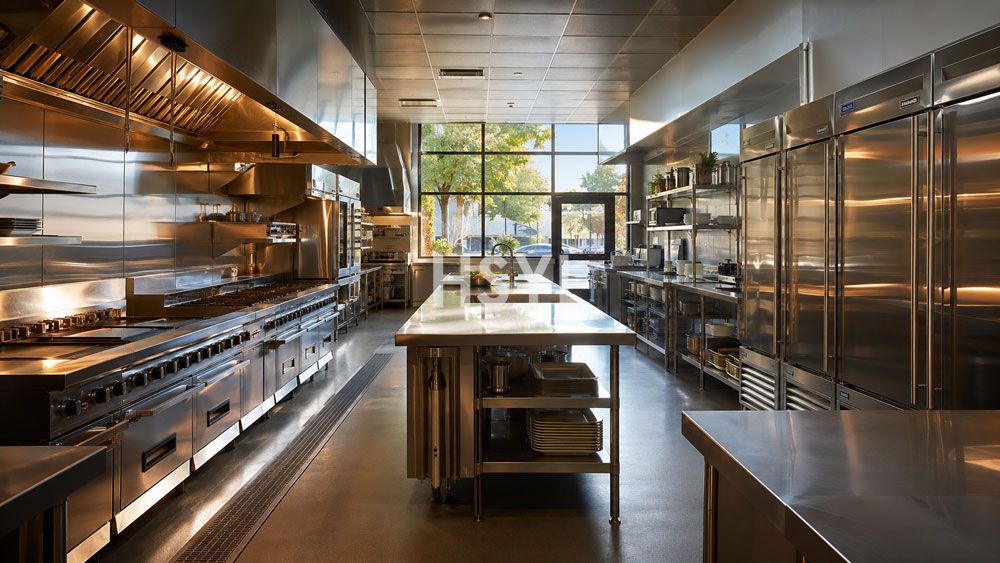
This checklist is built specifically for first-time restaurant operators and project managers opening a new venue. It covers the six equipment categories every commercial kitchen needs to address, the utility and layout planning that determines whether equipment installs cleanly, and the procurement timeline that ensures everything arrives before opening day rather than three weeks after. The framework applies whether you are opening a 40-seat bistro, a 120-seat full-service restaurant, or a quick-service concept with a compact back-of-house footprint.
If your project involves a multi-outlet central kitchen rather than a single restaurant, the complete kitchen equipment solutions overview covers the broader integrated workflow planning that applies at central-kitchen scale.
The Six Equipment Categories Every Restaurant Kitchen Must Address
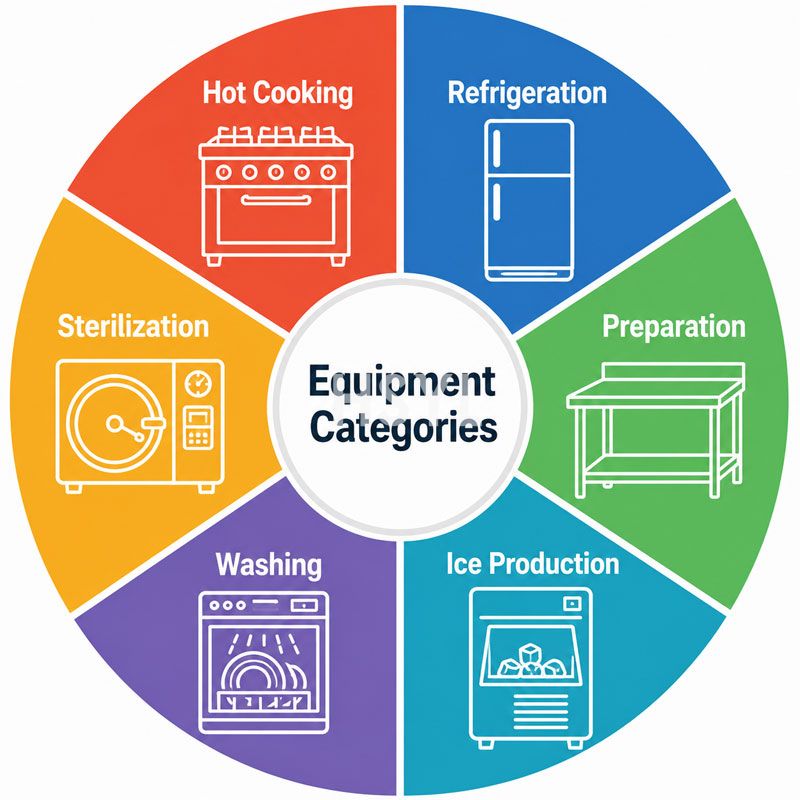
Every commercial restaurant kitchen, regardless of cuisine or service format, must address six equipment categories. Skipping any one category creates a workflow gap that will surface as an operational problem within the first month of service. The categories are:
| Category | Primary Function | Typical Equipment Types | What Happens If Skipped |
|---|---|---|---|
| 1. Hot Cooking | Heat-based food preparation | Cooking ranges, griddles, ovens, fryers, steamers, wok stations | Cannot execute menu; forced menu simplification; longer ticket times |
| 2. Refrigeration | Cold storage for ingredients and prepared items | Walk-in coolers, upright refrigerators, under-counter fridges, blast chillers, freezers | Ingredient spoilage; cross-contamination risk; inability to prep ahead |
| 3. Preparation | Cutting, mixing, portioning, assembly | Prep tables, food processors, mixers, slicers, scales, cutting boards | Slow prep; inconsistent portions; staff congestion at peak |
| 4. Ice Production | Beverage service, ingredient cooling, display | Cube ice makers, flake ice machines, ice storage bins | Bar service interruptions; inadequate ingredient cooling; runs on bagged ice |
| 5. Washing | Utensil, pan, and container cleaning | Commercial dishwashers, pot sinks, glasswashers, utensil washers | Clean dish shortage during peak; manual washing bottleneck; sanitation issues |
| 6. Sterilization | Hygiene-grade sanitization for compliance | UV sterilizers, pass-through sterilizer chambers, hot-air sterilizer cabinets | Health inspection failures; cannot meet HACCP or local food safety standards |
Practical Note: Many first-time operators treat sterilization as an optional add-on — "we will add it later if the inspector requires it." This is a mistake. Sterilization equipment is typically required for food safety compliance from day one in most jurisdictions, and retrofitting it after opening means either closing the kitchen for installation work or operating out of compliance while waiting for the equipment to arrive. Include sterilization in the initial equipment list and budget from the start.
Category 1: Hot Cooking Equipment Checklist
Hot cooking equipment is the heart of any restaurant kitchen and usually the largest single equipment investment. The exact configuration depends on your menu — a stir-fry-focused Asian restaurant needs different equipment than a wood-fired pizza restaurant or a modern American bistro. The checklist below covers the items most restaurants need to evaluate, with notes on when each is required versus optional.
Required for Most Restaurants
- Primary cooking range — gas or electric, sized to peak-hour cooking load. Multi-burner configurations like the Cooking Range 700 Series suit most full-service restaurants; the larger Cooking Range 900 Series handles high-volume operations.
- Griddle or flat-top — for eggs, pancakes, burgers, sandwiches, and grilled items. Countertop models like the Sandwich Griddle 37E/41E/57E handle breakfast and sandwich volume; integrated griddle stations on cooking ranges handle higher demand.
- Commercial oven — for baking, roasting, and finishing. The Full-View Electric Oven line offers 2-deck to 4-deck configurations with independent top/bottom heat control.
- Steamer cabinet — for rice, dim sum, seafood, and steamed vegetables. Choose between economic electric, intelligent dual-mode, fully automatic, or gas-powered based on your energy infrastructure and menu volume.
Required Depending on Menu
- Deep fryer — for fried menu items (fries, chicken, tempura, donuts). Required for quick-service and many casual dining concepts; optional for fine dining.
- Wok station — for Asian cuisine with high-heat stir-fry. Requires specialized burner configuration with water spray and wok support ring.
- Pizza oven — deck oven, conveyor oven, or wood-fired oven depending on pizza style and volume.
- Salamander or cheese melter — for finishing dishes under direct top-down heat. Common in bistro and gastropub formats.
- Charbroiler or flat grill — for grilled meats and vegetables. Required for steakhouses and grill-focused menus.
Category 2: Refrigeration Equipment Checklist
Refrigeration is consistently under-sized in new restaurant projects. Operators calculate refrigeration based on average daily inventory and discover at peak that the unit cannot hold enough ingredients to support a full dinner service. The checklist below addresses both the volume sizing issue and the multiple-temperature-zone requirement that most menus create.
Required for Most Restaurants
- Walk-in cooler or large upright refrigerator — primary bulk ingredient storage. Size based on daily ingredient intake multiplied by delivery frequency (typically 3-7 days of inventory).
- Under-counter refrigeration — at-line cold storage for ingredients used during service. Position at each cooking station so staff do not leave the line to retrieve ingredients.
- Freezer — for frozen ingredients, prepared frozen items, and ice cream if dessert menu includes it. Walk-in freezer for high-volume venues; upright freezer for smaller operations.
- Prep refrigerator with work surface — combination refrigeration and prep table for sandwich, salad, and pizza assembly stations.
Required Depending on Menu and Volume
- Blast chiller — for rapid cooling of cooked items to safe storage temperature. Required for cook-chill operations, large batch prep, and HACCP compliance in many jurisdictions.
- Wine and beverage refrigerator — separate temperature zone for wine service and chilled beverage storage.
- Dairy and pastry display refrigerator — for front-of-house dessert display or pastry case if menu includes visible dessert presentation.
- Specialty refrigeration — chocolate tempering cabinet, sushi display case, raw meat aging cabinet — depends on cuisine specialization.
Engineering Note: Refrigeration capacity should be calculated based on peak-day inventory (Friday or Saturday in most restaurants), not average-day inventory. A unit sized for average demand runs at full capacity during peak days, which both shortens compressor life and fails to maintain safe temperature when loaded with a full service's worth of ingredients. Plan for 20-30% capacity headroom above your peak-day calculation.
Category 3: Preparation Equipment Checklist
Preparation equipment is often the most under-specified category in new restaurant projects because operators focus on the cooking line and treat prep as "we will figure it out." The result is slow prep shifts, inconsistent portioning, and staff congestion at peak when everyone needs the same prep surface simultaneously.
Required for Most Restaurants
- Stainless steel prep tables — sufficient linear footage for simultaneous prep by multiple staff. Plan 1.5-2 meters of prep surface per prep cook per shift.
- Commercial food processor — for chopping, slicing, grating, and pureeing. Reduces prep time for vegetable-heavy menus by 60-80% versus manual cutting.
- Commercial mixer — for dough, batter, sauces, and whipped items. Required for any baking program; useful for most kitchens.
- Portion scale — for consistent plating and recipe adherence. Digital scales with 1g accuracy for plating; larger capacity scales for batch prep.
- Cutting boards and knife sets — color-coded boards for different food categories (red for raw meat, blue for raw fish, green for vegetables, yellow for poultry, white for dairy and bread) to prevent cross-contamination.
Required Depending on Menu
- Meat slicer — for deli meats, sandwich operations, and charcuterie programs.
- Dough sheeter or roller — for pizza, pasta, and pastry operations producing high volumes of rolled dough.
- Vacuum sealer — for sous vide programs, extended shelf-life storage, and cook-chill operations.
- Specialty prep equipment — tortilla press, sushi rice mixer, coffee grinder, espresso machine — depends on cuisine and beverage program.
Category 4: Ice Production Checklist
Ice production is frequently treated as an afterthought in new restaurant projects — operators buy a small under-counter ice maker assuming it will be enough, then discover at peak service that the bin runs dry and bar service stalls while staff run to bagged ice. Proper ice sizing requires calculating total daily demand across all ice uses, not just beverage service.
Required for Most Restaurants
- Primary ice maker — sized to total daily demand across beverage service, ingredient cooling, bar service, and display use. Mid-capacity models like the SD-1500/SD-2000 Commercial Cube Ice Maker cover 680-900 kg/day output for typical full-service restaurants.
- Ice storage bin — capacity matched to ice maker daily output, sized to hold at least 50% of daily production for peak-hour buffer.
- Ice transport containers — insulated containers for moving ice from storage to bar stations and prep areas.
Required Depending on Beverage Program
- Dedicated bar ice maker — separate from kitchen ice to prevent cross-contamination and ensure bar service continuity during kitchen ice demand spikes.
- Specialty ice equipment — flake ice for seafood display, crescent ice for premium beverage service, clear ice for cocktail programs.
- Ice crusher or shaver — for frozen cocktails, shaved ice desserts, and specialty beverages.
Category 5: Washing Equipment Checklist
Washing equipment determines whether your kitchen can sustain peak service without running out of clean pans, utensils, and plates. Under-sized washing capacity creates a bottleneck that compounds through service — once the dishwasher falls behind, every station slows down waiting for clean equipment.
Required for Most Restaurants
- Commercial dishwasher — high-temperature sanitizing type preferred over chemical type for faster cycle times and better grease removal. Door-type for most restaurants; conveyor type for high-volume operations.
- Three-compartment pot sink — for manual washing of large pots and pans that do not fit in the dishwasher. Required by health code in most jurisdictions.
- Hand-washing stations — dedicated hand-wash sinks at each work zone, separate from food prep sinks. Required by health code; cannot be combined with utensil washing.
- Pre-rinse spray valve — at the dishwashing station for scraping food waste before dishes enter the dishwasher.
- Dish and utensil racks — sufficient clean and dirty dish rack inventory to handle full peak service without running out.
Required Depending on Volume
- Glasswasher — dedicated bar glasswasher for beverage service, separate from kitchen dishwashing to prevent cross-contamination and maintain bar service speed.
- Pot and pan washer — for high-volume operations where manual pot washing creates a bottleneck.
- Commercial washing and cleaning machines — automated washing for specific equipment categories like hood filters, trays, or containers.
Category 6: Sterilization Equipment Checklist
Sterilization equipment is the category most often missing from first-time restaurant equipment lists, and it is also the category most likely to cause health inspection failures. Different from washing (which removes visible soil), sterilization reduces microbial contamination to safe levels required by food safety regulations.
Required for Most Restaurants
- UV sterilizer cabinet — for sanitizing utensils, cutting boards, and small food-contact items between uses. Position at the boundary between wash area and food prep area.
- Hot holding cabinet — for maintaining prepared food at safe holding temperature (above 60°C) before service. Required for banquet operations, buffet service, and high-volume prep-ahead kitchens.
Required Depending on Operation Type
- Pass-through sterilizer — for operations requiring strict hygiene zone separation, like central kitchens supplying multiple outlets, hospital food service, or high-volume catering. Models like the Double-Door Pass-Through Sterilizer allow items to be loaded from the wash side and retrieved from the clean side without re-entering the wash zone.
- CIP (Clean-in-Place) system — for operations with extensive pipe, tank, or vessel infrastructure that cannot be manually washed. Common in central kitchens and food production facilities.
- Specialty sterilization — retort sterilization for shelf-stable packaged products, high-pressure processing for cold-chain preservation — depends on production model.
Utility and Layout Planning: The Hidden Equipment Category
The six equipment categories above cover the visible machinery, but every restaurant project also needs to address utility infrastructure and kitchen layout — the "invisible equipment" that determines whether the visible equipment can actually operate. Many project delays and budget overruns trace back to utility planning that was treated as an afterthought rather than a parallel workstream.
Utility Checklist
- Electrical service capacity — total connected load calculation plus 25% headroom for future expansion. Confirm whether your building can deliver the required amperage before ordering equipment.
- Gas line sizing and pressure — if using gas equipment, confirm gas line capacity matches total connected gas load. Pressure testing required before equipment connection.
- Water supply and pressure — sufficient flow rate for simultaneous operation of dishwasher, ice maker, steamers, and prep sinks. Confirm incoming water pressure meets equipment minimums.
- Drainage capacity — floor drains sized to handle peak discharge from dishwashers, ice makers, and prep sinks. Grease trap sized to local code requirements.
- Ventilation and exhaust hoods — Type I hoods over grease-producing equipment (cooking ranges, fryers, griddles); Type II hoods over heat and steam producing equipment (ovens, steamers). Hood CFM must match equipment load.
- Make-up air — replacement air for exhausted air, required by code in most jurisdictions when exhaust exceeds a specified CFM threshold.
Layout Checklist
- Workflow zoning — separate hot zone (cooking), cold zone (refrigeration), prep zone (cutting and assembly), wash zone (dishwashing), and service zone (pass-through to dining room). Equipment placement should follow the workflow sequence from receiving to prep to cooking to service.
- Aisle widths — minimum 900 mm for single-staff aisles; 1200 mm for two-staff aisles. Do not let equipment placement create pinch points that slow service.
- Service clearance — minimum 600 mm clearance around equipment for maintenance access. Equipment pushed against walls or other equipment cannot be serviced without being moved, which often means it does not get serviced.
- Door swing and clearance — confirm that refrigerator doors, oven doors, and dishwasher doors do not conflict with each other or with aisle traffic when opened.
Practical Tip: Before finalizing equipment orders, draw a scaled floor plan of your kitchen and cut out scaled representations of each piece of equipment. Move them around the plan to test different layouts before committing. This exercise takes two hours and prevents layout mistakes that would otherwise cost tens of thousands of dollars to fix after installation. Many operators skip this step and discover too late that the dishwasher door cannot fully open because it hits the prep table.
Procurement Timeline: When to Order What
Equipment procurement for a new restaurant typically follows a 12-14 week timeline from specification to installation. Compressing this timeline is possible but expensive — expedited manufacturing and air freight can shorten the schedule by 4-6 weeks at significant cost premium. Plan the schedule backward from your target opening date to determine when each equipment decision must be finalized.
| Phase | Timeline | Key Activities | Critical Decisions |
|---|---|---|---|
| 1. Menu Finalization | Week 1-2 | Finalize menu, calculate peak-hour volume, identify cooking methods required | What equipment categories are required; rough capacity targets |
| 2. Equipment Specification | Week 2-4 | Detailed equipment list with models, dimensions, power requirements, utility connections | Specific model selection for each category; utility infrastructure requirements |
| 3. Vendor Quotation and Order | Week 4-6 | Request quotations from suppliers, compare, negotiate, place orders | Supplier selection; payment terms; delivery dates |
| 4. Manufacturing and Shipping | Week 6-10 | Equipment manufactured, quality checked, packaged, shipped to site | Shipping method; customs clearance for imported equipment |
| 5. Site Delivery and Installation | Week 10-12 | Equipment delivered, positioned, connected to utilities, leveled and tested | Installation contractor; utility connection coordination |
| 6. Utility Connection and Testing | Week 12-13 | Final electrical, gas, water, and drain connections; equipment tested under load | Inspection sign-off; commissioning documentation |
| 7. Staff Training and Soft Opening | Week 13-14 | Staff trained on each equipment piece; soft opening with limited service to test workflow | Final workflow adjustments; staff proficiency verification |
Budget Allocation Guidance
Equipment budget for a new restaurant kitchen typically falls in the range of $40,000-$120,000 for a full-service restaurant, $25,000-$60,000 for a quick-service concept, and $80,000-$200,000+ for a high-volume central kitchen. The allocation across the six categories follows a relatively consistent pattern, though cuisine and service format shift the proportions:
| Category | Typical Budget Share | Notes |
|---|---|---|
| Hot Cooking | 25-32% | Largest share; cooking ranges and ovens are the most expensive single items |
| Refrigeration | 20-26% | Walk-in cooler is typically the second-largest single investment |
| Preparation | 10-15% | Many small items rather than a few large ones; easy to underestimate |
| Ice Production | 6-10% | Single ice maker plus storage bin; often under-budgeted |
| Washing | 12-18% | Commercial dishwasher is a significant investment; pot sink and hand sinks add up |
| Sterilization | 4-8% | Often omitted from initial budget; retrofit cost is higher than initial inclusion |
| Installation and Utilities | 8-15% | Electrical, gas, plumbing, ventilation work required to make equipment operational |
Value Angle: The most common budget mistake in new restaurant projects is allocating too little to utility infrastructure. Operators budget for the equipment itself but underestimate the cost of electrical upgrades, gas line installation, ventilation hood installation, and drainage modifications required to make the equipment operational. Plan for utility infrastructure to cost 10-15% of total equipment cost — and confirm this number with a contractor before finalizing your equipment budget, because utility costs vary dramatically by building condition and local labor rates.
Next Steps for Your Restaurant Project
Once you have worked through the six-category checklist and have a draft equipment list, the following resources help you move from list to finalized procurement plan:
- Complete kitchen equipment solutions overview — How the six categories integrate into a complete kitchen workflow, with configuration examples for different restaurant formats and service volumes.
- Cooking Range 700 Series specifications — Reference cooking range configuration for typical full-service restaurant hot cooking load, with model-by-model capacity and utility data.
- How to start a food product line — Business planning framework covering menu engineering, financial modeling, and operational setup for new food service ventures.
- Food factory engineering layout and cost guide — Layout planning and cost allocation methodology for larger-scale food production facilities, applicable to multi-outlet restaurant groups planning central kitchen infrastructure.
Frequently Asked Questions
What equipment does a new restaurant kitchen need at minimum?
How much does kitchen equipment cost for a new restaurant?
When should I order restaurant kitchen equipment before opening?
How do I size refrigeration for a new restaurant?
What is the difference between washing and sterilization equipment?
Do I need a pass-through sterilizer for a restaurant?
How many hand-washing stations does a restaurant kitchen need?
Should I buy gas or electric cooking equipment for a new restaurant?
Related Articles


Get professional consultation
Do you have any questions or need technical support regarding the content of this article? Fill out the form below, and our expert team will provide you with professional solutions.