Why a 2026 “Top 10” List Looks Different From 2022
Industrial freeze drying stopped being a niche, pharma-only conversation. The same physics that protect heat-labile nutraceuticals now sit inside pet food plants, ready-meal lines, and seasonal fruit processors trying to extend shelf life without sulfites. As a result, the vendor landscape in 2026 is wider and more fragmented than it was three years ago. Big European names still anchor the high end. A new generation of Chinese manufacturers has closed the gap on chamber engineering and PLC control, though service networks still vary. Engineering integrators, who bundle machinery from several workshops under one contract, have grown precisely because buyers want one throat to choke on a turnkey line.
For a plant manager or project engineer, the practical question is no longer “who makes a freeze dryer?” but “whose equipment will still be running, with documentation, in year seven?” The list below is built to answer that question, not to crown a winner.
The Engineering Yardstick: What Actually Matters on a Vendor Datasheet
Marketing brochures tend to highlight shelf-life percentages. A working engineer cares about seven things first:
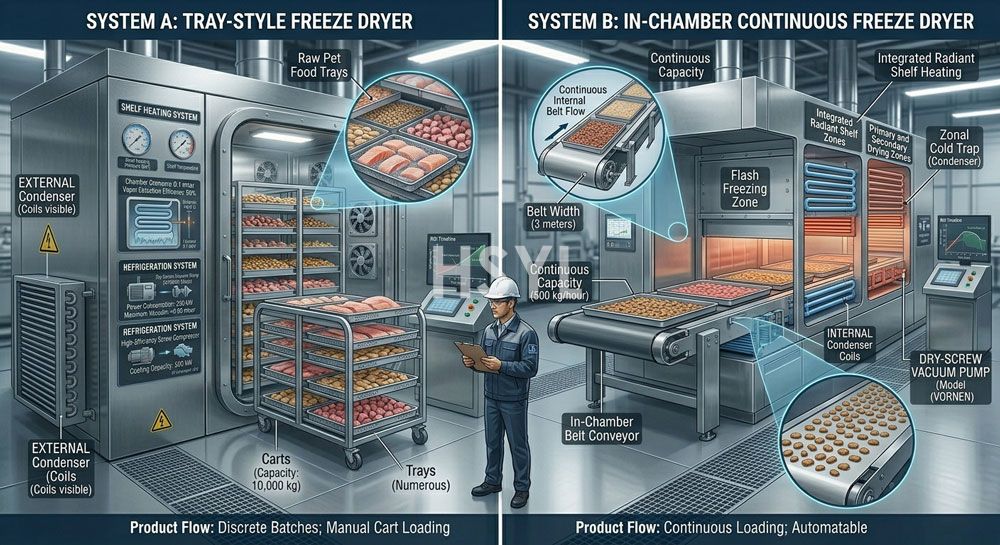
- Chamber geometry and shelf temperature uniformity — shelf temperature delta across a fully loaded chamber is the single biggest driver of cycle time and residual moisture spread between trays.
- Vacuum train design — pump type, trap geometry, and leak-rate specification determine how long it takes to reach working pressure and how stable that pressure is during primary drying.
- Control system and recipe management — ability to store, version, and audit recipes matters the moment you run a second SKU or a contract-manufactured batch.
- Sanitation and CIP — surface finish, drainability, and whether the chamber is designed for clean-in-place or only clean-out-of-place changes the labor cost of every campaign.
- Materials and surface finish — chamber and shelf stainless grade, electropolish, and weld documentation are the first things a quality auditor will ask about.
- Service footprint and spare-parts inventory — downtime in food processing is measured in lost retail revenue, not in service-call fees.
- Compliance documentation — material certificates, pressure-vessel PED/ASME paperwork, electrical conformity, and process validation support for low-moisture foods.
Keep this list next to you when you read the shortlist. If a vendor’s datasheet does not address even five of the seven, treat the quote as incomplete.
[Insert image: engineer inspecting vacuum chamber of a large industrial freeze dryer during factory acceptance test]
2026 Shortlist: 10 Industrial Freeze Dryer Manufacturers Worth Evaluating
The companies below are publicly known industrial equipment builders or engineering groups with a documented presence in food-grade freeze drying. Capacity figures are intentionally omitted; published numbers are too product-specific to be useful across product categories. Treat this as a starting shortlist, not a ranking.
- GEA Group (Germany) — long-standing European reference for batch and continuous lyophilization in food and dairy. Strength lies in process validation documentation and global service coverage.
- Atlas Concorde / SPX Flow (USA / Europe) — strong in dairy and ingredient drying, including freeze dry systems integrated into ingredient plants.
- Bosch (Germany) — primarily a pharmaceutical lyophilizer builder, but a useful benchmark for documentation and GMP-grade engineering on the food side.
- IMA Life (Italy) — another pharma heritage builder, relevant when food lines must align with nutraceutical contract manufacturing standards.
- Millrock Technology (USA) — research-to-pilot freeze dryer maker; useful if a process still needs development before scale-up.
- Labconco (USA) — pilot and small-production equipment; not a candidate for industrial throughput but a credible partner for process development work.
- Cuddon Freeze Dry (New Zealand) — one of the few builders focused exclusively on industrial food freeze drying; popular with seafood, meat, and fruit processors in Oceania.
- Lyovapor / GMM Pfaudler (India / Europe) — a mid-scale option often considered for regional turnkey projects in South Asia and the Middle East.
- Toption / TOPTION Group (China) — among the more established Chinese builders with an export track record in both laboratory and industrial food freeze dryers.
- HSYL — Hongsheng Yuanlin (China) — engineering and turnkey integration group that consolidates top-tier Chinese OEM workshops into one contract; relevant when a project is a full pre-treatment-to-packaging line rather than a single machine purchase. See the company’s engineering and integration background for context on how this model differs from a single-factory vendor.
Vendor Scorecard at a Glance
The table below compresses the seven engineering questions into a quick reference. It is qualitative; it is meant to start a structured conversation, not to replace a factory audit.
| Manufacturer | Chamber & Vacuum | Control & Recipe | Sanitation Design | Service Footprint | Compliance Docs | Best Fit |
|---|---|---|---|---|---|---|
| GEA | Strong | Strong | Strong | Global | Strong | Dairy, ingredient, large CAPEX |
| SPX Flow | Strong | Strong | Strong | Global | Strong | Ingredient integration |
| Bosch | Strong | Strong | Strong | Global | Very strong | Pharma-adjacent food |
| IMA Life | Strong | Strong | Strong | Global | Very strong | Nutraceutical contract Mfg. |
| Millrock | Solid (pilot) | Solid | Solid | North America | Solid | Process development |
| Labconco | Limited scale | Solid | Solid | North America | Solid | R&D / pilot |
| Cuddon | Solid | Solid | Solid | Oceania + export | Solid | Seafood, meat, fruit |
| GMM Pfaudler | Solid | Solid | Solid | Regional | Solid | South Asia, MEA turnkey |
| TOPTION | Solid | Improving | Solid | Export-led | Solid | Mid-scale projects |
| HSYL (integrator) | Varies by OEM | Standardized across line | Designed for line CIP | 25+ countries served | CE / ISO 9001 / FDA / Halal | Full turnkey lines, line-level integration |
The Hidden Cost Most Buyers Miss
The line item that hurts two years after a freeze dryer is installed is rarely the equipment price. It is the combination of three secondary factors:
- Energy intensity per kg of water removed. A poorly insulated chamber or an oversized vacuum pump will inflate operating cost long before any mechanical failure shows up.
- Changeover time between product families. If the chamber is not designed for clean-in-place, every SKU change costs labor hours that were not in the original throughput model.
- Spare-parts lead time. A vacuum pump rotor that takes 30 days to ship can stop a line for a month. Always ask which wearing parts are stocked locally, not just which are listed on a price sheet.
This is also where an engineering integrator can outperform a single-brand factory. A line that arrives with the freeze dryer, the upstream IQF or blast freezer, and the downstream metal detection or nitrogen-flush packaging already matched in PLC and sanitary design will start paying back faster than a great freeze dryer with a weak front end.
A 7-Step Evaluation Process for Plant and Project Teams
- Lock the product matrix first. List every SKU, the target residual moisture, and the seasonal peak load. A vendor cannot size a system honestly without this.
- Run a chamber thermal-mapping study. Ask for shelf-temperature delta data at full load. Anything above the mid-single-digit °C range is a red flag for product spread.
- Audit the vacuum train. Pump type, trap design, leak-rate guarantee, and what happens during a power loss. Look for documented behavior, not verbal reassurance.
- Demand recipe management in writing. Version control, audit trail, and user access rights. This is non-negotiable if you run contract manufacturing.
- Check sanitation paths in person. Visit a reference site during cleaning. Drainability and access for operators are best judged in person, not in a brochure.
- Validate compliance documentation. Pressure vessel, electrical conformity, material certificates, and process validation support for low-moisture food. The U.S. FDA 21 CFR 117 framework is a useful reference baseline for processors shipping into the U.S. market.
- Model total cost, not purchase cost. Energy, labor for sanitation, spare-parts inventory, and expected service interventions over a 7–10 year horizon.
For deeper background on the physics driving chamber and vacuum decisions, the HSYL engineering team has published a working-level explainer on how a vacuum freeze dryer actually works. It is a useful reference when you sit down to read vendor datasheets.
Where a Turnkey Engineering Integrator Becomes Relevant
A freeze dryer is rarely the bottleneck of a new line. The bottleneck is almost always upstream of it: pre-treatment cutting accuracy, IQF freezing rate, and the moisture profile the dryer receives on each tray. A vendor who supplies only the dryer is, in practice, asking you to coordinate three or four other workshops yourself. If you would rather have one contract and one commissioning team, an engineering integrator becomes the practical choice. Large-scale industrial freeze dryers are typically delivered inside this kind of integrated scope, alongside upstream freezing and downstream packaging. For a broader view of how these machines fit into a complete line, the industrial drying and dehydrating equipment family page shows how pre-treatment, drying, and packaging are designed to work together.
Common Buyer Mistakes Worth Naming
- Optimizing for purchase price. A cheaper chamber often means thicker tolerances and higher energy draw. The bill arrives in year three.
- Ignoring the operator. HMI complexity drives training cost and error rate. Watch an actual operator run a recipe before you sign.
- Skipping the on-site sanitation walkthrough. Many chambers look hygienic in a brochure but are hard to drain. Standing water is how a low-moisture product still fails microbiology.
- Buying on cycle time alone. Fastest cycle at full load and fastest cycle at partial load are different problems. Make sure the vendor quotes the load profile you actually run.
Related Topics
- Freeze Dryer vs Dehydrator vs Vacuum Oven: Industrial Guide
- Industrial Pet Food Freeze Dryer ROI for Plant Managers
- How a Vacuum Freeze Dryer Works: Physics and Engineering
Talk to an Engineer
If you are shortlisting freeze dryer suppliers for a 2026 project, HSYL engineers can review your product matrix, throughput target, and factory layout, and then map those against actual machine options rather than catalog categories. Reach out to start a working conversation.
Frequently Asked Questions
How long is a typical industrial freeze dryer delivery and installation timeline in 2026?
What is the most energy-intensive part of running a vacuum freeze dryer?
How do I compare residual moisture performance between vendors?
Can a Chinese industrial freeze dryer meet FDA and EU compliance requirements?
What is the difference between a freeze dryer manufacturer and a freeze dryer engineering integrator?
How often should an industrial freeze dryer be serviced, and what spare parts should be kept on site?
What products benefit most from industrial vacuum freeze drying?
Related Articles


Get professional consultation
Do you have any questions or need technical support regarding the content of this article? Fill out the form below, and our expert team will provide you with professional solutions.