Why Plant Managers Ask the ROI Question Differently
A finance team looks at a freeze dryer project as a discounted cash flow. A plant manager should look at it as an operating risk question. Will this line actually run, will the market absorb the output at the modeled price, and will the utility, labor, and maintenance reality match the budget model — or will the gap land in operations?
The freeze-dried pet food category has real demand, but it is also a category where vendor math can get aggressive. Return-on-investment claims in this space frequently blend best-case yield, full utilization, premium pricing that has not been tested in the target market, and zero downtime. None of these hold up against a real production calendar.
This piece is for the plant manager who has to defend the number in front of operations, finance, and the floor team. The framework below is built around the variables you can actually measure, the assumptions you should pressure-test, and the mistakes that quietly kill pet food freeze dryer projects.
What an Industrial Pet Food Freeze Dryer Is Actually Doing
Freeze drying pet food is a high-end preservation process. The product — raw meat, fish, organ meat, fruit, treats, complete diets — is frozen, then dried under deep vacuum. Moisture leaves as vapor directly from the frozen state, preserving nutrients, aroma, color, and structure far better than thermal drying or extrusion.
What that delivers to the pet food buyer:
- Higher protein retention and lower thermal degradation than cooked-extrusion routes
- Better palatability in many formulations, which can show up as lower refusal rates at the bowl
- Long shelf life at low water activity, often without preservatives
- Lightweight product that is easier to ship and portion
- A clean-label story that supports premium positioning
That last point is the one that drives ROI. Without a defensible price premium in the market, the capex and energy cost of freeze drying do not pencil out against conventional pet food lines. With it, the unit economics can be very different.
If you want the engineering side of sublimation, shelf design, and condenser sizing, the vacuum freeze dryer engineering walk-through covers the physics in depth.
The Honest Cost Structure
A pet food freeze dryer line has four cost buckets. Each one has hidden variables that vendor quotes often understate.
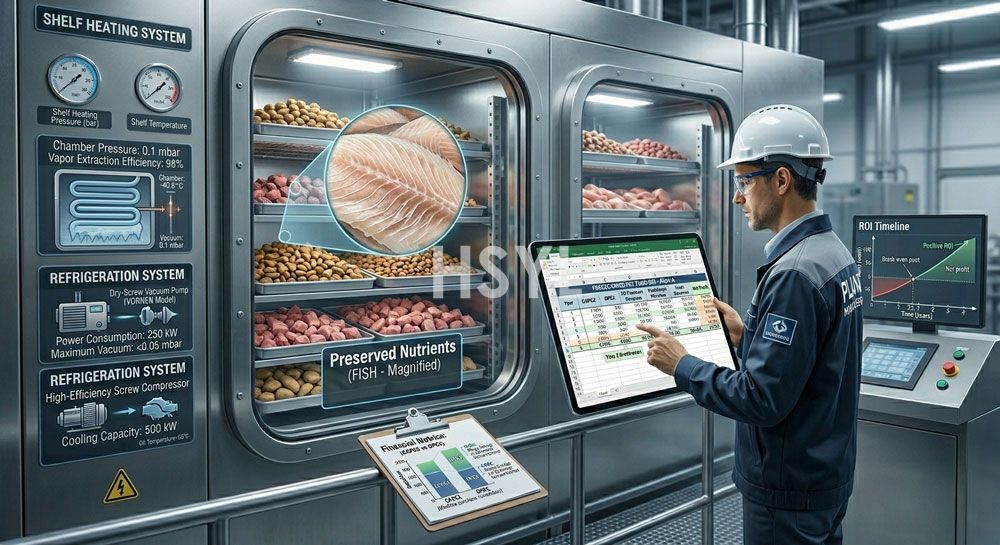
Capital cost. The freeze dryer itself is the largest single line item, but the install scope is what blows budgets. Refrigeration, vacuum, steam or hot water, electrical switchgear, CIP, room ventilation, structural floor loading, and pretreatment of the feed product all sit outside the equipment price. A common plant mistake is signing for the machine and discovering the install cost is a significant fraction of the equipment cost.
Energy. A freeze dryer is electricity-hungry. Vacuum pumps, condenser refrigeration, shelf heating, and defrost cycles all run long batch durations. The cost per kilogram of finished product is driven more by energy per kilogram of water removed than by the nameplate power of the machine. If your plant pays peak industrial rates, this is worth modeling carefully.
Labor and operator skill. A freeze dryer is not a set-and-walk-away machine. Loading density, shelf spacing, pre-freeze condition, and cycle profile are all recipe-driven. A weak recipe on a high-cost input material will quietly bleed margin. The plant manager who treats freeze drying like an extrusion line in terms of operator dependency will be disappointed.
Maintenance, sanitation, and downtime. Chambers, shelves, vacuum seals, condenser surfaces, and CIP loops all need preventive maintenance. Unplanned downtime on a multi-day cycle is brutal because every lost hour is lost shelf-time, not just lost production hours. A line that runs 80 percent of calendar time is realistic. A line that runs 95 percent is the exception, not the baseline.
The Honest Revenue Side
Revenue modeling is where most pet food freeze dryer projects get tested.
The realistic questions:
- Is the freeze-dried product going to retail, online direct, B2B ingredient supply, or contract manufacturing? Each channel has different margin.
- What is the achievable price per kilogram in your actual target market, not in the most optimistic market a vendor has sold into?
- Is the price premium supported by the brand, the formulation, the packaging, and the regulatory story? A freeze-dried claim on a generic commodity SKU is not the same as a premium positioning.
- What is the planned SKU mix, and how often will the line change between products? Long changeovers reduce effective throughput and effective revenue.
- What is the planned volume ramp in year one, year two, and year three? Vendor models often assume steady-state utilization from month one.
A useful exercise: build the model twice. First with the price and yield your CFO will defend in front of the board. Then with conservative price, conservative yield, and 70 to 80 percent utilization. If both models show a defensible payback, the project is real. If only the first one works, the project is fragile.
For a broader plant blueprint on freeze-dried pet food production, the freeze-dried pet food plant blueprint is a useful companion read.
The Four Cost Levers a Plant Manager Can Actually Control
Once the capex is committed, the levers that move ROI are operational. Four matter most.
Energy per kilogram of water removed. A poorly loaded chamber, an over-pumped vacuum, an oversized condenser, or a sloppy pre-freeze will all add energy cost. The recipe, the fill density, and the shelf temperature ramp are your controls. Track them batch by batch and look for drift.
Batch yield. Yield losses in freeze drying come from over-drying, product that does not meet moisture spec, and breakage during post-dry handling. Over-drying is the most common silent loss. Each extra percent of moisture removed past the spec point is wasted energy and reduced throughput. Spec the moisture range, not a single number.
Changeover and downtime. A pet food line that switches between salmon, chicken, liver, and fruit treats will lose hours to CIP and recipe change. The ROI model must reflect this, and the line layout must be designed for it. A freeze dryer shared across many SKUs is a different economic proposition from a freeze dryer dedicated to one high-volume SKU.
Operator capability. The difference between a well-run freeze dryer line and a poorly run one is not subtle. Operators who understand cycle curves, vacuum integrity, and shelf loading are a real operational asset. Training cost is small compared to the cost of one bad batch on a high-priced input.
A Simple Payback Framework
Most pet food freeze dryer paybacks land somewhere in the three to seven year range when the project is well-matched to the market. Paybacks shorter than three years usually assume unrealistic utilization or pricing. Paybacks longer than seven years usually mean the price premium is not real, the volume is too small, or both.
The variables that move payback the most:
- Premium price per kilogram of finished product
- Effective cycles per week, after CIP, changeover, and maintenance
- Yield from raw input to finished freeze-dried product
- Energy cost per kilogram of water removed
- Allocated labor, sanitation, and overhead
A defensible payback model should be sensitive to each of these. If the model is mostly sensitive to one variable — usually price — it is fragile.
Where Vendor Math Falls Apart
These are the assumptions worth challenging in any pet food freeze dryer proposal.
Yield above 95 percent. Real yield on freeze-dried pet food is rarely that high. Skin, fat, purge, and breakage all remove mass before and after the dryer. Vendor yield numbers often refer to recovery in the chamber, not recovery from raw input to finished SKU.
Energy per kilogram of water removed as a single number. This depends on the product, the recipe, the condenser temperature, and the operator. A vendor number from a lab or pilot run is not a production number.
Price premium of X times the conventional product. A premium exists only in a specific channel, in a specific market, with a specific brand behind it. Without those, the premium evaporates.
Continuous utilization from month one. Real lines ramp. The first quarter is usually commissioning, recipe tuning, and product qualification with the buyer's QA team. The first six to twelve months often run below design capacity.
Zero maintenance and zero downtime. No industrial food line runs this way, and a multi-day batch process is especially exposed to any unplanned hour of downtime.
Common ROI Mistakes in Pet Food Freeze Dryer Projects
A few patterns repeat across failed projects.
- Sizing to vendor throughput, not the buyer's actual order book. The machine is sized to feed a market that does not exist at the modeled volume.
- Ignoring the cost of qualified raw material. Freeze drying a high-quality raw input is the whole point. If the input supply is inconsistent, the product spec drifts and the price premium erodes.
- Treating freeze drying as a value-added add-on to an existing extrusion line. It rarely is. Freeze drying is its own process with its own utilities, sanitation, and operator skill set.
- Skipping the pilot. A pilot run on your actual product, with your actual utilities, is the only honest way to confirm yield, cycle time, and final moisture. Vendors who will not run a pilot should be a yellow flag.
- Underestimating regulatory work. Freeze-dried pet food crosses food safety, labeling, and often export registration. Build the regulatory timeline into the project plan, not into a post-commissioning surprise.
A Practical Checklist for the Plant Manager
Before approving the project, walk through this list:
- Confirm the target SKU, target channel, and target retail or B2B price, with two written quotes or pre-orders where possible
- Define the moisture and water activity spec, and the acceptable range, not a single number
- Run a pilot batch on the actual product before locking the equipment size
- Build the energy model using your plant's actual utility rates and load profile
- Model changeover, CIP, and recipe change time into effective cycles per week
- Assume a realistic uptime, not a vendor assumption
- Size for the second-year volume, not the first-year ambition
- Plan for spare parts, vacuum seal replacement, and shelf maintenance in the operating budget from day one
- Confirm the regulatory and labeling path before commissioning, not after
- Build a dashboard that tracks energy per batch, yield, cycle time, and downtime from the first production run
Where HSYL Fits in This Decision
HSYL supplies industrial pet food freeze drying equipment as part of a broader pet food production solutions portfolio that includes canned, wet, and complete-diet lines. The engineering team is used to working with plant managers who already have a target margin, a target volume, and a target channel — and who need an equipment specification that is honest about energy, yield, and cycle time.
The right starting point for any pet food freeze dryer conversation is not the machine. It is the SKU, the price, the volume, and the pilot data. Once those are clear, the equipment specification follows.
For a side-by-side look at how pet food freeze drying compares to vacuum frying in plant economics, the vacuum frying vs freeze drying selection guide is a useful next read. For the engineering deep dive on the freeze-dryer mechanism itself, the vacuum freeze dryer physics and engineering article is a good reference.
Related Topics
- Pet Food Freeze Drying Equipment
- Industrial Freeze-Dried Pet Food Production: A Plant Blueprint
- Pet Food Production Solutions
Talk to an HSYL Engineer
If you are sizing a pet food freeze dryer line against an actual margin target, send us your SKU, target channel, planned daily volume, and the utility profile of your plant. We will respond with an honest equipment specification and a payback model you can defend in front of your finance team. Start the conversation through the HSYL contact page.
Frequently Asked Questions
How long does an industrial pet food freeze dryer take to pay back?
What is the biggest hidden cost in a pet food freeze dryer project?
Can pet food freeze drying run alongside an existing extrusion line?
What is the realistic energy cost per kilogram of finished product?
Do I need to run a pilot before committing to a full-scale freeze dryer?
How long does a typical freeze dryer batch cycle take?
What water activity should a freeze-dried pet food reach?
Is freeze-dried pet food only a premium retail product?
What is the most common reason pet food freeze dryer projects fail?
Related Articles


Get professional consultation
Do you have any questions or need technical support regarding the content of this article? Fill out the form below, and our expert team will provide you with professional solutions.