Ultrasonic cutting has moved from a niche technology used primarily in high-end bakery and confectionery into a broadly adopted industrial process across protein, dairy, and prepared food categories. The adoption is not driven by technology curiosity. It is driven by specific, measurable production problems that mechanical blades cannot solve cost-effectively: product sticking to the blade every 15 minutes, slice weight giveaway eating into margins, or product crushing that renders a percentage of output unsaleable.
This article covers ten applications where ultrasonic cutting has gained meaningful industrial adoption. Each application is presented with the specific problem it solves and the operational impact. The intent is not to list every possible use — it is to show the pattern that determines where ultrasonic cutting makes economic sense and where it does not.
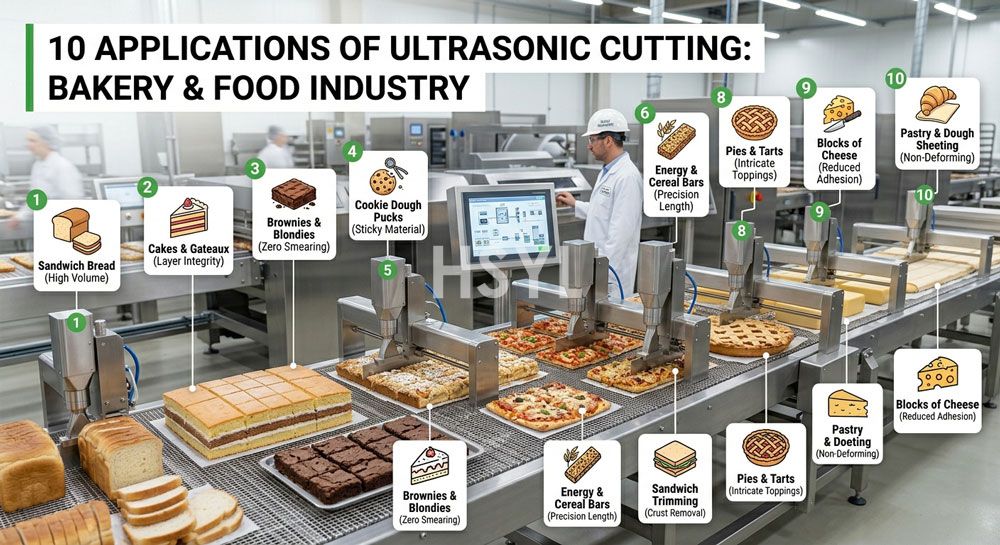
1. Cheesecake and Mousse Cake Slicing
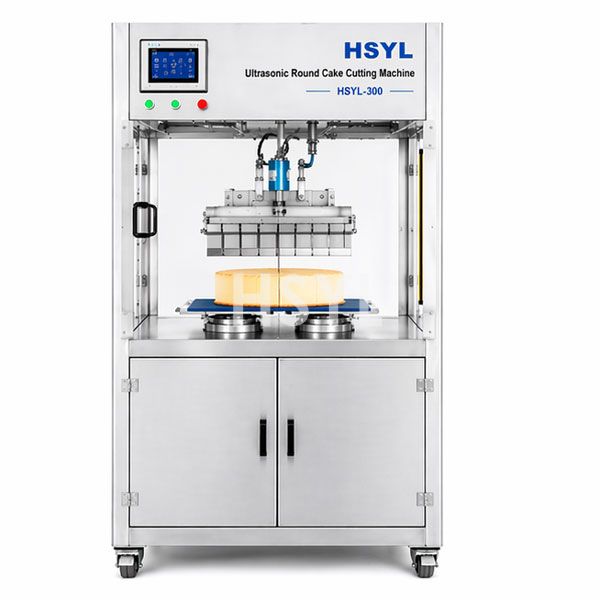
This is the application where ultrasonic cutting first gained traction in food processing. Multi-layer cheesecakes and mousse cakes have soft fillings, crumb bases, and aerated structures that mechanical blades compress, smear, or delaminate. A band saw or wire cutter drags the soft filling across the cut face, producing a smeared appearance that does not meet retail presentation standards.
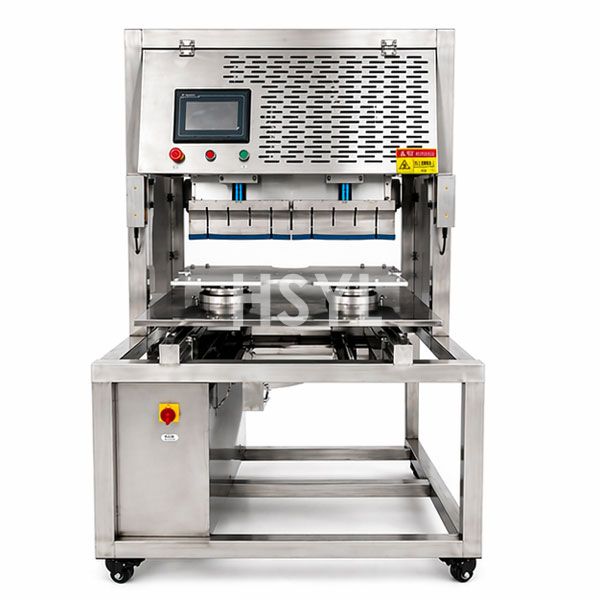
Ultrasonic cutting at 40 kHz with 20-30 micron amplitude produces clean layer separation with zero smearing. The cut surface has a polished appearance that allows retail packaging without secondary trimming. The primary adoption driver here is not yield but aesthetics — a clean-cut cheesecake commands a higher retail price than one with visible drag marks. See the ultrasonic cheesecake cutting machine for the specific system configuration used in high-volume bakery lines.
2. Brownie and Bar Product Portioning
Brownies, blondies, and dense baked bars present a different problem: the product is too soft for a band saw but too firm for a wire cutter. Mechanical blades stick to the surface due to sugar crystallization and fat content, requiring blade cleaning every 20-30 minutes on a production line. On a two-shift operation, this cleaning downtime can consume 60-90 minutes per day.
Ultrasonic cutting eliminates blade adhesion through the 20 kHz vibration, which prevents any continuous contact between the blade and the product surface. Lines running ultrasonic brownie cutters report cleaning intervals extended to once per shift rather than every half hour. The throughput gain from reduced downtime often exceeds the yield improvement in the payback calculation.
3. Energy and Nutrition Bar Cutting
Energy bars containing dates, nuts, seeds, chocolate chips, and binding syrups are among the most difficult products for mechanical cutting. The sticky syrup matrix adheres to steel blades, and the hard nut inclusions cause edge chipping on conventional cutters. Many facilities running high-volume nutrition bar lines have switched to ultrasonic cutting primarily for blade life reasons.
The titanium horn with a PVD coating resists adhesive buildup, and the vibration passes through nut inclusions without the impact stress that chips steel blades. Typical blade life on nutrition bars is 3,000-5,000 hours for an ultrasonic horn compared to 40-80 hours for a mechanical blade. For facilities running multiple SKU changeovers per shift with different inclusion types, the reduction in blade changes alone justifies the equipment cost.
4. Artisan Bread and Toast Slicing
High-moisture artisan breads with open crumb structure collapse under the pressure of mechanical band slicers. The compression flattens the internal air pockets, producing dense, uneven slices that do not match the product's intended texture. This is particularly problematic for sourdough, brioche, and other premium breads where the crumb structure is a differentiating quality attribute.
Ultrasonic slicing at 35-40 kHz preserves the crumb structure because the blade transmits near-zero compressive force into the loaf. The slice face shows the full pore structure without compressed bands at the cut edges. The automatic toast ultrasonic cutting machine is configured for inline bread slicing at commercial bakery speeds while maintaining this quality advantage.
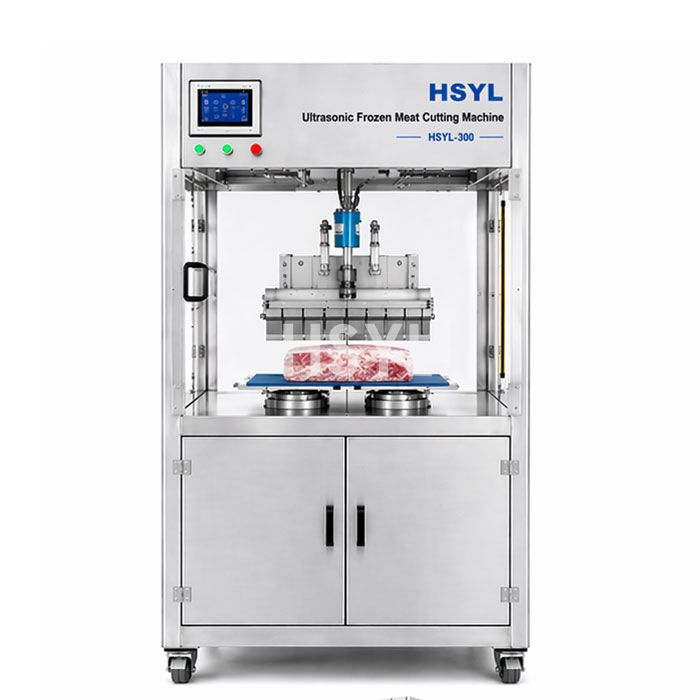
5. Frozen Meat Block Dicing and Portioning
Frozen meat at minus 18 degrees Celsius is one of the most demanding cutting applications regardless of technology. Band saws generate meat dust at 3-5% of product weight, require blade changes every 4-8 hours, and produce rough cut surfaces that affect vacuum packaging seal quality. The dust is not just yield loss — it creates a sanitation burden on the surrounding equipment and floor area.
Ultrasonic cutting at 20 kHz with 50-80 micron amplitude reduces dust generation to under 1%. The clean cut surface improves vacuum seal integrity because there are no loose particles at the seal interface. Facilities processing frozen meat for retail portion packs are the primary adopters, where the combination of yield recovery and packaging quality provides the strongest business case.
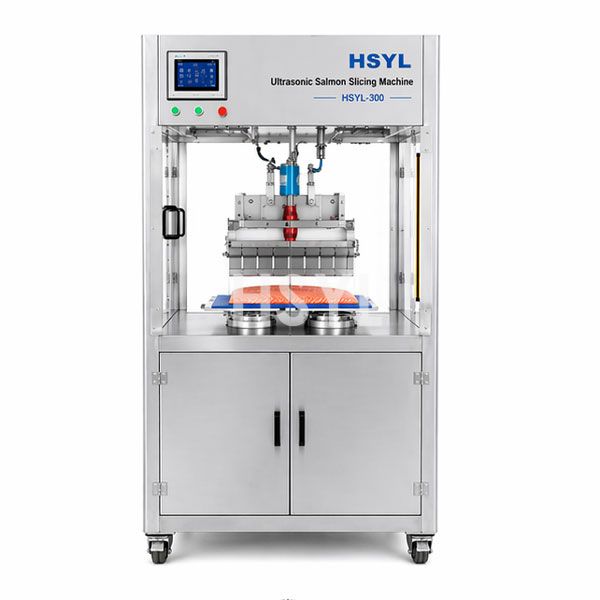
6. Salmon and Fish Fillet Portioning
Salmon and other oily fish present a unique cutting challenge: the high fat content causes mechanical blades to "smear" the flesh rather than cut cleanly, producing a ragged surface with oil bleeding onto the cut face. This reduces visual quality for sashimi-grade and retail portions, and the oil buildup on the blade requires frequent cleaning.
Ultrasonic cutting at 35-40 kHz with 15-30 micron amplitude produces a clean, glossy cut surface on salmon fillets with minimal oil bleed. The blade does not heat the product — a concern with mechanical saws on fatty fish where localized heating can begin to cook the cut surface. The ultrasonic salmon slicing machine is designed specifically for this application with a titanium blade geometry matched to fillet profiles.
7. Pizza and Quiche Wedge Cutting
Cutting pizza and quiche into wedges or rectangular portions requires clean separation through multiple layers: a firm crust, soft filling, and sometimes a topping layer that is brittle (melted cheese) or sticky (caramelized onions). Mechanical rotary cutters and guillotines either crush the crust edge or drag the topping across the cut surface.
Ultrasonic cutting produces clean wedge cuts with intact crust edges and undisturbed topping distribution. The vertical impact cutting motion avoids the lateral smear that rotary blades create on cheese toppings. The same system can switch between pizza sizes and wedge counts through recipe changes on the HMI without tooling changes.
8. Sandwich and Wrap Halving
Prepared sandwich and wrap production requires cutting through multiple components — bread, spreads, proteins, vegetables — without smearing the spread across the cut face or compressing the bread. Mechanical guillotines push the filling outward during the cut, creating an unappealing edge where the filling extrudes past the bread line.
Ultrasonic cutting maintains the structural integrity of each layer through the cut. The boundary-layer liquefaction at the blade edge separates each component cleanly without pushing soft fillings. This is particularly valuable for premium sandwich lines where visual presentation at the cut face determines the product's retail appeal.
9. Butter and Cheese Block Cutting
Block butter and cheese cutting presents a combination of adhesion and precision problems. High-fat content causes sticking. Portion weight specifications require tight tolerances. And the product temperature can vary from chilled (2 degrees C) to tempered (12 degrees C), changing the cutting characteristics throughout a production shift.
Ultrasonic cutting handles the temperature variation through adaptive amplitude control — the generator adjusts the blade amplitude as the product softens with warming. The non-stick blade surface eliminates the fat residue buildup that requires frequent wiping on mechanical wire cutters. For dairies producing portion-controlled butter pats or cheese blocks, the reduction in giveaway from ±3% band saw tolerance to ±1% ultrasonic tolerance provides a direct payback calculation.
10. Multi-Layer Desserts and Confections
High-end multi-layer desserts — tiramisu, layered mousse cakes, Napoleon pastries, trifle slices — require cutting through alternating textures without mixing the layers. Any lateral blade movement during the cut smears the layers together, producing a cross-section that looks like a single blended mass rather than distinct strata.
Ultrasonic cutting's vertical-only blade motion, combined with the absence of lateral shear force, preserves distinct layer boundaries. The cut surface shows each layer clearly separated, which is the quality standard for premium retail and food service desserts. For bakeries positioning products in the premium retail segment, this application alone can justify the investment in ultrasonic cutting equipment.
What These Applications Have in Common
Looking across these ten applications, a pattern emerges that defines where ultrasonic cutting provides clear value:
- Product adhesiveness: Every application involves a product that sticks to, smears on, or leaves residue on mechanical blades. The 20 kHz vibration prevents adhesion mechanically — no release agent or blade coating is required.
- Yield sensitivity: The product value per kilogram is high enough that 1-3% yield improvement translates into a meaningful annual dollar recovery. This is true for proteins, bakery, and confectionery but may not hold for commodity products.
- Quality sensitivity: The product's final appearance at the cut surface affects its selling price. Retail bakery, premium protein portions, and food service desserts all depend on visual quality that mechanical cutting cannot consistently deliver.
- Labor dependency: Mechanical cutting in these applications requires operator intervention for blade cleaning, weight checking, and defect sorting. Ultrasonic cutting reduces operator dependency, which matters as food processing labor markets tighten.
For a broader view of the full machine range serving these applications, the cutting and slicing equipment section covers both ultrasonic and mechanical options across product categories.
Market Trends Accelerating Ultrasonic Cutting Adoption
Three market-level trends are accelerating the adoption curve for ultrasonic cutting in food processing.
Labor availability for mechanical cutting operations is declining. Skilled operators who can run a band saw to tight weight tolerances are retiring, and replacement workers are harder to find. Ultrasonic systems with servo-controlled indexing and recipe-based HMI reduce operator skill requirements — the machine controls the cut quality, not the operator's experience level. This is a significant factor in facilities where operator turnover exceeds 30% annually.
Retail and food service specifications are tightening portion weight tolerance. Major retailers increasingly enforce maximum weight variation standards on private-label products. A band saw operating at ±5% weight variation may fall outside these specifications. Ultrasonic cutting at ±1% keeps the producer within compliance without frequent manual weight checks and adjustments.
Yield optimization has become a procurement criterion for capital equipment. Food processing companies now include yield recovery projections in their capital justification templates. A technology that recovers 2-4% of product that was previously lost to dust, smearing, or giveaway is evaluated differently than it was five years ago, when yield was considered an operational variable rather than an equipment specification.
Practical Assessment for Plant Managers
If you are evaluating ultrasonic cutting for any of these applications, the starting point is not comparing machine specifications. It is measuring the current cost of the mechanical blade's limitations at your facility:
- Track blade cleaning downtime per shift for the cutting station.
- Weigh the dust, crumbs, or smeared product removed during cleaning and rejected during inspection.
- Calculate slice weight giveaway by weighing 100 consecutive portions and comparing actual weight to declared weight.
- Document rework or downgrade volume from cut surface defects.
If the annual cost of these four factors exceeds $50,000-80,000 per cutting line, ultrasonic cutting is worth a formal evaluation with a machine trial using your product. If it is lower than that, the payback period will extend beyond what most capital budgets accept, and mechanical cutting remains the practical choice.
Related Topics
- Ultrasonic vs Mechanical Cutting in Bakery Processing
- Ultrasonic Cutter ROI for Bakery Lines: An Engineering Guide
- When Not to Use Ultrasonic Cutting: An Engineering Guide
Application Engineering Support
HSYL provides application-specific ultrasonic cutting systems for each of the ten applications described above. If you want to test whether ultrasonic cutting solves your specific product problem, we offer cut testing with your product samples at our factory. Send us the product description, current cutting method, and the specific problem you are trying to solve — we will recommend the appropriate frequency, blade geometry, and system configuration and provide a cut sample for your evaluation.
Frequently Asked Questions
What is the most common application of ultrasonic cutting in food processing?
Does ultrasonic cutting work on frozen products?
How many different products can one ultrasonic machine handle?
What is the typical throughput range for ultrasonic food cutting?
What is the payback period for an ultrasonic cutting system in a bakery?
Which food products are NOT suitable for ultrasonic cutting?
Related Articles



Get professional consultation
Do you have any questions or need technical support regarding the content of this article? Fill out the form below, and our expert team will provide you with professional solutions.