Ultrasonic technology operates by vibrating a titanium sonotrode between 20kHz and 40kHz. This rapid micro-movement virtually eliminates friction between the food matrix and the blade surface. It performs exceptionally well on sticky cheeses, delicate sponges, and complex layered bakery goods where deformation is a primary concern.
However, assuming this acoustic technology is a universal fix for all slicing problems is a common engineering error. Applying this principle to the wrong material or production layout causes rapid mechanical failure and eroded profit margins. Knowing when not to use ultrasonic cutting requires walking the factory floor, evaluating physical product structures, and acknowledging the harsh reality of plant maintenance.
For operations directors and technical buyers, equipment specification must be grounded in material science. This analysis breaks down the physical, operational, and financial constraints where traditional mechanical cutting methods simply outperform ultrasonic solutions.
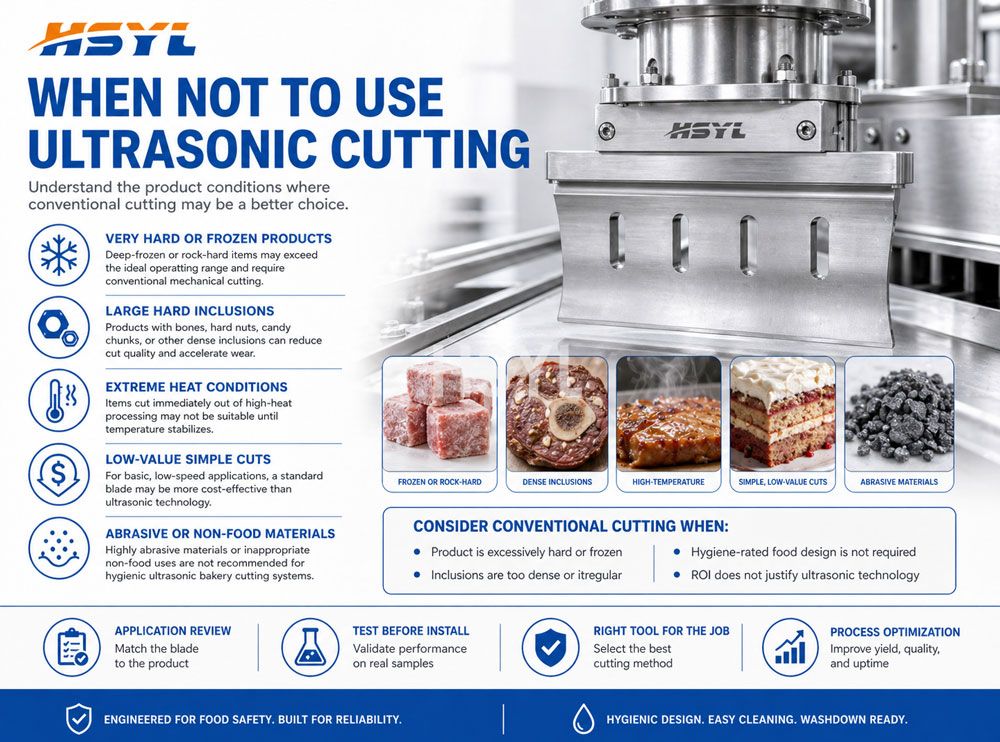
The Physics of Acoustic Limitations
The system relies on acoustic energy passing through the product rather than functioning as a sheer physical wedge against an immovable solid. When evaluating an application, engineers must first look at the product matrix compliance. If the food product lacks the necessary structural give, ultrasound becomes a liability.
Acoustic Resistance in Deep-Frozen Solids
When processing deep-frozen products that have not been tempered, traditional heavy-duty band saws remain the standard. The acoustic energy from an ultrasonic generator requires a minimum degree of compliance within the material to dissipate effectively.
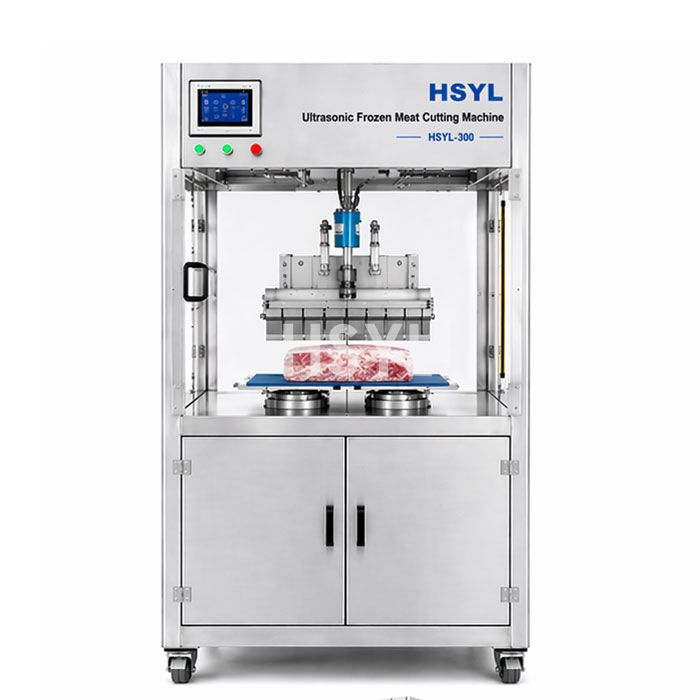
Hitting a completely unyielding block of ice or deep-frozen meat below -18°C causes the physical resonance to reflect heavily back into the transducer package. This reflection leads to severe localized heating, acute loss of amplitude, or sudden fracturing of the titanium blade. Unless the product is specifically tempered to allow partial blade penetration, ultrasonic deployment on hard frozen blocks is an engineering risk.
High-Bone Content and Calcified Structures
Industrial meat processing lines handling heavy bone-in cuts should strictly avoid acoustic slicing systems. The micro-vibration cannot effectively sever thick, dense calcified structures like mammalian bone or hard shells.
Attempting to force an ultrasonic blade through these specific cuts will instantly chip the delicate cutting edge of the sonotrode. The material grade of ultrasonic blades prioritizes acoustic transmission over raw impact toughness. For heavy bone processing, hydraulic shear systems or aggressive mechanical band saws are the only viable technical routes.
Highly Abrasive Inclusions
Many snack and bakery facilities process doughs heavily fortified with hard seeds, dense nuts, or coarse salt aggregates. While an ultrasonic blade will physically cut through these inclusions initially, the abrasive friction against the titanium edge is extremely high.
A highly abrasive food matrix will quickly degrade the cutting accuracy by rounding off the sharp profile of the instrument. The resulting downtime for tooling changes heavily skews the financial viability of the line. Managers must prioritize longevity over theoretical precision if the blend contains a high volume of abrasive particulates.
Production Bottlenecks: Throughput vs. Precision
A major factor in deciding when to avoid this technology relates directly to target production rates. The technology is inherently constrained by the speed at which the blade can travel through the food matrix without inducing a stall condition on the generator.
Stroke Speed and Generator Limits
In high-volume operations where sheer tonnage per hour is the primary performance metric, mechanical cutting often secures the highest overall yield. For example, continuously slicing uniform extruded commodities at several hundred cuts per minute is easily achieved with high-speed rotary steel blade systems.
Ultrasonic blades generally operate with a slower vertical stroke speed. If you force an ultrasonic blade too fast through a dense product, you exceed the generator's capacity to maintain the required amplitude. This aggressive action results in a poor cut finish, structural tearing, or an immediate overload fault on the equipment.
Continuous vs. Indexing Workflows
When processing a continuous web of dough on a wide belt, aligning ultrasonic guillotines requires exact speed matching and frequently a brief pause or synchronization loop. This necessitates complex PLC logic and servo motor coordination to prevent product bunching.
If your existing assembly architecture relies on continuous, uninterrupted high-speed flow without accumulation buffers, forcing an acoustic system into the layout can restrict upstream processing. You often have to explore how to balance the line by reviewing an inline vs batch ultrasonic cutting selection guide. In highly continuous webs, a standard rotary or flying mechanical cutter naturally offers a more practical, low-friction integration choice.
Financial Realities: Lifecycle Cost and Maintenance
The upfront capital expenditure for an ultrasonic portioning system is substantially higher than a mechanical equivalent. This premium is easily justified when processing high-value, fragile goods where exact portion weight directly impacts the margins. However, for low-margin, high-volume commodities, the lifecycle cost often fails the investment threshold.
The Fragility of Titanium Sonotrodes
The hidden operational cost is embedded directly in the tooling. These blades are precision-engineered acoustic instruments crafted from aerospace-grade titanium. A standard mechanical stainless steel blade can be sharpened repeatedly by local maintenance staff or replaced for a nominal cost.
Conversely, an ultrasonic horn requires specialized return-to-factory servicing to reshape and retune, or highly expensive replacement when it simply reaches the end of its fatigue life. If your product does not strictly require the friction-reduction properties of ultrasound, your facility is absorbing a disproportionately high lifecycle cost without realizing an equivalent technical advantage.
Operator Dependency and Tuning Overhead
Acoustic systems mandate a higher baseline of technical understanding from the floor staff. Generators occasionally require parameter adjustments, and the horns must be torqued precisely to the boosters using specific tools. A poorly torqued assembly will fail to resonate and will quickly destroy the internal piezoelectric transducers.
If a manufacturing plant struggles with high operator turnover or lacks a dedicated instrumentation technician on every shift, the system will eventually fail due to mishandling. In environments with variable technical competency, robust and straightforward mechanical systems will continually report higher equipment uptime.
Sanitation Design and Compliance Challenges
Robust sanitation design is a non-negotiable aspect of food manufacturing. While the smooth titanium blades themselves resist biofilm buildup and are highly sanitary, the surrounding mounting hardware and sophisticated transducer housings introduce significant cleaning complexity.
Vulnerabilities During Washdown
Standard high-pressure washdown protocols employed in daily meat and facility cleanings must be heavily modified around acoustic stations. Exposing the transducer elements to high-pressure water jets or harsh caustic chemicals will cause premature electrical shorts and total unit failure.
Additionally, the blades are exceptionally susceptible to mechanical shock. A sanitation worker casually dropping a heavy cleaning hose against the edge, or resting the blade improperly on a stainless steel worktable, can induce deep micro-fractures. In such cases, integrating acoustic equipment requires strict adherence to hygiene protocols, similar to FDA food facility regulations, ensuring that compliance requirements align with handling fragility. If the plant's current cleaning workflow cannot reliably accommodate delicate handling, ultrasonic technology introduces unacceptable operational risk.
Temperature Control Variables
While acoustic slicing generates vastly less friction than mechanical dragging, prolonged continuous operation on highly dense blocks can still induce localized blade heating. The acoustic energy inevitably turns into thermal energy within dense physical limits.
In highly temperature-sensitive applications, such as portioning raw chocolate mass or butter-heavy pastry slabs, this localized ambient heating can cause minor melting or smearing precisely at the cut interface. For these very narrow recipes, a heated mechanical blade, or a chilled wire cutter framework, might actively offer superior temperature control and minimize adverse moisture loss.
Technical Matrix: Evaluating Cutting Methods
To clarify the engineering boundaries across different applications, technical buyers should evaluate their factory requirements against this objective capability matrix.
| Application Profile | Ultrasonic Suitability | Recommended Mechanical Alternative | Primary Engineering Constraint |
|---|---|---|---|
| Commodity High-Speed Slicing | Low | Rotary Knife System | Stroke speed limits the peak theoretical throughput |
| Deep-Frozen Untempered Blocks | Low | Heavy-Duty Band Saw | Acoustic reflection severely causes blade fracturing |
| Heavy Bone-In Meat Processing | Low | Hydraulic Meat Shear or Saw | Calcified structural material quickly destroys titanium edges |
| Heavy Nut/Seed Inclusions | Moderate to Low | Standard Guillotine Blade | Abrasive friction wear drastically reduces horn lifecycle |
| Delicate, Layered, Sticky Pastries | Excellent | None Recommended | Optimal acoustic isolation prevents layer smearing |
Plant Manager Action Plan: 4 Steps for Equipment Selection
Before committing major capital to a complete ultrasonic integration, engineering managers should execute this practical, reality-based evaluation across their floor operators.
1. Analyze the Physical Product State: If the primary SKU is frozen solid below -15°C, or routinely contains abrasive inclusions like unground spices or thick shells, default to testing standard mechanical solutions first. Only evaluate ultrasonic engineering principles if deformation issues persist.
2. Calculate the True Throughput Needs: Compare the maximum vertical stroke rate of the specific ultrasonic generator model against your peak seasonal production demands. Ensure the deployment will not artificially bottleneck upstream formulation systems or downstream packaging belts.
3. Review the Sanitation Competency: Audit your current end-of-shift cleaning workflow directly on the floor. Accurately determine if the third-party sanitation crew can reliably adapt to managing delicate, high-cost electrical components without inducing impact damage.
4. Run the Full Lifecycle Cost: Do not base the financial ROI solely on an isolated yield improvement percentage. Model the actual projected cost of blade replacements, generator calibrations, spare parts stocking, and the inevitable specialized training needed over a 5-year heavy-duty operational window.
Final Engineering Verdict
Ultrasonic technology represents an exceptional engineering pivot for precise industrial processing challenges that involve sticky, delicate, or easily deformed materials. However, treating it as an automatic upgrade for every slicing requirement is a costly oversight.
By heavily understanding when not to use ultrasonic cutting—specifically in high-tonnage, low-margin, highly dense, abrasive, or deep-frozen lines—operations directors can avoid serious financial missteps. Ultimately, focusing strictly on the hard physical properties of the food matrix and the realistic, everyday capabilities of the maintenance team ensures that capital is deployed toward the most effective piece of machinery for the factory floor.
Related Topics
- Ultrasonic Food Cutting Engineering Principles and Industrial Selection Guide
- Inline vs Batch Ultrasonic Cutting Selection Guide for Plants
- Ultrasonic vs Mechanical Cutting in Baking Technical Comparison
Consult with HSYL Engineers
Determining the exact right cutting technology requires a rigorous evaluation of your product matrix, throughput goals, and factory floor realities. Stop guessing with capital budget allocations. Contact the technical engineering team at HSYL today to discuss your specific processing line, run real material test samples, and engineer a layout that delivers reliable yield without hidden maintenance traps.
Frequently Asked Questions
What happens if you use an ultrasonic cutter on frozen meat ?
Can ultrasonic blades cut through bone or hard fruit pits ?
Why is the maintenance cost higher for ultrasonic cutting systems ?
Does ultrasonic cutting speed match standard mechanical rotary knives ?
How does sanitation differ for ultrasonic cutting equipment ?
How do hard inclusions like nuts affect the ultrasonic blade ?
Can I install an ultrasonic cutter on any existing continuous conveyor ?
Related Articles
Get professional consultation
Do you have any questions or need technical support regarding the content of this article? Fill out the form below, and our expert team will provide you with professional solutions.