In bakery processing, the cutting method is rarely a secondary equipment decision. It influences portion accuracy, edge quality, line stability, sanitation workload, and how much finished product is lost to crumbs, smear, breakage, or rework. On paper, ultrasonic cutting is often presented as the more advanced option, while mechanical cutting is treated as the conventional baseline. That framing is too simple to help a plant manager, project engineer, or technical buyer make a sound decision.
The better question is not which cutting technology appears more sophisticated. The better question is which cutting method fits the actual product behavior, production rhythm, hygiene requirements, and maintenance capacity of the plant. A bakery producing dry, structurally stable products may gain little from adding a more specialized system. A line handling sticky bars, layered cakes, cream-filled portions, or frozen desserts may see the opposite. In those cases, the cutting method can directly influence saleable yield and complaint rates.
As engineers, we learn quickly that bakery products do not fail in the same way during cutting. Some products crumble because the structure is brittle. Some smear because fat, cream, or sugar phases warm at the cut face. Some collapse because the product cannot resist compression. Some show visible layer displacement even when weight control still looks acceptable. That is why a useful comparison must be based on product mechanics, temperature condition, blade interaction, and line integration, not on generalized claims about technology.
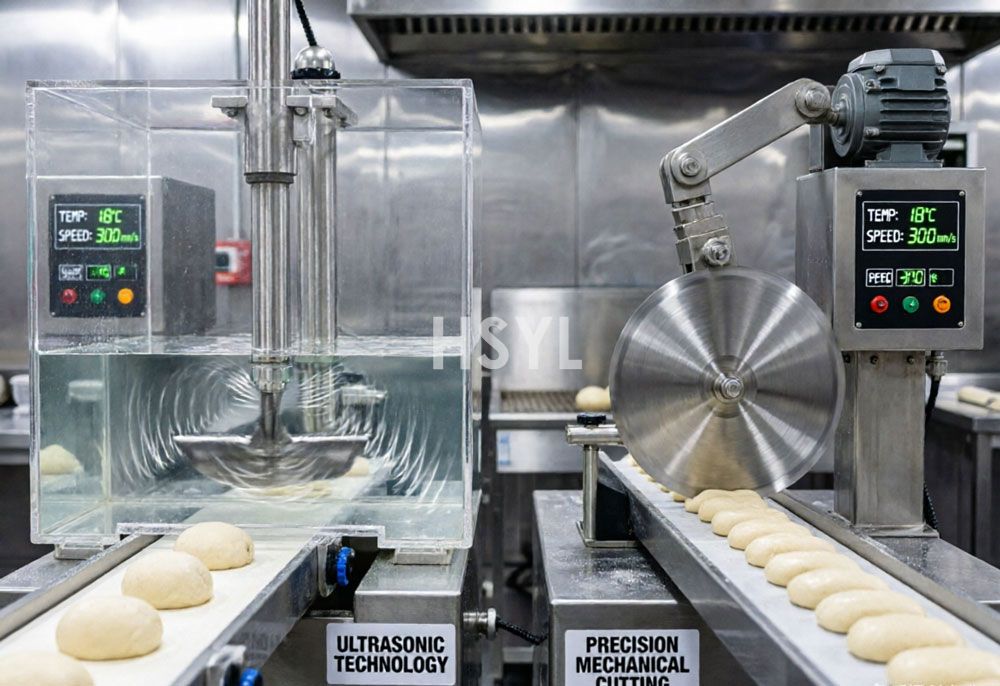
Why bakery plants get misleading results when they compare cutter types too loosely
Many plants compare cutting systems by watching a short demonstration and judging whether the sample looks clean. That may be useful as a first impression, but it is not an industrial evaluation. Bakery cutting performance is sensitive to infeed consistency, product temperature, inclusion distribution, belt tracking, topping adhesion, and the way products behave after the cut when they transfer to packaging or collection.
A cutter that performs well on one sample tray may perform very differently when the line runs continuously across multiple SKUs, with varying product heights and shift-to-shift operator differences. This is especially true in bakery operations where recipes change often and the same cutting cell may be expected to handle a broad product family. A line that looks acceptable in a controlled demonstration can become unstable once residue builds, blade cleaning intervals shorten, or product presentation drifts over time.
The hidden cost of a poor cutting match is rarely limited to visible defects. It shows up in the form of manual correction, slower belt speed, additional reject sorting, more frequent stops for cleaning, and wider weight variation between portions. These losses may appear small one by one, but across a production week they can outweigh the apparent savings of choosing the cheaper cutter type without enough process analysis.
Where ultrasonic cutting changes the physics of the cut
Ultrasonic cutting is most relevant when the problem is not simply separating product, but separating product without excessive drag, compression, or surface tearing. In food applications, the vibrating blade reduces resistance at the blade-product interface, which can help when a conventional blade tends to pull, smear, or distort the product during the cut. In bakery processing, this matters most with products that are soft, adhesive, layered, cream-filled, coated, or temperature-sensitive.
Typical examples include mousse cakes, cheesecakes, cream-layer cakes, sticky cereal or confectionery bars, and some frozen or semi-frozen desserts. These products may not fail because the blade is dull in the usual sense. They fail because the contact itself creates too much friction or force at the wrong point in the structure. A conventional blade can drag filling through the cut path, damage toppings, crack glazed surfaces, or pull delicate layers out of alignment before the portion separates cleanly.
In those cases, ultrasonic cutting often improves the visual quality of the cut and reduces the product disturbance that leads to rework. That does not mean it should be treated as a universal upgrade. It means the technology is valuable when the defect mechanism is driven by adhesion, deformation, or structural fragility under conventional contact. Plants that ignore this distinction often invest in ultrasonic systems for products that would have run acceptably on a simpler mechanical solution.
For bakery teams already reviewing this technology, HSYL’s automatic ultrasonic frozen cake cutting machine is one example of how ultrasonic cutting is applied where layered or frozen bakery products need cleaner portioning with lower surface damage risk.
Mechanical cutting remains the better choice in more applications than many buyers assume
Mechanical cutting still has a strong place in bakery production because many products do not require a highly specialized cut interface. If the product is firm enough to hold its structure, if the cut specification is not visually unforgiving, and if blade cleaning frequency remains manageable, a mechanical system may be the more sensible investment. This is often true for lower-adhesion sheet products, some bread items, some denser bars, and applications where the process window is broad enough to tolerate minor variation.
Mechanical systems also offer practical advantages that matter in real factories. Maintenance teams are usually more familiar with them. Spare parts are often easier to source. Blade change, sharpening logic, operator training, and troubleshooting can be simpler. In plants where technical staffing is limited or where uptime discipline is inconsistent, these practical advantages are not secondary; they are part of the economic case.
The mistake is to assume that “conventional” means “outdated.” In many bakery lines, mechanical cutting is still the correct engineering solution because the product itself does not justify the extra specialization, tuning, and ownership complexity of ultrasonic equipment. If the product is structurally stable and rejects remain low, the more advanced option may not deliver a proportionate operational benefit.
The right comparison is not blade technology alone but the full cutting cell
One of the most common selection errors is to focus entirely on the blade while ignoring everything around it. Cutting quality depends heavily on how the product enters the cut zone. If spacing varies, if products are not indexed properly, if the belt introduces vibration, or if product temperature drifts across the conveyor, even a technically superior cutting method will struggle to deliver stable results.
That is why the comparison should include the complete cutting cell: infeed control, product positioning, temperature window, crumb management, cleaning access, recipe changeover, and downstream transfer behavior. In bakery plants, a large share of cutting complaints are not caused by the blade in isolation. They are caused by mismatch between product condition and the surrounding process.
If a plant only compares sample cut quality and machine price, it misses the operating reality. A more serious evaluation asks whether the cutter can maintain consistent results at the planned line speed, across the intended SKU range, under normal sanitation intervals, with the actual labor profile of the plant. That is the level at which the total ownership decision becomes visible.
| Evaluation Factor | Ultrasonic Cutting | Mechanical Cutting |
|---|---|---|
| Soft or sticky bakery products | Often better suited where drag, smear, or deformation are major concerns | Can become unstable when adhesion and product pull are high |
| Firm, low-stick products | May be more capability than the application requires | Often sufficient and easier to justify economically |
| Edge quality on layered or filled items | Usually stronger where appearance is highly sensitive | More dependent on blade condition and product handling |
| Maintenance complexity | Higher specialization and more application-specific support needs | Typically simpler for in-house teams to manage |
| Cleaning and sanitation review | Must be assessed carefully around blade assembly and access points | Often simpler, though hygienic design still matters greatly |
| Operator familiarity | May require more training depending on the plant | Usually easier for conventional production teams to adopt |
| Capital sensitivity | Generally higher | Generally lower |
| Application flexibility | Strong in problem products, but must be justified by product behavior | Strong where product families are simpler and more stable |
Product type matters more than category labels such as “cake” or “bread”
One reason cutting projects go wrong is that product categories are too broad to guide equipment decisions. “Cake” is not a single cutting condition. A frozen layer cake, a room-temperature sponge sheet, a dense brownie slab, and a cream-filled retail dessert all respond differently to blade contact. The same applies to bars. A dry cereal bar and a sticky inclusions-heavy bar may look similar in packaging but behave very differently in the cut zone.
For that reason, the more useful classification is based on processing behavior. Plants should group products by characteristics such as stickiness, layer sensitivity, filling mobility, surface coating fragility, temperature dependence, and required visual finish. This approach gives the engineering team a better basis for deciding whether a conventional blade system is sufficient or whether ultrasonic cutting is likely to solve a recurring defect pattern.
This is also where supplier conversations become more productive. Instead of asking which machine is “best,” the plant can ask more precise questions: Which products show drag at the cut face? Which products require the tightest visual standard? Which SKUs force operators to stop most often for blade cleaning? Which items lose saleable quality when production speed is increased? These are the questions that lead to a valid equipment decision.
Sanitation, washdown access, and changeover burden often decide the real winner
Cut quality is important, but it is not the only criterion that affects line profitability. In bakery operations, cleaning frequency and sanitation design often determine whether a cutting system remains practical over time. This is particularly important where cream residue, sugar build-up, sticky fillings, fruit preparations, or allergen changeovers demand strict hygiene control between runs.
A cutting solution that produces beautiful portions but slows sanitation or complicates access may not be the right long-term investment. Hygienic design, food-contact material selection, surface finish, access to product-contact zones, and removal or cleaning procedure all matter. Plants with strict audit expectations should review the cutting area in line with established food safety practice. For broader regulatory context, processors often refer to FDA food safety resources during equipment assessment and sanitation planning.
The same applies to changeover burden. If the bakery runs many SKUs, the time required to switch recipes, adjust cut patterns, verify portion dimensions, and return to a sanitary ready state can be as important as the cut itself. A line designed for one product family may perform well in isolation yet become inefficient in a mixed-SKU environment if changeover logic is not engineered properly.
Where HSYL’s broader line perspective becomes more relevant than the cutter alone
In many bakery projects, the cutting station is only one part of a larger engineering problem. Product quality at the cut is shaped by upstream preparation, cooling condition, conveyor presentation, and the way finished portions are transferred into packaging. A cutter selected without regard to the rest of the line may appear correct during quotation review but underperform after commissioning.
That is why some projects are better approached at the line level rather than at the single-machine level. If the product family includes temperature-sensitive cakes, bars, or desserts, the plant may need to review not only cutting method but also conveying stability, product spacing, and the handoff to secondary processing or packaging. HSYL’s broader bakery and cereal production solutions page is relevant here because it frames cutting as part of a coordinated bakery process rather than as a standalone purchase.
For technical buyers, this matters because a good cutting result must be repeatable across actual operating conditions. In industrial bakery work, repeatability is usually the real standard. One clean sample does not prove process suitability. Stable output across shifts, operators, products, and sanitation cycles does.
What experienced plant engineers usually notice before a purchase team does
The common assumption is that poor cut quality means the blade technology is wrong. Sometimes that is true, but not always. In many plants, the more immediate cause is product presentation inconsistency. A product that enters the cutter with unstable spacing, poor orientation, or variable temperature will create quality variation regardless of whether the blade is ultrasonic or mechanical.
Another overlooked point is that some lines should first quantify the cost of intervention before choosing a new cutter. If operators are stopping frequently to wipe blades, reposition products, remove damaged pieces, or lower throughput to maintain quality, then the plant has a measurable process problem. If those interventions are rare and defects remain commercially acceptable, the case for a more specialized technology may be weak even if the demonstration result looks better.
This is why engineering-led testing is essential. A serious trial should include representative SKUs, realistic temperatures, practical line speeds, and enough runtime to expose cleaning and stability issues. The trial should not only ask whether the cutter can produce a clean sample. It should ask whether the plant can keep that result consistently under production conditions.
Three practical checks plant managers can take to the floor before requesting quotations
- Identify the exact failure mode. Do not just describe the issue as poor cutting. Record whether the dominant defect is tearing, crumbing, smear, layer shift, topping damage, or portion inconsistency. Different failure modes point to different equipment needs.
- Measure intervention frequency. Track how often operators stop for blade cleaning, product repositioning, reject removal, or speed reduction. These recurring interventions often reveal whether the current process problem is serious enough to justify a technology change.
- Check the process around the cut. Review infeed consistency, product temperature control, spacing accuracy, conveyor behavior, and downstream acceptance before assuming that the blade alone is responsible for the problem.
For industrial bakery lines, the decision is not whether ultrasonic cutting is modern or whether mechanical cutting is traditional. The decision is whether the product portfolio and operating conditions create defects, labor burden, or quality loss severe enough to justify a more specialized cut interface. When the process does not demand that extra capability, a mechanical system may remain the sounder investment. When the process does demand it, ultrasonic cutting shifts from being a premium feature to being a practical quality-control tool.
Related Topics
- what ultrasonic cutting actually means in food processing
- automatic ultrasonic frozen cake cutting machine
- bakery and cereal production solutions
Call to Action
If your bakery line is dealing with product deformation, cut-edge defects, or inconsistent portioning, HSYL can help review the issue from product behavior to line layout. Share your product type, temperature range, target capacity, and cut format, and the team can advise whether a mechanical or ultrasonic solution is the better engineering fit.
Frequently Asked Questions
Is ultrasonic cutting always better than mechanical cutting for bakery products
Which bakery products are the strongest candidates for ultrasonic cutting
What should a bakery plant compare besides cut quality
Does ultrasonic cutting reduce waste in every bakery line
How should a plant test ultrasonic and mechanical cutting before buying
Related Articles




Get professional consultation
Do you have any questions or need technical support regarding the content of this article? Fill out the form below, and our expert team will provide you with professional solutions.