The Physics of Friction: Defining Ultrasonic Cutting for the Modern Food Factory
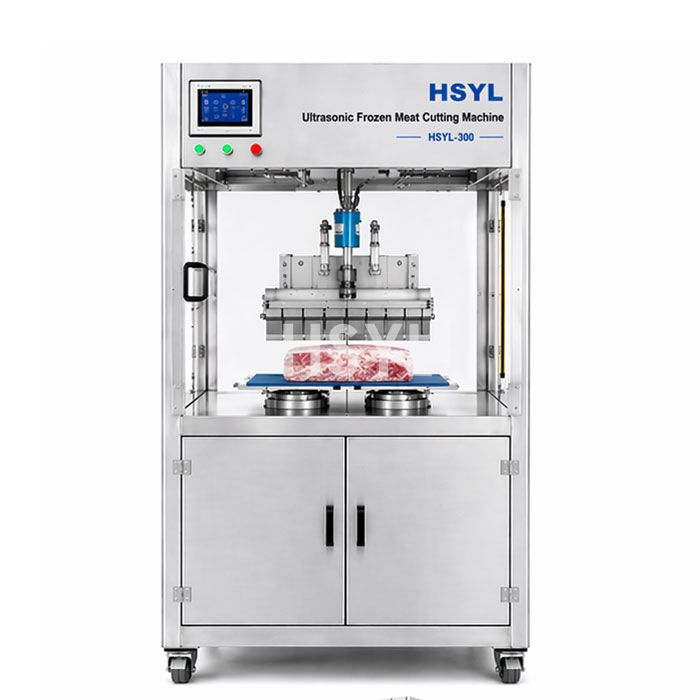
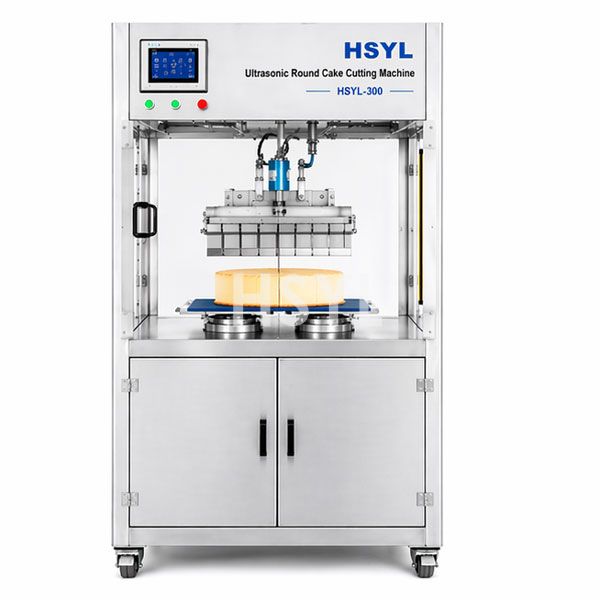
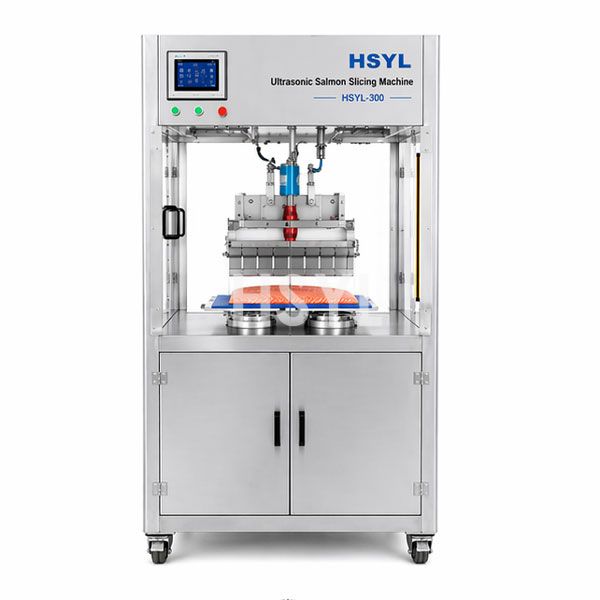
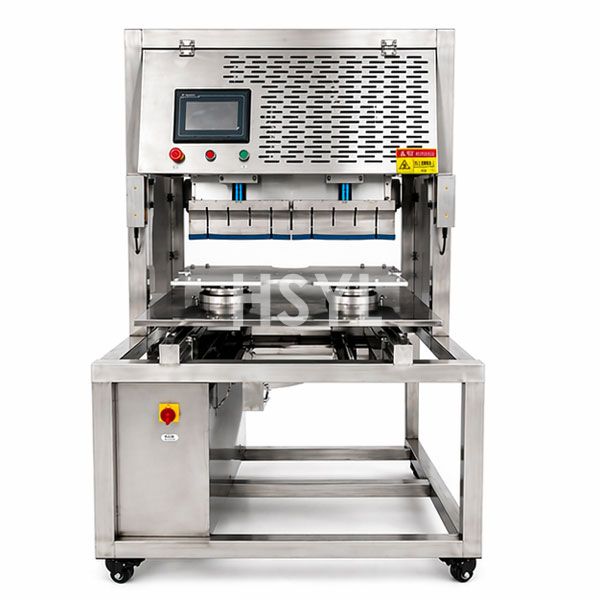
In the context of HSYL’s industrial food processing solutions, ultrasonic cutting is the application of mechanical resonance to a sharp cutting edge, typically a blade forged from food-grade titanium alloy (Ti6Al4V). The vibration frequency—usually 20kHz or 40kHz—is longitudinal, meaning the blade moves back and forth at a microscopic amplitude of 10 to 60 microns. This movement is so rapid that it effectively eliminates the friction between the food product and the blade surface.
When I troubleshoot lines for our ultrasonic cutting production line clients, I explain it as "molecular separation." Because the blade surface is oscillating at 20,000 times per second, the fats and sugars in products like layered mousse cakes or sticky energy bars simply cannot adhere to the metal. You aren't "pushing" through the food; you are separating it with virtually zero mechanical resistance. This allows for cutting through soft-on-hard layers (like a sponge cake with a hard chocolate base) without causing the layers to smear or collapse.

Core Components of an Industrial Cutting System
- The Generator: Converts standard 220V/380V power into high-frequency electrical signals with auto-tuning capabilities to match the blade's resonance.
- The Transducer: Uses piezoelectric ceramics to convert electrical energy into mechanical vibration.
- The Booster: Amplifies the amplitude of the vibration to achieve the specific "glide" required for different food densities.
- The Sonotrode (Blade): The final delivery tool. HSYL uses vacuum-heat-treated titanium to ensure the blade can withstand 24/7 continuous operation without fatigue cracks.
Ultrasonic Machining (USM): Why It Belongs in the Toolroom, Not the Food Line
On the other side of the engineering spectrum is Ultrasonic Machining (USM). Unlike cutting, USM is a nontraditional material removal process used for hard, brittle materials like ceramics, glass, and quartz. It does not use a sharp blade. Instead, it uses a relatively soft tool (often made of mild steel or stainless steel) that vibrates at high frequencies in the presence of an abrasive slurry (boron carbide or silicon carbide particles mixed with water).
The "machining" happens when the vibrating tool hammers the abrasive particles into the workpiece, causing microscopic chipping. This process is slow, precise, and involves material removal rates (MRR) measured in milligrams per minute. If you attempted to use USM on a food product, the abrasive slurry would contaminate the food, making it unfit for human consumption and violating every FDA and BRCGS food safety standard in existence. It is a critical distinction: Cutting is about keeping the product whole; Machining is about taking pieces away.
Engineering Comparison: Cutting vs. Machining Parameters
| Parameter | Ultrasonic Food Cutting (UC) | Ultrasonic Machining (USM) |
|---|---|---|
| Objective | Frictionless separation of soft/sticky solids | Abrasive erosion of hard/brittle solids |
| Tool Interface | Sharp Titanium Alloy Blade | Soft Steel Form Tool + Abrasive Slurry |
| Medium | Air/Dry environment | Liquid Slurry (Water + Abrasive Grains) |
| Typical Workpiece | Cake, Cheese, Dough, Candy, Deli Meat | Ceramic, Glass, Sapphire, Ferrite |
| Portion Precision | ±0.5mm for large blocks | ±0.01mm for micro-holes |
| Frequency Range | 20kHz - 40kHz | 19kHz - 25kHz |
The HSYL Contrarian View: Why "Faster" Frequency Can Sometimes Ruin Your Yield
In many marketing brochures, you will see a push toward 40kHz systems as the "ultimate" solution for everything. As an engineer who has spent sleepless nights at 3,000kg/hour snack factories, I hold a contrarian view: 40kHz is not always better than 20kHz. While 40kHz offers a higher frequency, the amplitude (the physical distance the blade moves) is much smaller—often half that of a 20kHz system.
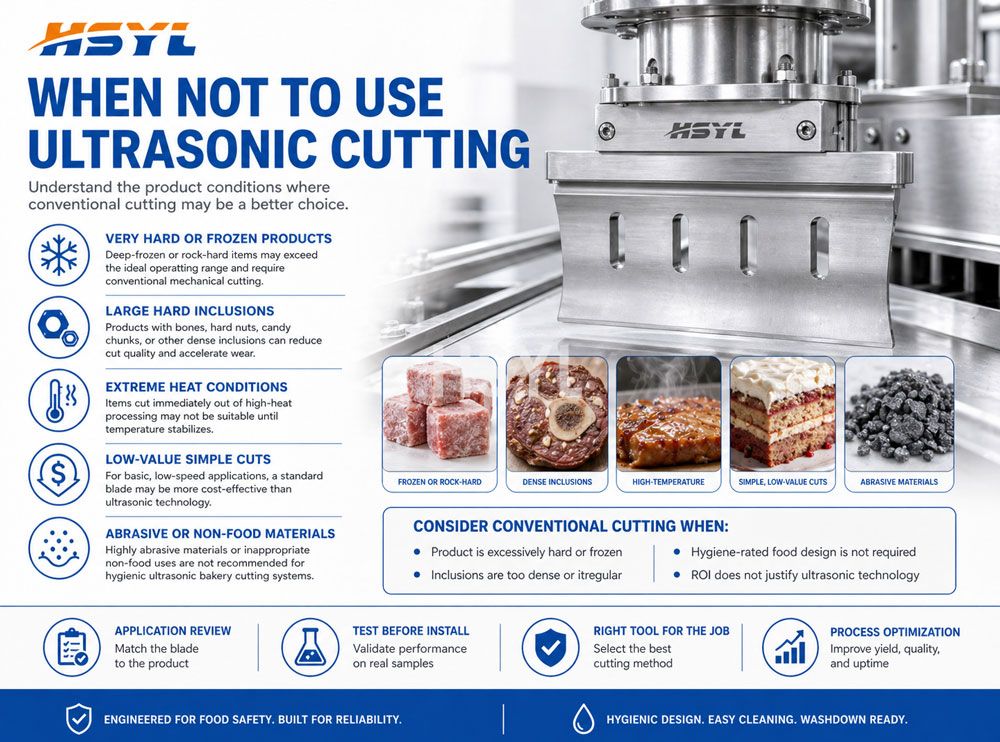
For a dense, frozen cheesecake or a heavy sandwich wrap, a 40kHz blade often lacks the "punch" to overcome the mechanical damping effect of the fat content. The result? The blade stalls, the generator throws an overload error, and your line stops. At HSYL, we use the Fat-to-Friction Ratio (FFR) Formula to determine your setup:
HSYL Efficiency Coefficient (E) = (Amplitude [μm] x Frequency [kHz]) / Substrate Density [kg/m³]
If your "E" value falls below 12.5, you will experience smearing. This is why for industrial-scale energy bar production, a heavy-duty automatic ultrasonic cutting machine running at 20kHz with a 60-micron amplitude is almost always superior to a delicate 40kHz setup. A high-value procurement decision must be based on the damping characteristics of your specific product recipe.
Maintaining the "Sweet Spot": Tool Life and Fatigue Management
Whether you are dealing with cutting or machining, the acoustic horn (the tool) is under incredible stress. In cutting, the blade vibrates at 20,000 times per second. If the blade is not perfectly balanced, it will develop internal heat spots. Within 4-6 hours of operation, an unbalanced blade will reach temperatures exceeding 80°C, which will melt the cream or fat in your product instantly, defeating the purpose of ultrasonic cutting.
This is where HSYL’s Digital Frequency Tracking technology becomes an industrial-grade solution for plant managers. Unlike cheaper competitors that use fixed-frequency generators, our systems scan the resonant frequency every 1 millisecond. If the product temperature changes or the blade experiences slight wear, the generator shifts the electrical output to maintain the "Sweet Spot." This prevents transducer burnout and extends blade life by 40% compared to analog systems.
Actionable Audit: 3 Steps for Factory Managers to Verify Their System
If you currently have an ultrasonic system on your floor and you are seeing inconsistent cuts or hearing a "screaming" high-pitched noise, perform these checks immediately:
- Thermal Scan: After 30 minutes of cutting, use an IR thermometer on the blade. If the temperature exceeds 40°C in a dry environment, your resonance is failing or your booster is incorrectly sized for the product density.
- Amplitude Witness Test: Place a piece of white paper near the blade (do not touch). You should see a clear "blur" or "ghosting" effect. If the edge looks perfectly sharp while running, your piezoelectric ceramics are likely cracked or aged.
- Cleaning Protocol Audit: Ensure your team is not using abrasive pads to clean the titanium blades. Titanium is a self-healing oxide material; scratching it with metal wool disrupts the acoustic wave distribution, leading to premature blade failure.
For those looking to integrate these systems into a new facility, I strongly recommend reviewing the latest CE and BRCGS sanitary design requirements for high-frequency equipment to ensure your electrical enclosures are properly shielded from EMI (Electromagnetic Interference).
Related Topics
- Ultrasonic Cutting Machine Advantages: An Engineer's In-Depth Analysis
- Industrial Ultrasonic Cutting Production Line Solutions
As the engineering head at HSYL, I don't believe in "one size fits all" sales pitches. Your factory layout, your product's moisture content, and your regional power stability all dictate the mechanical configuration of your system. If you are struggling with a difficult-to-cut product or are unsure whether your project requires a 20kHz or 40kHz setup, I invite you to send our team a sample for a free laboratory trial. We will provide a full high-speed video analysis and a custom line layout to help you maximize your factory's potential. Let's build a line that works.
Frequently Asked Questions
Can an ultrasonic food cutter accidentally "machined" the conveyor belt
Why is titanium the preferred material for ultrasonic cutting blades over stainless steel
How do I calculate the ROI for switching from manual cutting to an HSYL ultrasonic system
Do I need a special technician to operate an ultrasonic cutting machine
What happens if a hard object like a stone enters the ultrasonic cutting area
Related Articles




Get professional consultation
Do you have any questions or need technical support regarding the content of this article? Fill out the form below, and our expert team will provide you with professional solutions.