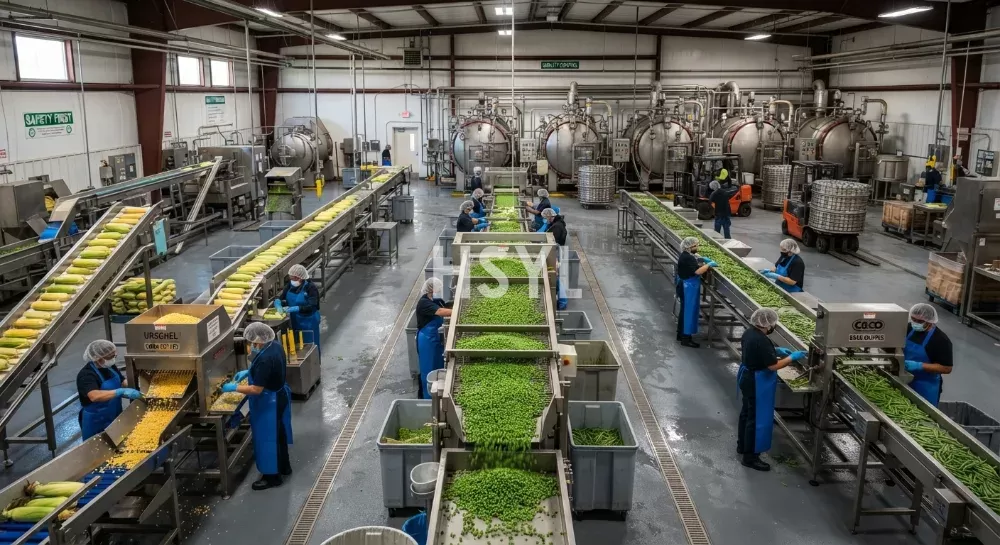
Low-Acid Canned Vegetables: Corn, Peas and Green Beans Processing Line
Low-acid canned vegetable processing line for corn, peas, and green beans. Press...


Ultrasonic cutting production line for industrial bakeries and confectionery plants. Multi-station ultrasonic slicing with programmable patterns, SUS304 build, turnkey integration with existing lines.
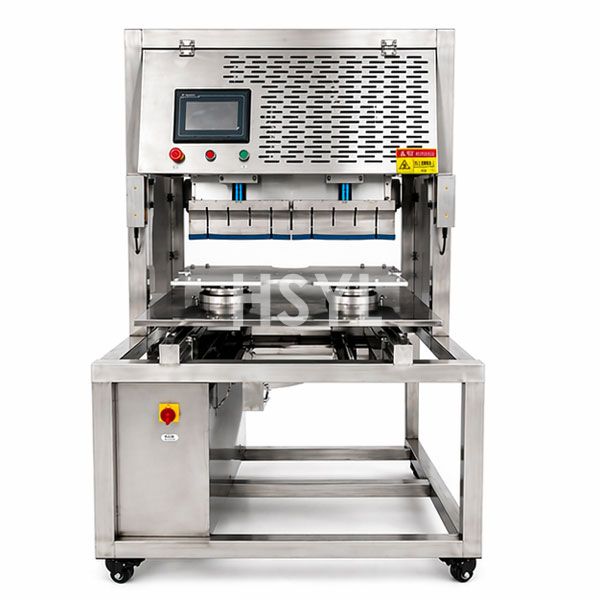
The ultrasonic cutting production line is designed for industrial bakeries, confectionery plants, and central dessert kitchens that need a fully integrated slicing system rather than a single stand-alone machine. It combines multiple ultrasonic cutting heads, programmable motion, and synchronized conveying into one line so that multi-layer cakes, bars, nougat slabs, frozen desserts, and similar products can be portioned with consistent precision at industrial scale.
Instead of relying on manual transfer between separate cutting machines, the line brings products through a defined cutting sequence under PLC control. This reduces handling, keeps cut patterns repeatable, and improves yield on premium products where both structure and visual appearance are critical.
| Parameter | Specification Details |
|---|---|
| Model | HS-USC3260 Ultrasonic Cutting Line |
| Dimensions (L×W×H) | Approx. 3260 × 1200 × 1920 mm |
| Primary Blade Configuration | 2 × 305 mm titanium ultrasonic blades |
| Secondary Blade Configuration | 2 × 205 mm titanium ultrasonic blades |
| Maximum Product Height | Approx. 80 mm |
| Total Power | Approx. 3,800 W installed cutting power |
| Rated Voltage | 220 V, 50/60 Hz (other voltages on request) |
| Typical Capacity | Approx. 300–800 portions/hour depending on product size and cut pattern |
| Material Grade | Food-grade SUS304 frame, SUS316L food-contact zones |
| Control System | PLC with touchscreen HMI and recipe storage |
Many high-value bakery and confectionery products suffer from deformation and smearing when cut with conventional blades. Multi-layer mousse cakes, slab cakes with fruit inclusions, sticky nougat, and frozen desserts often show squeezed layers, dragged fillings, and smeared toppings after cutting. As volume increases, these defects directly affect yield and shelf presentation.
The ultrasonic cutting line uses multiple titanium blades that vibrate at ultrasonic frequency with a controlled amplitude. These acoustic vibrations reduce friction at the blade-product interface, so the blade separates layers and inclusions instead of pushing them sideways. The programmable gantry moves blades through straight and angled trajectories, and each cut is executed with repeatable positioning across the conveyor width.
Because several blades are installed in one line, different product formats can be cut in a single pass: for example, longitudinal cuts to form strips with one set of blades, followed by cross cuts to form bars or squares with another set. This staged approach replaces manual cutting steps and helps maintain consistent geometry from the first slab to the last in a production run.
The HS-USC3260 line is typically configured with an infeed section, ultrasonic cutting zone, and outfeed section. Products such as sheet cakes, nougat slabs, or frozen dessert blocks are placed on trays or directly on the conveyor and indexed into the cutting area. The primary ultrasonic blades perform the first set of cuts, creating strips or segments according to the recipe. The secondary blades then execute cross cuts or diagonal cuts to reach the final portion size.
The PLC coordinates conveyor indexing and the programmed cutting sequence. Stored recipes can simplify repeat jobs by recalling the settings available on the selected configuration. A product changeover may also require adjustments to guides, supports, blade arrangements or transfer equipment. Confirm the changeover procedure for your intended product range, including cleaning, mechanical adjustments and the first acceptable portions after restart.
The mechanical structure is built from SUS304 stainless steel with a welded frame designed for stability. Blade mounting and transducer assemblies are designed to maintain resonance at operating frequency over long runs. Electrical components are housed in an enclosure that supports washdown in the cutting zone while keeping control hardware protected.
Industrial bakeries and confectionery plants use the ultrasonic cutting line for a variety of products, including layered mousse cakes, cheesecakes, decorated sheet cakes, nougat and nut bars, and frozen dessert slabs. In many cases, the line follows a cooling or freezing step so that products reach the correct firmness for clean ultrasonic cuts.
The line is well suited to high-value products where portion size, edge quality, and decoration integrity all matter. For example, cakes with mirror glazes, ganache layers, or delicate fruit toppings benefit from reduced smearing, while nougat and bar products benefit from consistent portion dimensions and reduced crumb loss. Frozen dessert producers use the line to cut ice cream cakes and layered frozen desserts into consistent shapes for retail packaging or food service.
Central kitchens that produce desserts for multiple outlets can use the line to standardize portion sizes across locations. By storing recipes for each dessert format, they can change from one slab size or cut pattern to another without extended changeover time, which is important for facilities running smaller batches of multiple SKUs.
Define the supply scope around the product entering and leaving the cutting section. A cutting production line may form part of a larger bakery or confectionery project, but cooling, product separation, weighing and packaging should each be identified in the quotation.
| Production stage | Details to confirm |
|---|---|
| Product infeed | Incoming slab or tray dimensions, product condition, loading method and conveyor height |
| Cutting sequence | Required longitudinal, transverse or angled cuts and the blade arrangement proposed for them |
| Portion discharge | Whether portions leave together or require separation, spacing, orientation or tray placement |
| Packaging connection | Wrapper or tray-loading requirements, transfer speed and control interfaces |
| Supporting equipment | Which cooling, weighing, inspection and packaging units are existing, included or separately supplied |
For an existing plant, provide a layout showing the upstream discharge and downstream receiving points. Include access space for operators, cleaning and maintenance, as well as the available utilities.
Agree on an output target for the complete sequence using representative products and portion patterns. The assessment should cover loading, cutting and discharge, including what happens when downstream equipment pauses. State any manual handling that remains part of normal operation.
Product-contact surfaces on the ultrasonic cutting line are designed for bakery and confectionery hygiene requirements. SUS304 and SUS316L stainless steel are used in appropriate zones, and surfaces are finished to make daily cleaning efficient. Guards are designed to provide both operator safety and access for sanitation teams so that cutting zones, blades, and conveyors can be inspected and cleaned according to plant procedures.
Safety systems include guarding around the cutting area, emergency stop circuits, and interlocks that stop blade movement when guards are opened. During project implementation, Hongsheng Yuanlin works with customer safety and quality teams to align operating and cleaning procedures with local regulations and company standards.
Service support for ultrasonic cutting lines includes commissioning, operator and maintenance training, and consultation on recipe setup for different products. Recommended spare blades, transducers, and other wear parts can be supplied with the line, and configurations can be adapted to regional electrical standards and preferred control platforms for international projects.
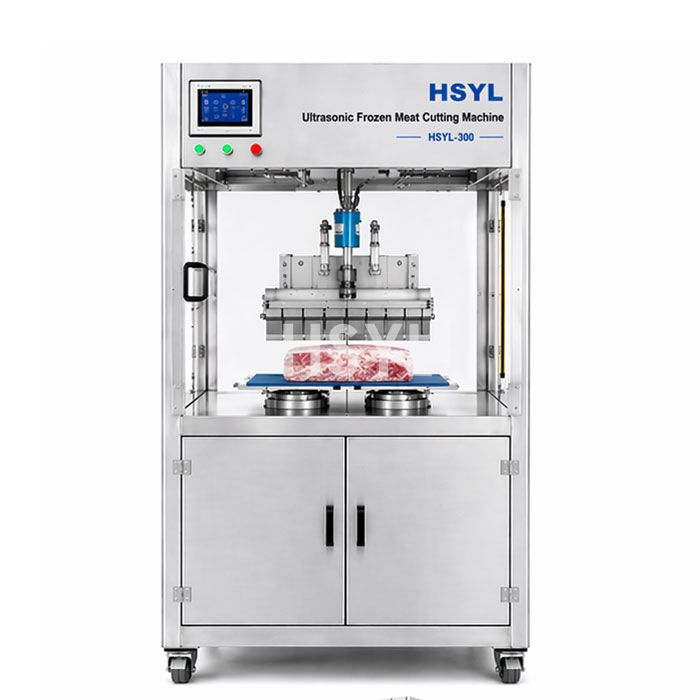
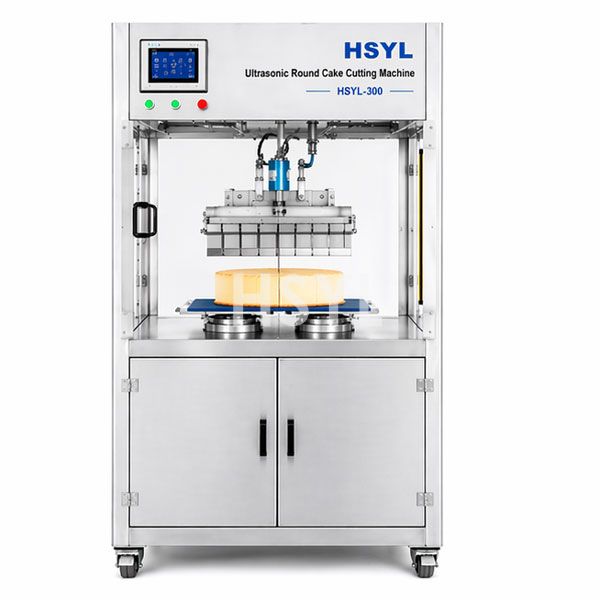
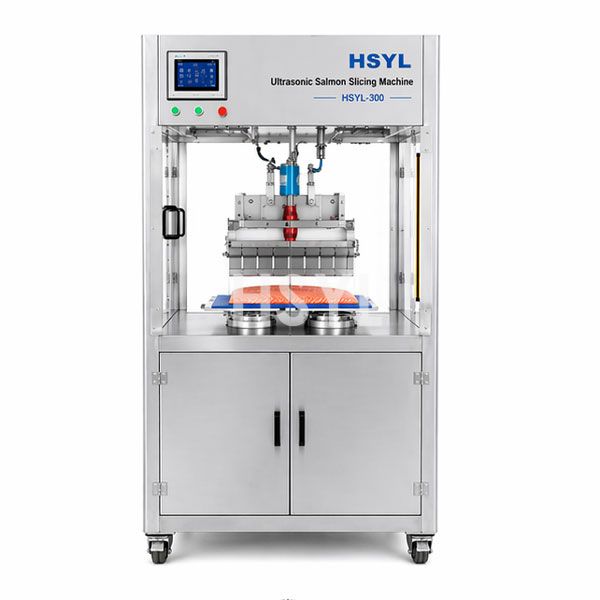


Low-acid canned vegetable processing line for corn, peas, and green beans. Press...
The filling medium — the liquid that fills the void spaces between the fish piec...
Direct AnswerThe most expensive asset in a fish cannery is not the retort or the...
Complete sardine and mackerel canning line: heading and gutting automation, can ...