In high-throughput bakery operations, the portioning station frequently emerges as the primary constraint on line velocity. Plant managers often tolerate a baseline percentage of product deformation, layer smearing, and dimensional variance. They treat these defects as an inherent cost of doing business with difficult matrices like sticky creams, brittle crusts, and dense fruitcakes. However, as commodity prices tighten and manual labor becomes scarce, this operational tolerance translates directly into a structural financial liability.
Replacing standard wire cutters or band saws with acoustic wave technology requires a substantial upfront capital allocation. Engineering and procurement teams cannot justify this expenditure based solely on aesthetic improvements. Transitioning to ultrasonic cutting demands a rigorous analysis of Return on Investment (ROI) extending across the entire production sequence. Buyers must quantify exact recovery metrics in product yield, line uptime, and sanitation efficiency.
The Physics of Acoustic Tooling vs. Mechanical Drag
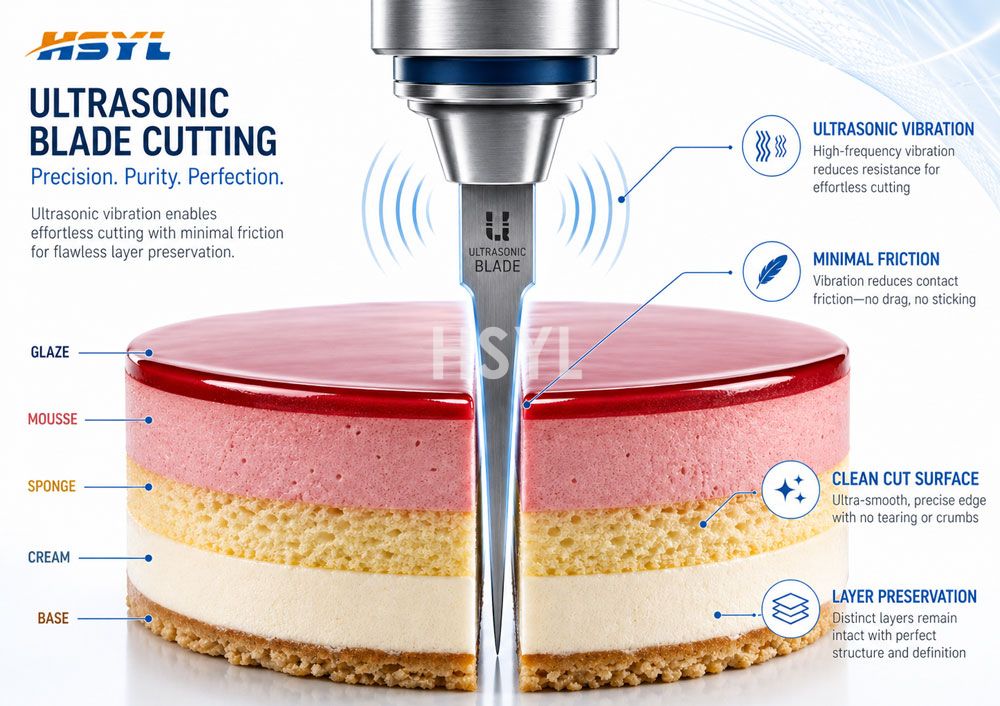
Traditional slicing equipment relies on physical downward force and friction to sever a product. When a standard stainless steel guillotine enters a multi-layered cake, the blade's surface area creates drag. This downward friction pulls distinct cream layers into the sponge matrix. For products with heavy inclusions like nuts, chocolate chips, or dried fruit, a dulling mechanical blade pushes the obstruction through the crumb, tearing the internal cell structure.
This physical resistance forces many facilities to dramatically lower the core temperature of their products prior to slicing. Running cakes through a secondary freezing tunnel hardens the fat content, making it easier for a mechanical blade to pass through without destroying the product architecture. This introduces massive secondary utility costs. Freezing operations consume heavy electrical loads and extend the overall cycle time of the plant.
An ultrasonic cutting system replaces macro-mechanical force with high-frequency micro-vibrations. The architecture consists of a standard line voltage generator, a piezoelectric converter, an amplitude booster, and a titanium alloy blade (the sonotrode). The converter translates electrical energy into mechanical movement. The blade oscillates longitudinally at frequencies generally set at 20,000 Hz or 40,000 Hz. These microscopic movements create a nearly frictionless interface between the metal and the food. Topping smearing is eliminated because the frosting simply cannot adhere to a surface vibrating thousands of times per second.
Structuring the ROI Financial Model
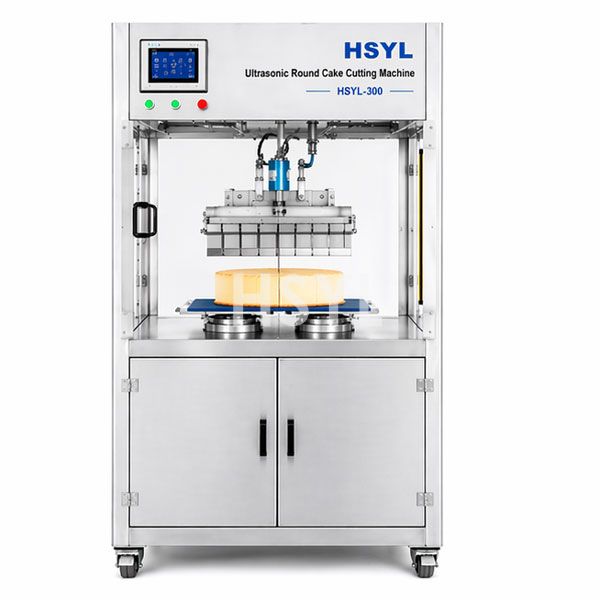
To secure capital expenditure approval, operations directors must build a definitive cash-flow recovery model. The ROI of an ultrasonic round cake cutting machine or an inline sheet slicer is derived from reversing existing production losses. Procurement engineers must compartmentalize these losses into three distinct operational pillars.
Pillar 1: Yield Reclamation and Scrap Elimination
Product give-away is a stealth variable that consistently erodes bakery margins. If a mechanical slicer routinely crushes the trailing edge of a sponge cake, operators must trim that edge to meet commercial packaging specifications. A 5mm trim across thousands of units per shift rapidly accumulates into metric tons of wasted raw material annually.
Acoustic tooling provides exact, clean portion control without compressing the bake's cell structure. Every millimeter of product edge is preserved for retail. When calculating this specific ROI vector, engineers should isolate the daily scrap weight generated exclusively by cutting defects. Multiply this volume by the raw ingredient cost per kilogram. In facilities running continuous shifts, eliminating trimming waste often recaptures the machine's initial sticker price within twelve to eighteen months.
Pillar 2: Overall Equipment Effectiveness (OEE) and Uptime
OEE relies heavily on machine availability. Mechanical blades inevitably accumulate dense, sticky residue when processing frostings, caramels, or fruit jams. This build-up degrades cut quality exponentially. Consequently, production lines must halt execution repeatedly throughout a shift so operators can manually scrape and sanitize the blades.
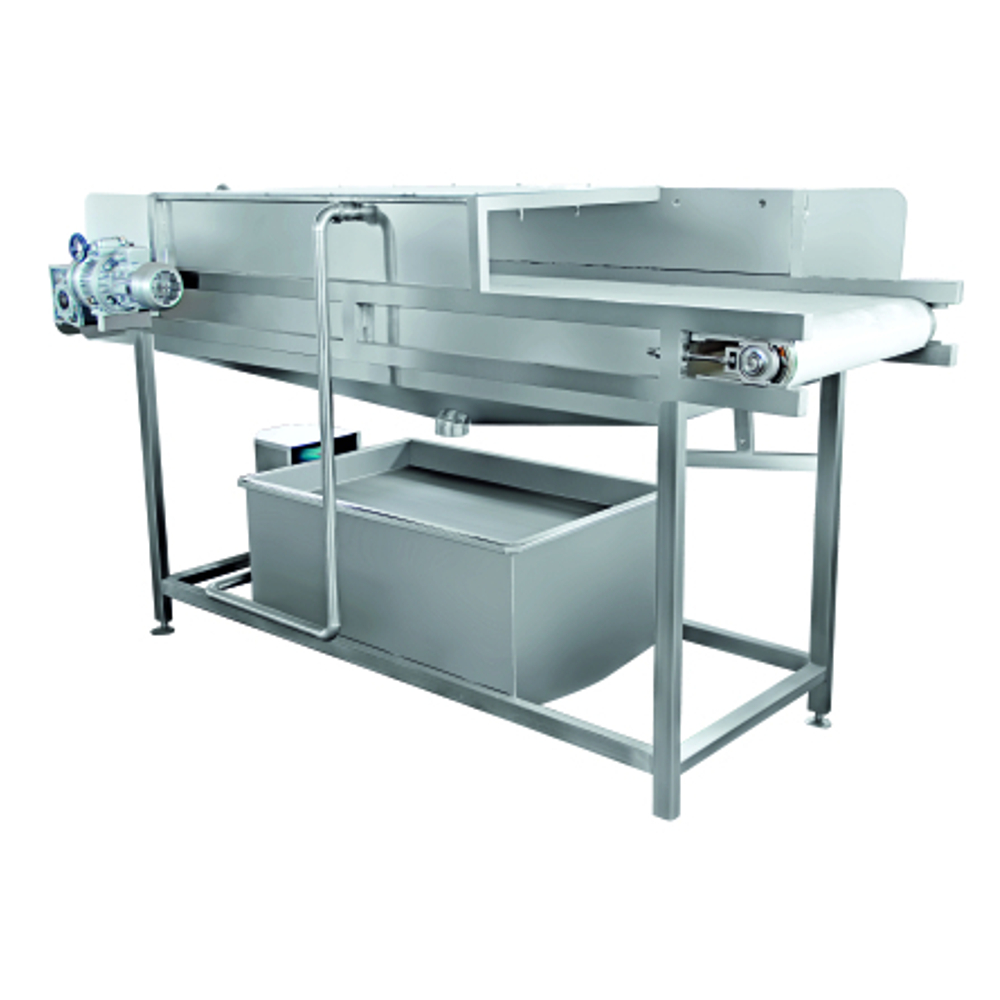
Ultrasonic systems inherently repel sticky particulates. While the blades eventually require cleaning, the interval between interventions is drastically extended. Additionally, modern setups utilize automated blade cleaning systems. An integrated water bath and air-knife purge sequence can sanitize the sonotrode in seconds without operator input. Engineering teams must log current weekly downtime hours attributed to manual blade wiping, calculate the burdened labor rate, and assign that recovered capacity to the ROI model.
Pillar 3: Changeover Economics and Flexibility
High-mix, low-volume production schedules are becoming standard as bakeries expand their SKU portfolios. Moving a line from processing a dense brownie to a fragile chiffon cake requires meticulous mechanical adjustment. Traditional changeovers rely heavily on operator intuition to align blades, adjust tension, and calibrate belt speeds. This introduces wide variability in start-up scrap.
Ultrasonic systems neutralize this variability through Programmable Logic Controllers (PLCs) and servo-driven actuators. Parameters for blade depth, cutting speed, and acoustic amplitude are assigned to specific recipe profiles. A line operator simply selects the new SKU on the human-machine interface (HMI). Toolless changeovers drop from hours to minutes. Standardizing execution logic limits operator dependency and accelerates the time-to-first-good-piece.
Engineering Sizing and Equipment Selection
Procuring an acoustic cutting solution demands precise alignment between the plant environment and the specified machinery layout. Technical buyers cannot evaluate equipment based merely on specified output rates; they must map the machine architecture to the physical constraints of the facility.
Inline Conveyor Integration vs. Offline Workcells
For high-velocity, single-product lines, selecting an inline vs batch ultrasonic cutting configuration is the primary architectural decision. Inline systems mount the cutting gantry directly above the main production belt. This requires complex servo-synchronization. The cutting head must track the product velocity perfectly. Any lag or advance during the downward stroke will bend the sonotrode and damage the product. Inline integration is economically superior but mechanically complex.
Offline, or batch-style operations deploy a standalone cutting station. Workers manually transfer baked trays or molds onto the machine's dedicated belt. While this introduces a manual touchpoint, it offers unparalleled flexibility for plants managing diverse product geometries. Standalone units allow engineering managers to centralize the slicing operation, processing output from multiple different upstream ovens at a single highly controlled station.
Acoustic Frequency Correlation
The operating frequency acts as the central performance metric of the system. 20kHz generators produce longer acoustic waves with greater amplitude. This aggressive oscillation is mandated for dense, heavily frozen, or thick-crusted bakery items. The physical robustness of a 20kHz titanium horn easily withstands the mechanical resistance of hard matrix foods.
Conversely, 40kHz configurations operate with half the amplitude but double the frequency. The resulting blade profile is significantly thinner. This tooling is specified strictly for delicate products where aesthetic disruption must be minimized, such as fragile layered tortes or fine cheeses. Misapplying a 40kHz blade to a dense frozen dough will induce micro-fractures in the titanium structure, leading to catastrophic tooling failure. Plant engineers must define product density profiles prior to issuing a Request for Quotation (RFQ).
Hygiene Compliance and Maintenance Realities
Sanitary design dictates lifecycle maintenance costs. Mechanical guillotines often employ complex physical guards, exposed springs, and overlapping metal joints. These components act as bacterial harborage points, complicating washdowns and risking audit failures. Following strict compliance mandates, such as those published by the EHEDG, requires eliminating these dead zones.
Ultrasonic machines present a much simpler physical profile over the product zone. Servo motors controlling the multi-axis gantry are typically housed in IP69K-rated stainless steel enclosures, permitting aggressive chemical foaming and high-pressure steam cleaning. However, the ultrasonic generator cabinet must remain isolated from direct washdown zones to protect internal microprocessors.
Maintenance teams must adjust to different tooling paradigms. Titanium sonotrodes are highly resonant structural elements. If a blade is dropped onto a concrete floor, or if an operator attempts to sharpen the edge with a standard grinder, the acoustic tuning is immediately destroyed. The equipment will draw excessive amperage and fault out. Preventive maintenance shifts from physical blade sharpening to periodic acoustic health checks using diagnostic software.
Avoiding Common Procurement Disconnects
Technical buyers frequently construct flawed business cases by operating in isolated data silos. The most common engineering mistake is assuming the cutting station operates independently of upstream systems. Ultrasonic blades guarantee precision, but they cannot rectify volumetric errors originating at the depositor, or uneven moisture distribution caused by a failing baking zone.
If the upstream cooling tunnel fluctuates, delivering cakes with core temperatures varying by ten degrees, the acoustic blade will behave differently across the batch. Soft cores will stick, while frozen edges will fracture. The entire processing line must be validated for thermodynamic consistency to realize the advertised capabilities of the ultrasonic upgrade.
Additionally, buyers often disregard the integration of the conveyor belt itself. If the sonotrode extends too deep and impacts the polyurethane belt, it will damage the acoustic horn and introduce plastic fragments into the food stream. Advanced systems mitigate this by employing laser height sensors and specially formulated acoustic cutting boards mounted beneath the belt. Procurement specs must mandate these secondary protection features.
Actionable Evaluation Checklist for Plant Operations
Prior to contacting suppliers or drafting a capital request, factory managers must baseline their current operational reality. Execute this technical audit to establish empirical procurement data:
- Isolate Scrap Profiles: Conduct a five-day observation capturing exactly how many kilograms of product are rejected or downgraded specifically due to mechanical tearing, dragging, or edge crushing.
- Map the Cleaning Cadence: Record the precise minute-count dedicated to machinery wipe-downs and blade swapping during mid-shift operations. Track the associated labor hour expenditure.
- Verify Upstream Stability: Deploy data loggers to measure the core temperature and dimensions of products as they enter the cutting zone. Ensure variance is within an acceptable margin.
- Assess Maintenance Readiness: Audit your internal maintenance department to ensure your technicians possess the discipline to handle, mount, and calibrate specialized titanium acoustic tooling without inflicting mechanical shock.
- Define the Worst-Case Product: Identify the single most difficult SKU in your portfolio. Base your ultrasonic frequency requirements and amplitude specifications on this baseline challenge, not your easiest product.
Upgrading to ultrasonic technology transcends simple equipment replacement. It enforces a transition from reactive, manual intervention to intelligent, data-driven line management. By mapping hard metrics against equipment capability, food engineering leaders can construct a bulletproof ROI model, ensuring the procurement directly bolsters plant profitability and competitive capacity.
Related Topics
- Cake Production Line Solutions
- Ultrasonic vs Mechanical Cutting for High-Fat Bakery Products
- Engineering Guide: Choosing Between 20kHz and 40kHz Cutters
Consult HSYL Engineering
Determining the exact ROI for an equipment upgrade requires matching process variables with the correct machinery architecture. If your facility struggles with yield loss, excessive changeover times, or complex multi-texture bakery slicing, the engineering team at HSYL can assist. Contact us to discuss throughput requirements, evaluate core product metrics, and specify an ultrasonic cutting solution engineered for your exact operational footprint.
Frequently Asked Questions
What is the expected lifespan of a titanium ultrasonic blade?
How does moisture content affect the ultrasonic cutting process?
Can ultrasonic systems be retrofitted onto existing bakery conveyors?
Do operators need specialized training to run an ultrasonic slicer?
What is the standard washdown procedure for the cutting head?
Is a 40kHz frequency always superior to 20kHz for bakery applications?
How does acoustic technology solve topping drag on frosted layer cakes?
Related Articles


Get professional consultation
Do you have any questions or need technical support regarding the content of this article? Fill out the form below, and our expert team will provide you with professional solutions.