Buyers often ask the wrong first question. They ask whether a 20kHz ultrasonic cutter is better than a 40kHz system, as if frequency alone determines cut quality. In real production, it does not. Frequency matters, but it only makes sense when considered with blade length, product temperature, cut geometry, sanitation design, generator tuning, head weight, and the way the cutter will sit inside the line.
That is why the same frequency can perform well in one plant and become a recurring maintenance or quality problem in another. A cheesecake line, a wrap line, and a snack bar line may all use ultrasonic cutting, but they do not load the cutting system in the same way. The question is not which frequency sounds more advanced. The question is which frequency fits the actual mechanical job.
For readers who want a broader refresher on the cutting method itself, HSYL already covers the basics in Ultrasonic Food Cutting: Engineering Principles and Industrial Selection Guide. This article focuses on the narrower selection decision between 20kHz and 40kHz for industrial food plants.

Start With the Cutting Job, Not the Frequency Label
An ultrasonic cutter is not just a vibrating blade. It is a stack made up of generator, transducer, booster, sonotrode or blade assembly, motion system, and product handling. When a buyer jumps straight to frequency, they often skip the three questions that actually drive the answer.
- What exactly is being cut? A sticky oat bar, a cream-filled cake, a tortilla wrap, and a thin decorative pastry all load the blade differently.
- How large is the cut? Product height, blade reach, cut length, and number of lanes affect how much mechanical reserve the stack needs.
- What happens after the cut? Some lines need only a clean separation. Others need precise transfer to flow wrap, tray loading, or robotic pick-and-place without edge damage.
Once those questions are defined, the frequency discussion becomes much more productive. Without them, frequency selection often turns into guesswork shaped by a sales brochure, noise preference, or the assumption that higher frequency must be more precise.
What Actually Changes Between 20kHz and 40kHz
In practical terms, moving from 20kHz to 40kHz changes the behavior of the entire tooling package. It affects how the stack is built, how the blade is sized, how aggressively the blade separates product, how much head mass the motion system carries, and how tolerant the system is to a difficult product window.
In many industrial applications, 20kHz systems are chosen when more mechanical reserve is needed. 40kHz systems are more often considered when the tool package is smaller, the cut is finer, or the designer is trying to reduce moving mass. That does not make 40kHz inherently more precise in every situation. It means the application is more selective.
| Selection Factor | 20kHz Tendency | 40kHz Tendency | What It Means on the Line |
|---|---|---|---|
| Tool size | Better suited to larger blade packages | Better suited to smaller, lighter tool packages | Large cakes, bars, and slab products often push the decision toward 20kHz |
| Cutting reserve | Usually preferred for heavier or more demanding cuts | Often preferred for lighter-duty or finer cuts | Sticky, tall, or inclusion-heavy products usually expose underpowered selections quickly |
| Moving head mass | Higher assembly mass is common | Lower moving mass can be an advantage | Robot-mounted or high-speed moving heads may favor 40kHz |
| Noise profile | Lower frequency systems are typically more noticeable acoustically | Higher frequency systems are often perceived as quieter in operation | Operator environment may matter in open or semi-manual production cells |
| Product window tolerance | Often more forgiving when the product window shifts | Can perform very well, but usually under a narrower application envelope | If temperature control is inconsistent, the wrong high-frequency choice can become sensitive |
That matrix is only a starting point. It does not replace a product trial. It does, however, explain why frequency selection should be treated as a line-engineering question rather than a simple component preference.
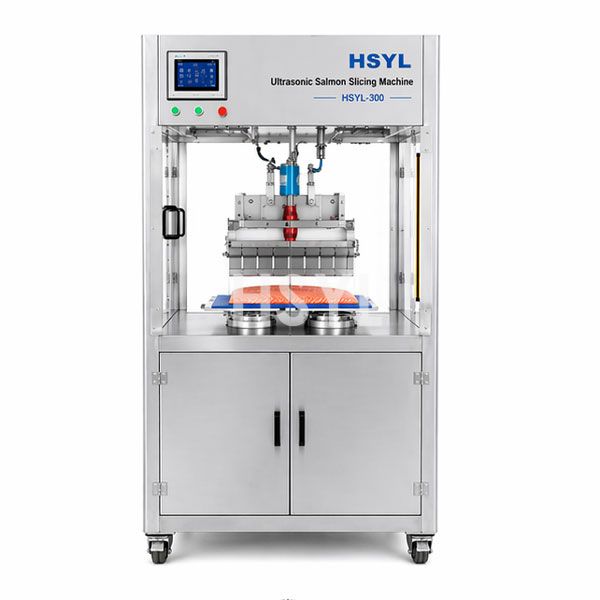
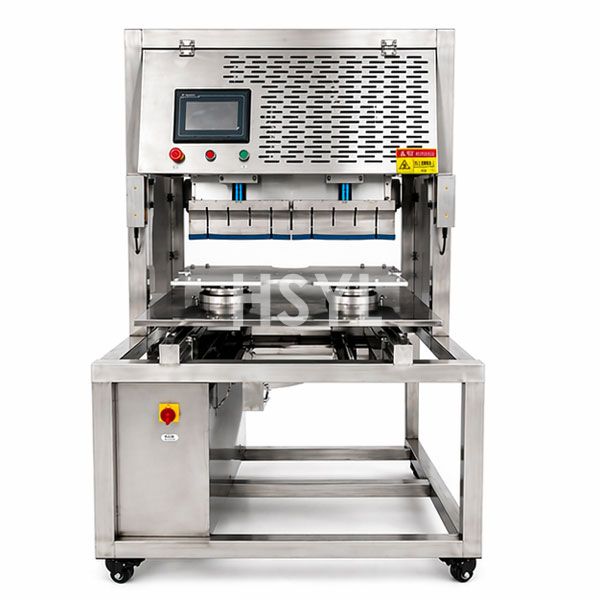
[Insert image: side-by-side comparison of 20kHz and 40kHz ultrasonic stack assemblies on an industrial food cutting frame]
When 20kHz Is Usually the Better Starting Point
If the product is tall, sticky, dense, or cut with a relatively large blade, 20kHz is often the safer starting point. This is especially true in bakery and snack applications where the cutter is expected to deal with variable moisture, inclusions, topping layers, or imperfectly controlled product temperature.
Examples include large round cakes, slab cakes, brownies, pizza portions, sticky granola bars, and some high-density snack bars. In those cases, the buyer usually needs mechanical headroom more than they need a lighter ultrasonic stack. If the product window shifts a few degrees warmer, or if the inclusions become slightly more irregular, a system chosen too aggressively toward a light, fine configuration may start showing sidewall smear, incomplete separation, or blade fouling.
- Larger blade reach: when the cut height or cut span is not small, 20kHz often gives the supplier more room to build a stable tooling package.
- Heavier-duty product load: cakes with toppings, bars with nuts, and sticky layered products usually reward a more robust setup.
- Higher SKU variation: if one cutter must handle several products with different textures, the more forgiving option is often easier to live with.
- Inline industrial cells: where uptime, spare parts simplicity, and operator tolerance matter, buyers often prefer the more practical window over theoretical finesse.
That is one reason many commercial discussions in food cutting begin around 20kHz unless there is a specific reason to move higher. If you are comparing actual supplier packages rather than generic frequency claims, it is usually worth reviewing the available blade and machine configurations together. HSYL's Ultrasonic Food Cutting Machine Manufacturer page is one useful place to look at that broader equipment context.
When 40kHz Deserves Serious Consideration
40kHz should not be treated as a luxury option or a marketing upgrade. It is better thought of as a more selective engineering choice. It becomes relevant when the product is smaller, the cut is more delicate, or the machine design benefits from a lighter ultrasonic head.
There are cases where a smaller, lighter, finer tooling package is the better answer. Decorative bakery work, smaller-format portions, compact cutting heads, and applications where the motion system is sensitive to moving mass can all point in that direction. The same can be true when the plant places a high value on acoustic comfort around the machine and the product does not demand a heavy-duty cut package.
What buyers sometimes miss is the trade-off. A 40kHz system can be a poor choice if the product is physically larger, more adhesive, or more temperature-sensitive than the initial trial suggested. It is not unusual to see a supplier or end user attracted to the idea of a finer system, only to find later that the real production mix asks more from the blade than expected.
Selection Mistakes That Show Up After Commissioning
The most common mistake is choosing frequency too early. Plants sometimes decide on 20kHz or 40kHz before they have clearly defined the product temperature at cut, the maximum product height, the changeover pattern, or the quality standard at downstream packaging. Frequency selection made without that context tends to move the problem into commissioning.
The second mistake is treating cut appearance as the only KPI. A line can produce a beautiful trial cut and still be a poor production choice if it is hard to clean, sensitive to operator setup, or difficult to keep in tune over long shifts. Throughput, cleaning workflow, spare parts lead time, and recovery after sanitation are often more important than a slight visual difference in a single sample.
The third mistake is ignoring the rest of the motion system. Frequency interacts with blade design, actuator path, product support, and transfer method. If the product flexes, bounces, or misaligns under the blade, changing frequency alone may not solve the problem. Many plants that think they need a different ultrasonic stack actually need better product presentation or a more stable conveyor handoff.
That is one reason full-line context matters. If the cutter is part of an inline system, the supplier should be thinking about transfer logic and downstream handling, not only the cut event itself. HSYL's Ultrasonic Cutting Production Line page is relevant here because it frames the cutter as one part of a production cell rather than a stand-alone machine.
A Practical RFQ Checklist Before You Ask for 20kHz or 40kHz
If the purchasing team wants better supplier proposals, the RFQ should describe the application conditions in a way that lets engineering choose the right frequency family. This is where many projects improve immediately. Better inputs produce better recommendations.
- Product type and structure: include layers, inclusions, topping load, density, and whether the product is fragile, elastic, sticky, or crumbly.
- Temperature at cut: not just room temperature, but the actual product temperature range during production.
- Cut geometry: product height, cut length, pattern, blade reach, and whether diagonal, radial, or grid cuts are needed.
- Throughput target: average and peak output, including whether there are future expansion plans.
- Sanitation conditions: washdown intensity, cleaning frequency, allergen changeover, and access constraints.
- Downstream transfer: manual pickup, tray loading, flow wrap, robotic handling, or direct conveyor discharge.
- Acceptance criteria: define what counts as a pass in FAT or product trial, including sidewall condition, yield, and acceptable operator adjustment.
If You Need One Rule of Thumb, Use This One
For industrial food lines, start with the assumption that 20kHz is the practical default when the cut is physically larger or mechanically demanding. Move toward 40kHz only when the product, blade package, and motion architecture clearly support it. That is not a sales rule. It is a risk-management rule.
If the application is large-format cake, pizza, sticky snack bars, or other mechanically demanding products, asking a supplier to justify a 40kHz choice is reasonable. If the application is small-format, delicate, and benefits from lighter moving tooling, asking why 20kHz is still being proposed is equally reasonable. The point is not to favor one frequency in the abstract. The point is to force the proposal to reflect the real cut.
What Plant Managers and Project Engineers Can Do Next
If you are in early supplier selection, ask each vendor for the same three things: the proposed frequency, the expected product window, and the reason that choice fits the blade size and motion system. If you are already troubleshooting an installed line, review the product temperature at cut, blade geometry, and conveyor presentation before assuming the wrong frequency was chosen. In practice, many ultrasonic problems are system problems, not frequency problems.
The best procurement teams do not ask, "Which frequency is better?" They ask, "Which stack, blade, and motion package is most tolerant for our product, sanitation routine, and throughput target?" That question usually leads to a better machine and a shorter commissioning period.
Related Topics
- Ultrasonic Food Cutting: Engineering Principles and Industrial Selection Guide
- Ultrasonic Cutting Machine Advantages: An Engineer's In-Depth Analysis
- How To Choose Industrial Bakery Cutting Equipment: Technical Guide
Call to Action
If you are weighing 20kHz against 40kHz for a real food product, send HSYL the product type, cut pattern, temperature window, and line layout. That usually makes the selection discussion much more useful than comparing frequencies in isolation.
Frequently Asked Questions
Is 40kHz always better for cleaner cuts?
When is 20kHz usually the safer choice in food plants?
Can the same product sometimes be cut with either 20kHz or 40kHz?
Does higher frequency mean lower maintenance?
What should be included in an RFQ for an ultrasonic cutter?
How important is product temperature when choosing ultrasonic frequency?
Should buyers choose frequency before running a product trial?
Can 40kHz be the right choice for a food cutting line?
Related Articles



Get professional consultation
Do you have any questions or need technical support regarding the content of this article? Fill out the form below, and our expert team will provide you with professional solutions.