Engineering the Precise Separation of Sub-Zero Substrates
In the industrial bakery and processed meat sectors, the transition from fresh to frozen portioning represents a fundamental shift in mechanical requirements. While many plant managers view cutting as a simple mechanical act of shearing, the reality on the production floor is far more complex. Cutting a multi-layer mousse cake or a dense meat slab at -18°C involves managing brittle-to-ductile transitions and massive acoustic impedance shifts. To achieve a cut without cracking the top glaze or crushing the internal structure, we must move beyond the "sharpness" of the blade and focus on the system-level engineering of the ultrasonic stack.

At HSYL, our Equipment Know-How is built on the reality of the shop floor. We know that a machine that cuts perfectly at 9 AM might fail by noon if the generator electronics cannot compensate for the rising thermal load of a continuous cycle. The following technical guide dives into the component selection, electronic stability, and maintenance protocols required to maintain precision in high-capacity frozen food lines.
The Ultrasonic Stack: Managing Transducer-Booster-Horn Dynamics
The core of any frozen cutting system is the "stack." This sub-assembly consists of the piezoelectric transducer, the mechanical booster, and the sonotrode (the blade). When cutting frozen blocks, the resistance of the material creates a back-pressure (mechanical impedance) that attempts to dampen the vibration.
A high-Q transducer is essential for frozen applications. "Q" refers to the quality factor of the piezoelectric ceramics. A high-Q transducer generates less internal heat per watt of output, which is critical when the generator must push 1,000+ watts to overcome the density of a frozen energy bar or a slab of salmon. The booster then amplifies this microscopic vibration, typically by a factor of 1:1.5 or 1:2.0, to achieve the peak-to-peak amplitude necessary to separate the product. For frozen foods, we typically aim for a displacement of 60 to 80 microns at the blade edge; anything less, and the blade will "bind" in the frozen mass, leading to the "crushing" effect.
Generator Intelligence: PLL Frequency Tracking
The most common cause of "shattered" frozen products is frequency mismatch. As an ultrasonic blade enters a frozen cake, the load on the blade increases instantaneously. This load effectively shifts the resonant frequency of the titanium. If the ultrasonic generator is a "fixed-frequency" unit, it will continue to output at its set point (e.g., 20,000Hz), while the blade is now resonating at 20,050Hz. This mismatch creates massive internal stress and a loss of cutting power.
State-of-the-art automatic ultrasonic cutting machines utilize Phase-Locked-Loop (PLL) digital frequency tracking. The generator "listens" to the feedback from the transducer and adjusts its output frequency in real-time (within milliseconds) to match the loaded frequency of the blade. This ensures that the maximal power transfer occurs exactly at the moment of the cut, preventing the brittle fracture caused by an under-powered, out-of-sync blade.
Metallurgy: Why Material Grade is Non-Negotiable
When cutting at sub-zero temperatures, the physical properties of the blade material change. Standard stainless steels become brittle and work-harden rapidly under ultrasonic oscillation. For durable industrial service, Grade 5 Titanium (Ti-6Al-4V) is mandatory. This aerospace alloy possesses a superior strength-to-weight ratio and a high fatigue limit, allowing it to withstand the hundreds of millions of cycles required in a typical production week.
However, not all titanium sonotrodes are created equal. In our ultrasonic frozen product cutting machine design, we utilize vacuum-hardened titanium with a specific grain orientation. This prevents "micro-pitting" on the cutting edge. When micro-pitting occurs, the surface tension of the blade increases, leading to product adhesion (smear). For engineers, checking the "surface roughness" of a blade after 500 hours of operation is a primary diagnostic for equipment health.
Selection Pitfalls: The 20kHz vs. 40kHz Argument
A frequent procurement error is selecting a 40kHz system for frozen blocks. While 40kHz offers a superior finish on delicate fresh pastries, the acoustic mass of a 40kHz blade is significantly lower. In a frozen application, the "shock load" of hitting a -15°C block can easily stall a 40kHz transducer or cause the thin blade to warp. For frozen food portioning—especially cakes over 50mm thick or meat products—a 20kHz heavy-duty system is the engineer's choice. The larger mass of the 20kHz horn acts as a flywheel, providing the momentum needed to maintain a consistent cut through varying product densities.
Sanitation and Thermal Shock Management
Hygiene protocols often clash with equipment durability. A common "Equipment Know-How" error is the use of high-temperature washdowns (80°C+) on blades that have just been cutting -18°C products. This thermal shock can create microscopic surface cracks in the titanium. At HSYL, we recommend a "tempering zone" in the ultrasonic vs. mechanical cutting comparison. The blade should be allowed to reach ambient temperature before being subjected to high-pressure cleaning. Additionally, the electrical connection points (the studs) must be protected from moisture ingress using specialized IP-rated gaskets to prevent "arcing" and total transducer failure.
Technical Parameter Matrix for Frozen Portioning
| Product State | Frequency | Min. Power Requirement | Required Amplitude | Maintenance Check |
|---|---|---|---|---|
| Deep Frozen (-18°C) | 20 kHz | 1.2 kW+ | 70 - 90 µm | Stud Torque & Frequency Sweep |
| Tempered (-8°C) | 20/30 kHz | 0.8 kW | 50 - 70 µm | Surface Wear Audit |
| Chilled (+2°C) | 30/40 kHz | 0.5 kW | 30 - 50 µm | Blade Alignment |
Engineer’s Field Step: The "Impedance Sweep"
If you are experiencing inconsistent "cracking" in your frozen line, performing a static impedance sweep is your first diagnostic step. Using an ultrasonic analyzer, you can map the resonant frequency of the stack. A healthy stack will show a single, sharp resonant peak. If you see multiple peaks or a broad, flat peak, it indicates a loose connection, a crack in the booster, or a blade that has reached its fatigue limit. This proactive measurement takes less than 10 minutes but can prevent a total line halt by allowing for scheduled replacement of a failing component.
Designing Resilience with HSYL
Ultimately, a successful frozen cutting line is the result of balancing vibratory energy against material resistance. At HSYL, we don’t just sell knives; we sell the engineering solutions that make your production line reliable. Whether it's managing the PLL response times or optimizing the alloy for your specific SKU mix, our team is committed to the "Equipment Know-How" that ensures your factory runs at peak OEE. Contact HSYL today to discuss your next sub-zero processing challenge with a technical lead.
Related Topics
- Technical Comparison: Ultrasonic vs. Mechanical Cutting Resilience
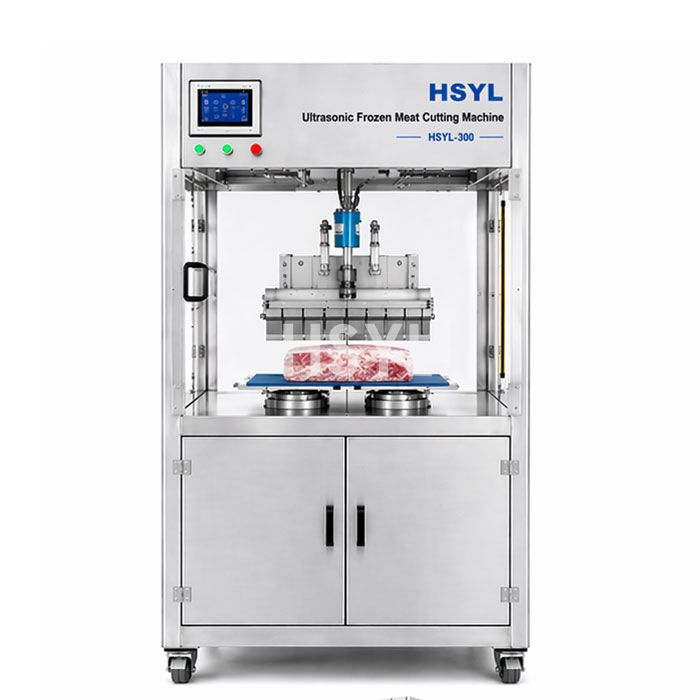
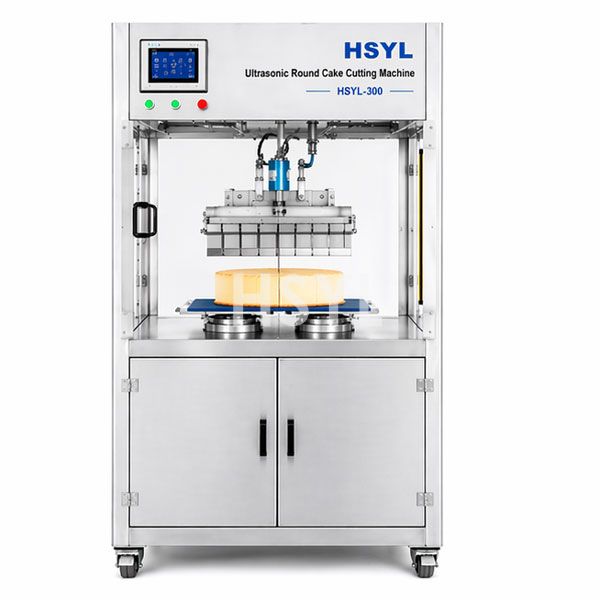
- Advanced Automatic Slicing Systems for Frozen Industrial Cakes
- Product Specs: HSYL Heavy-Duty Frozen Product Ultrasonic Systems
Contact HSYL for Mechanical & Acoustic Consultancy
If your facility is facing rising spare parts costs or inconsistent quality in the cutting section, our engineers are available for a technical audit. We go beyond the surface to analyze your stack dynamics and generator stability, ensuring your equipment is perfectly tuned for your frozen SKUs. Reach out to HSYL today to discuss a turnkey upgrade or a new line layout optimized for sub-zero performance.
Frequently Asked Questions
What is "Frequency Drift" and how does it affect frozen cutting
Can I increase the power to cut through colder frozen products
How often should the ultrasonic booster be replaced
Is titanium the only material for frozen food cutting horns
What causes the "crushing" effect instead of a clean cut
How can I tell if my transducer is failing
Related Articles




Get professional consultation
Do you have any questions or need technical support regarding the content of this article? Fill out the form below, and our expert team will provide you with professional solutions.