Why this machine is easier to buy than to buy correctly
An electric meat food slicer is one of those machines that looks simple until it enters real production. On a quotation sheet, the comparison appears manageable: motor power, slicing range, nominal throughput, and price. On the factory floor, the result depends on things that are much less visible at purchasing stage, such as product temperature, fat behavior, feed stability, sanitation access, blade wear, and how cleanly the slicer hands product to the next process.
That is why slicer projects often disappoint for reasons that are not obvious in the RFQ. The machine may technically run, yet still create giveaway, uneven slice presentation, cleaning delays, or constant operator correction. In practice, the right buying question is not “Which slicer can cut meat?” but “Which slicer can hold cut quality, hygiene, and line stability under our actual production conditions?”
Start with the actual plant problem, not the machine category
Most buyers searching for this equipment are not simply looking for a slicer. They are trying to solve one or more plant-level problems: unstable slice weight, excess giveaway, labor dependence, difficult cleaning, limited capacity, or an expansion project that needs a more reliable slicing step. That means the sourcing process usually combines equipment selection, ROI evaluation, line planning, and supplier comparison.
Before you compare suppliers, define the real bottleneck. Are you trying to improve portion control? Reduce operator dependency? Add a higher-hygiene machine to fit a stricter sanitation regime? Feed a packaging machine more consistently? If the team does not agree on the actual operating problem, the sourcing discussion usually drifts into feature comparison that has little to do with line performance.
The engineering variables that decide slicer performance
1. Product condition matters more than many RFQs admit
Meat slicing behavior changes with temperature, firmness, moisture, fat distribution, connective tissue, and whether the product is cooked, cured, chilled, tempered, or partially frozen. A slicer that behaves well on one product family may struggle on another, even if both are casually described as “meat products.”
This is where procurement documents often go wrong. If the supplier does not understand your actual product window, trial results become less meaningful. “Slicing meat” is not a real process definition. “Slicing chilled cooked ham with variable surface moisture and tight thickness control for retail packs” is much closer to what engineering needs.
2. Feed presentation is a common hidden cause of poor cut quality
Even a sound blade system cannot compensate for unstable infeed. If upstream loading, alignment, or transfer control is inconsistent, the slicer receives a moving target. That shows up as thickness variation, poor stack quality, uneven shingling, or intermittent misfeeds.
Experienced engineers do not stop at the cutting head. They ask what happens one conveyor upstream. If the product arrives twisted, soft, or poorly spaced, buying a more expensive slicer may not solve the real problem.
3. Blade and cutting system selection should match the application, not the sales pitch
Industrial slicers are not all built around the same cutting logic. Some configurations are better suited to repetitive high-speed slicing, some to tighter portion control, and some to easier cleaning or maintenance access. The machine should be judged by how stable the cut remains through actual running conditions, not by how good the first few sample slices look during a controlled demo.
Ask how blade wear changes slice quality over time. A machine that performs well only at the start of the maintenance cycle can quietly increase quality loss and operator intervention as the shift goes on.
4. Sanitation design is part of productivity
In a meat plant, sanitation is not a side issue. Surface finish, open-frame design, accessible guards, drainage behavior, material grade, and tool-less disassembly all shape the cleaning workflow. If cleaning takes too long or leaves difficult residue points, your real operating cost rises and your hygiene control becomes less robust.
The shop-floor reality is blunt: a machine that is awkward to clean rarely gets cleaned as well as the sanitation SOP expects. Buyers who focus only on nominal capacity often discover this after commissioning, when the line is already committed.
5. Changeover time can matter more than headline speed
If your plant runs several SKUs, multiple slice thickness targets, or different product dimensions, changeover time matters. Guard removal, blade access, recipe changes, guide settings, conveyor adjustments, and restart verification all consume labor and production time.
For mixed production environments, lower operator dependency is often more valuable than impressive brochure speed. Stable repeatability after changeover is what protects the schedule.
Common sourcing mistakes that create long-term cost
- Buying on throughput alone. Throughput that cannot be sustained with acceptable slice quality and stable downstream flow is not real output.
- Ignoring giveaway. Small slice-weight drift can turn into a large ongoing cost in fixed-weight or retail applications.
- Underestimating sanitation labor. A cheaper machine can become expensive if it adds cleaning time every shift.
- Assuming skilled operators will make up for weak machine design. That may work temporarily, but it does not scale or stay stable across staffing changes.
- Skipping integration review. A slicer must work with upstream product delivery and downstream packaging logic, not just fit the available footprint.
- Neglecting serviceability. Blade replacement access, wear-part handling, and maintenance reach zones matter in everyday operation.
How to think about ROI without forcing fake precision
Many buyers ask for a simple ROI percentage before the engineering review is complete. That usually leads to weak assumptions. The commercial value of a slicer depends less on a generic formula and more on which recurring losses it removes from your process.
In practice, the ROI case usually comes from some mix of these factors:
- Reduced manual labor or lower operator dependency
- Improved cutting accuracy and lower giveaway
- Lower rework from damaged or nonconforming slices
- Shorter downtime caused by jams, unstable feeding, or poor cleaning access
- More stable throughput into packaging or further processing
- Lower sanitation burden and easier verification
- Better maintainability and fewer unplanned stoppages
The common mistake is to look only at labor replacement. In many plants, the larger hidden cost sits in yield loss, schedule disruption, and repeated minor stoppages. Those losses do not always stand out in a quotation, but they are what operations teams live with every week.
A practical supplier evaluation matrix
| Evaluation Area | What to Ask | Why It Matters |
|---|---|---|
| Product fit | What specific meat products and product-condition ranges has the slicer been tested on? | Shows whether the machine suits your real application rather than a generic category. |
| Cut consistency | How does slice quality change as blade condition changes through normal production? | Affects giveaway, pack appearance, and downstream acceptance. |
| Sanitation design | Which parts are tool-less, open for inspection, and easy to wash and drain? | Directly affects cleaning time, hygiene verification, and sanitation labor. |
| Maintenance | What are the blade replacement, wear-part, and preventive maintenance routines? | Shapes downtime risk and service planning. |
| Changeover | How are product-format changes and recipe adjustments handled? | Important for plants with multiple SKUs or shorter runs. |
| Line integration | How does the slicer interface with infeed, transfer, weighing, or packaging equipment? | Prevents bottlenecks and unstable product flow. |
| Support | What spare parts, commissioning support, and technical documentation are available? | Important for startup reliability and lifecycle cost control. |
What experienced plant teams watch during a trial
A useful trial is not simply a short demo where the machine cuts a clean sample under ideal conditions. It should expose the machine to the kinds of variation your line actually sees: softer product, small dimensional changes, stop-start conditions, and realistic operator handling.
During a proper evaluation, plant teams usually watch for the following:
- Whether slice quality stays stable when product condition shifts slightly
- How often the operator needs to intervene or make fine corrections
- Where residue accumulates around blades, guides, and transfer points
- How the machine restarts after a brief stop or interruption
- Whether downstream presentation still holds up near the intended production rate
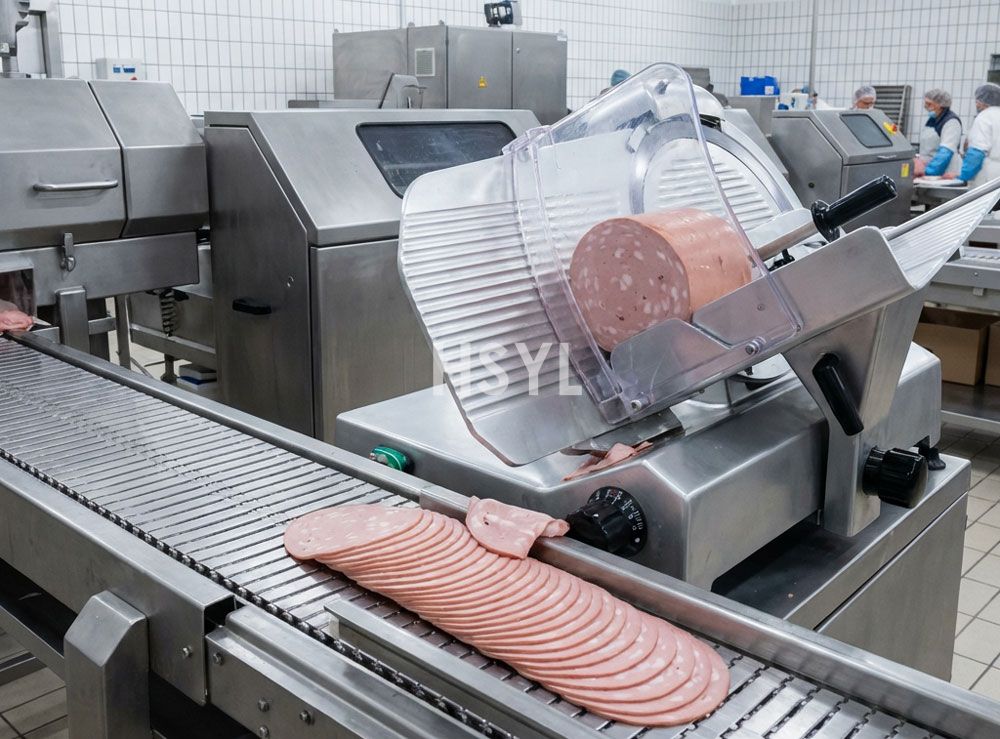
The old engineering rule still applies: do not trust a trial that looks too easy. If the supplier shows only best-case material under controlled conditions, ask to see the awkward product, the softer batch, or the changeover scenario your operators will actually face.
Related Topics
Call to Action
If you are planning a slicing project, HSYL can discuss the application from a practical engineering angle. That includes product condition, equipment matching, layout logic, and how the slicer should fit with upstream and downstream operations before the final specification is locked.
Frequently Asked Questions
How do I choose the right electric meat food slicer for my factory?
What affects ROI most when buying an industrial meat slicer?
Why do meat slicers perform well in demos but poorly after installation?
What should I check during a meat slicer trial?
Is sanitation design really as important as slicing performance?
When should a processor look beyond a standalone slicer and discuss line integration?
Related Articles


Get professional consultation
Do you have any questions or need technical support regarding the content of this article? Fill out the form below, and our expert team will provide you with professional solutions.