In today’s advanced food industry, canned foods maintain a critical market position globally due to their extended shelf life, nutritional retention, and convenience. According to the latest FAO report, the global canned food market is projected to exceed $120 billion by 2025, growing at a steady CAGR of 4.2%. Yet beneath this growth lies a harsh reality: production line stability, operational efficiency, and food safety compliance now determine corporate survival. A scientifically designed canning line with premium equipment doesn’t just reduce comprehensive energy consumption by over 30%—it slashes product defect rates to below 0.5%. This is where specialized equipment suppliers deliver irreplaceable value.For complete autoclave batch scheduling and facility sanitation planning, refer to our engineering overview on sea fish canning production line.

HSYL, a National High-Tech Enterprise with 20 years in food machinery innovation, has engineered customized solutions for over 800 canning plants across 60+ countries. This guide dissects every critical stage of modern canning production—combining equipment selection logic, quality control protocols, and real-world case studies—to help you build a production line that delivers high throughput, minimal downtime, and zero safety compromises.
(Insert image: HSYL smart canning production line panoramic view with core stations labeled)
I. Canning Production Line Overview: Automation as the Foundation of Efficiency & Safety
Modern canning lines have evolved from semi-manual operations to fully integrated, data-driven intelligent systems. A complete line typically integrates six core modules: Raw Material Preprocessing → Filling & Seaming → Sterilization & Cooling → Drying & Inspection → Labeling & Packaging → Warehouse Logistics. These modules synchronize via a central PLC control system, enabling end-to-end traceability from raw material intake to finished goods dispatch.
Industry Trends Deep Dive:
- Flexible Production: Single lines rapidly switch between fruits, meats, seafood, and sauces (via interchangeable filling heads and programmable sterilization profiles) to fulfill small-batch custom orders
- Green Energy Efficiency: Next-gen continuous sterilizers with heat recovery systems cut steam consumption by 40%; VFD-driven pumps reduce water usage by 25%
- AI Quality Assurance: Machine vision systems detect seam wrinkles and label misalignment at 0.1mm precision with <0.01% false rejection rates
Key Insight: A production line isn’t merely equipment assembled—it’s an organic system structured by HACCP protocols and powered by OEE (Overall Equipment Effectiveness). According to the China Canned Food Industry Association, modular-designed lines reduce average downtime by 65% and shorten ROI periods to 2.3 years.

II. Core Equipment Breakdown: Technical Specifications & Selection Criteria
(1) Raw Material Preprocessing: The First Line of Quality Defense
- Cleaning Systems:
Brush Washer (for root vegetables): 304 stainless steel rollers + high-pressure spray (1-5 TPH capacity; residual soil <0.3%)
Bubble Agitation Washer (for leafy greens/fruit): Ozone + ultrasonic decontamination; 5μm water filtration
Selection Tip: Match water pressure to product density—soft fruits like peaches require low-pressure (0.15MPa) rinsing, while potatoes need high-pressure (0.4MPa) jets
[Internal Link: HSYL Bubble Washer Technical Specifications] - Sorting & Cutting:
Optical sorters auto-reject defects by color/blemish (200 items/sec); laser-guided dicers achieve ±0.5mm precision. Note: Seafood processing requires -18°C blast freezers to prevent protein denaturation
(2) Filling & Seaming: The Precision-Sealing Nexus
- Filling Technology Comparison:
Equipment Type Best For Accuracy Output (Cans/Min) Piston Filler Viscous sauces, chunks ±1% 20-120 Gravity Filler Low-viscosity juices ±0.5% 60-300 Vacuum Filler Carbonated/tomato products ±0.3% 40-200 Critical Detail: Filling heads must use 316L medical-grade stainless steel with Ra≤0.4μm mirror polish to eliminate microbial harborage points Seaming Technology:
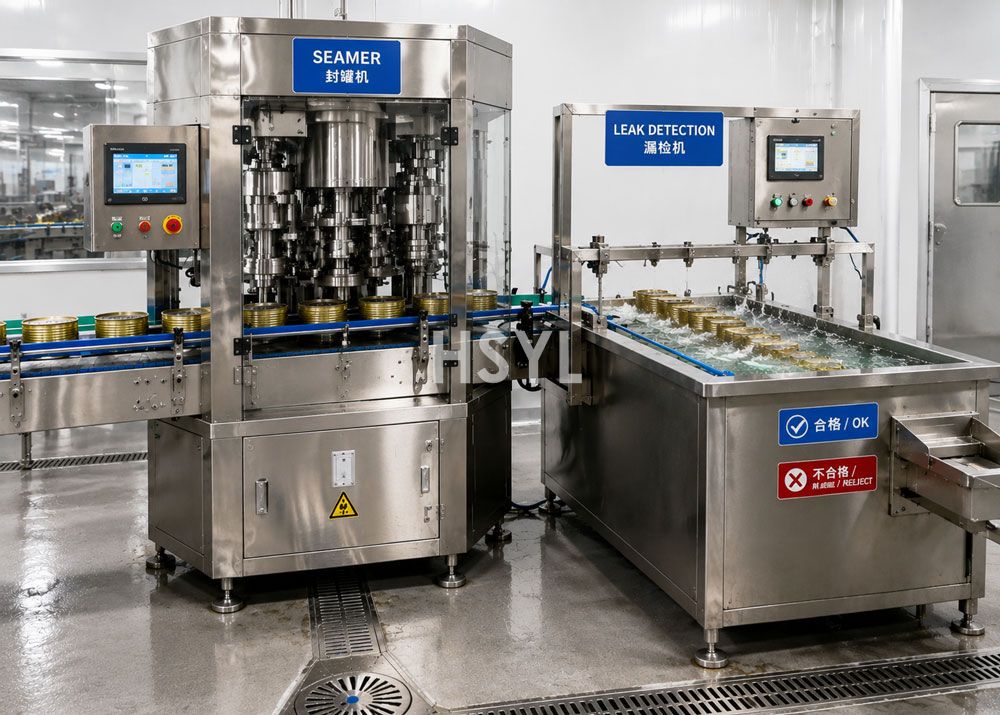
Double-seam can sealers (e.g., HSYL-FG800) form a 5-layer metal interlock via triple-roll precision forming:
End – Compound – Body – Compound – End
Non-Negotiable Metrics: Lap joint ≥50%, Tightness ≥90%, Body/End hook length 1.8-2.2mm. Mandatory: Electronic seam thickness calibration every 2 hours!
(Insert image: Microscopic cross-section of double seam with critical dimensions labeled)

(3) Sterilization & Cooling: The Food Safety Lifeline
- Sterilizer Selection Decision Tree:
  A[Product Type] -->|Low-Acid pH>4.6| B(Thermal Processing 121°C)
  A -->|High-Acid pH<4.6| C(Pasteurization 85-95°C)
  B --> D{Packaging Format}
  D -->|Tinplate Cans| E[Horizontal Retort]
  D -->|Pouches/Glass Jars| F[Shower-Type Retort]
  E --> G[Capacity Requirement]
  G -->|<500 cans/batch| H[Vertical Retort]
  G -->|>1000 cans/batch| I[Automatic Continuous System]
Hard Requirements: Sterilization F₀ value ≥3.0 (meat products ≥6.0); steam pressure tolerance ±0.01MPa; cooling water residual chlorine 0.5-1.0ppm
Industry Problem Solver: HSYL’s patented ramped temperature-pressure algorithm reduces glass jar breakage from industry-standard 5% to 0.2% through dynamic pressure compensation
(4) Downstream Packaging: The Efficiency Finish Line
- Smart Inspection Stations: X-ray contaminant detection (sensitivity Φ0.3mm Fe); vacuum decay seal testing (leak rate <1×10⁻⁵ Pa·m³/s)
- High-Speed Labeling: Servo-driven systems + CCD vision correction achieve ±0.1mm positioning accuracy at 80m/min line speed with <0.05% label wrinkling
- Packing Robotics: Delta robots handle 60 cans/minute, using AI to adjust grip force based on can stacking patterns
System Synchronization Warning: Filler output MUST match retort capacity! A common error is pairing a 120-cans/minute filler with an 80-cans/minute retort, causing frequent line stoppages that reduce motor lifespan by 40%

III. Capacity Planning & Facility Layout: Where Space Equals Profit
Scientific Capacity Calculation:
Theoretical Output = (60 minutes × Equipment Efficiency) / Cycle Time per Can
Note: Equipment efficiency must account for cleaning, changeovers, and downtime (industry average OEE: 65-75%)
Layout Strategy Comparison:
- U-Shape Layout: Ideal for 200-500 cans/hour; reduces material travel distance by 30% but limits scalability
- Linear Layout: Optimal for 500+ cans/hour; modular stations enable future expansion
- Vertical Integration: Multi-floor design (e.g., raw processing on 2nd floor, filling on 1st) boosts land utilization by 50% but requires reinforced structural support
Costly Mistake Case: A Southeast Asian fruit cannery failed to reserve 30% expansion space. Within 2 years, they spent $200,000+ on facility demolition/reconstruction. HSYL’s Rule: Equipment Footprint = Actual Footprint × 1.8 (includes maintenance aisles, buffer zones, utility corridors)
Utility Requirements Non-Negotiables:
- Steam: 0.6-0.8MPa continuous supply; vertical retorts peak at 1.2 tons/hour
- Power: 380V 3-phase with 25% capacity buffer
- Water: Filling water conductivity <10μS/cm; cooling water hardness <50ppm
IV. Quality & Safety Control: HACCP Implementation Beyond Compliance
Critical Control Points (CCPs) Protocol:
- CCP1 Raw Material Intake: Batch testing for pesticides/heavy metals; freeze suppliers with >5% rejection rate
- CCP2 Thermal Processing: Temperature probes auto-calibrate every 15 minutes; F₀ values monitored in real-time with cloud alerts for values <3.0
- CCP3 Hermetic Seal Verification: Seam teardown testing every 2,000 cans; 100% vacuum decay testing
Top Industry Failure Modes & Solutions:
- Swollen Cans (physical/chemical/biological): Biological types require sterilization curve audits; physical types need venting temperature checks; chemical types demand acid corrosion testing
- Sulfide Staining: For corn/asparagus in tinplate cans, use oxygen absorbers + nitrogen flushing (headspace O₂ <0.5%)
- Can Corrosion: For pH<4.0 products, mandate epoxy-phenolic lined cans with minimum 11.2g/m² tin coating
Mandatory Compliance Frameworks:
- China: GB 7098-2015 (Canned Food Hygiene Standard)
- USA: FDA 21 CFR 113 (Low-Acid) / 114 (Acidified Foods)
- EU: EC No 852/2004 (Food Hygiene)
All HSYL equipment carries CE, NSF, and ISO 22000 certification with pre-loaded sterilization parameters for 47 global markets
V. Real-World Case Studies & Top Engineer Questions
Case Study: Shandong Asparagus Exporter Line Upgrade
- Pain Points: 800 cans/hour capacity; 1.2% seam failure rate; $350,000/year in customer claims
- HSYL Solution:
- Automatic piston filler (±0.8% accuracy)
- Custom dual-batch retort with ramped temperature control
- AI-powered seam inspection system
- Results: Capacity increased to 1,500 cans/hour; seam failures reduced to 0.08%; ROI achieved in 14 months
Top 5 Engineer Questions Answered:
- Q: Why do glass jars shatter after sterilization?
A: 90% stem from uncontrolled ramp rates. Implement "pressure-follows-temperature" profiles: Increase pressure at 0.02MPa/min during heating; release pressure synchronously during cooling. HSYL systems auto-calculate compensation curves. - Q: How to prevent oil leakage in seafood can seams?
A: Oil compromises compound adhesion! Seal within 30 seconds of filling using oil-resistant butyl rubber gaskets (HSYL patent: -40°C to 150°C tolerance). - Q: How to validate retort cold spots?
A: Deploy wireless temperature loggers (e.g., Ellab TrackSense) at hardest-to-heat locations. Acceptable if F₀ value variation stays <5% across 3 consecutive batches. - Q: Low-cost traceability for small plants?
A: HSYL budget solution: QR codes on raw material bins → filler scanner links batches → labeler auto-prints trace codes. Total cost: $8,000. - Q: How to set maintenance schedules?
A: Core formula: Maintenance Interval = (MTBF × 0.7) / Daily Operating Hours
Example: Filler MTBF=10,000 hours, runs 18 hrs/day → Major overhaul every 390 days
VI. How to Select Equipment Suppliers: Avoiding 3 Deadly Traps
Supplier Evaluation Scorecard:
| Evaluation Criteria | Professional Supplier (e.g., HSYL) | Risky Supplier Red Flags |
|---|---|---|
| Technical Capability | Provides F₀ validation reports + thermal mapping data | Shows only equipment photos |
| After-Sales Support | 4-hour remote diagnosis; 72-hour on-site response | Demands 30% upfront payment for repairs |
| Spare Parts Access | 10-year guarantee on critical components (bearings/seals) | Post-discontinuation parts cost 300% premium |
3 Non-Negotiable Documents to Demand:
- Pressure Vessel Manufacturing License (required for retorts)
- FDA 21 CFR Part 11 Compliance Statement (data integrity)
- Acceptance Reports from Similar Clients (verify 3+ contactable references)
HSYL Guarantee:
- 100% sterilization curve compliance with target market regulations
- 5-year warranty on core equipment (industry standard: 2 years)
- Free GMP facility design guide (including personnel/material flow diagrams)
Conclusion: Building Future-Proof Canning Production Lines
As the global canned food market shifts toward premium products (organic produce, ready-to-eat meals), production line competitiveness has evolved from "functional" to "intelligent, flexible, and defect-free." Data from HSYL’s top clients reveals: AIoT-integrated lines boost per-worker output by 3.2x, achieve 100% customer audit pass rates, and slash new product launch cycles by 60 days.
Are You Facing These Challenges?
✓ Needing capacity expansion in limited space
✓ Losing export orders due to failed thermal process validation
✓ Suffering bulk leakage claims from manual seaming
HSYL Mission: Ensuring every can delivers safe food to consumers while transforming your production line into a profit engine.
20 Years Serving 800+ Plants · 6 Global Technical Centers · 37 National Patents
Related Articles



Get professional consultation
Do you have any questions or need technical support regarding the content of this article? Fill out the form below, and our expert team will provide you with professional solutions.