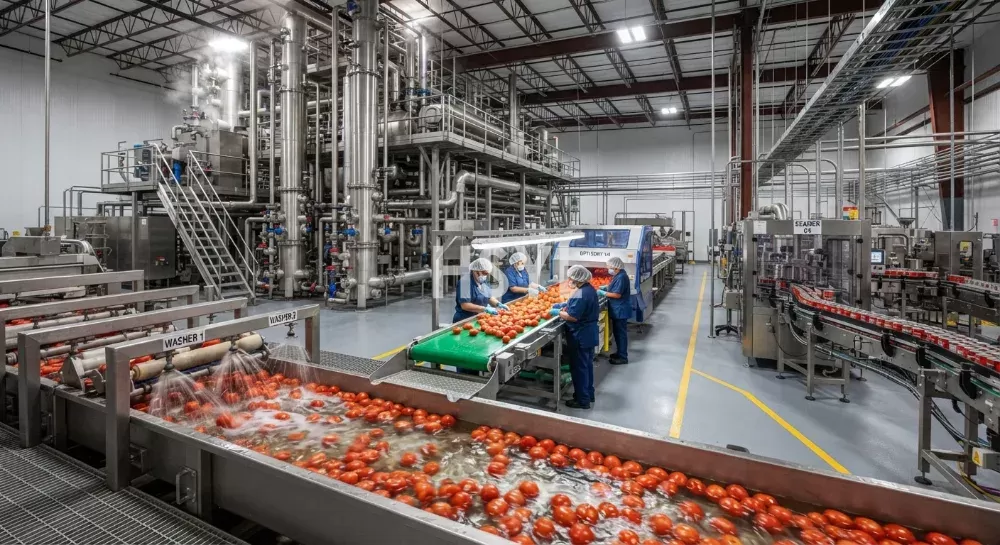
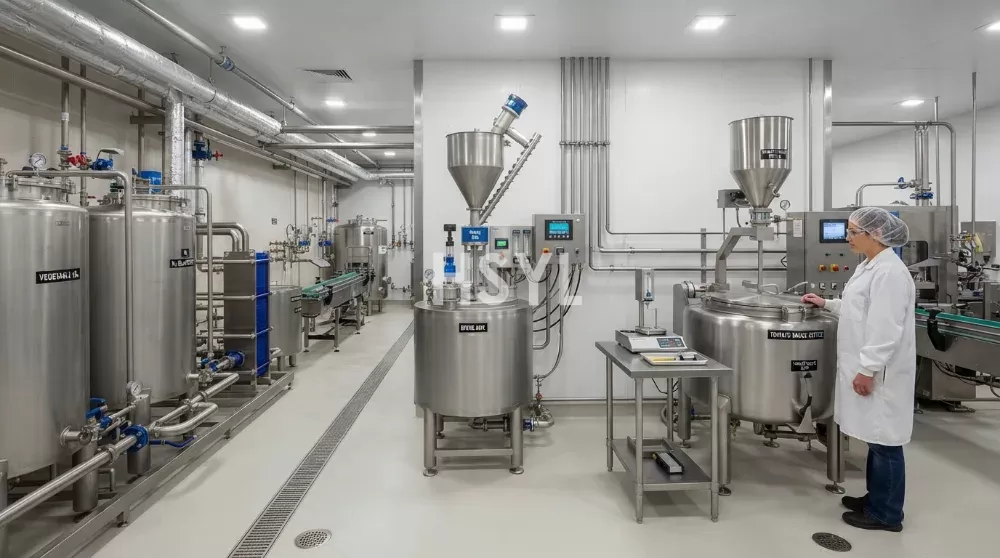
Tomato Products Canning Line: Paste, Whole Peeled, Diced and Sauce Processing
Direct AnswerA tomato products canning line converts fresh tomatoes into four di...


HSYL Sandwich Griddle HSG37E, HSG41E and HSG57E are compact 230V/50Hz countertop electric griddles at 370, 410 and 570 mm width, with 1.8 to 3.6 kW power, for sandwich shops, cafés, convenience stores and food trucks without 380V supply.
The Sandwich Griddle 37E / 41E / 57E is HSYL's compact countertop electric griddle line, built for small-food-business operators who need commercial griddle cooking without the floor space, power supply or capital outlay of a full-size upright range. The line covers three models — HSG37E, HSG41E and HSG57E — at 370 mm, 410 mm and 570 mm griddle width respectively, all sharing a 305 mm depth and 210 mm height that lets them sit on an existing counter without under-counter cabinet installation.
All three models run on 230V/50Hz single-phase power — the same supply available at a standard household or small-commercial wall outlet. Power scales with griddle width: 1.8 kW on the HSG37E for a sandwich-only volume, 2.2 kW on the HSG41E for a sandwich-plus-breakfast menu, and 3.6 kW on the HSG57E for a busier griddle-heavy menu. No 380V three-phase supply is required on any model, which removes the most common barrier to commercial griddle adoption in small venues.
This line is built for buyers who do not need an upright Cooking Range 700 Series HG griddle and should not be paying for a floor-standing cabinet, gas connection or 380V electrical upgrade. It belongs to HSYL's broader cooking and frying equipment range, so a Sandwich Griddle can be specified as the griddle station in a small-kitchen lineup alongside other countertop and small-footprint cooking equipment.
| Item | HSG37E | HSG41E | HSG57E |
|---|---|---|---|
| Model | HSG37E | HSG41E | HSG57E |
| Power Supply | 230V / 50Hz | 230V / 50Hz | 230V / 50Hz |
| Electric Power | 1.8 kW | 2.2 kW | 3.6 kW |
| Net Weight | 14 kg | 20 kg | 27 kg |
| Gross Weight | See note | See note | 27 kg |
| Net Size (W×D×H) | 370×305×210 mm | 410×305×210 mm | 570×305×210 mm |
| Configuration | Countertop electric griddle | Countertop electric griddle | Countertop electric griddle |
| Installation | Sits on existing counter, no cabinet base required | Sits on existing counter, no cabinet base required | Sits on existing counter, no cabinet base required |
Gross weight values for HSG37E and HSG41E are flagged as anomalies in the source specification (source G.W. less than N.W.) and are listed as "See note". HSG57E values are confirmed. Product team to confirm correct G.W. for the two smaller models before publication; all other specifications — power supply, electric power, net weight, net size — are confirmed.
For project-specific requirements including griddle plate material, plate thickness, temperature range, thermostat type, certification and plug type, HSYL confirms configuration against your local electrical standard, menu requirement and food-contact regulations during quotation.
For small-venue griddle selection, the deciding variable is menu breadth — a sandwich-only menu needs less griddle surface than a sandwich-plus-breakfast menu, which needs less than a full griddle-heavy menu. Use the three-model ladder to pick the right fit.
At 370×305 mm griddle surface and 1.8 kW, the HSG37E is the entry model for venues whose griddle use is primarily sandwich and panini pressing, with limited simultaneous searing. The 14 kg N.W. makes it portable enough to relocate for cleaning or to share between two stations in a small kitchen. Suitable for a sandwich-only shop, a small office pantry, or a convenience store corner.
At 410×305 mm griddle surface and 2.2 kW, the HSG41E adds 22% more power and a slightly wider cooking area than the HSG37E. The extra width fits two sandwiches side by side or one sandwich plus breakfast eggs and bacon. Suitable for a café or bistro that runs a sandwich-plus-light-breakfast menu, or a food truck that needs one griddle for both sandwich pressing and egg cooking.
At 570×305 mm griddle surface and 3.6 kW, the HSG57E doubles the power of the HSG37E and adds 54% more cooking surface. This is the model for a breakfast-and-sandwich venue where the griddle runs continuously through morning service — eggs, bacon, sausages, hash browns and sandwiches on the same plate at the same time. Suitable for a busy breakfast café, a small diner, or a convenience store with a hot-food counter.
| If your menu is... | Specify | Primary reason |
|---|---|---|
| Sandwich-only, single item at a time | HSG37E | 1.8 kW, 370 mm width, lowest capital outlay |
| Sandwich plus light breakfast, two items at a time | HSG41E | 2.2 kW, 410 mm width fits two items side by side |
| Sandwich plus full breakfast, continuous griddle use | HSG57E | 3.6 kW, 570 mm width, doubles power of HSG37E |
The highest-value deployment is the small sandwich shop and food truck scenario: the 230V single-phase supply and countertop format let a buyer add commercial griddle cooking to a venue that has neither 380V three-phase power nor floor space for an upright range — opening commercial griddle capability to venues that would otherwise be limited to domestic equipment.
The Sandwich Griddle is one piece of a small-food-business cooking lineup. These HSYL resources are typically evaluated alongside it:
Send your menu type (sandwich-only, sandwich plus breakfast, full breakfast griddle), your available power supply (230V single-phase confirmed?) and your counter clear dimensions (width × depth × height in mm) — HSYL will return the right HSG model recommendation and confirm griddle plate material, thermostat type and certification for your venue.
Operating a multi-site sandwich shop or café chain? Ask our engineers for a fleet standardization brief covering the HSG37E, HSG41E and HSG57E lineup, with unified plug type and service scheduling.
Unsure whether your venue needs the countertop Sandwich Griddle or the upright 700 Series HG griddle? Tell us your peak-hour sandwich count and counter clear height — we will model both options against your menu volume.


Direct AnswerA tomato products canning line converts fresh tomatoes into four di...
The filling medium — the liquid that fills the void spaces between the fish piec...
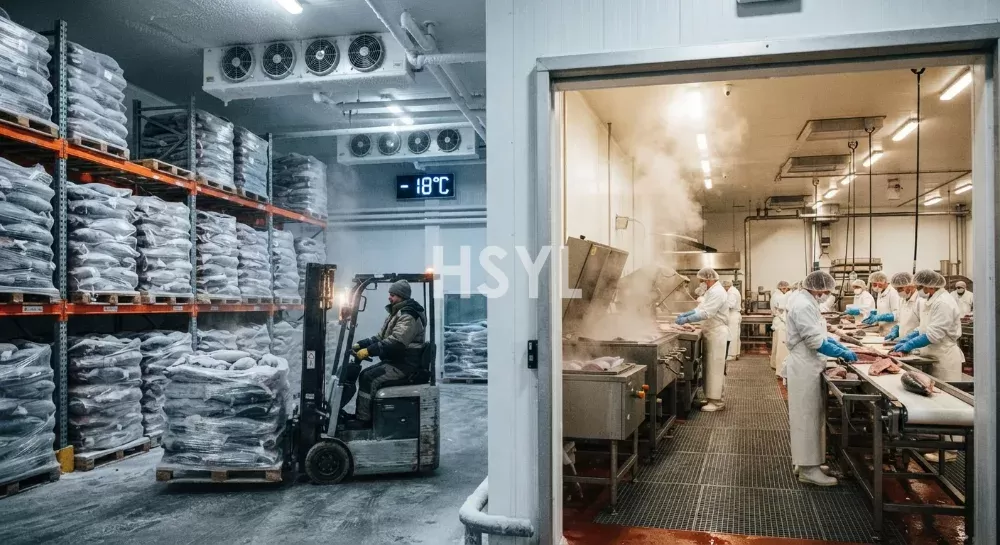
Direct AnswerThe most expensive asset in a fish cannery is not the retort or the...
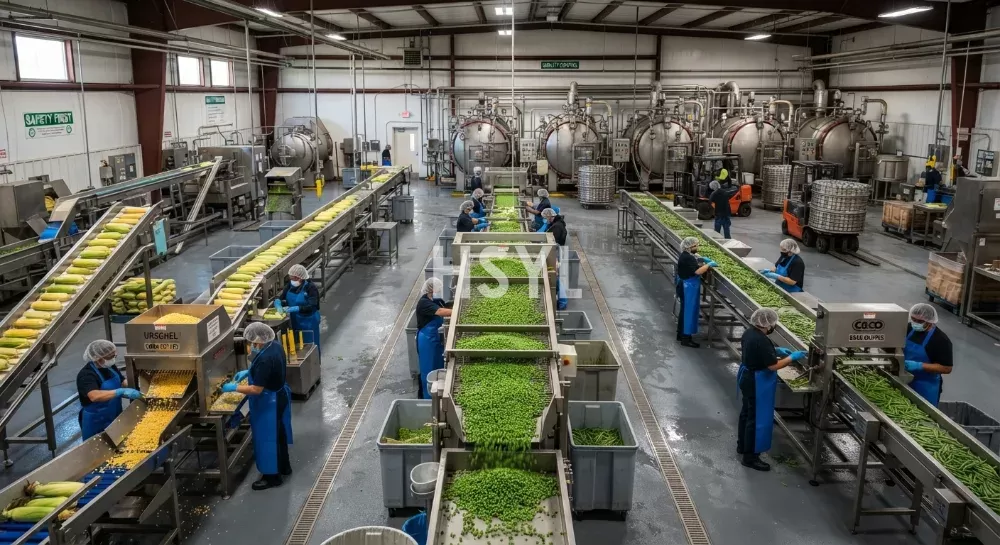
Direct AnswerA low-acid canned vegetable processing line — corn, peas, and green...