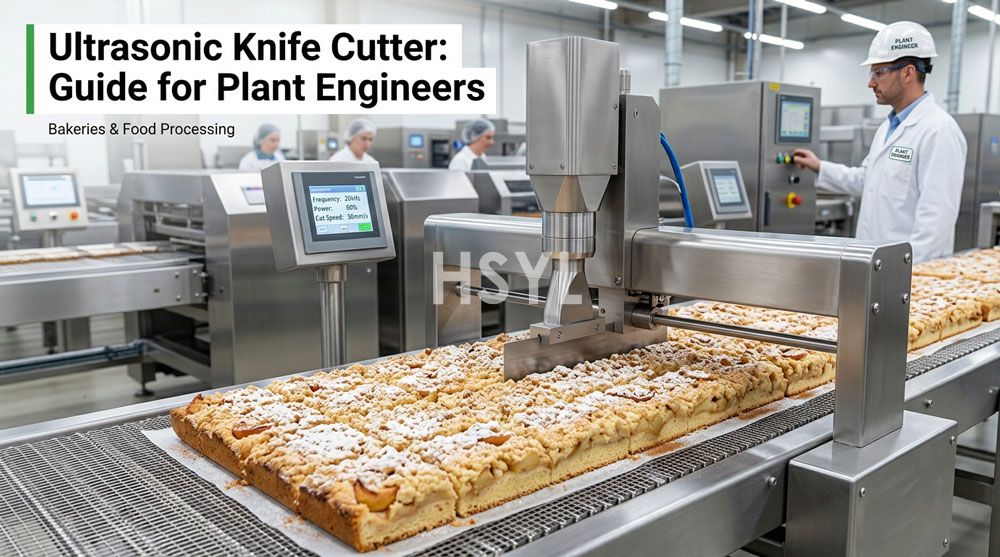
The ultrasonic knife cutter is not a single technology. It is a system composed of four distinct subsystems that must be tuned to each other and to the product being cut. When all four are correctly matched, the result is a cut surface that no mechanical blade can replicate. When one element is wrong — wrong frequency, incorrect amplitude, mismatched horn geometry — the system produces the same smearing, crushing, or dusting that it was meant to solve.
This article walks through the engineering behind each subsystem, the decisions a plant engineer faces when specifying or troubleshooting an ultrasonic knife cutter, and the operational realities that rarely appear in vendor brochures.
The Four Subsystems of an Ultrasonic Knife Cutter
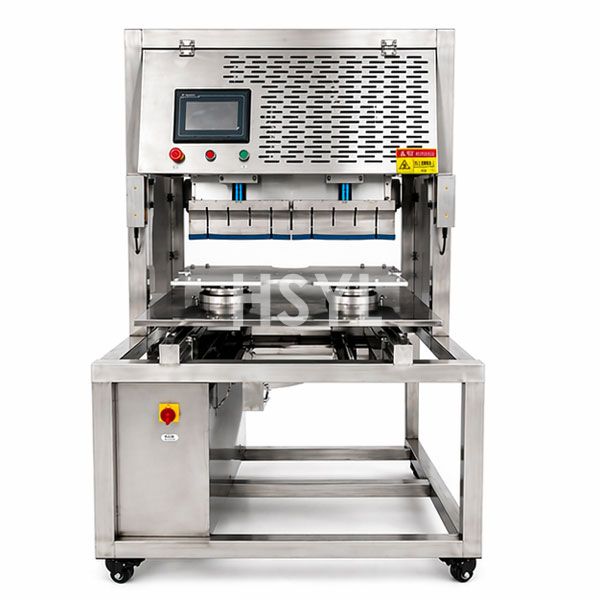
Every industrial ultrasonic cutting system has four components that work together: the ultrasonic generator, the piezoelectric transducer, the booster, and the horn (also called the sonotrode or blade). Each has a specific function, and each introduces variables that affect cut quality.
Ultrasonic Generator
The generator converts line power (typically 220-480V AC) into a high-frequency electrical signal at a specific resonant frequency, usually 20 kHz, 35 kHz, or 40 kHz. The generator also runs a phase-locked loop that continuously tracks the resonant frequency of the mechanical assembly. As the blade warms up during operation, its resonant frequency shifts slightly. The generator compensates for this drift in real time. A generator without active frequency tracking will lose cutting efficiency after 15-20 minutes of continuous operation as the blade warms and drifts off resonance.
Piezoelectric Transducer
The transducer converts the electrical signal into mechanical vibration using lead zirconate titanate (PZT) ceramic discs sandwiched between metal electrodes. When the alternating electrical field is applied at the resonant frequency, the ceramics expand and contract microscopically, producing a mechanical oscillation. The amplitude at the transducer face is typically 8-12 microns. That is not enough for cutting. The amplitude must be amplified mechanically through the next two components.
Booster
The booster is a tuned metal component that sits between the transducer and the horn. It mechanically amplifies the vibration amplitude through a change in cross-sectional area. The amplification ratio — typically 1:1.5 to 1:3 — is determined by the booster geometry. Some boosters also serve as a mounting point for the entire assembly, with a nodal ring positioned at a vibration null point so the housing does not vibrate.
Horn (Sonotrode / Blade)
The horn is the component that contacts the food. It is the final mechanical amplifier and determines the cutting geometry. Horns are typically machined from titanium alloys (Ti-6Al-4V is the most common) because titanium has excellent acoustic properties, high fatigue strength, and food-grade corrosion resistance. The horn geometry — its length, cross-sectional taper, and blade edge profile — determines the final amplitude delivered to the cutting edge and the shape of the cut.
Typical cutting amplitudes range from 20 to 80 microns. Delicate products like mousse cakes require lower amplitudes (20-40 microns) to avoid fracturing the aerated structure. Dense frozen products like meat blocks at -18 °C require higher amplitudes (50-80 microns) to create enough cavitation at the blade edge to separate the ice crystal matrix.
Frequency Selection: 20 kHz vs. 35 kHz vs. 40 kHz
The operating frequency of an ultrasonic knife cutter determines the balance between cutting speed, precision, and audible noise. There is no single correct frequency for all applications.
| Frequency | Blade Stroke Rate | Typical Amplitude Range | Best Suited For | Trade-off |
|---|---|---|---|---|
| 20 kHz | 20,000 strokes/sec | 30-80 microns | Dense, frozen, or viscous products (meat blocks, frozen butter, hard cheese) | Higher audible noise; more aggressive cut; can damage delicate structures |
| 35 kHz | 35,000 strokes/sec | 15-40 microns | Medium-density products (bread, cakes, energy bars) | Good balance of speed and gentleness; lower audible noise |
| 40 kHz | 40,000 strokes/sec | 10-25 microns | Delicate, aerated, or sticky products (mousse, cheesecake, soft bread) | Gentlest cut; lowest amplitude; slower cutting speed on dense products |
A common mistake is assuming higher frequency always means a better cut. It does not. A 40 kHz system on a frozen meat block will not generate enough cavitation force at the blade edge to separate the ice crystals. The blade will drag and the generator will trip on overload. The correct decision depends entirely on the product's density, temperature, and internal structure. For a more detailed breakdown of this decision, see our engineering guide on choosing between 20kHz and 40kHz ultrasonic cutters.
Blade Material and Its Impact on Performance
Titanium dominates ultrasonic knife cutter construction for good reasons, but not all titanium alloys perform the same way. Ti-6Al-4V (Grade 5) is the standard because it offers high tensile strength (950 MPa), good acoustic transmission efficiency, and excellent corrosion resistance in acidic or salty food environments. Some suppliers use Ti-6Al-4V ELI (Extra Low Interstitial) for improved fracture toughness in high-cycle applications.
Hard-coated blades exist for niche applications. A titanium blade with a physical vapor deposition (PVD) coating of titanium nitride or diamond-like carbon can extend service life on abrasive products like granola bars with hard nut inclusions. The trade-off is cost: a coated horn costs roughly 40-60% more than an uncoated one, and the coating can delaminate if the blade is run at amplitudes beyond its design range.
Stainless steel horns exist but are uncommon in food applications. Steel has lower acoustic transmission efficiency than titanium, meaning more energy is lost as heat within the horn. This reduces cutting amplitude at the blade edge and increases the risk of cooking or browning the cut surface on heat-sensitive products.
Amplitude and Its Relationship to Product Texture
Amplitude is the distance the blade tip travels during each vibration cycle. It is the most important adjustable parameter for dialing in cut quality on a specific product. Too little amplitude and the blade cannot separate the product — it pushes the product down rather than cutting through it. Too much amplitude and the blade fractures the product internally, creating a ragged cut face or generating fines.
The correct amplitude depends on the product's modulus of elasticity and its internal cohesion. Soft, elastic products (fresh bread, soft cheese) require lower amplitudes with a slower feed rate. Rigid, brittle products (frozen meat, hard candy) require higher amplitudes to create enough cavitation at the blade edge to initiate separation before the product can fracture along an uncontrolled plane.
Most industrial ultrasonic knife cutters allow amplitude adjustment via the generator interface, typically expressed as a percentage of maximum output. In practice, starting at 60-70% amplitude and adjusting up or down in 5% increments while inspecting the cut surface is a reliable tuning protocol. The goal is to find the lowest amplitude at which the blade separates the product cleanly. Running at higher-than-necessary amplitude shortens blade life and increases the risk of product damage.
Blade Lifespan and Replacement Indicators
An ultrasonic knife cutter blade does not wear the same way a mechanical blade does. There is no sharp edge to dull. Instead, the blade gradually loses its ability to vibrate at the designed amplitude because of microscopic fatigue cracks at the blade tip or changes in the acoustic impedance of the assembly.
Under normal operating conditions on bakery products (8-hour shift, moderate amplitude), a titanium horn typically delivers 3,500 to 5,000 hours of service before the generator's frequency tracking can no longer compensate for the acoustic drift. On harder products like frozen meat at high amplitude, this drops to 2,000-3,000 hours.
Operators should watch for these signs that the blade needs replacement or retuning:
- The generator reports increased power draw to maintain the same cutting amplitude.
- The cut surface shows increasingly rough or ragged edges on a product that previously cut cleanly.
- The blade tip shows visible pitting or edge rounding under regular inspection.
- The generator trips on overload more frequently during normal operation.
Keeping a spare calibrated horn assembly in inventory is standard practice for facilities running ultrasonic cutting on more than one shift.
A Practical Comparison: Ultrasonic vs. Mechanical Cutting on Common Food Products
Understanding when ultrasonic cutting is worth the investment requires an honest comparison with mechanical alternatives on real production metrics.
| Product | Mechanical Blade Issue | Ultrasonic Advantage | Where Mechanical Still Wins |
|---|---|---|---|
| Multi-layer cheesecake | Smearing between layers; crumb shearing on base | Clean layer separation at 40 kHz, 25 micron amplitude | Hardly ever — mechanical blades cannot prevent smearing on soft fillings |
| Frozen beef block (-18 deg C) | Meat dust (3-5% loss); blade wear | 0.5-0.8% fines; 3,000 hr blade life | Capital cost — ultrasonic is 3-5x more expensive than a band saw |
| Granola bar with almonds | Nuts fracture and fall off; blade jams | Inclusions cut through without dislodging; but blade coating required | Coating cost and replacement frequency |
| Fresh bread loaf | Crumb compression; uneven slices | No compression; consistent slice thickness | Throughput — ultrasonic is slower than high-speed band slicers on bread |
| Block cheese (cheddar) | Drag marks; fat smear on blade | Clean glossy cut face; no residue buildup | Hard to justify for low-volume lines; price premium matters |
The decision to specify ultrasonic cutting should be based on a yield analysis, not on the technology itself. If a mechanical blade is losing 3% of product to smearing or dusting, and the line runs 2,000 tons per year, the recoverable 60 tons of product usually justifies the higher capital cost within 12-18 months. If yield loss is under 1%, the payback period stretches beyond what most capital budgets will approve. For a broader view of where ultrasonic fits into your production strategy, the cutting and slicing equipment section covers both ultrasonic and mechanical options across different product categories.
Five Plant-Floor Considerations That Affect Ultrasonic Knife Cutter Performance
These are the aspects of ultrasonic cutting that experienced plant engineers learn through installation and troubleshooting, not from datasheets.
1. Conveyor synchronization matters more than blade selection.The most common cause of poor cut quality in an ultrasonic knife cutter is not the blade — it is poor conveyor indexing. If the conveyor belt jitters or overshoots during indexing, the blade lands on the wrong part of the product. The servo-driven conveyor system should have a positional accuracy of at least ±0.5 mm at the cutting zone. Cheaper conveyors with open-loop drives create inconsistent cut spacing and make the ultrasonic system look like the problem when it is not.
2. Product temperature is the single largest variable affecting cut consistency.A product at -5 °C cuts differently than the same product at -10 °C. The difference in ice crystal hardness changes the load on the blade and shifts the resonant frequency. Facilities that run ultrasonic cutters across multiple temperature zones (e.g., product fresh from a -18 °C freezer vs. tempered product at -5 °C) need a generator with adaptive frequency tracking and the ability to store multiple amplitude profiles per SKU. Without this, the operator must manually adjust amplitude every time product temperature varies.
3. Hard inclusions reduce blade life consistently.Nuts, seeds, hard candy pieces, and bone fragments create localized stress concentrations at the blade edge. Over time, these stress cycles initiate microcracks in the titanium that propagate and eventually cause the blade to fail acoustically. Products with hard inclusions should use coated titanium blades, and the blade inspection interval should be shortened to every 200 hours of operation.
4. The mounting and damping structure affects cut precision.The ultrasonic assembly must be mounted at the nodal point (the vibration null). If the mounting bracket clamps the horn at a vibrating point, energy bleeds into the machine frame, reducing cutting amplitude and creating frame resonance that can loosen fasteners over time. A properly designed mounting system uses a tuned ring or flange at a vibration node, isolated from the frame with elastomeric dampers.
5. Blade cleaning protocol is a maintenance scheduling issue.Even though ultrasonic blades resist adhesion, they still require periodic cleaning. Protein and sugar residues can bake onto the blade tip from the localized frictional heat generated during the cut. The standard approach is a weekly soak in a 60 °C enzymatic cleaner, followed by a distilled water rinse and a resonance check. Do not use abrasive brushes on titanium — they remove the passive oxide layer that gives titanium its corrosion resistance. For the complete cleaning protocol, read our guide on ultrasonic blade cleaning and HACCP washdown protocols.
When Not to Specify an Ultrasonic Knife Cutter
Ultrasonic cutting is not universally superior. The technology has specific limitations that make it the wrong choice for certain applications:
- Products with large hard inclusions at high throughput: If the product contains bone fragments, hard pits, or large nut pieces and the line runs above 150 cuts per minute, the blade impact stress will reduce service life below economically viable levels.
- Extremely high-water-activity products (above 0.98 Aw): Products like watermelon or tomato slices have such high free water content that the ultrasonic cavitation at the blade edge can atomize the water into a fine mist, creating a wet, frayed cut surface rather than a clean one.
- Very high throughput lines on non-sticky products: If the product does not stick to mechanical blades and yield loss is under 1%, the capital cost of an ultrasonic system (typically 3-5x higher than a comparable mechanical slicer) rarely justifies the investment.
- Products with extreme temperature variation within the same batch: If product temperature varies by more than 8-10 °C within a single production run, even adaptive frequency tracking cannot maintain consistent cut quality without frequent operator intervention.
Related Topics
- How to Choose 20kHz vs 40kHz Ultrasonic Cutter
- Ultrasonic vs Mechanical Cutting in Bakery Processing: What Plant Engineers Should Compare
- When Not to Use Ultrasonic Cutting: An Engineering Guide
Talk to an Engineer Who Has Installed Both
We design and build ultrasonic knife cutters for industrial food processing lines. We also build mechanical slicers. Our engineering team can review your product specifications, line speed, temperature range, and yield targets and advise whether ultrasonic cutting makes sense for your application — and if so, which frequency and amplitude configuration matches your product profile. Contact our engineering team to discuss your cutting requirements.
Frequently Asked Questions
How often does the titanium blade on an ultrasonic knife cutter need to be replaced?
Can the same ultrasonic knife cutter handle both frozen meat blocks and delicate cakes?
What causes an ultrasonic knife cutter blade to stop cutting cleanly mid-shift?
Does an ultrasonic knife cutter blade ever need sharpening?
What cleaning method is recommended for an ultrasonic knife cutter blade used on sticky products?
Can an ultrasonic knife cutter be retrofitted onto an existing packaging line?
What is the typical lead time for a custom ultrasonic knife cutter system?
How do I know if my product is suitable for ultrasonic cutting?
Related Articles





Get professional consultation
Do you have any questions or need technical support regarding the content of this article? Fill out the form below, and our expert team will provide you with professional solutions.