The question "which ice machine should I buy?" has two layers. The first layer is capacity — how many kilograms per day, covered in sizing guides. The second layer is shape — what geometry should that ice take once it leaves the machine. Shape determines how fast it melts, how it looks in the glass, whether it damages delicate seafood, and whether your bartenders can work with it efficiently during a Friday night rush.
This guide compares the four principal commercial ice shapes — cube (square), crescent, flake and bullet (nugget) — across physical properties, melt behavior, beverage compatibility and non-beverage uses so you can match an ice type to your specific operation rather than defaulting to whatever the salesperson recommends first.
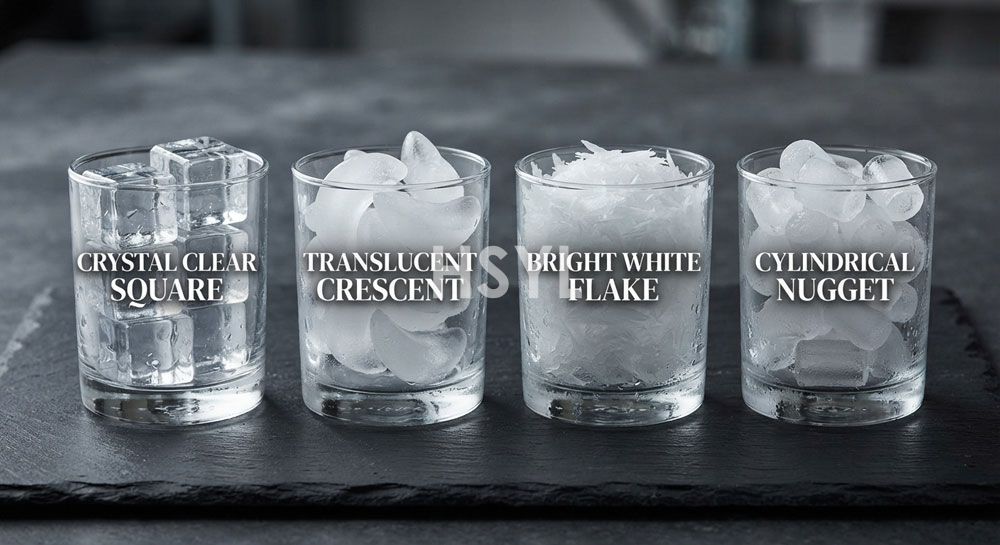
1. Four Ice Types: Physical Profile
| Property | Square Cube Ice | Crescent Ice (Moon Ice) | Flake Ice | Bullet / Nugget Ice |
|---|---|---|---|---|
| Shape | Uniform square with rounded edges; solid through center | Crescent / half-moon slice with curved profile | Thin, flat irregular chips or granules | Cylindrical pellet with rounded hemispherical ends |
| Typical dimensions | 20–22 mm per side (full cube) | Variable by model; typically 25–35 mm arc length | 1.5–2.5 mm thick; irregular width | Diameter 8–12 mm; length 15–25 mm |
| Density | Highest (~0.92 g/cm³ near solid ice density) | High (~0.88–0.91 g/cm³) | Lowest (~0.65–0.75 g/cm³, contains trapped air) | Moderate-high (~0.85–0.89 g/cm³) |
| Melt rate (relative) | Slowest — holds shape 35–45+ minutes in glass at room temperature | Moderate-slow — visible contour change after 20–25 minutes | Fastest — significant volume loss within 10–15 minutes | Moderate — between crescent and cube; good balance |
| Surface area-to-volume ratio | Low (compact solid form minimizes exposed surface) | Moderate (curved face adds surface vs cube) | Very high (thin flat shape maximizes exposure) | Moderate-low (cylinder shape reasonably compact) |
| Clarity / appearance | Crystal clear when made from filtered water; premium visual impression | Translucent white with characteristic moon-curve aesthetic; visually distinctive | Cloudy-white opaque; not intended for beverage presentation | Semi-translucent frosty appearance; casual-friendly look |
| HSYL machine family | SD Square Ice Series (under-counter); SD-3000 / SD-4000 (floor-standing) | AM Series Crescent Ice Maker | AP Series Flake Ice Machine | SC Series Bullet Ice Maker |
Key Insight: Melt rate is not just about aesthetics — it directly affects drink quality. Faster-melting ice dilutes your cocktail more quickly, altering the balance your bartender carefully measured. For stirred drinks where dilution control matters (Manhattan, Negroni, Old Fashioned), low melt rate is a functional requirement, not a preference.
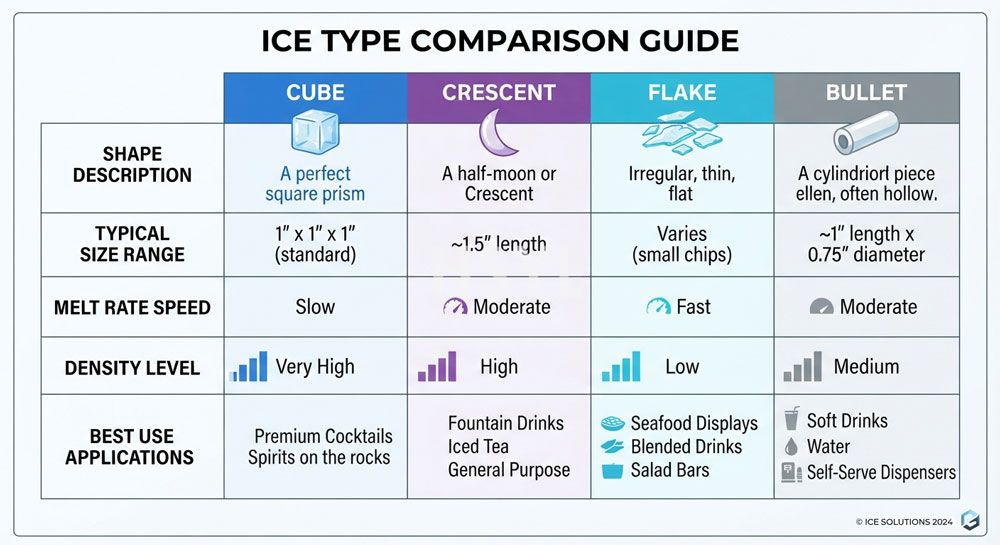
2. Beverage Application Matrix
Different drink categories have different ice requirements. Using the wrong ice type for a given drink is not catastrophic, but it does affect presentation, texture and dilution speed. The matrix below maps each ice type to its strongest and weakest beverage fits.
| Drink Category | Best Ice Type | Acceptable Alternative | Poor Choice (Avoid) | Reason |
|---|---|---|---|---|
| Stirred cocktails on rocks (Old Fashioned, Negroni, Manhattan, Sazerac) | Square Cube Ice | Crescent (if large-format available) | Flake, Bullet | Large solid mass needed for slow dilution over 30+ minute sipping window; small ice over-dilutes within 10 minutes |
| Shaken cocktails served up (Daiquiri, Whiskey Sour, Cosmopolitan) | Cube or Crescent | Bullet (for casual service speed) | Flake (as serving ice) | Dilution ice in shaker can be any type; serving ice must be presentable and slow-melting enough for consumption window |
| Shaken cocktails served on rocks (Margarita on the rocks, Lemon Drop) | Cube or Crescent | Bullet | Flake (melts too fast, waters down quickly) | Rocks presentation requires visible ice that maintains glass chill without rapid dilution |
| Highball and tall mixed drinks (Gin Tonic, Tom Collins, Paloma, Dark & Stormy) | Crescent or Cube | Bullet | Flake (displaces too much liquid volume, melts too fast) | Tall glasses need ice that fills vertical space efficiently while maintaining chill over 15–25 minute drinking period |
| Iced coffee and cold brew (Iced Latte, Cold Brew, Vietnamese Iced Coffee) | Cube or Bullet | Crescent | Flake (acceptable for blended only; poor for straight iced) | Iced coffee tolerates moderate melt because dairy masks dilution; bullet dispenses well from countertop machines |
| Blended frozen drinks (Frozen Margarita, Smoothie, Frappe, Daiquiri Frozen) | Flake or Any (will be blender-crushed anyway) | All types acceptable | N/A — all become slush in blender | Blender destroys original geometry; lowest-cost ice source is optimal for blended programs |
| Soft drinks and fountain service (Cola, Lemonade, Iced Tea, Sports Drinks) | Bullet / Nugget | Cube (premium feel), Crescent | Flake (over-dilutes, displaces liquid) | Fountain operations value chewable texture and consistent portion-controlled dispensing from ice machines with built-in dispensers |
| Beer (shandy, radler, beer cocktail) | Cube or Crescent | Bullet | Flake | Beer drinks need slow melt to prevent excessive watering-down of beer base |
Practical Rule: If more than 40% of your menu consists of stirred or shaken cocktails where presentation and dilution control matter, cube ice should be your primary production type. If your operation is primarily soft drinks, fountain service and iced coffee where speed and dispensing convenience outrank presentation precision, bullet or crescent may serve you better at lower cost per kilogram.
3. Non-Beverage Uses: Where Flake Ice Wins
A common misconception is that all commercial ice serves beverages. In many operations — particularly supermarkets, healthcare facilities, catering companies and seafood restaurants — the majority of ice produced never touches a glass. For these applications, flake ice's fast melt rate is an advantage rather than a flaw.
| Non-Beverage Application | Best Ice Type | Why This Type? | Typical Venue |
|---|---|---|---|
| Seafood display bed (fish on ice, oysters, sushi bar) | Flake Ice | Conforms to irregular product shapes; rapid surface cooling prevents bacterial growth; thin flakes pack densely around fish contours | Seafood restaurants, supermarket fresh counters, fish markets, oyster bars |
| Salad bar / garnish cooling | Flake Ice | Spreads evenly under display pans; high surface area maximizes cooling contact; melts into drainage without leaving hard chunks | Hotel breakfast buffets, cafeteria self-service lines, catering displays |
| Food prep rapid chilling (blanching stop-cool, stock reduction, sauce cooling) | Flake Ice | Large surface area transfers heat fastest; small particle size distributes evenly around food items; no sharp edges damage delicate products | Central kitchens, commissaries, food processing plants, banquet kitchens |
| Healthcare therapy packs (cold compress, patient comfort cooling) | Flake or Crushed | Molds to body contours; soft texture comfortable against skin; no hard corners cause pressure points | Hospitals, clinics, sports medicine facilities, nursing homes |
| Blended dessert base (shaved ice, bingsu, kakigori, snow cone) | Flake or Cube (via ice shaver) | Flake ice requires minimal shaving effort; cube ice produces higher-quality fine snow when shaved with dedicated equipment | Asian dessert cafes, tropical bars, summer pop-up stands, amusement venues |
| Transportation cold chain (perishable goods in transit, delivery cooling) | Flake Ice | Lightweight per cooled-volume (lower density = less transport weight); packs around irregular cargo shapes; acceptable if it partially melts during transit since purpose is cooling, not presentation | Catering delivery services, meal-kit distributors, event logistics |
4. Cost Comparison: Price Per Kilogram by Ice Type
Different ice types carry different production costs due to machine complexity, energy efficiency and yield rates. Understanding cost-per-kilogram helps when budgeting for an operation that may need two ice types simultaneously.
| Cost Factor | Cube Ice (SD Series) | Crescent Ice (AM Series) | Flake Ice (AP Series) | Bullet / Nugget (SC Series) |
|---|---|---|---|---|
| Machine price range (typical) | $800 – $6,000+ depending on capacity tier | $1,200 – $4,500 | $1,500 – $8,000+ | $900 – $3,500 |
| Electricity per kg produced (estimated) | 0.06–0.12 kWh/kg | 0.07–0.13 kWh/kg | 0.08–0.15 kWh/kg | 0.06–0.11 kWh/kg |
| Water usage per kg (estimated) | 1.8–2.5 L/kg | 2.0–2.8 L/kg | 2.2–3.5 L/kg (higher due to thin-flake harvest inefficiency) | 1.9–2.6 L/kg |
| Service interval | 6–12 months depending on tier | 6 months | 3–6 months (flake machines require more frequent cleaning due to evaporator geometry) | 6 months |
| Relative total cost of ownership per kg (over 5 years) | Baseline (1.0x) | 1.1–1.2x baseline | 1.3–1.5x baseline | 0.95–1.05x baseline |
Cost Angle: If your operation needs both cube ice (for the bar) and flake ice (for seafood display or salad bar), the most economical configuration is typically one cube ice machine sized for total demand plus a smaller dedicated flake unit for the non-beverage application — rather than trying to make both types from a single multi-purpose machine (which rarely exists at commercial scale) or overspecifying a single ice type to cover all use cases inadequately.
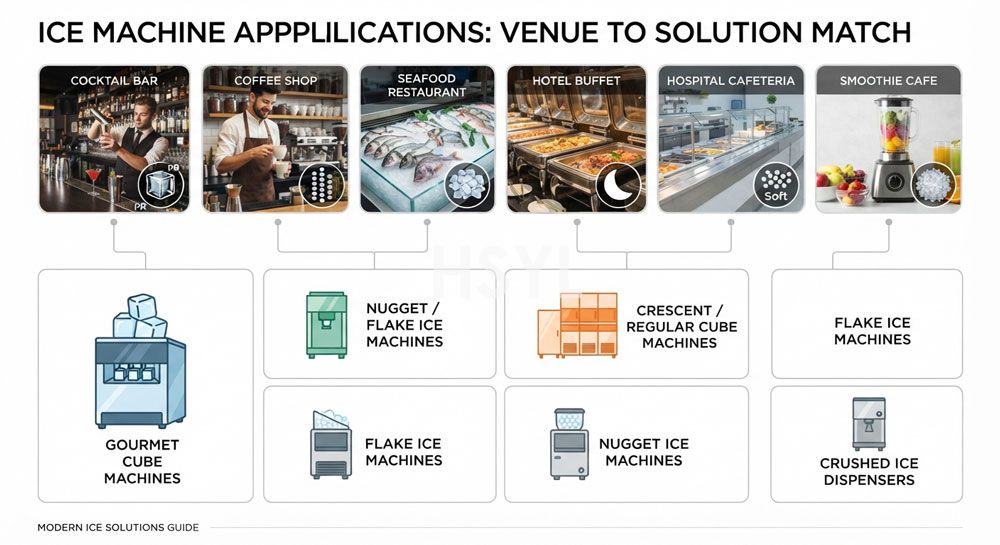
5. Ice Type Selection Decision Tree
Use this three-step decision framework to identify your primary ice type. Most venues end up with one primary type plus optionally a secondary type for a specialized use case.
Step A — What is your dominant ice-consuming activity?
- Primarily beverage service (cocktails, soft drinks, iced coffee, beer) — Go to Step B
- Primarily food-related (seafood display, salad bar, food prep cooling, healthcare) — Flake ice is likely your primary type. Consider adding a small cube or bullet unit if any beverage service exists alongside the food operation.
- Mixed (significant beverage AND significant food-display use) — Go to Step C for dual-type guidance.
Step B — Within beverage service, what drives your menu?
- Cocktail-forward program (stirred + shaken, premium presentation matters) → Square Cube Ice. This covers craft cocktail bars, hotel lounges, upscale restaurant bars, speakeasy-style venues, and anywhere an Old Fashioned orNegroni is a signature order. The SD Square Ice Series (15–70 kg/day) or SD-3000/SD-4000 (1,360–1,800 kg/day) depending on scale.
- High-volume fountain and casual beverage program (soft drinks, iced tea, iced coffee, minimal cocktails) → Bullet / Nugget Ice OR Crescent Ice. Bullet ice dispenses well from countertop machines with built-in dispensers, making it ideal for quick-service restaurants, cafeterias, convenience-store beverage stations, and hospitals. Crescent ice offers a slight presentation upgrade over bullet while maintaining reasonable dispensing speed. Choose AM Series crescent or SC Series bullet based on whether visual aesthetics or dispensing throughput is the priority.
- Blended-frozen drink specialty (smoothie bar, beach bar, margarita-focused) → Flake Ice (cheapest input for blender) OR any available ice type. Since the blender obliterates original ice geometry, the lowest-cost-per-kilogram source is economically optimal. Many smoothie bars run a dedicated flake unit purely for blend economics, even if they also stock cube ice for straight iced drinks on the same menu.
Step C — Dual-type setup: combining two ice types
If your venue legitimately needs two ice types (common for hotels, full-service restaurants with seafood programs, and supermarkets), plan a primary + secondary layout rather than two equal-sized machines:
| Your Venue Profile | Primary Ice Machine | Secondary Ice Machine | Split Rationale |
|---|---|---|---|
| Hotel with lobby bar + breakfast buffet + banquet seafood | Cube ice (bar + room service + minibar) Size for ~70% of total demand | Flake ice (buffet + seafood display + banquet) Size for ~30% of total demand | Beverage ice dominates by volume but food-display ice is functionally irreplaceable by cube |
| Seafood restaurant with full bar | Cube ice (cocktails, bar service) Size for ~50% of total demand | Flake ice (fish display, oyster bed, garnish) Size for ~50% of total demand | Near-even split; neither type can substitute for the other in this format |
| Supermarket fresh-food counter + customer beverage station | Flake or Cube (display/seafood) Size for ~80% of total demand | Bullet or Cube (customer beverage station, employee break room) Size for ~20% of total demand | Display ice dominates by volume; beverage ice is convenience add-on |
| Hospital cafeteria + patient hydration stations | Flake or Cube (food service, salad bar) Size for ~60% of total demand | Bullet (patient floor hydration dispensers, nurse station) Size for ~40% of total demand | Patient-facing stations favor chewable, dispensing-friendly bullet ice |
| Café with light food menu (sandwiches, salads, pastries) | Cube or Bullet (iced coffee, soft drinks) Size for ~85% of total demand | Small flake unit (salad ingredient cooling, sandwich prep) Size for ~15% of total demand | Beverage dominates; flake is utility-grade backup for kitchen prep only |
6. Common Ice Type Mistakes
- Using flake ice as the primary bar ice for cocktails. A cocktail poured over flake ice will be noticeably diluted within 10–15 minutes and will look cloudy in the glass. Reserve flake for blending, display and food-contact uses. Use cube or crescent behind the bar for any drink where the guest will hold the glass longer than 5 minutes before finishing.
- Overspecifying cube ice for an operation that is 90% soft drinks and iced coffee. Cube ice costs more per kilogram to produce than bullet or crescent, and its slow-melt advantage provides no measurable benefit in a drink consumed in 5–7 minutes (the typical soft-drink consumption window). Match ice type to actual consumption pattern, not to aspirational menu positioning.
- Assuming one ice type can cover all use cases adequately. While cube ice is the most versatile single choice (it works acceptably in almost every beverage application), it performs poorly in food-display and healthcare applications where flake's conformability and rapid cooling are functional requirements. If your operation includes both categories, budget for a dual-type installation from the start rather than retrofitting later.
- Ignoring the dispensing workflow difference between ice types. Bullet and nugget ice dispenses cleanly through automated hopper mechanisms built into many countertop machines — a meaningful labor saving in high-volume fountain operations. Cube and crescent ice typically require manual scooping, which adds 2–3 seconds per drink. In a venue pouring 300+ fountain drinks per day, that dispensing difference adds up to 10–15 minutes of daily bartender labor that could be eliminated with bullet ice.
- Choosing ice type based on machine aesthetics rather than operational fit. A sleek stainless cube ice maker may look impressive on the showroom floor, but if your menu is 70% smoothies and blended frappes, a flake unit would produce equivalent results at lower operating cost and with faster harvest cycles. Lead with operational requirements; let aesthetics follow.
Ice Type and Equipment Resources
Once you have identified your target ice type(s) using the framework above, these HSYL resources provide the specific machine options and planning context:
- SD Square Ice Series Upright Ice Makers — Five models producing crystal-clear square cube ice at 15–70 kg/24 h in under-counter widths of 430 mm and 530 mm. The default choice for bars, cafes and lounges where cube ice is the primary beverage type and counter space is limited.
- SD-3000 / SD-4000 Commercial Cube Ice Maker — Industrial-grade cube ice production at 1,360–1,800 kg/24 h for hotels, hospitals, supermarkets and wholesale operations requiring high-volume cube ice supply with water-cooled condensing and ISO 22000 compliance option.
- Crescent Ice Maker (AM Series) — Produces visually distinctive crescent/moon-shaped ice optimized for cocktail presentation and highball programs where ice aesthetics influence customer perception. Suitable as primary type for upscale lounges or as cube-ice complement for signature drinks.
- Commercial Ice Shaver Machine (SY-168 / SY-158) — Converts cube or block ice into fine or coarse shaved ice for Asian dessert programs (bingsu, kakigori, shaved-ice treats) and tropical cocktail presentations. Pairs naturally with any HSYL cube ice maker as a post-production accessory.
- Kitchen Equipment Solutions — Broader context for integrating ice supply equipment into your complete kitchen layout alongside cooking ranges, refrigeration and preparation stations.
Frequently Asked Questions
What is the difference between cube ice and flake ice?
When should I choose crescent ice over cube ice?
Can I use the same ice machine to produce both cube ice and flake ice?
Which ice type is best for cocktails?
Which ice type is best for a seafood restaurant?
Is flake ice safe for direct consumption in drinks?
How long does each ice type last in a drink at room temperature?
Does ice type affect the taste of the drink?
What is bullet or nugget ice best used for?
Related Articles




Get professional consultation
Do you have any questions or need technical support regarding the content of this article? Fill out the form below, and our expert team will provide you with professional solutions.