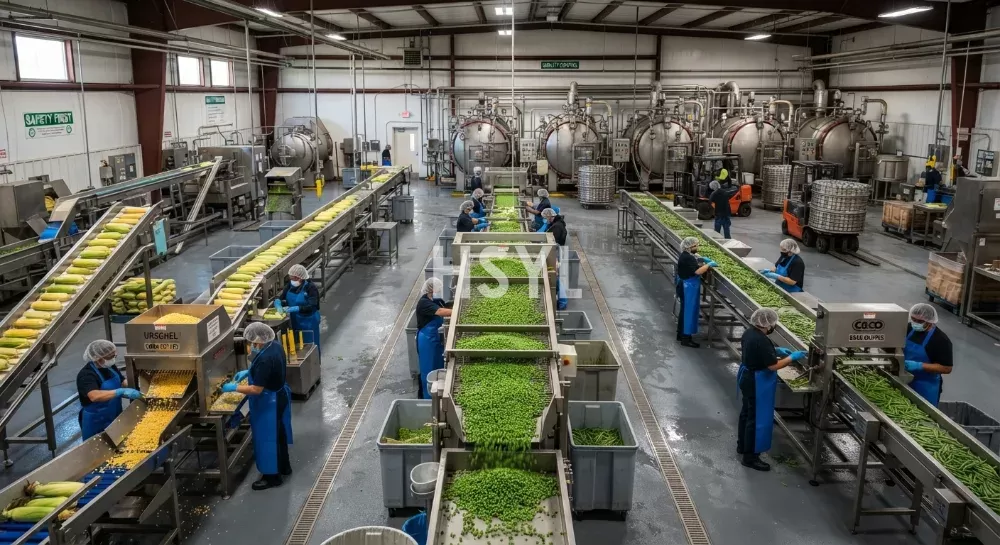
Low-Acid Canned Vegetables: Corn, Peas and Green Beans Processing Line
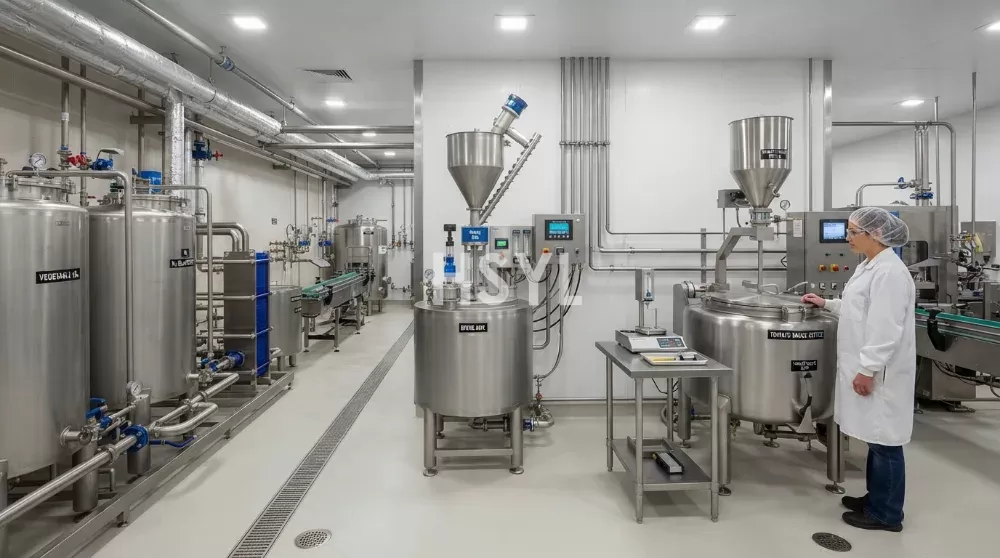
Direct AnswerA low-acid canned vegetable processing line — corn, peas, and green...

HSYL SD-3000 and SD-4000 commercial cube ice makers cover 1,360–1,800 kg/24h at 55–52 dB(A), with CE, FDA 21 CFR 175.300 and ISO 22000 options for hospitals, supermarkets and wholesale ice plants on 380V three-phase power.
The SD-3000 and SD-4000 are HSYL's mid- and top-tier commercial cube ice makers, engineered as a matched pair for facilities that need industrial-scale cube ice supply under hospital, supermarket, wholesale-plant and banquet-kitchen conditions. Both machines share the same 1,220 × 960 mm plan footprint, the same 380V three-phase power supply, the same R404A refrigerant and the same CE + FDA 21 CFR 175.300 food-contact compliance baseline — so buyers can standardize on one utility-pen design across a multi-site estate and choose per-site capacity without re-engineering the building.
Where the two models diverge is on the five variables that actually decide a tender: daily output (1,360 vs 1,800 kg/24h), storage buffer (120 vs 180 kg), noise (55 vs 52 dB(A)), certification tier (CE+FDA vs CE+FDA+ISO 22000) and service interval (6 vs 12 months). This page lays out both models in full, then provides a scenario-driven selection guide so a hospital, supermarket, ice factory or hotel buyer can identify the right unit without guessing.
The SD series sits within HSYL's broader commercial kitchen equipment range, which means cube ice supply can be specified alongside adjacent equipment rather than as a standalone utility decision. For sites scaling up from a smaller unit, the SD-1500 / SD-2000 commercial cube ice maker provides the lower-capacity entry point below the SD-3000.
| Item | SD-3000 | SD-4000 |
|---|---|---|
| Model | SD-3000 | SD-4000 |
| Ice Production Capacity | 1,360 kg / 24 h | 1,800 kg / 24 h |
| Ice Storage Capacity | 120 kg (approx. 30-min peak reserve) | 180 kg (approx. 45-min peak reserve) |
| Ice Shape | Commercial cube ice (cube dimensions: To confirm) | Commercial cube ice (cube dimensions: To confirm) |
| Water Consumption | 3,400 L / 24 h (water-cooled) | 4,500 L / 24 h (water-cooled) |
| Power Consumption | 4,500 W | 6,300 W |
| Voltage | 380 V, 3-phase, 50/60 Hz | 380 V, 3-phase, 50/60 Hz |
| Refrigerant | R404A (GWP 3922, ozone-safe) | R404A (GWP 3922, ozone-safe) |
| Noise Level | 55 dB(A) | 52 dB(A) |
| Dimensions (L×W×H) | 1,220 × 960 × 2,400 mm | 1,220 × 960 × 2,750 mm |
| Weight | To confirm | To confirm |
| Compressor | To confirm (industrial-grade, 380V compatible) | To confirm (industrial-grade, 380V compatible) |
| Condensing Method | To confirm (water-cooled based on water consumption spec) | To confirm (water-cooled based on water consumption spec) |
| Service Interval | 6 months | 12 months |
| Compliance Certifications | CE; FDA 21 CFR 175.300 | CE; FDA 21 CFR 175.300; ISO 22000 |
| Material (food-contact zone) | Food-grade stainless steel (grade: To confirm) | Food-grade stainless steel (grade: To confirm) |
| Automatic Cleaning Cycle | Standard | Standard (enables 12-month service interval) |
Condensing method, exact cube dimensions, compressor brand and stainless-steel grade are listed as To confirm because they are configurable per project. HSYL finalizes these against your local water quality, ambient temperature and food-contact regulations before quotation.
The two models are not "better" and "worse" versions of the same machine. They target different operating realities. The right choice depends on which combination of capacity, compliance, noise, service cadence and utility budget matches a specific facility.
If a tender explicitly requires ISO 22000 — common for hospital groups operating central patient-care kitchens with documented food-safety management systems — only the SD-4000 qualifies. ISO 22000 is tied to the model's design and documentation; it is not a field retrofit, so the SD-3000 cannot be upgraded to it later. The SD-4000's 52 dB(A) noise rating also widens the set of installable locations inside patient-care buildings, which often matters as much as the certification itself.
If ISO 22000 is not on the tender's compliance checklist and daily ice demand sits below 1,360 kg/24h, the SD-3000's 55 dB(A) operation is still within typical institutional noise policy, and its 4,500 W connected load eases retrofit into older hospital electrical infrastructure.
For supermarkets, the deciding variable is weekend peak duration rather than average daily demand. A counter that runs steadily through the week but spikes on weekends needs storage buffer more than peak output. The SD-4000's 180 kg storage bin holds roughly 45 minutes of peak reserve at rated output, versus the SD-3000's 120 kg and 30-minute reserve. For a single distribution center feeding multiple fresh-food counters, that extra 15 minutes of buffer is often the difference between uninterrupted service and an ice shortage during Saturday rush.
For a smaller single-counter format with moderate weekend peaks, the SD-3000 covers the demand at lower power and water draw. For multi-counter distribution, step up to the SD-4000.
Wholesale route economics favor the SD-4000. At 1,800 kg/24h per unit, fewer machines are needed to hit a route target, reducing footprint per kilogram of output, reducing maintenance coordination, and reducing the number of compressors that can fail on any given day. The 12-month service interval compounds this advantage: a factory running four SD-4000 units schedules four service visits per year, versus eight for the equivalent SD-3000 capacity.
The trade-off is connected load and water consumption, but at factory scale the SD-4000 also wins on per-kilogram efficiency: four SD-4000 units draw 25.2 kW and consume 18,000 L/24h, while the equivalent SD-3000 capacity (about six units) draws 27 kW and consumes 20,400 L/24h — so the SD-4000 is lower on both per kilogram of output, in addition to the maintenance advantage.
Hotel banquet ice demand is bursty — long quiet periods punctuated by event setup windows where multiple bars, buffet lines and chilling stations draw ice simultaneously. The SD-4000's 180 kg storage bin handles a larger setup-window draw without the compressor cycling to catch up; the SD-3000's 120 kg bin is sufficient if the property staggers bar setups or runs a smaller event calendar.
For convention-center-scale properties running back-to-back events, specify the SD-4000. For a single-ballroom hotel with moderate event volume, the SD-3000 is typically adequate.
| If your scenario is... | Specify | Primary reason |
|---|---|---|
| Hospital tender with ISO 22000 clause | SD-4000 | ISO 22000 + 52 dB(A) |
| Hospital without ISO 22000, demand < 1,360 kg/24h | SD-3000 | 55 dB(A) compliant, lower retrofit cost |
| Supermarket multi-counter distribution | SD-4000 | 180 kg peak buffer |
| Supermarket single counter, moderate peak | SD-3000 | Sufficient capacity at lower utility draw |
| Wholesale ice factory | SD-4000 | Fewer units, 12-month service, lower per-kg utility cost |
| Convention-center hotel | SD-4000 | 180 kg buffer for bursty event demand |
| Single-ballroom hotel, moderate events | SD-3000 | 120 kg buffer adequate |
Both models follow the same cube ice production cycle. Differences in capacity and service interval come from component sizing and the automatic cleaning system, not from a fundamentally different process.
If you are scaling cube ice capacity step-by-step, or adding complementary ice types for different stations, these HSYL resources sit in the same cluster:
Tell us your facility type (hospital, supermarket, ice plant, hotel), your peak-hour ice demand and your compliance requirements — HSYL will return a model recommendation (SD-3000 or SD-4000) and a side-by-side quotation.
Running a tender with an ISO 22000 clause? Ask our engineers for the SD-4000 compliance documentation pack.
Need help calculating whether your peak-hour buffer favors the 120 kg or 180 kg storage bin? Send your daily ice demand profile and we will model both options against your rush pattern.


Direct AnswerA low-acid canned vegetable processing line — corn, peas, and green...
The filling medium — the liquid that fills the void spaces between the fish piec...
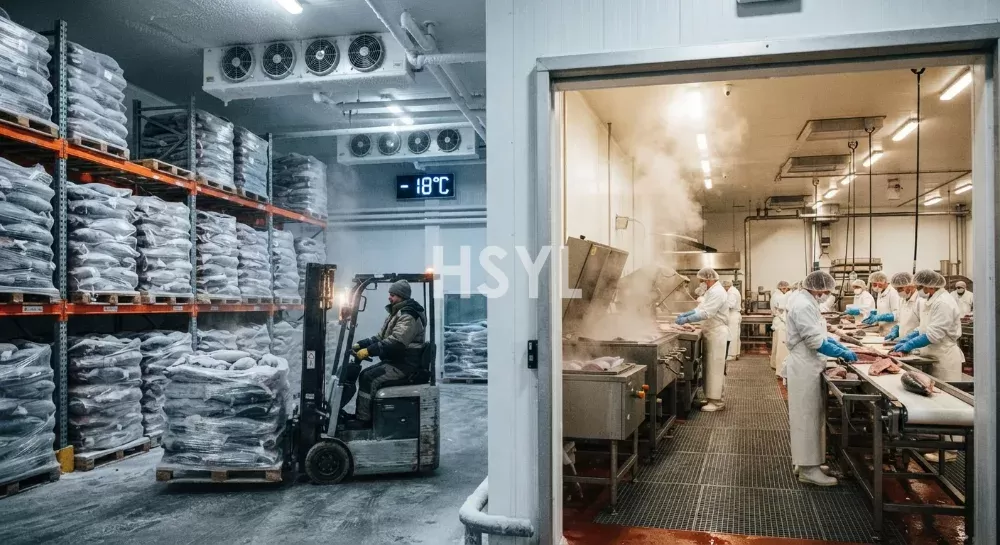
Direct AnswerThe most expensive asset in a fish cannery is not the retort or the...
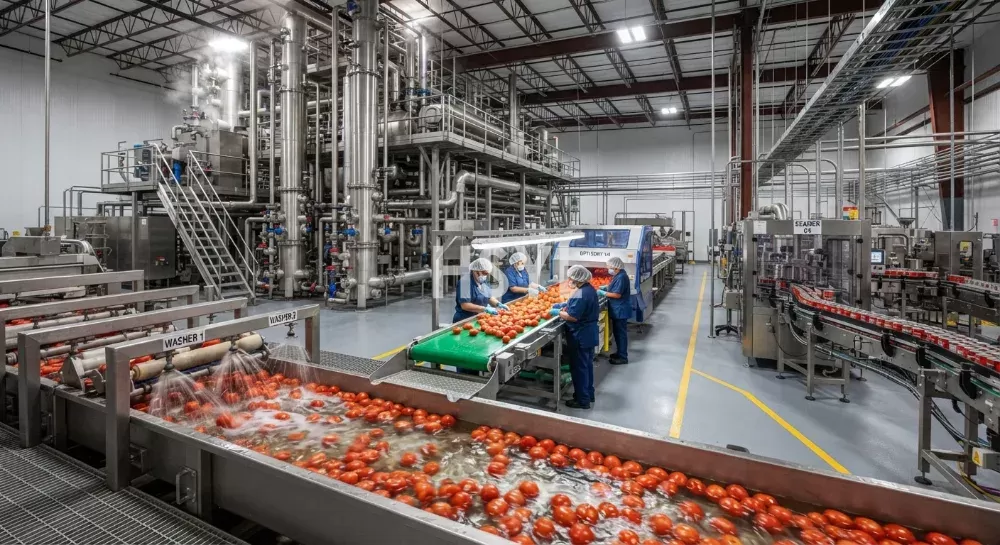
Direct AnswerA tomato products canning line converts fresh tomatoes into four di...