Direct Answer
A low-acid canned vegetable processing line — corn, peas, and green beans — requires pressure retort sterilization at 116–121°C under a scheduled process filed with the FDA under 21 CFR 113 because the natural pH of these products is between 5.0 and 6.5, well above the 4.6 threshold below which Clostridium botulinum spores cannot germinate. This single fact — that the product is low-acid — drives the retort specification, the boiler capacity, the cooling-water system, and the regulatory compliance framework. A line that processes these three vegetables must also accommodate three different raw-material forms (whole ears for corn, pods with peas inside for peas, whole pods for green beans) and three different preprocessing requirements (husking and kernel cutting for corn, vining for peas, snipping and cross-cutting for green beans). This guide walks through the processing path for each vegetable, the equipment decisions that change with each species, the thermal process requirements, the common starch-related defects unique to corn and peas, and the capacity planning that addresses the short harvest window all three vegetables share.Ensure your thermal processing curve complies with FDA 21 CFR Part 113 rules by following our complete canned vegetables production line from receiving to retort.
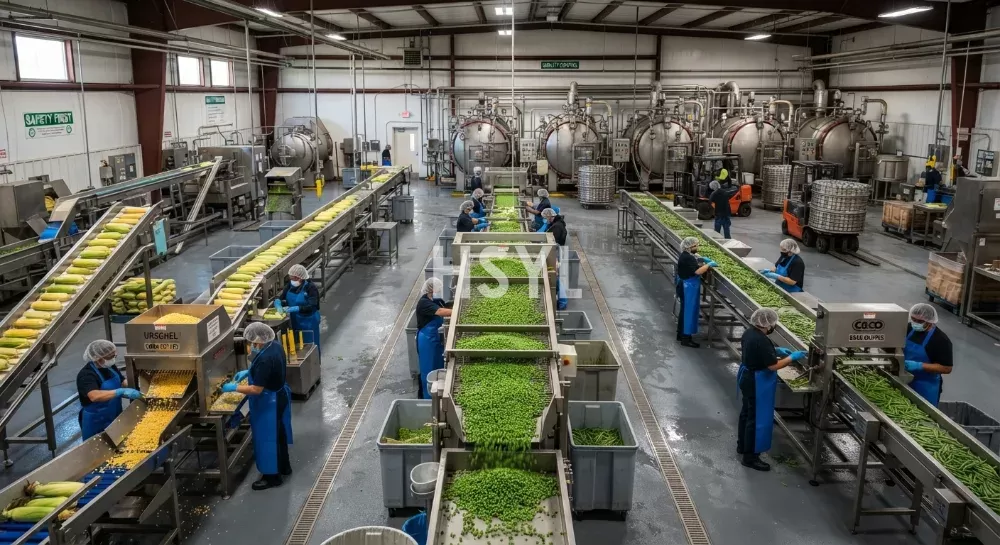
What Defines a Low-Acid Canned Vegetable and Why It Matters
The pH classification of a canned vegetable determines the sterilization temperature, the retort type, the boiler specification, and the regulatory filing path. Vegetables with a natural pH above 4.6 — corn (pH 5.8–6.5), peas (pH 5.6–6.5), green beans (pH 5.0–5.6), carrots (pH 5.0–6.0), potatoes (pH 5.4–5.9), and mushrooms (pH 6.0–6.5) — are classified as low-acid canned foods. They must be sterilized in a pressure retort at 116–121°C to achieve a minimum F₀ of 3.0, which provides a 12-log reduction of C. botulinum spores. Most processors design to an F₀ of 6–8 to provide a safety margin for process variability. This thermal requirement has three engineering consequences that do not apply to acid products:
- The retort must be a pressure vessel rated for operation at 121°C or above. Atmospheric steam or hot-water pasteurizers — which are sufficient for acid products such as tomatoes and acidified vegetables — cannot reach 116°C because water and steam at atmospheric pressure are limited to 100°C. The retort must be a pressurized vessel with overpressure capability, typically 0.1–0.2 MPa (15–30 psi) above the saturated steam pressure at the operating temperature, to prevent can deformation during the heating and cooling phases.
- The boiler must be sized for the simultaneous steam demand of all retorts at peak load. A batch retort processing 2,000–3,000 cans per load at 121°C draws a steam flow that depends on the retort size, the number of retorts in operation, and the come-up time. A factory with four batch retorts operating simultaneously has a peak steam demand that is a multiple of the steady-state demand, and the boiler must be sized for the peak, not the average.
Cooling water must be chlorinated and the cooling rate must be controlled. After the sterilization hold, the retort cooling cycle brings the can center temperature below 40°C. The initial cooling phase — when the steam pressure inside the retort drops faster than the can internal pressure — creates a momentary vacuum inside the can that can draw micro-droplets of cooling water across the still-soft seam compound. The cooling water must be chlorinated to a free chlorine residual of 2–5 ppm at the point of can contact. This is a CCP in every low-acid canned food HACCP plan.
Product-Specific Processing Paths
Path A: Canned Sweet Corn Processing
Sweet corn for canning is harvested at the milk stage — when the kernels are fully formed but the endosperm is still liquid and sweet, with a moisture content of 68–72%. The harvest window for a given variety at a given planting is approximately 5–7 days — any shorter and the yield is too low, any longer and the sugars convert to starch, producing a tough, bland product that fails the tenderometer specification. The processing path:
A1. Husking, Silking, and Washing
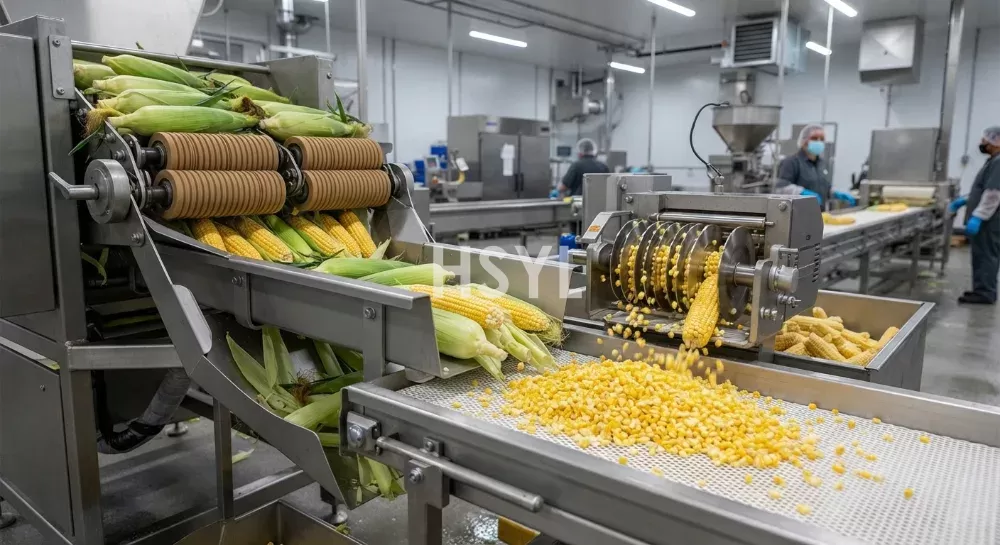
Whole ears enter the husker — a set of counter-rotating rubber rollers that grip the husk leaves and pull them away from the ear. The husker must remove 95–98% of the husk without damaging the kernels at the ear tip. After husking, the ears pass through a silking machine — rotating brushes or water-spray bars that remove the silk threads from between the kernel rows. Residual silk in the can is a visual defect that lowers the product grade. The husked, silked ears then pass through a spray washer. The entire husking-to-washing sequence must complete within {{CORN_HUSK_TO_WASH_MINUTES}} minutes of ear entry to minimize the time that the exposed kernels are exposed to airborne contamination.
A2. Kernel Cutting and Cleaning
The washed ears feed into a kernel cutter — a machine that positions each ear vertically and passes it through a set of circular knives that cut the kernels from the cob. The cutting depth is adjustable and determines the proportion of whole-kernel to cut-kernel pieces in the final product. The cut kernels — now a mixture of whole kernels, broken kernel pieces, cob fragments, and residual silk — pass over a vibrating cleaning screen and through a flume that washes away the lighter debris. The kernel yield from whole-ear corn is approximately {{KERNEL_YIELD_PCT}}% of the ear weight; the remaining cob and husk are a waste stream that must be removed continuously from the processing area to prevent insect attraction and microbial growth.
A3. Blanching and Cooling
Corn kernels are blanched in water or steam at 88–95°C for {{CORN_BLANCH_TIME_MINUTES}} minutes. The blanch inactivates peroxidase, removes tissue gases, and — critically for corn — gelatinizes the starch granules at the kernel surface. Surface starch gelatinization creates a thin protective layer that reduces the leaching of soluble solids (sugars, water-soluble vitamins) into the brine during the filling-to-retort interval. After blanching, the kernels are cooled in a cold-water flume to below 40°C. The cooling water must be potable and should not introduce microbial contamination to the blanched product, which has a reduced competitive microflora after the heat treatment and is vulnerable to colonization by any surviving or introduced organisms.
A4. Filling, Brine Dosing, and Seaming
Cooled corn kernels are filled into cans — typically by a volumetric filler for whole-kernel corn, which is free-flowing. The brine for canned corn is simpler than for most other vegetables: water, salt (1–2% w/v in the finished product), and sugar (2–5% w/v depending on the sweetness specification for the product grade). Some processors add a small amount of zinc chloride or calcium chloride as a color stabilizer, though this is product-grade-specific and must be declared on the label. The brine is heated to 85–90°C before dosing. After liquid fill, the can is seamed and transferred to the retort within {{FILL_TO_RETORT_MINUTES}} minutes to prevent the proliferation of thermophilic spores that survived the blanch and can germinate in the warm, filled can during the pre-retort hold.
A5. Retort Sterilization and Cooling
Canned corn — particularly cream-style corn, which has a higher viscosity than whole-kernel corn in brine — presents a heat-penetration challenge. The starch released from the cut kernels during retorting increases the viscosity of the liquid phase, reducing convection currents and slowing heat transfer to the can cold point. Cream-style corn has a longer required process time than whole-kernel corn in brine for the same can size because conduction, not convection, is the dominant heat-transfer mechanism. The scheduled process must be established by a thermal process authority using heat-penetration data from the actual product formulation, piece size, and can size. After sterilization, the cans must be cooled to a center temperature below 40°C within {{COOLING_TIME_MINUTES}} minutes to prevent flat-sour spoilage by thermophilic spore-formers and to arrest the cooking process before overcooking degrades the texture.
Path B: Canned Green Pea Processing
Green peas for canning are harvested at a specific maturity measured by tenderometer — an instrument that measures the force required to crush a sample of peas through a standardized grid. The target tenderometer reading for canning peas is typically {{TENDEROMETER_TARGET}}, corresponding to a pea that is fully formed but still tender and sweet. Peas with a higher tenderometer reading (harder, more mature) contain more starch and less sugar and produce a canned product that is mealy rather than tender. The harvest window for peas at the target maturity is as short as 24–48 hours for a given field — the line must be ready to process at the peak daily intake because delayed harvesting produces over-mature peas that cannot be upgraded by processing.
B1. Vining
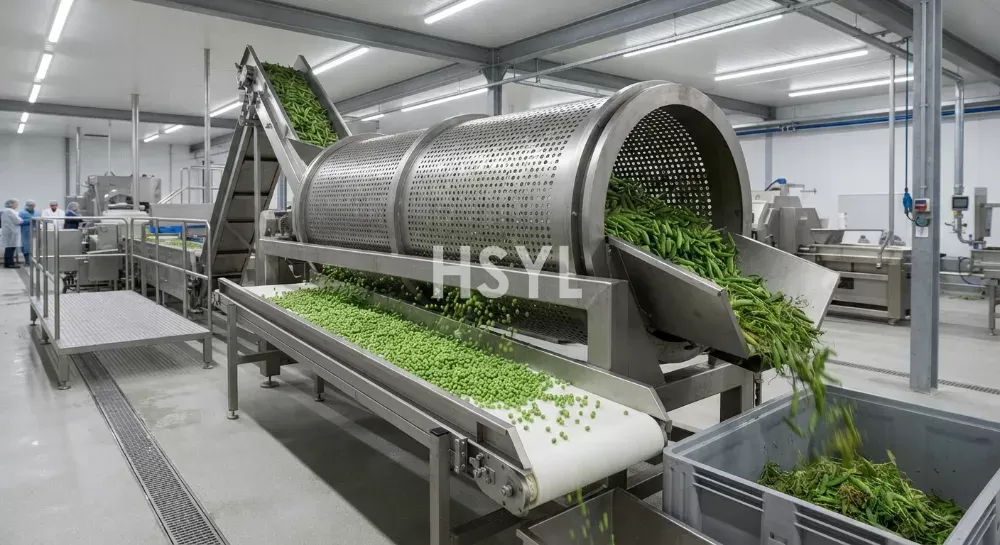
Peas arrive at the factory as whole pods — the pea is still inside the pod. The pods must be vined to extract the peas. The viner is a rotating perforated drum with internal beaters that knock the peas out of the pods. The peas fall through the perforations onto a collection conveyor; the empty pods are discharged from the end of the drum as waste. Viner throughput is the capacity bottleneck on many pea lines — a single viner can process {{VINER_CAPACITY_TONS_HR}} tons of pods per hour, and a factory must install enough viners to match the peak daily pod intake. The empty pods — representing {{POD_WASTE_PCT}}% of the incoming weight — must be removed from the factory continuously; accumulated pod waste is a source of odor, insects, and microbial contamination.
B2. Cleaning, Grading, and Blanching
The shelled peas pass through a series of cleaning operations: a de-stoner (gravity separator that removes stones and soil clods), a flume washer, and a foam washer (air-injection flotation tank that removes insect-damaged and hollow peas that float while sound peas sink). After cleaning, the peas are graded by size on a vibratory screen grader into three to five size fractions. Size grading is critical because the blanching time and the retort process time are calculated for the largest pea in the size fraction — ungraded peas with a mix of sizes require the process to be designed for the largest pea, and smaller peas are over-processed. Graded peas are blanched in water at 85–95°C for {{PEA_BLANCH_TIME_MINUTES}} minutes depending on the size grade, cooled, filled into cans, topped up with hot brine (water, 1.5–2.5% salt, 2–4% sugar), seamed, and retort-sterilized.
B3. Starch and Color Defects
Canned peas are prone to two quality defects that are largely controlled by raw-material maturity and processing conditions. The first is starch precipitation — over-mature peas release starch granules into the brine during retorting, producing a cloudy, opaque brine rather than the clear brine expected in a premium-grade product. Prevention is by controlling the raw-material tenderometer and by minimizing the time from vining to blanching (starch continues to be synthesized from sugar in the shelled pea during the pre-blanch hold). The second defect is color degradation — the chlorophyll in the pea is converted to pheophytin (olive-brown) by the heat of retorting, a reaction accelerated by acidic conditions. Canned peas that have degraded from bright green to olive-brown are downgraded. Unlike green beans — where the can size allows the addition of alkaline salts to the brine to raise the pH and reduce pheophytin formation — peas in small cans have a higher surface-to-volume ratio and lose color more rapidly. The color shelf life of canned peas is shorter than that of canned green beans, and export shipments to warm climates where warehouse temperatures exceed 30°C should be rotated faster than domestic inventory.
Path C: Canned Green Bean Processing
Green beans (snap beans, string beans) for canning are harvested when the pod is fully elongated but the seeds inside are still immature — the pod wall is the consumed portion, and seed development inside the pod produces a tough, fibrous product. The raw material is the entire pod. The processing path:
C1. Pre-Grading, Snipping, and Cutting
Whole green bean pods arrive in bulk bins or trailers. After washing to remove field soil, the pods pass through a pre-grader — a roller grader that sorts the pods by diameter. Diameter grading serves two purposes: it separates the pods into size fractions for the subsequent snipping and cutting operations (which are diameter-dependent), and it ensures that the final canned product has a uniform pod diameter and therefore a uniform texture after the retort process. Graded pods are fed into the snipper — a machine that trims the stem end and the tip from each pod. The snipper removes approximately {{SNIP_LOSS_PCT}}% of the pod length as waste. After snipping, the pods are cross-cut to the target length — typically 25–38 mm depending on the can size — in a cross-cutter. Whole green beans (unsnipped, uncut, packed lengthwise in tall cans) are a premium product with a different filling method (hand-pack into an upright orientation) and a longer process time due to the larger can size.
C2. Blanching, Filling, and Retort
Cut green beans are blanched in water or steam at 88–95°C for {{BEAN_BLANCH_TIME_MINUTES}} minutes. After blanching and cooling, the beans are filled into cans — volumetric filling for cut beans, hand-pack for whole beans — and topped up with hot brine (water, 1.5–2.5% salt). The brine for green beans is typically a simple salt brine without added sugar, unlike peas and corn. After seaming, the cans are retort-sterilized at 116–121°C. Green beans have a lower starch content than peas and corn, so the heat-penetration characteristics are more favorable — convection heating in the brine is the dominant mechanism, and the process time is shorter than for cream-style corn or large peas.
C3. Color Retention
Green bean color retention during retorting is the primary quality challenge. The chlorophyll-to-pheophytin conversion is pH-dependent — a higher pH (more alkaline) retards the reaction. Processors of canned green beans commonly add an alkaline salt — typically magnesium carbonate or sodium bicarbonate, and historically calcium hydroxide — to the brine to raise the pH to 7.5–8.5, which slows pheophytin formation and preserves the green color. However, alkaline brine softens the bean tissue by solubilizing pectin, and the degree of softening must be balanced against the color benefit. The alkaline brine also increases the risk of can internal corrosion if the can lining is not specified for alkaline conditions — a standard R-enamel (oleoresinous) lining may be adequate for neutral-brine canned beans, but highly alkaline brine may require a different lining system. The trade-off between color, texture, and can compatibility is specific to each product formulation and must be validated by shelf-life testing.
Equipment Summary Table
| Process Stage | Corn (Whole Kernel) | Peas | Green Beans (Cut) |
|---|---|---|---|
| Raw material form | Whole ears in bulk bins/trailers | Whole pods in bulk bins/trailers | Whole pods in bulk bins/trailers |
| Initial preparation | Husker → silker → washer | Viner → de-stoner → flume washer | Washer → pre-grader |
| Size reduction | Kernel cutter → cleaning screen | Foam washer → vibratory grader | Snipper → cross-cutter |
| Blanching | Water/steam, 88–95°C | Water, 85–95°C (size-dependent) | Water/steam, 88–95°C |
| Filling | Volumetric filler | Volumetric filler | Volumetric filler (hand-pack for whole) |
| Brine | Salt + sugar | Salt + sugar | Salt (alkaline optional) |
| Retort | Batch/continuous, 116–121°C | Batch/continuous, 116–121°C | Batch/continuous, 116–121°C |
| Key quality risk | Starch gelation → slow heat penetration | Starch cloudiness; color degradation | Color degradation; alkaline softening |
Thermal Process Engineering Across the Three Vegetables
The retort process time and temperature for low-acid canned vegetables is product-specific because the heat-penetration rate — how quickly the can cold point reaches the target sterilization temperature — depends on the product's physical properties inside the can. The relevant factors:
- Starch content and gelatinization: Corn and peas release starch into the brine during retorting. The starch gelatinizes and increases the viscosity of the liquid phase, reducing the convection currents that are the main heat-transfer mechanism in a can of free-floating particles in brine. The retorting of high-starch products is therefore a conduction-dominated process after the starch has gelatinized, and the process time is longer than for a low-starch product in the same can size.
- Solid-to-liquid ratio: The proportion of solid vegetable pieces to brine affects heat transfer. A can that is tightly packed with solid pieces — such as cut green beans packed to the maximum fill weight — has less free liquid and slower convection, and the cold point may be inside a solid piece rather than in the liquid at the geometric center. The scheduled process must be based on heat-penetration data from the actual fill ratio.
- Piece size: The largest piece in the can determines the thermal center temperature. Size grading before filling is therefore a process-control step, not merely a quality step — it ensures that the largest piece in the can is within the size range for which the scheduled process was developed.
- Initial temperature (IT): The temperature of the can contents entering the retort — the initial temperature or IT — affects the come-up time. Hot-filling at 85–90°C reduces the come-up time versus cold-filling at ambient temperature, and the scheduled process may specify a minimum IT that must be achieved and recorded for every retort load. If the IT drops below the minimum — for example, because the filler stops for maintenance and filled cans cool while waiting for the seamer — the retort operator must extend the process time to compensate, following the come-up time correction procedure in the scheduled process.
For the underlying thermal process science, see the guide on canned food thermal process control. For the broader HACCP framework, consult the HACCP fish canning line design guide — the CCP framework is common across all low-acid canned food, though product-specific monitoring parameters differ.
Seasonal Harvest Planning
Corn, peas, and green beans share a common operational challenge: all three are harvested seasonally, with processing windows of 6–10 weeks. A factory that processes all three on the same line manages the harvest calendar sequentially. In temperate Northern Hemisphere regions, the typical sequence is peas (late spring to early summer), green beans (mid-summer), and sweet corn (late summer to early autumn). The line must be designed for the highest-volume crop — typically sweet corn, which has the highest raw-material intake per hectare — and must accommodate the changeover between crops. Changeover involves cleaning all product-contact surfaces (the washers, conveyors, blancher, filler, and brine system), switching the cutting equipment (kernel cutter for corn, snipper and cross-cutter for beans), and validating the blanching and retort parameters for the incoming crop. Changeover time is typically {{CHANGEOVER_HOURS}} hours and must be factored into the annual production schedule.
For factories in tropical regions where multiple planting cycles are possible, or for factories that supplement fresh-harvest processing with frozen raw material during the off-season, the line can operate year-round. The frozen-raw-material option — receiving IQF (individually quick-frozen) corn kernels, peas, or cut green beans, thawing them under controlled conditions, and processing them through the blanching and filling stages — is standard in factories that export to markets where year-round supply is a customer requirement. The thawing system must be designed to avoid condensate accumulation on the product surface, which promotes microbial growth during the thaw-to-blanch interval.
Planning Inputs
- Target vegetable species and for each: harvest window, peak daily intake, and acceptable post-harvest-to-processing time.
- Product format per species: whole kernel, cream-style, or both for corn; size-graded or blended for peas; cut or whole for green beans.
- Can sizes and annual volume per can size.
- Target F₀ per product, established by a thermal process authority.
- Available steam capacity and boiler specification.
- Cooling-water source, quality, and chlorination system.
- Wastewater treatment capacity for the peak-harvest processing volume.
- Target food safety certifications (BRCGS, IFS, FSSC 22000) and regulatory filing requirements (FDA FCE/SID for US export).
Conclusion
A low-acid canned vegetable line — corn, peas, and green beans — is defined by the pressure retort requirement that follows from the product pH classification. The line processes three different raw-material forms through three different preparation paths that converge at the blancher and remain common through filling, seaming, and retort. The starch content of corn and peas creates heat-penetration challenges that increase the required retort process time; the chlorophyll content of peas and green beans creates color-degradation challenges that must be managed through raw-material maturity control, pH adjustment, and shelf-life management. The seasonal harvest pattern requires the line to be sized for the peak daily intake and to accommodate changeover between crops. For the broader vegetable canning context, see the green bean canned food production line and the companion guide on canning line bottlenecks. When ready to specify the line, prepare the planning inputs above and contact the engineering team.
Frequently Asked Questions
Why do corn, peas, and green beans require pressure retort when tomatoes only need atmospheric pasteurization?
What causes cloudy brine in canned peas and how is it prevented?
Why is alkaline brine used for canned green beans?
What is the scheduled process and who must establish it?
How does starch affect retort time for canned corn and peas?
Can one line process corn, peas, and green beans in sequence during the same season?
What is the purpose of the viner on a pea canning line?
How is cream-style corn processed differently from whole-kernel corn?
Related Articles


Get professional consultation
Do you have any questions or need technical support regarding the content of this article? Fill out the form below, and our expert team will provide you with professional solutions.