Direct Answer
A tomato products canning line converts fresh tomatoes into four distinct shelf-stable product categories — tomato paste, whole peeled tomatoes, diced tomatoes, and tomato sauce — each with its own process path, equipment set, and quality specification. The line is defined by one engineering decision that is made before any equipment is ordered: whether the incoming tomatoes will be processed by the hot-break method (rapid heating to 85–95°C immediately after crushing, which inactivates pectin methylesterase and polygalacturonase, preserving the pectin that gives paste its viscosity) or the cold-break method (crushing at 60–70°C without immediate enzyme inactivation, producing a thinner product with a fresher color and flavor preferred for diced and whole peeled products). This decision determines the pre-heater specification, the evaporator type and number of effects, the paste concentration limit, and the product categories the line can economically produce. A line designed for hot-break paste cannot simply switch to cold-break diced without equipment modification — the pre-heater, the finisher screen size, and the evaporator configuration are all different. This guide walks through the processing paths for each tomato product, the equipment at each stage, the critical quality parameters, and the utility demands that determine whether a factory can support the line.For thermal sterilization validation standards across high-acid sauces and neutral pH vegetables, compare protocols in our low-acid canned vegetables processing line engineering standard.
Why a Tomato Canning Line Is Engineered Differently from Other Vegetable Lines
Tomatoes are botanically fruit, processed industrially as vegetables, and occupy the largest single-product category in the global canned vegetable market — over 35 million tons of tomatoes are processed annually worldwide, roughly four times the volume of the next largest canned vegetable category. A tomato canning line differs from a general vegetable canning line in five engineering dimensions:
- Water removal is the core operation. Fresh tomatoes are approximately 93–95% water by weight. Tomato paste — the largest-volume tomato product — is concentrated to 28–30°Brix (for hot-break paste destined for remanufacturing into ketchup, sauces, and soups) or 36–38°Brix (for super-concentrated paste that reduces transport cost for export). To produce one ton of 30°Brix paste from 5°Brix fresh tomatoes, the line must remove approximately 5.3 tons of water per ton of paste output. The evaporator is therefore the largest, most capital-intensive, and most energy-consuming piece of equipment on the line — not the filler or the retort, which dominate other vegetable lines.
- The product can be packed in cans, jars, aseptic bags, or bulk drums. Other canned vegetables go exclusively into cans or jars with a brine or sauce fill. Tomato paste is packed in formats ranging from 70 g sachets to 220 L aseptic bag-in-drum, with the bulk formats (200 L drums, 1,000 L IBC totes) representing the majority of industrial tomato paste volume. The packaging decision drives the filler type, the sterilization method (retort for cans, aseptic filling for bags/drums), and the downstream logistics.
- Hot-break vs. cold-break determines the entire line configuration. No other vegetable product has a comparable binary process-path decision that changes the pre-heater, the finisher, the evaporator, and the final product quality. The decision must be made at the project-planning stage and cannot be reversed without equipment replacement.
- Multiple products are produced from a single raw material on a single site. A tomato processing factory typically runs paste production during the peak harvest period (when volume is highest and quality is suited for concentration) and whole-peeled or diced production during the early and late harvest (when the tomatoes are firmer and more uniform in size). The line must be designed for the common infrastructure — receiving, washing, sorting — with parallel downstream paths for each product category.
- The regulatory framework depends on the final product pH and the packaging format. Whole peeled, diced, and crushed tomatoes are acid products (natural pH 4.0–4.6) and can be pasteurized rather than pressure-retorted. Tomato paste, when concentrated above 28°Brix, has a reduced water activity that contributes to microbial stability in addition to pH. However, when paste is packed in large-format aseptic bags rather than small cans, the sterilization method shifts from in-container thermal processing to aseptic processing — and the regulatory filing path under FDA 21 CFR 113 (low-acid canned food in hermetically sealed containers) or 21 CFR 108/113 (aseptic processing) changes accordingly.
Raw Material: What Drives Line Speed, Yield, and Product Quality
Tomatoes for canning are grown from processing-specific varieties that differ from fresh-market tomatoes in three economically significant ways: they have higher soluble solids (4.5–6.0°Brix vs. 3.5–4.5°Brix for fresh-market varieties), thicker fruit walls that withstand mechanical harvesting and bulk transport, and a more determinate fruit-set pattern that concentrates the harvest into a 6–10 week window. The processing tomato harvest is fully mechanized in most growing regions — mechanical harvesters cut the entire plant, separate the fruit from the vine via a shaking mechanism, and load the fruit into trailers that follow alongside the harvester.
The line speed for a tomato canning factory is determined by the peak daily receiving rate during the harvest window. A factory that must process 100,000 tons of tomatoes in a 70-day season has an average daily intake of approximately 1,430 tons, but the peak daily intake — driven by harvest logistics, weather, and the maturity profile of the crop — can be 150–200% of the average. The receiving, washing, and sorting equipment must be sized for the peak day, not the average day. A factory that sizes its receiving equipment for the average throughput will lose raw material on peak days — tomatoes left in trailers beyond 8–12 hours from harvest begin to degrade, losing soluble solids to respiration and developing mold at bruised surfaces.
Step-by-Step Process Flow: Common Infrastructure
Stage 1: Receiving, Fluming, and Washing
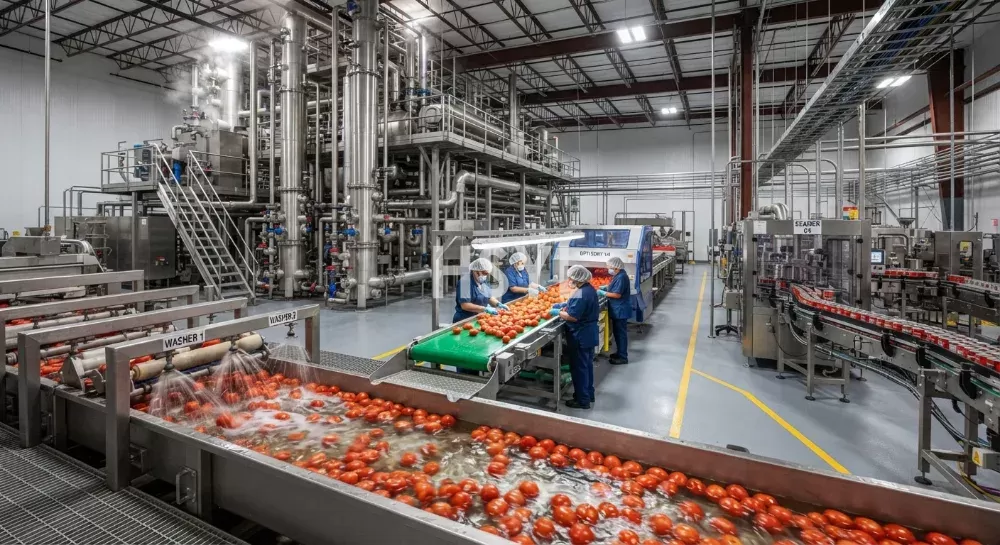
Tomatoes arrive in bulk trailers or bins and are unloaded into a flume system — a water channel that transports the tomatoes from the receiving pit to the washing station while simultaneously providing the first cleaning step. The flume water carries off loose soil, sand, and field debris. The flume must be designed with a gradient of 0.5–1.0% to ensure adequate transport velocity without damaging the fruit; too steep a gradient causes the tomatoes to tumble and bruise, producing yield loss in the subsequent peeling stage for whole-peeled products. The flume water is recirculated through a rotary screen filter that removes solids above 1,500 microns and a settlement tank that removes sand and gravel. Make-up water enters at the cleanest point (the spray washer discharge) and flows counter-current to the tomatoes, so the dirtiest water is at the receiving end where it first contacts the incoming fruit.
After the flume, the tomatoes pass through a spray washer — a series of high-pressure spray bars (200–400 kPa) positioned above and below a roller conveyor. The spray washer removes the remaining soil and reduces the microbial load on the fruit surface. Wash water is chlorinated to 2–5 ppm free chlorine, monitored continuously, with the residual recorded every hour in the production log.
Stage 2: Sorting and Grading
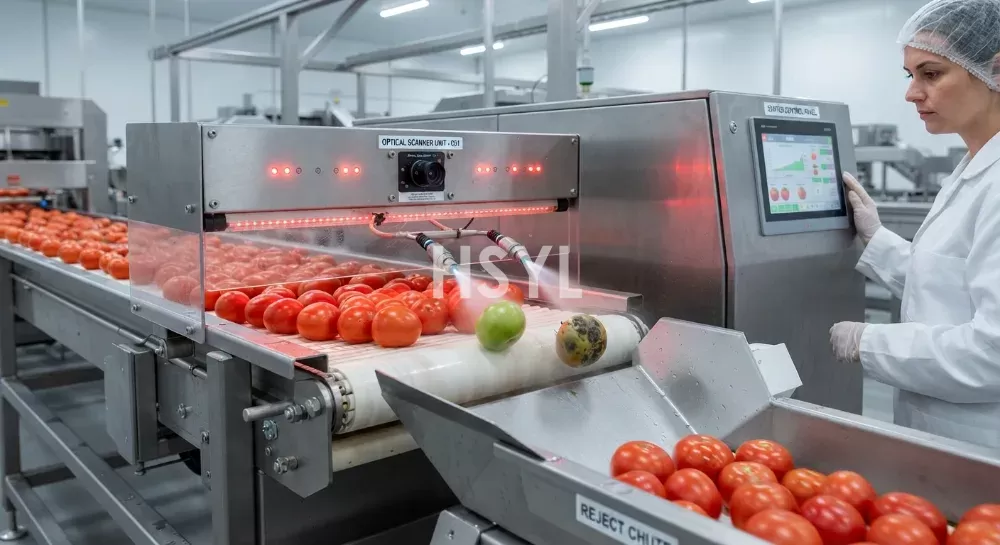
After washing, the tomatoes pass over an inspection belt where operators remove foreign material (vine fragments, weed stems, stones that passed the flume settlement trap), unripe or overripe fruit, and mold-damaged fruit. The inspection belt speed is limited by the ability of the human eye to detect defects at the belt speed — typically 8–12 m/min, requiring 2–4 operators per meter of belt width depending on the defect rate of the incoming raw material. In factories operating under BRCGS or equivalent GFSI standards, the inspection belt must be illuminated to a minimum of 540 lux at the belt surface, and the operators must rotate positions every 30–45 minutes to maintain detection accuracy.
Optical sorting — using CCD cameras in the visible and near-infrared spectrum — is increasingly supplementing or replacing manual inspection. An optical sorter can process 5–15 tons of tomatoes per hour per meter of belt width, ejecting defective fruit with compressed-air nozzles with a detection accuracy of 90–98% depending on the defect type and the sorter configuration. The optical sorter's rejection rate is typically 2–5% of the incoming volume, and the eject stream is either sent to a lower-value product stream (diced or crushed where visual uniformity is less critical) or discarded. The optical sorter does not fully eliminate the manual inspection belt — it reduces the operator headcount from 8–12 to 2–4, with the remaining operators catching defects the sorter misses (internal mold visible only after cutting, or defects on the underside that the top-view camera cannot see).
Step-by-Step Process Flow: Product-Specific Paths
Path A: Tomato Paste Production
Tomato paste — the largest-volume product — follows the hot-break process path: crushing, pre-heating, pulping/finishing, evaporation, and aseptic filling or canning. Each stage:
A1. Crushing and Hot-Break Pre-Heating
Washed and sorted tomatoes enter the crusher — a hammer mill or a rotary crusher that breaks the fruit into a pumpable slurry. Immediately after crushing, the slurry is pumped to the hot-break pre-heater, a shell-and-tube or scraped-surface heat exchanger that raises the slurry temperature to 85–95°C within 15–30 seconds. The speed of this temperature rise is critical: the hot-break targets pectin methylesterase (PME) and polygalacturonase (PG), the two enzymes that degrade pectin. PME demethylates pectin, making it susceptible to PG-catalyzed chain scission; PG then depolymerizes the pectin, reducing the viscosity of the final paste. By inactivating both enzymes within seconds of crushing, the hot-break preserves the pectin polymer intact, producing a paste that — when reconstituted to single-strength — has a Bostwick consistency of 4–8 cm/30s (thick, suitable for ketchup and sauce manufacture). A cold-break process, by contrast, allows PME and PG to act on the pectin for 15–30 minutes before the slurry reaches the evaporation temperature sufficient to inactivate them, producing a paste with a Bostwick consistency of 10–15 cm/30s (thin, suitable for tomato juice and soups where high viscosity is not required).
The pre-heater is the first major steam consumer on the paste line. The heat load to raise 20,000 kg/h of 5°Brix tomato slurry from 20°C to 90°C is approximately 1,600 kW, supplied by saturated steam at 6–8 bar. The exact values depend on the line throughput and must be calculated per project.
A2. Pulping and Finishing
The pre-heated slurry passes through a pulper — a rotating paddle inside a cylindrical screen that forces the pulp (the liquid and fine solids) through the screen while retaining the skins and seeds. The screen aperture size determines the fineness of the pulp: a screen with 1.0–1.5 mm apertures produces a smooth pulp for paste; a screen with 0.5–0.8 mm apertures produces a finer pulp for ketchup base. The pulp — now called tomato juice or serum at 4.5–6.0°Brix — proceeds to evaporation. The skin-and-seed waste stream (pomace), representing approximately 3–5% of the incoming tomato weight, is either sold as animal feed, spread on agricultural land, or processed for lycopene extraction (a high-value coproduct that some factories recover).
A3. Evaporation
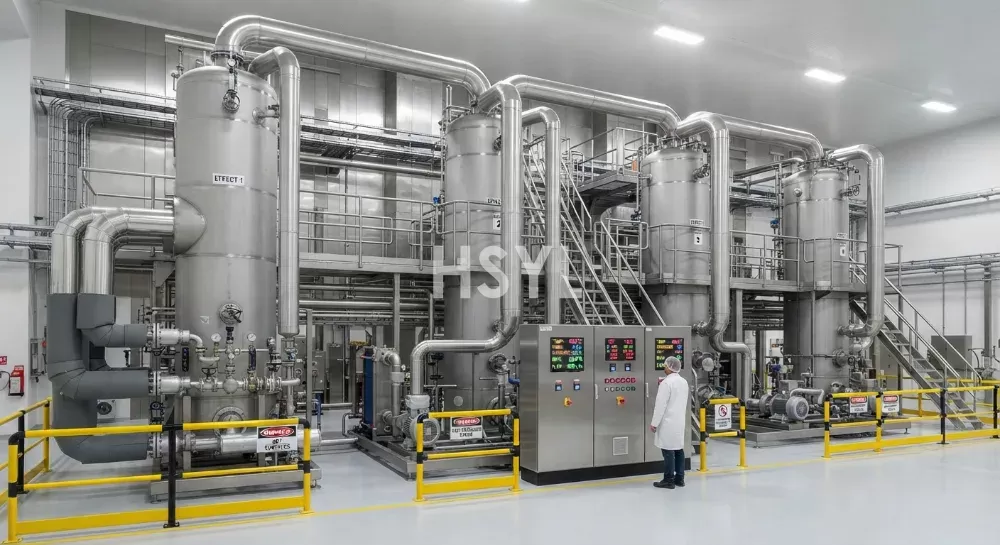
Tomato juice at 4.5–6.0°Brix enters the evaporator and is concentrated to the target final Brix — typically 28–30°Brix for hot-break paste (the global commodity standard, traded as "28–30°Brix hot-break tomato paste" in 200 L aseptic drums), or 36–38°Brix for products destined for specific customers. The most common evaporator configuration for tomato paste is the forced-circulation multi-effect evaporator, typically with three or four effects operating at progressively lower pressures and temperatures. A three-effect evaporator with the first effect operating at 70–75°C, the second at 55–60°C, and the third at 40–45°C under vacuum, achieves a steam economy of approximately 2.5–3.0 kg of water evaporated per kg of steam consumed. A four-effect evaporator can achieve a steam economy of 3.5–4.0, and a five-effect evaporator with thermal vapor recompression (TVR) or mechanical vapor recompression (MVR) can achieve 5.5–7.0 — but with higher capital cost and a longer payback period.
The evaporator is the most energy-intensive operation and the control point for paste quality. Overheating the product — particularly in the later effects where the solids concentration is high and the heat-transfer surface can foul with burned-on solids — produces a cooked flavor and a brown color that reduce the paste grade from "extra" to "standard." The residence time in each effect, the product-side heat-transfer coefficient, and the cleaning frequency (every 72–96 hours of continuous operation for forced-circulation evaporators) are the parameters that determine both the product quality and the line uptime. For the CIP methodology used on tomato evaporators, see the guide on CIP systems for canning lines.
A4. Paste Filling and Packaging
Hot tomato paste — at 28–30°Brix and approximately 60–70°C after the final evaporator effect — is pumped to the filling station. The filling method depends on the package format:
- Canned tomato paste: paste is filled into cans (typically 70 g, 140 g, 210 g, 400 g, or 800 g net weight for retail; #10 cans / 3 kg for food service) through a piston filler that handles the high viscosity of the paste. After filling, the can is seamed and retort-sterilized. Because tomato paste is an acid product (pH 4.0–4.3 at 28°Brix), the sterilization requirement is pasteurization at 100°C rather than pressure retort — the low pH prevents C. botulinum spore germination, and the heat treatment targets vegetative spoilage organisms (lactic acid bacteria, yeasts, molds) and pectolytic enzymes that could cause viscosity loss during shelf life.
- Aseptic bag-in-drum: for industrial tomato paste sold as an ingredient to remanufacturers, the paste is sterilized in a tubular or scraped-surface aseptic sterilizer, cooled to 30–35°C in an aseptic cooler, and filled into pre-sterilized 200–220 L aseptic bags inside steel drums or 1,000 L IBC totes inside a sterile filling chamber. Aseptic filling is the dominant packaging format for industrial tomato paste because it (a) avoids the thermal over-processing that occurs in small cans during retort come-up, (b) reduces packaging cost per kg of paste versus small cans, and (c) extends the unopened shelf life to 18–24 months at ambient temperature without the need for refrigerated storage. The aseptic filling system must be validated by a thermal process authority, and every bag must be tested for seal integrity before release — a pinhole leak in a 200 L aseptic bag results in spoilage of the entire bag within days.
- Sachets and flexible packaging: single-serve sachets (70 g) and stand-up pouches (200–500 g) are filled on form-fill-seal machines with integrated paste dosing. The sachet material is typically a laminate of polyester, aluminum foil, and polyethylene that provides an oxygen and light barrier, extending the shelf life versus a plain polyethylene pouch. Sachet lines run at higher speeds than can lines — 200–300 pouches per minute — and the filler must deliver an accurate dose of a viscous, sticky product at that speed without stringing or dripping, which would contaminate the seal area and cause seal failures.
Path B: Whole Peeled Tomato Canning
Whole peeled tomatoes are the premium canned tomato product — they command the highest price per kg and have the strictest quality specifications. The process is labor-intensive and equipment-intensive because every tomato must be peeled individually, and any residual skin in the can is a quality defect that lowers the product grade.
B1. Peeling
Whole tomatoes are peeled by one of two methods:
- Steam peeling: the dominant method for volume production. Tomatoes pass through a steam chamber on a conveyor; saturated steam at 100–150 kPa condenses on the cold tomato surface, rapidly heating the skin and a thin layer of flesh immediately beneath it. The tomatoes then pass through a vacuum chamber (or a mechanical pinch-roller) that removes the loosened skin. Steam peeling time is 15–45 seconds depending on the tomato variety, maturity, and size. The peel removal rate — the percentage of tomatoes that exit the peeler fully peeled — must exceed 95% for a Grade A (Fancy) pack. Under-peeled tomatoes (residual skin patches) must be removed by operators on the inspection belt downstream and either re-peeled manually or diverted to the diced-tomato line.
- Lye peeling: immersion in a 10–20% sodium hydroxide (NaOH) solution at 90–100°C for 20–60 seconds, followed by a high-pressure water spray that removes the chemically loosened skin and neutralizes the residual lye. Lye peeling produces a smoother surface on the peeled tomato and a slightly higher yield than steam peeling because less flesh is removed with the skin. It requires a lye recovery or neutralization system to treat the wastewater, and the lye concentration and temperature must be precisely controlled — too strong or too long produces a slimy surface texture and excessive flesh loss; too weak or too short produces under-peeling. Lye peeling is less common in new installations than steam peeling due to the chemical handling and wastewater treatment requirements, but it remains in use in older factories and in factories where the tomato variety does not peel well with steam alone.
B2. Coring, Sorting, and Can Filling
After peeling, each tomato passes over an inspection belt where operators remove the stem scar (the core) with a small knife or a mechanical coring tool mounted at each operator station. The cored, peeled tomatoes are then graded by size and visual quality. Grade A (Fancy) requires whole or almost-whole tomatoes, uniform in color (red, without yellow or green patches), free from blemishes, cracks, and residual skin. The tomatoes are packed into cans by hand — an operator at each can position places whole tomatoes into the can, orienting them to maximize the number of whole tomatoes visible through the can top. This is the most labor-intensive operation on the entire tomato canning line, with 12–18 operators per packing line. Robotic vision-guided pick-and-place systems are emerging as a replacement for hand packing, but adoption is limited by the complexity of handling soft, irregularly shaped whole tomatoes without bruising.
After the solid fill, the can is topped up with tomato juice or purée (the "packing medium") — typically the juice expressed during the peeling and coring stages, screened to remove seeds and skin fragments, and heated to 85–90°C before dosing. The packing medium fills the void spaces between the whole tomatoes and provides the liquid portion of the can contents. The ratio of drained tomato weight to net can weight is a regulated parameter — under US FDA standards, canned whole tomatoes must have a minimum drained weight of 50% of the water capacity of the can, and the actual drained weight must be stated on the label.
B3. Seaming and Pasteurization
Filled and topped-up cans proceed through the seamer and then to pasteurization. Canned whole peeled tomatoes are pasteurized at 100°C in atmospheric steam or hot water because the product pH of 4.0–4.4 is below the 4.6 threshold for C. botulinum growth. Pasteurization time is 25–45 minutes at can center temperature, depending on the can size. Calcium chloride (CaCl₂) at 0.1–0.2% is commonly added to the packing medium as a firming agent — it crosslinks the pectin in the tomato tissue, reducing the softening that occurs during pasteurization and giving the finished product a firmer texture that survives the heating and distribution.
Path C: Diced Tomato Canning
Diced tomatoes are the fastest-growing canned tomato category in many markets, driven by the convenience of pre-diced product for food service and home cooking. The process shares the receiving, washing, and sorting infrastructure with the paste and whole-peeled lines, diverging after sorting:
C1. Dicing
Washed, sorted whole tomatoes — which for diced production are typically firmer, slightly less ripe fruit than those used for paste — are fed into a mechanical dicer. The dicer uses a two-stage cutting mechanism: first, a series of circular knives slice the tomato into slabs of the target thickness (typically 10 mm, 15 mm, or 20 mm depending on the customer specification); second, a cross-cut knife grid dices the slabs into cubes. The dicer must be kept sharp — dull knives crush the tomato tissue rather than cutting it cleanly, producing ragged edges, excessive juice loss, and a mushy texture that does not meet the drained-weight specification. Blade sharpening or replacement every 4–6 hours of operation is standard.
C2. Draining and Calcium Treatment
Diced tomatoes release juice (serum) during and after cutting. The dice are passed over a vibrating dewatering screen to remove the free juice, which is collected and can be concentrated into purée or paste as a co-product. After dewatering, the dice are treated with a calcium chloride solution (0.3–0.5% CaCl₂ w/w of the dice weight) by immersion or spray. The calcium ions crosslink the pectin in the tomato cell walls, increasing the firmness of the dice and reducing the softening that occurs during the subsequent thermal process. Without calcium treatment, canned diced tomatoes lose their cube shape during pasteurization and shelf life, becoming a mush that fails the drained-weight and visual-appearance specifications.
C3. Filling, Seaming, and Pasteurization
The calcium-treated dice are filled into cans — typically by a volumetric filler for diced products, as the dice are free-flowing and do not require the hand-pack placement of whole peeled. The can is topped up with tomato juice or a seasoned sauce (for products such as "diced tomatoes with basil and garlic"), seamed, and pasteurized at 100°C. The drained-weight specification for diced tomatoes is typically 55–65% of the net can weight — higher than for whole peeled because the dice pack more densely than whole tomatoes and less packing medium is needed to fill the void spaces.
Path D: Tomato Sauce and Crushed Tomato Canning
Tomato sauce and crushed tomatoes are intermediate products between paste and whole/diced — they use a simpler process with fewer unit operations, and they are typically produced from the tomatoes that are not suitable for whole-peeled or diced due to size, shape, or minor defects.
- Crushed tomatoes: washed and sorted tomatoes are crushed through a coarse screen (typically 12–15 mm apertures) that retains the seeds while passing the pulp and skin fragments. The crushed pulp is heated to 90–95°C in a tubular heat exchanger to inactivate enzymes, hot-filled into cans, seamed, and pasteurized. Crushed tomatoes are the simplest canned tomato product — the line consists of a crusher, a screen, a pre-heater, a filler, a seamer, and a pasteurizer, with no evaporation, no peeling, and no dicing.
- Tomato sauce: crushed or puréed tomatoes are concentrated to the target Brix (typically 8–12°Brix for a cooking sauce, thicker than single-strength juice but thinner than paste), seasoned with salt, sugar, herbs, and spices in a batching tank, heated, filled, seamed, and pasteurized. The sauce line adds a batching/cooking tank and a herb-and-spice dosing system to the crushed-tomato equipment set.
Equipment Summary Table
| Process Stage | Recommended Equipment | Product Applicability | Standard / Optional | Key Specification Input |
|---|---|---|---|---|
| Receiving | Flume system with recirculation, sand trap, rotary screen | All products | Standard | Peak daily receiving tonnage; flume gradient |
| Washing | Spray washer with chlorinated water system | All products | Standard | Water pressure; chlorine residual target |
| Sorting | Inspection belt with optional optical sorter | All products | Standard (manual); Optional (optical) | Defect tolerance; labor cost; belt speed |
| Crushing (paste path) | Hammer mill or rotary crusher | Paste only | Standard | Target particle size; throughput |
| Hot-break pre-heating | Shell-and-tube or scraped-surface heat exchanger | Paste (hot-break) only | Standard for hot-break paste | Target pre-heat temperature; residence time |
| Pulping/finishing | Paddle pulper with interchangeable screens | Paste only | Standard | Screen aperture size; pulp fineness |
| Evaporation | Multi-effect forced-circulation evaporator (3–5 effects) | Paste only | Standard | Inlet Brix; target Brix; steam economy target |
| Paste filling (cans) | Piston filler, seamer, pasteurizer | Paste (canned format) | Optional — only for canned paste | Can size; fill weight; line speed |
| Paste filling (aseptic) | Aseptic sterilizer, aseptic bag filler, seal tester | Paste (industrial format) | Optional — only for aseptic bulk | Bag size; sterilizer type; fill temperature |
| Peeling (whole peeled) | Steam peeler (or lye peeler) | Whole peeled only | Standard | Peel removal rate; tomato variety |
| Coring and hand-pack | Inspection/coring belt, manual pack stations | Whole peeled only | Standard | Operator count; can size; grade specification |
| Dicing | Mechanical dicer with dewatering screen | Diced only | Standard | Dice size; blade change interval |
| Calcium treatment | Immersion or spray system with CaCl₂ dosing | Diced (optional for whole peeled) | Standard for diced | CaCl₂ concentration; contact time |
| Seaming and pasteurization | Seamer, atmospheric pasteurizer | Whole peeled, diced, sauce | Standard | Can size; pasteurization time; cooling rate |
For broader procurement considerations across canning categories, see the canning line procurement guide. For the common thermal process science that underpins pasteurization of acid tomato products, consult the canned food thermal process control guide.
Quality Parameters by Product Category
| Product | Key Quality Parameter | Specification Range | Measurement Method | Process Control Point |
|---|---|---|---|---|
| Tomato paste (hot-break, 28–30°Brix) | Brix | 28.0–30.0°Brix | Refractometer (20°C, corrected for temperature) | Evaporator discharge; inline refractometer with feedback to steam valve |
| Tomato paste (hot-break, 28–30°Brix) | Bostwick consistency | 4–8 cm/30s (12°Brix dilution) | Bostwick consistometer at 20°C | Post-evaporator sample; adjusts with finisher screen size |
| Tomato paste (hot-break, 28–30°Brix) | Hunter a/b color ratio | ≥ 1.8 (premium); ≥ 1.6 (standard) | HunterLab colorimeter | Post-evaporator; darker color indicates overheating in evaporator |
| Tomato paste (hot-break, 28–30°Brix) | Howard mold count | ≤ 40% positive fields (USDA Grade A) | Microscopic mold count (AOAC 945.89) | Receiving inspection; moldy raw material must be rejected or diverted |
| Whole peeled tomatoes | Drained weight | ≥ 50% of can water capacity | USDA drained-weight procedure | Fill weight of tomatoes and liquid; filler calibration |
| Whole peeled tomatoes | Wholeness | ≥ 90% whole or almost-whole (Grade A) | Visual inspection of opened cans | Hand-pack quality; operator training; tomato variety |
| Whole peeled tomatoes | Skin residue | ≤ 3.5 cm² skin per kg drained weight | Visual inspection under 540 lux light | Peeling efficiency; inspection belt operators |
| Diced tomatoes | Drained weight | 55–65% of net weight | USDA drained-weight procedure | Fill weight; calcium treatment; dewatering screen |
| Diced tomatoes | Dice size distribution | ≥ 80% within target size range | Sieve analysis (dry) | Dicer blade condition; tomato firmness at receiving |
Utility Requirements
The utility demand on a tomato canning line is dominated by the evaporator for paste production. The following are order-of-magnitude figures for planning; exact values must be calculated per project:
- Steam: the evaporator is the largest steam consumer. A three-effect evaporator producing 3.5–5.0 tons/hour of 30°Brix paste from 5°Brix juice consumes approximately 5,000–7,000 kg of steam per hour at 6–8 bar. The hot-break pre-heater adds approximately 800–1,200 kg/h. The total steam demand drives the boiler specification — a tomato paste line cannot operate on a boiler sized for a general vegetable canning line that does not include an evaporator.
- Water: the flume system, spray washer, and evaporator condenser are the largest water consumers. The evaporator condenser — which condenses the water vapor produced by the evaporation — requires cooling water at a flow rate that depends on the condenser type (direct-contact barometric condenser vs. surface condenser with cooling tower). A barometric condenser consumes 50–70 m³/h of cooling water per ton of water evaporated; a surface condenser with a cooling tower recirculates most of this water but has higher capital cost. The water consumption per ton of raw tomato processed is 3–5 m³/ton for a factory with water recirculation on the flume and washer.
- Electricity: the evaporator's circulation pumps, the vacuum pump, and the can conveyors are the largest electrical loads. The connected electrical load for a 20 ton/hour tomato paste line is approximately 400–600 kW, with the evaporator circulation pumps accounting for approximately 40–50% of this total.
- Wastewater: tomato processing produces high-BOD wastewater from the flume overflow, the washer discharge, the evaporator condensate, and the CIP wash water. The flume water, after recirculation and screening, carries dissolved sugars and organic acids — BOD typically 500–1,500 mg/L. The evaporator condensate, if not recirculated, is a high-volume, low-BOD stream (50–200 mg/L) that can be used for flume make-up water or sent to the cooling tower. The total wastewater volume per ton of raw tomato is 2–4 m³/ton, and the factory must have either an on-site wastewater treatment plant or a municipal discharge agreement with a surcharge rate for the BOD load during the harvest season.
Planning Inputs Required for Equipment Specification
Before a tomato canning line can be specified, the following must be confirmed:
- Product mix: paste (hot-break or cold-break), whole peeled, diced, crushed, and/or sauce. For each product: the annual tonnage, the can size or packaging format, and the target market.
- Harvest-season duration in weeks and the peak daily receiving tonnage.
- Average and peak Brix of the incoming tomatoes — this determines the evaporator's water-removal duty per ton of paste output.
- Hot-break or cold-break process decision, and whether the factory needs to run both (which requires two separate pre-heater and finisher circuits).
- Paste packaging format: small cans (retail), #10 cans (food service), aseptic bag-in-drum (industrial), or a combination.
- Target paste Brix and viscosity (Bostwick) specification.
- Available utilities at the factory site: steam capacity and pressure, cooling-water availability and temperature, electrical supply, and wastewater treatment capacity.
- Target food safety certifications and the relevant regulatory framework (FDA 21 CFR 113, 114, or 108/113 for aseptic).
- Automation level: manual sorting and hand-pack, semi-automatic, or fully automatic with optical sorting.
Conclusion
A tomato products canning line is an evaporator-driven operation. The evaporator consumes the majority of the capital, the steam, the water, and the engineering attention. The hot-break vs. cold-break decision — made before any equipment is ordered — determines the pre-heater, the finisher, the evaporator performance, and the paste viscosity. The four product paths (paste, whole peeled, diced, and sauce/crushed) share the receiving, washing, and sorting infrastructure but diverge entirely after sorting — a factory that intends to produce multiple product categories must install parallel downstream lines or accept changeover time and the associated production loss. Whole peeled remains the highest-value, most labor-intensive product; paste is the commodity-volume product where evaporator efficiency determines the factory's profitability; diced is the growth category where calcium treatment and dicer maintenance determine product quality. For product-specific line references within the vegetable category, see the green bean canned food production line and the broader canned beans production line. For the canning factory equipment procurement framework, see the canning line procurement guide. When ready to specify a tomato line, prepare the planning inputs listed above and contact the engineering team.
Frequently Asked Questions
What is the difference between hot-break and cold-break tomato processing?
Why does tomato paste require an evaporator when other canned vegetables do not?
Can a tomato line produce both paste and whole peeled tomatoes?
How is tomato paste quality measured?
What is the purpose of calcium chloride in canned whole peeled and diced tomatoes?
Why is aseptic bag-in-drum filling used for industrial tomato paste?
What causes black specks in tomato paste and how are they prevented?
How do I calculate the evaporator capacity needed for a tomato paste line?
Related Articles




Get professional consultation
Do you have any questions or need technical support regarding the content of this article? Fill out the form below, and our expert team will provide you with professional solutions.