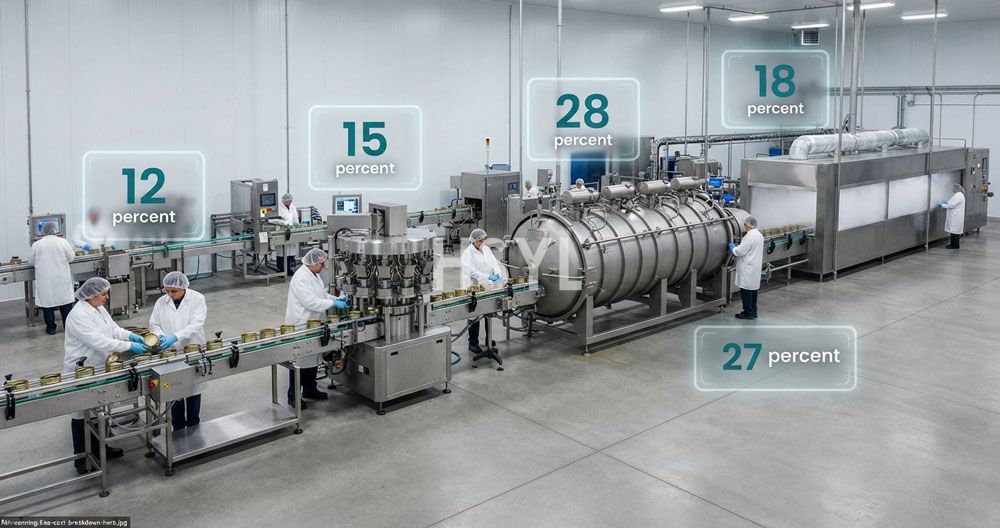
When investors and plant managers request a fish canning line quotation, the number that arrives in the proposal email typically represents 40 to 55 percent of the final project budget. The remaining 45 to 60 percent — facility preparation, utility infrastructure, thermal process validation, working capital, commissioning, and the hidden cost drivers that emerge during construction — determines whether the project completes on budget or requires mid-project capital injection. Yet most cannery budget approvals are based on the equipment quotation alone, with facility and validation costs treated as secondary line items discovered after the equipment deposit is already paid.To maximize machinery ROI during off-peak fishery seasons, evaluate processing schedules in our guide on seasonal fish canning and year-round line utilization.
This guide decomposes the complete cost structure of a fish canning line project into six categories, identifies the cost drivers within each category that have the largest impact on final budget, and provides a framework for evaluating whether a quoted equipment price represents genuine value or merely a low entry point that will be recovered through change orders and optional accessories during commissioning. The framework applies to tuna, sardine, mackerel, salmon, and mixed-species canning operations producing between 5,000 and 80,000 cans per day, whether supplied as turnkey installations or as equipment packages integrated with locally sourced facility infrastructure. For integrated production line planning that addresses cost from the facility design stage, see HSYL's food processing line solutions overview.
The cost analysis methodology does not require access to proprietary supplier pricing — it requires understanding which cost categories exist, what percentage of total budget each category typically represents, and which cost drivers within each category offer the greatest opportunity for value engineering without compromising food safety or operational capability. The methodology is equally applicable to buyers evaluating competing supplier proposals and to investors assessing the financial feasibility of a new cannery project before committing capital.
1. The Real Cost Structure: Equipment Is Less Than Half the Total
Equipment list price is the most visible cost component because it arrives as a single quotation document with itemized prices per machine. This visibility creates a systematic budgeting error: buyers treat the equipment quotation as the project budget and allocate remaining funds loosely across "installation and other costs." In practice, the six cost categories below each represent material percentages of total project cost, and underestimating any one category forces capital rationing during construction that compromises project quality.
| Cost Category | Typical % of Total Project | What It Includes | Common Budgeting Error |
|---|---|---|---|
| Equipment Capital | 40 to 55% | Filling, seaming, retort, cooling, conveying, control system, inspection equipment delivered to site | Treating equipment quotation as total project cost; omitting spare parts and commissioning support from equipment negotiation |
| Facility Preparation | 15 to 22% | Building modification or new construction, floor reinforcement, drainage, floor slope, wall finishes, ceiling, lighting, doors | Underestimating floor reinforcement for heavy retort vessels and refrigeration loads; omitting food-grade wall and floor finish requirements |
| Utility Infrastructure | 12 to 18% | Steam generation, compressed air, electrical supply upgrade, water treatment, cooling tower or chiller, wastewater treatment | Treating utilities as "existing facility" without verifying capacity; omitting cooling water treatment and wastewater organic load handling |
| Validation and Compliance | 5 to 10% | Process authority fees, F0 validation studies, heat distribution testing, regulatory filing, HACCP plan development, third-party audit | Treating validation as post-commissioning formality rather than pre-production cost; omitting process authority fees from initial budget |
| Working Capital and Inventory | 8 to 12% | Raw material inventory build, packaging material inventory, finished goods inventory during distribution ramp, spare parts inventory | Omitting 60 to 90 day raw material and packaging inventory required before first commercial production run |
| Commissioning and Training | 4 to 8% | Supplier commissioning engineers, operator training, recipe development, trial production runs, waste during commissioning | Compressing commissioning timeline to start production sooner; underbudgeting trial production waste and operator training hours |
Budget Allocation Rule: If your equipment quotation represents more than 60 percent of your approved project budget, the project is underfunded. The remaining five categories collectively require 45 to 60 percent of equipment cost, and compressing them to fit a constrained budget compromises food safety (validation), operational reliability (utilities), or production capability (working capital). Build the total project budget first, then negotiate equipment scope to fit within the equipment capital allocation — not the reverse.
2. Equipment Cost Drivers: Where the Capital Actually Goes
Within the equipment capital category, four equipment groups dominate the quotation. Understanding the cost driver within each group helps buyers evaluate whether a lower quotation represents genuine value or a specification compromise that will surface as operational problems after commissioning.
Retort Sterilization Battery: 25 to 35% of Equipment Cost
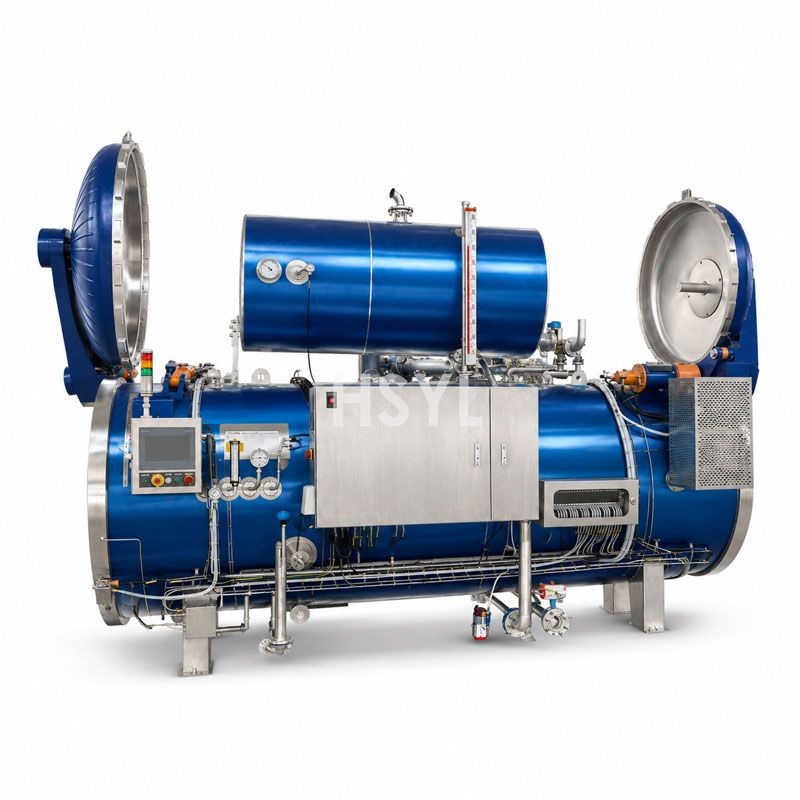
The retort battery is typically the single most expensive equipment group in a fish canning line. Cost drivers include vessel diameter and length (which determine cans per batch), heating medium technology (water immersion, steam-air, water spray, or rotary), number of vessels operating in parallel, and automation level of basket handling and control systems. A single batch retort vessel with manual basket handling may cost 40 to 60 percent less than an equivalent-capacity vessel with automatic basket loading and PLC-controlled process execution, but the labor cost differential and cycle time inconsistency of manual operation typically erode the capital savings within 18 to 30 months of operation.
Continuous retort systems represent a step-change in capital cost — typically 3 to 6 times the cost of an equivalent-capacity batch retort battery — but deliver substantially higher throughput per square meter of floor space and lower labor cost per can processed. The continuous retort capital premium is justified only at sustained daily output above 60,000 to 80,000 cans with limited SKU variety; below this threshold, batch retort with staggered multi-vessel scheduling delivers lower total cost of ownership.
Can Seaming Equipment: 12 to 18% of Equipment Cost
Can seamer cost scales non-linearly with throughput capacity. Doubling the rated cans per minute typically increases seamer price by 2.5 to 4 times, because higher speeds require heavier spindle construction, more precise dynamic balancing, faster vacuum pump cycling, and increasingly sophisticated control systems. The economic imperative is to buy enough speed to avoid being the line bottleneck, but not so much that capital sits idle while the retort governs actual throughput. For most small and medium fish canneries, a rotary automatic seamer rated 60 to 150 cans per minute provides sufficient capacity at a capital cost 40 to 60 percent below high-speed in-line integrated seaming systems rated above 300 cans per minute.
Filling Equipment: 10 to 15% of Equipment Cost
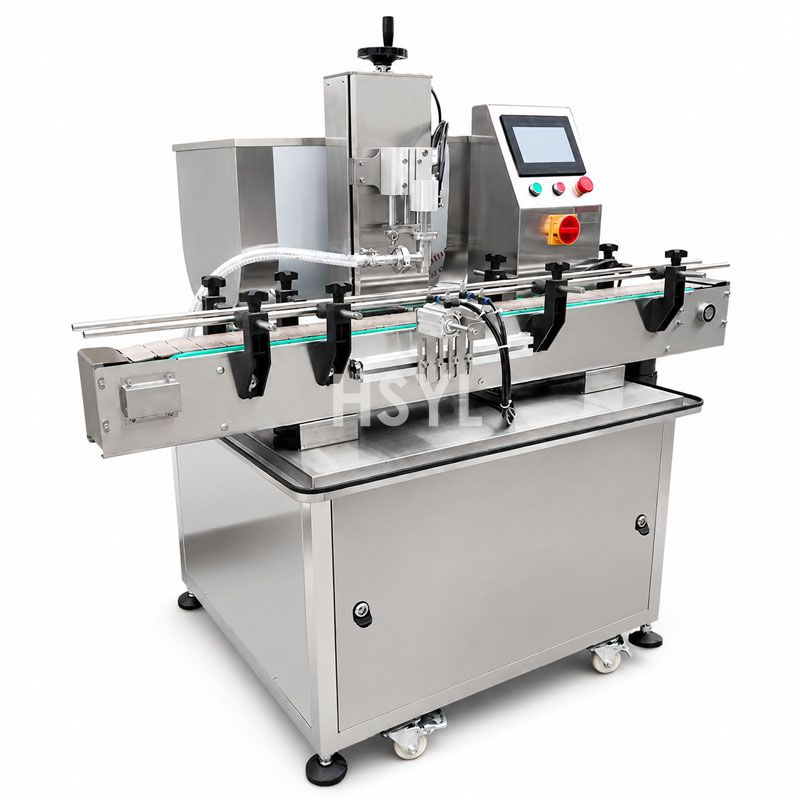
Fish canning filling equipment cost depends on product format (chunk, solid pack, minced), automation level (manual, semi-automatic, fully automatic), and fill weight accuracy requirement. Manual filling stations with operator placement remain common for premium sardine and specialty tuna products where visual presentation justifies labor cost. Volumetric piston fillers for chunk tuna represent the mid-range capital tier. Weight-controlled solid pack fillers with servo-driven trimming mechanism represent the premium tier, justified only for products graded by minimum solid meat content where fill accuracy directly affects grade qualification.
Pre-Processing Equipment: 15 to 25% of Equipment Cost
Pre-processing equipment — thawing tanks, washing and grading conveyors, heading and gutting machines, butchering tables, loin cutting machines, pre-cooking cabinets, brining tanks — collectively represents a substantial equipment capital category that varies dramatically by species. Tuna canning requires large-scale pre-cooking infrastructure representing 20 to 30 percent of total equipment capital. Sardine canning skips pre-cooking entirely, replacing it with simpler brining tanks representing 3 to 8 percent of equipment capital. This single category difference explains much of the capital cost gap between tuna and sardine canning lines of equivalent daily output. For species-specific line configurations and their cost implications, see the tuna canned production line and sardine canning production line solution pages.
3. Facility Preparation Costs: The Hidden 15 to 22 Percent
Facility preparation costs are the most consistently underestimated category in fish canning line budgets. Equipment quotations arrive with dimensioned footprints and utility connection requirements, but the building modifications required to receive the equipment are rarely quantified until construction begins. Five facility preparation cost components are routinely underbudgeted:
Floor Reinforcement and Slope
Retort vessels filled with product, water, and basket mass weigh 2 to 8 tonnes per vessel. Walk-in freezers filled with frozen raw material add 500 to 1,500 kilograms per square meter of floor load. Existing facility floors designed for light commercial use typically cannot support these loads without reinforcement. Floor reinforcement for a medium-scale cannery (20,000 to 40,000 cans per day) typically costs $15,000 to $60,000 depending on existing slab condition and required load capacity. Food-grade floor slope of 1/4 inch per foot toward floor drains must be cast into the concrete slab; retrofitting floor slope by applying epoxy overlay costs 2 to 4 times more than casting slope into new construction.
Drainage and Wastewater
Fish canning generates wastewater with high organic load from blood, oil, and protein residues. Municipal sewer systems may not accept this wastewater without pretreatment. On-site wastewater pretreatment — fat trap, screening, flow equalization, biological treatment for high organic load — typically costs $20,000 to $150,000 for a medium-scale cannery depending on discharge volume and local regulatory limits. Omitting wastewater pretreatment from initial facility budget and discovering the requirement during commissioning forces emergency installation at premium cost and may delay production start by 4 to 12 weeks.
Wall and Ceiling Finishes
Food production areas require washable, non-toxic, non-shedding wall and ceiling finishes that withstand daily chemical cleaning and high-pressure washdown. Epoxy wall coating, PVC wall panels, or stainless steel cladding cost $8 to $35 per square meter depending on material and finish quality. Suspended ceilings with washable panels and coved transitions between wall and ceiling cost $15 to $45 per square meter. For a 500 square meter cannery, wall and ceiling finish costs typically total $25,000 to $80,000 — a category frequently omitted from initial budgets that assumed standard commercial building finishes would suffice.
Ventilation and Exhaust Ductwork
Pre-cooking equipment, retort vessels, and cooling tunnels all generate heat, steam, and moisture that must be removed through dedicated exhaust ductwork. Type I hoods over grease-producing equipment require stainless steel ductwork routed through fire-rated shafts to roof-mounted exhaust fans. Steam exhaust from retort vessels requires separate stainless steel ductwork sized for peak steam release during cooling phase. Total ductwork and fan cost for a medium-scale cannery typically ranges from $20,000 to $80,000 depending on roof penetration complexity and horizontal duct runs.
Compressed Air and Process Water Piping
Compressed air distribution piping (stainless steel or copper, not plastic which sheds particles) and process water piping (stainless steel for food contact, galvanized for non-contact) must be routed from utility sources to each equipment connection point. Piping installation cost depends on route complexity, number of connection points, and pipe material. For a medium-scale cannery with 15 to 25 equipment connection points, piping installation typically costs $12,000 to $45,000.
Facility Cost Reality: For a fish canning line with $800,000 in equipment capital, expect facility preparation costs of $150,000 to $250,000 — not the $30,000 to $50,000 that buyers frequently estimate by treating facility preparation as minor building modification. The facility cost percentage is highest when repurposing an existing building that was not originally designed for food production, because the cost of removing and replacing non-compliant finishes often exceeds the cost of new construction. Greenfield construction on an empty site allows facility preparation to be engineered as a single integrated package, typically reducing cost by 15 to 25 percent compared to retrofit. For facility-level cost and layout planning, see the fish canning factory layout engineering design guide.
4. Utility Infrastructure: Power, Steam, Water and Air
Utility infrastructure costs are driven by the equipment specified in the canning line, but the utilities themselves are purchased and installed separately from the equipment. Buyers who focus on equipment price negotiation without verifying utility capacity in their facility frequently discover during commissioning that the quoted equipment cannot operate at rated capacity because steam supply, electrical capacity, or cooling water infrastructure is insufficient.
Steam Generation
Steam is the largest utility cost for fish canning operations that include pre-cooking (tuna) or retort sterilization (all low-acid canned fish). A medium-scale tuna cannery producing 30,000 cans per day requires 1,500 to 3,500 kilograms per hour of steam during peak pre-cooking and retort cycles. Industrial steam boiler capacity of this scale, including installation, stack, feedwater system, and condensate return, typically costs $80,000 to $250,000 depending on fuel type (gas, diesel, electric), boiler efficiency, and local emission control requirements. Sardine canneries without pre-cooking require substantially less steam (500 to 1,200 kilograms per hour) and correspondingly lower boiler capital.
Electrical Supply
Fish canning line electrical connected load ranges from 90 kW for a small sardine line to 350 kW for a medium-scale tuna line with automated filling and large retort battery. Existing facility electrical service is frequently insufficient and requires upgrade including transformer capacity, main distribution panel, motor control centers, and dedicated circuits for high-load equipment. Electrical upgrade cost depends on utility company connection fees, transformer size, and route distance from utility point of connection to cannery distribution panel. Typical upgrade cost for a medium-scale cannery: $25,000 to $120,000.
Compressed Air
Pneumatic equipment — automatic seamer lid dispensers, retort door actuators, pneumatic filling valves, conveying systems — requires compressed air at 6 to 7 bar with food-grade quality (dry, oil-free, filtered). Compressed air system cost including compressor, air dryer, receiver tank, filtration, and distribution piping typically costs $15,000 to $50,000 for a medium-scale cannery. Oil-free compressors cost 40 to 80 percent more than lubricated compressors but eliminate the risk of oil contamination in food contact areas — a non-negotiable requirement for food safety compliance.
Cooling Water
Retort cooling phase consumes 15 to 50 cubic meters per hour of cooling water per vessel during the 15 to 30 minute cooling cycle. In warm climates or summer operation, recirculating chiller systems are required to achieve cooling water temperature below 20 degrees Celsius. Chiller system cost including chiller unit, cooling tower, recirculation pumps, and water treatment typically costs $30,000 to $120,000 for a medium-scale cannery. Without adequate cooling water capacity, retort cycle times extend by 15 to 25 percent, silently reducing daily throughput.
5. Validation and Compliance: The Non-Negotiable 5 to 10 Percent
Thermal process validation is not an optional formality — it is a regulatory and food safety requirement that determines whether your canned fish products can be legally sold in target markets. Validation costs are frequently omitted from initial project budgets because they are not equipment costs, but they must be completed before commercial production can begin. Compressing or skipping validation to save cost creates legal liability and food safety risk that no equipment savings can justify.
Process Authority Fees
A recognized process authority must develop and validate the thermal process specification (F0 value, retort temperature, hold time, come-up time, cooling parameters) for each product-container combination. Process authority fees typically range from $3,000 to $15,000 per product-process combination depending on product complexity, container size range, and jurisdiction of regulatory filing. A cannery launching with 3 product variants in 2 can sizes should budget $18,000 to $90,000 for process authority fees alone.
Heat Penetration and Distribution Studies
Heat penetration testing instruments sample cans with thermocouples positioned at the geometric center (slowest-heating point) of the most challenging product variant. A complete heat penetration study for a single product-container combination typically requires 15 to 50 instrumented test runs across multiple can positions and retort load configurations, costing $8,000 to $35,000 per combination. Heat distribution testing verifies temperature uniformity across all positions within the retort vessel, adding $3,000 to $12,000 per vessel configuration.
Regulatory Filing and Third-Party Audit
Depending on target market, regulatory filing fees and third-party audit costs add $5,000 to $25,000 per market. US FDA registration and low-acid canned food (LACF) process filing, EU export health certificate, Halal certification, BRCGS or IFS food safety audit — each carries its own fee structure and timeline. Budget for regulatory filing as a parallel cost track alongside equipment installation, not as a post-commissioning afterthought.
6. Working Capital and Operational Costs Before Break-Even
Working capital is the funding required to operate the cannery from equipment commissioning through the point where cumulative revenue from product sales exceeds cumulative operational cost. For a new fish cannery, break-even typically occurs 12 to 30 months after commercial production begins, depending on market development speed, product mix, and distribution channel establishment. Working capital must fund 60 to 90 days of raw material inventory, packaging material inventory, finished goods inventory during distribution ramp, labor, energy, and spare parts before positive cash flow is achieved.
| Working Capital Component | Typical Days of Inventory | Cost Basis |
|---|---|---|
| Raw fish inventory (frozen or fresh) | 30 to 60 days | Daily raw material consumption × days × unit cost per kg |
| Empty can and lid inventory | 60 to 90 days | Daily can consumption × days × unit cost per can (minimum order quantities often force longer inventory) |
| Oil, sauce, brine ingredients | 30 to 45 days | Daily ingredient consumption × days × unit cost |
| Finished goods inventory before distribution | 15 to 45 days | Daily production volume × days × variable production cost per can |
| Spare parts inventory | Continuous | 2 to 4% of equipment capital value, replenished annually |
| Labor and energy during ramp | 3 to 6 months | Monthly labor and energy cost × months until break-even production volume reached |
For a medium-scale cannery producing 30,000 cans per day with break-even at 18 months, total working capital requirement typically ranges from $200,000 to $600,000 depending on raw material cost, product mix, and market development speed. This capital is not optional — without it, the cannery cannot sustain operations through the ramp period when production volume exceeds sales volume and inventory accumulates faster than revenue is collected.
7. Hidden Cost Drivers That Cause Budget Overruns
Beyond the six planned cost categories, five hidden cost drivers routinely cause 10 to 25 percent budget overruns on fish canning line projects. These cost drivers are not always visible in supplier proposals and frequently emerge only during construction or commissioning:
- Change orders during construction: Modifications to equipment specification, utility connection points, or facility layout discovered after construction begins typically cost 8 to 15 percent more than the same modifications priced during design. The cost premium reflects mobilization, demobilization, and schedule disruption rather than the technical scope of the change. Minimize change orders by completing detailed design review and utility verification before construction commitment.
- Commissioning delays: Each month of commissioning delay beyond the planned timeline costs $15,000 to $80,000 in extended supplier engineer presence, idle labor, facility overhead, and delayed revenue. Commissioning delays most frequently result from incomplete utility infrastructure, late delivery of packaging materials, or regulatory inspection scheduling. Build 2 to 4 months of commissioning contingency into the project timeline.
- Currency exchange fluctuation: Fish canning equipment is frequently sourced internationally, with quotation validity of 30 to 90 days. Between quotation acceptance and final payment (typically 6 to 12 months), currency exchange rates may move 5 to 12 percent. A 10 percent adverse currency movement on a $1 million equipment package adds $100,000 to final cost. Negotiate fixed-price contracts or purchase currency forwards to manage this risk.
- Shipping, customs, and inland transport: International equipment shipping (ocean freight, port handling, customs duties, inland transport to site) typically adds 3 to 8 percent to equipment cost. Customs duty rates vary by country and product classification; some countries impose 15 to 25 percent import duty on food processing equipment. Verify customs classification and duty rate before finalizing equipment budget, not after goods arrive at port.
- Spare parts and wear item inventory: Commissioning spare parts package (seamer rolls, retort seals, filler nozzles, filter elements, valve seats) typically costs 3 to 6 percent of equipment capital value. This is not optional — without commissioning spares, a single worn component can halt production for 2 to 6 weeks while a replacement is sourced internationally. Budget spares as a capital cost at project initiation, not as an operating expense discovered after commissioning.
8. Cost Optimization Without Compromising Food Safety
Cost optimization is legitimate and necessary — but it must target genuine waste without compromising the food safety, validation, or operational capability that determines long-term project success. The following optimization sequence reduces total project cost by 10 to 20 percent without creating food safety or compliance risk:
| Optimization Lever | Typical Cost Reduction | Risk Level | When to Apply |
|---|---|---|---|
| Phased capacity installation | 15 to 25% of initial capital | Low — preserves future expansion option | When demand growth is projected but not yet contracted; install semi-automatic equipment first with planned migration to automatic |
| Standard specification over custom engineering | 10 to 20% of equipment cost | Low — standard models are validated and field-proven | When product and can size requirements fit standard equipment specifications without custom modification |
| Competitive supplier bidding on equal specification | 8 to 15% of equipment cost | Low — provided specification is genuinely equivalent | When multiple qualified suppliers offer equivalent equipment; avoid using low-price supplier as leverage against preferred supplier |
| Local sourcing for facility and utility work | 15 to 30% of facility cost | Low — local contractors familiar with regional building codes | When facility preparation scope can be clearly specified and locally executed without specialized food production expertise |
| Shared utility infrastructure for multi-product facility | 10 to 20% of utility cost | Medium — requires careful scheduling discipline | When facility processes multiple product categories sharing steam, electrical, and cooling infrastructure |
Optimization Discipline: Never optimize cost by reducing validation scope, omitting spare parts inventory, compressing commissioning timeline, or downgrading food-grade material specifications. These four "optimizations" appear to save 5 to 15 percent of project cost during budgeting but create food safety risk, regulatory non-compliance, operational unreliability, and legal liability that costs multiples of the apparent saving to resolve. The correct optimization targets are equipment scope phasing, standard versus custom specification, supplier competition, and local facility work sourcing — all of which reduce cost without touching the non-negotiable foundations of food safety and operational capability.
9. Building a Defensible Total Project Budget
A defensible fish canning line project budget follows a structured sequence that prevents the common error of treating equipment quotation as project budget:
- Start with market and volume projection: Define daily, monthly, and annual production volume targets based on contracted or forecast sales, not equipment capacity. Volume determines equipment specification, which determines utility and facility requirements, which determine total cost. Starting with equipment capacity and hoping to find markets for the output inverts the correct sequence.
- Specify equipment based on validated product and process requirements: Confirm product formulations, can sizes, F0 process specifications, and target market regulatory requirements before requesting equipment quotations. Quotations based on assumed specifications produce change orders when actual requirements emerge during detailed design.
- Request itemized equipment quotations with utility and facility interface specifications: Each equipment quotation must include utility connection requirements (steam kg/h, electrical kW, compressed air Nm3/min, cooling water m3/h), equipment weight and floor load, and foundation requirements. Without these, facility and utility budgets cannot be estimated accurately.
- Build facility and utility budgets from equipment interface specifications: Use the utility and facility requirements from equipment quotations to scope facility preparation and utility infrastructure work. Obtain firm quotes from local contractors for facility work before finalizing project budget.
- Add validation, working capital, commissioning, and contingency as separate line items: Each of these categories has its own cost drivers and timeline. Do not fold them into a single "contingency" line — that hides the actual cost structure and prevents informed decision-making when trade-offs become necessary.
- Apply 10 to 15 percent project contingency to the total: Even with detailed planning, fish canning projects encounter unforeseen costs during construction and commissioning. A 10 to 15 percent contingency applied to the structured total (not added on top of an already-inflated budget) provides the financial buffer to absorb these costs without mid-project capital injection.
The result of this structured budgeting process is a total project cost that typically runs 1.8 to 2.4 times the equipment quotation value. If the structured total exceeds available capital, reduce equipment scope (phased capacity), simplify product mix, or revisit market projections — do not compress validation, working capital, or food safety infrastructure to fit an inadequate budget. A delayed or scaled-down project that maintains food safety integrity is preferable to a full-scope project that cuts corners on the non-negotiable foundations.
Related Canning Line Cost and Procurement Resources
The following resources address total cost of ownership, turnkey procurement, and automation investment decisions that connect directly to the cost framework described in this guide:
- Canning Line Procurement Guide: Optimizing TCO and OEE in Food Production — Total cost of ownership and overall equipment effectiveness methodology for evaluating canning line procurement decisions beyond initial equipment price, complementing the cost structure decomposition in this guide with the operational performance metrics that determine whether quoted equipment delivers expected lifetime value.
- Sourcing a Turnkey Fish Canning Plant: B2B Procurement Guide — Procurement methodology for buyers evaluating turnkey canning plant proposals, covering supplier qualification, scope definition, contract structure, and acceptance testing — the procurement-side decisions that determine whether the cost framework in this guide translates into a contract that protects the buyer's financial interest through commissioning and warranty periods.
- Small Scale Canning Line: When to Start Semi-Automatic Instead of Fully Automatic — Phased capacity investment decision framework that determines whether semi-automatic or fully automatic equipment configuration produces lower total cost of ownership for small to medium canning operations, directly applicable to the phased capacity optimization lever described in Section 8.
Frequently Asked Questions
What is the total cost of a fish canning line?
Why does fish canning equipment cost less than the total project budget?
How much does retort sterilization equipment cost for a fish cannery?
What hidden costs cause fish canning line budget overruns?
How much working capital does a fish cannery need before break-even?
How much does thermal process validation cost for canned fish?
Can I reduce fish canning line cost without compromising food safety?
How does tuna canning line cost compare to sardine canning line cost?
What contingency should I budget for a fish canning line project?
Related Articles



Get professional consultation
Do you have any questions or need technical support regarding the content of this article? Fill out the form below, and our expert team will provide you with professional solutions.