Direct Answer
A canned vegetables production line converts fresh or frozen vegetables into shelf-stable canned products through a sequence of washing, grading, size reduction, blanching, filling, brine or sauce dosing, seaming, and thermal processing. The line is defined by two engineering decisions that determine every downstream specification: whether the product is low-acid (pH above 4.6, requiring pressure retort at 116–121°C to achieve a minimum F₀ of 3.0 against Clostridium botulinum spores) or acidified (pH at or below 4.6, requiring pasteurization at 100°C or below). This classification is not a product-labeling formality — it governs the retort specification, the utilities budget, the factory steam capacity, and the regulatory filing path with the FDA under 21 CFR 113 (low-acid) or 21 CFR 114 (acidified). Get this classification wrong at the project-planning stage, and the resulting line will either be dangerously under-processed or wastefully over-engineered. This guide walks through the complete process flow, equipment at each stage, critical control points, capacity bottlenecks, and the plant-engineering inputs required to specify a canned vegetable line correctly.When configuring automated dosing units for heavy syrup, light brine, or purée media, review our canned fruit production line syrup control guide.
What Makes a Canned Vegetable Line Different from Other Canning Lines
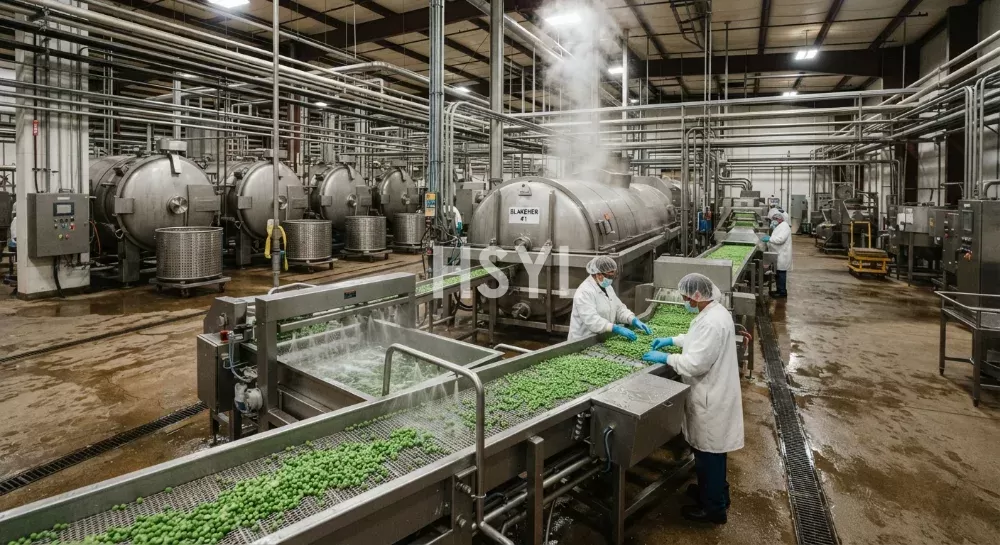
A canned vegetables production line processes living plant tissue that continues to respire after harvest. Unlike fish and meat — which can be frozen and stockpiled — most vegetables for canning arrive fresh during a harvest window that typically lasts 6 to 12 weeks per crop. The entire annual production volume must be processed during this window. This seasonal reality has three consequences that shape the line design:
- Line speed is driven by harvest throughput, not by year-round demand. A pea canning line that must process 5,000 tons of raw pods in a 6-week window needs a line capacity calculated against the peak daily harvest intake — not against the average daily sales volume spread across 12 months. Designing the line against average demand produces a factory that cannot process the harvest before it degrades.
- Raw material receiving and grading is the most equipment-intensive part of the line. Vegetables arrive with field heat, soil, stems, leaves, insect-damaged units, and an inherent size-and-maturity distribution that does not match the can. The receiving, washing, grading, and size-reduction stages consume more equipment, more floor space, and more labor than the filling-and-seaming stages that follow. A fish canning line puts its equipment density in the pre-cooking and filling zones; a vegetable canning line puts it in the washing and grading zones.
- Blanching is a process-defining step that has no equivalent in meat or fish canning. Blanching inactivates the peroxidase and catalase enzymes that cause off-flavors, color degradation, and nutrient loss during frozen storage and shelf life; removes tissue gases that would otherwise cause can corrosion and headspace loss; softens the tissue for proper can fill weight; and reduces the initial microbial load entering the thermal process. The blanching parameters — time, temperature, and whether the medium is water, steam, or microwave — must be established per vegetable variety and per cut size. A line designed without per-product blanching parameters produces vegetables that discolor and develop off-flavor within weeks of processing.
Raw Material Conditions: Why Vegetable Species Drive the Equipment List
The equipment configuration of a canned vegetables production line changes with the vegetable species in ways that a generic "vegetable canning line" specification cannot capture. The differences are material:
- Peas and green beans (Phaseolus vulgaris): arrive as whole pods. The line requires pod tipping and snipping, pod grading by diameter, and — for cut beans — cross-cutting to a specified length (typically 20–38 mm depending on can size). Peas require pod vining to extract the peas from the pod before the pea goes to the blancher. The viner is unique to pea canning and occupies a footprint comparable to the rest of the line combined if the factory processes fresh in-shell peas.
- Sweet corn (Zea mays): arrives as whole ears. The line requires husking, silking, and kernel cutting — three stages that are mechanically demanding and produce high volumes of waste (husks, cobs, and silks) that require continuous removal. Corn also carries a higher sugar content than most other vegetables (5–9% in standard sweet corn, higher in supersweet varieties), which affects both the blanching Maillard browning risk and the retort time.
- Carrots and root vegetables: arrive with soil attached. They require washing with high-pressure spray or drum washers, peeling — which in volume production uses steam peeling (500–800 kPa for 15–45 seconds depending on diameter) followed by a brush peeler to remove the loosened skin, rather than the abrasive peeling used for smaller volumes — and then dicing, slicing, or batonnet cutting depending on the final product format.
- Tomatoes: are botanically fruit but processed industrially as vegetables. They are the single largest canned vegetable category globally, and their processing path — washing, sorting, steam or lye peeling, coring, and whole-pack or diced filling — is distinct enough from other vegetables that tomato canning deserves its own line specification.
- Mushrooms (Agaricus bisporus): present the narrowest post-harvest processing window of any canned vegetable — typically 4 to 6 hours from harvest to blancher, after which enzymatic browning and texture softening become irreversible. The line must be located within transport distance of the mushroom farm, and the receiving-to-blanching time is a hard process constraint that governs the maximum line speed.
- Leafy vegetables (spinach, collards, kale): are low-density, high-volume raw materials that lose approximately 85–90% of their volume during blanching. The line must accommodate the raw-material volume at the receiving and washing end while the post-blanching filling equipment operates on a small fraction of that initial volume. The layout must not force the blanched product to travel back through the raw-material zone — this is a clean-dirty separation problem unique to leafy vegetable canning.
Step-by-Step Process Flow
A canned vegetables production line follows a seven-stage process flow. Each stage is described below with the parameters that determine equipment specification:
Stage 1: Raw Material Receiving and Inspection
Fresh vegetables arrive in bins, crates, or bulk trucks. The receiving dock must accommodate the peak daily harvest intake, not the average. A pea or corn line receiving 200 tons per day during a 6-week harvest needs a receiving area sized for that daily volume plus surge capacity for weather-related harvest delays. At the receiving dock, the first quality checkpoint applies: a representative sample from each delivery is tested for maturity (tenderometer for peas, shear-press for green beans), color (visual or spectrophotometric), foreign material, and pesticide residue compliance. Material that fails receiving inspection must be quarantined in a designated area, not held in the same cold room as accepted material.
For frozen vegetables — used in factories that run year-round by alternating between fresh during harvest and frozen during off-season — the receiving stage includes frozen-block inspection, temperature verification (core temperature at or below -18°C), and a staged thawing system. The thawing method (controlled-temperature cold room, water immersion, or microwave-assisted) affects the subsequent blanching time, as pre-thawed tissue requires less thermal input to reach enzyme-inactivation temperature than fully frozen blocks going directly into the blancher.
Stage 2: Washing and Cleaning
Washing removes soil, sand, and loose debris. The washer type is selected by the vegetable's physical characteristics:
- Drum washers suit root vegetables and firm-fleshed produce (carrots, potatoes, beets) because the tumbling action provides mechanical scrubbing without excessive tissue damage.
- Flume washers suit peas, cut beans, and corn kernels — products that can be transported in a water stream that simultaneously washes and conveys. The flume water must be recirculated through a filtration system (rotary screen or hydrocyclone) to reduce water consumption; a typical flume system recirculates 80–90% of its water, with make-up water entering at the cleanest point and discharge at the dirtiest.
- Bubble washers suit leafy vegetables and delicate products — the agitation from injected air bubbles dislodges soil and insects without tearing leaf tissue.
- Spray washers apply pressurized water (200–500 kPa depending on the product) through nozzles positioned above a mesh conveyor. Spray washers are common as a secondary wash after an initial soak or drum wash.
Washing water quality must be potable; chlorine or chlorine dioxide dosing at 2–5 ppm free chlorine in the wash water is standard practice in facilities operating under BRCGS or equivalent GFSI-benchmarked standards. The wash water temperature should not exceed 10°C above the product temperature to avoid thermal shock that opens stomata and drives water uptake into the tissue — water uptake during washing increases subsequent blanching energy demand and can dilute flavor compounds.
Stage 3: Grading, Sorting, and Size Reduction
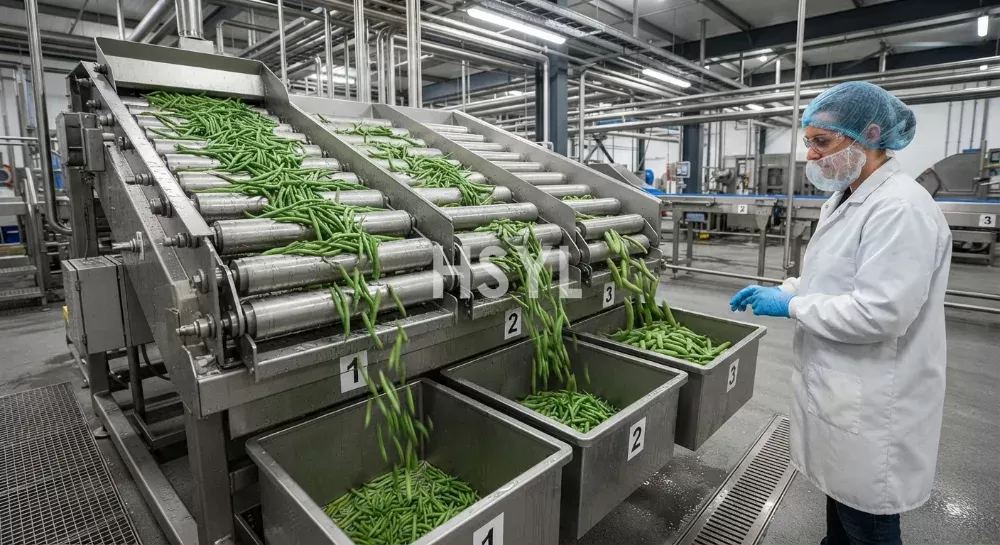
Grading sorts the raw material by size, maturity, and color. The grading equipment is typically the highest-cost single machine on the vegetable preparation side of the line. Size grading is critical because the thermal process (blanching time and retort time) is calculated for the largest piece in the can — if a can contains a mix of sizes, the process must be designed for the largest piece, and smaller pieces will be over-processed. Consistent size grading therefore reduces over-processing, improves texture, and reduces energy consumption per can.
- Roller graders sort by diameter — used for green beans, carrots, and asparagus spears.
- Vibratory screen graders sort by particle size — used for peas, diced carrots, and corn kernels. Multi-deck screens produce three to five size fractions.
- Optical sorters (camera-based, operating in visible and near-infrared spectra) inspect every piece on a high-speed conveyor and eject defective units — discolored, insect-damaged, or foreign-material — via compressed-air nozzles. Optical sorters are increasingly standard on export-grade lines because they reduce the labor requirement of manual inspection belts by 60–80% while improving detection consistency, especially for defects that are difficult for the human eye to catch at belt speed (translucent insect larvae, early-stage mold).
- Color sorters (visible-spectrum only, lower cost than full optical) are used for products where color is the primary quality attribute — tomatoes, carrots, red peppers.
Size reduction — cutting, slicing, dicing, and snipping — follows grading. The cutting equipment is specified per product: cross-cutters for green beans, dicers (with interchangeable grids for different cube sizes) for carrots and potatoes, kernel cutters for corn, and slicers for products packed as slices (beets, carrots). Cutting must be performed after washing and before blanching to minimize the leaching of soluble solids (sugars, vitamins, minerals) from cut surfaces during blanching. The time from cutting to blanching should not exceed 15–20 minutes for most vegetables to limit enzymatic browning at the cut surfaces.
Stage 4: Blanching
Blanching is the thermal treatment applied to vegetables before filling. It is not a cooking step — its purpose is to inactivate enzymes, remove tissue gases, and soften the tissue for proper can fill weight. The blanching parameters are product-specific and must be established experimentally for each vegetable variety and cut size. Industry references provide starting-point ranges, but every factory must validate its own parameters because enzyme activity varies with variety, maturity, growing conditions, and post-harvest handling.
Blanching method selection:
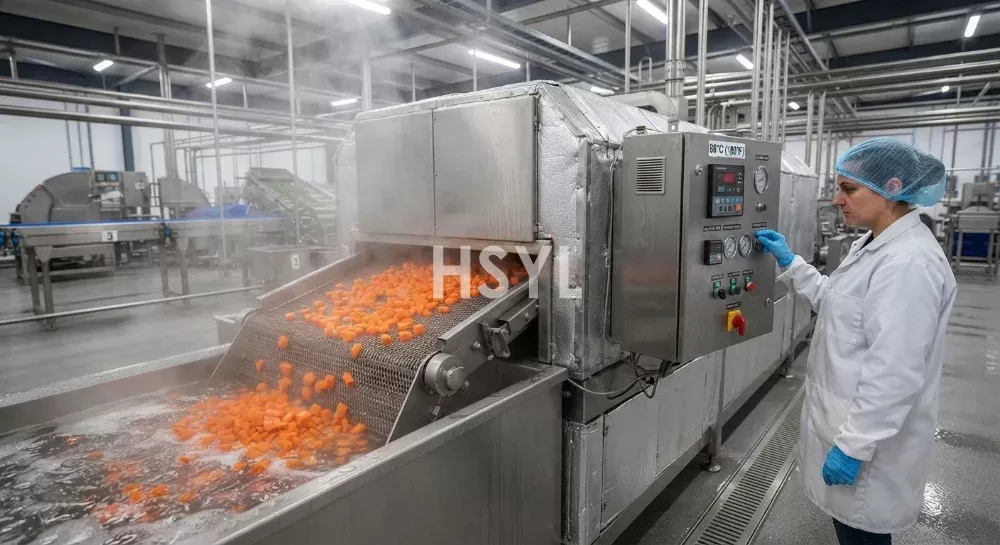
- Water blanching (immersion in hot water at 88–100°C) is the most common method for most vegetables. It provides uniform heat transfer and is suitable for products where some leaching of soluble solids into the blanch water is acceptable. The blanch water must be changed or continuously replenished to prevent the accumulation of leached solids that increase the COD load on the wastewater system and alter the blanching heat-transfer rate.
- Steam blanching (exposure to saturated steam at 100°C on a mesh conveyor inside an insulated tunnel) reduces leaching losses compared to water blanching — typically by 20–40% for water-soluble vitamins and minerals. Steam blanching is preferred for diced and sliced products where cut-surface leaching is a concern. The steam tunnel requires uniform steam distribution across the belt width; cold spots produce under-blanched product that will discolor in the can.
- Microwave blanching uses volumetric heating and achieves enzyme inactivation with minimal leaching. It is used in lines where product quality (color retention, nutrient retention) commands a price premium that justifies the higher capital cost. Microwave blanching is not standard on commodity vegetable lines; it appears on premium and organic lines where the quality differential is monetizable.
Blanching time is governed by the time required to inactivate peroxidase at the thermal center of the largest piece. Peroxidase is the indicator enzyme because it is the most heat-resistant of the enzymes responsible for quality deterioration; when peroxidase is inactivated, catalase and lipoxygenase are also inactivated. Peroxidase inactivation is typically achieved at a center temperature of 90°C held for 1–2 minutes, but the total blanch time is longer because the center must first reach that temperature. Cooling after blanching — typically in a cold-water flume or on a cooling conveyor — must bring the product below 40°C within 5 minutes to prevent the growth of thermophilic spoilage organisms that survive blanching temperatures and proliferate in the 45–65°C range during the filling-to-retort delay.
Stage 5: Filling and Brine Dosing
Blanched and cooled vegetables are conveyed to the filling station. The filling operation for canned vegetables is a two-step process: solid fill (the vegetable pieces) followed by liquid fill (brine, sauce, or water). The two fills can be performed by separate machines or by an integrated filler-briner unit.
Solid filling methods:
- Volumetric fillers dispense a measured volume of product into each can via a pocket or cup mechanism. They are suitable for free-flowing products of uniform size — peas, diced carrots, cut beans, corn kernels. Volumetric fill accuracy is ±3–5% by weight for uniform products and degrades with product variability.
- Weigh fillers weigh each portion before it drops into the can via a combination weigher or linear weigher. Weigh fillers achieve ±0.5–1% fill-weight accuracy and are preferred for high-value products (asparagus spears, whole mushrooms) and for export lines where drained-weight regulatory tolerance is tight. The higher capital cost of weigh fillers is offset by reduced product giveaway and fewer drained-weight rejections.
- Hand-pack belts remain in use for products that cannot be mechanically filled without damage — whole peeled tomatoes, asparagus spears in the vertical orientation, and mixed vegetables where a specific visual composition must be maintained. Hand-pack belts are the highest-labor stage on the line, with 8–20 operators per belt depending on line speed, and are increasingly being replaced by robotic pick-and-place systems that use vision-guided grippers to replicate the hand-pack placement.
Brine formulation and dosing:
The brine or sauce is prepared in a separate room — the brine kitchen — and pumped to the filler. Brine composition is product-specific but typically consists of water, salt (1–3% w/v in the finished product), and optionally sugar (1–5% w/v), calcium chloride (0.1–0.3% as a firming agent), citric acid for pH adjustment in acidified products, and flavorings. The brine is heated to 80–90°C before dosing to improve the initial can temperature entering the seamer, which reduces the come-up time in the retort and helps maintain the vacuum level after cooling. Brine dosing accuracy must be within ±2% of the target fill volume; under-filling produces excessive headspace and a weak vacuum; over-filling produces insufficient headspace and can deformation during retort.
The brine preparation system includes: a water treatment unit (carbon filtration and UV sterilization to remove chlorine, chloramines, and microbial load that would otherwise react with the can lining or produce off-flavors), batching tanks with load cells for ingredient weighing, a holding tank with temperature control and agitation to prevent salt or sugar stratification, a plate heat exchanger or shell-and-tube heat exchanger to bring the brine to filling temperature, and a dosing pump or piston filler calibrated to the can size and line speed.
Stage 6: Seaming
Immediately after filling — ideally within 30 seconds to minimize the cooling of the can contents — the filled can passes through the seamer. The seamer rolls the can end onto the can body flange, forming a double seam that must be hermetic. For a detailed treatment of double-seam quality, see the companion guide on common double seam defects. The seamer is one of two universal CCPs on every canned food line (the other being the thermal process), and every can coming off the seamer must undergo a seam inspection at a frequency set by the HACCP plan — typically one destructive seam tear-down inspection at the start of each shift, after every seamer jam, and after every seamer adjustment, plus one non-destructive visual inspection of every can for obvious seam defects (cut-over, sharp seam, droop, or V-edge).
Stage 7: Retort Sterilization and Cooling
The thermal process is the second universal CCP and the most energy-intensive stage on the line. The retort type, temperature, pressure, and time are determined by the product's pH classification:
- Low-acid canned vegetables (pH above 4.6 — includes corn, peas, green beans, carrots, potatoes, mushrooms, asparagus): require retort sterilization at 116–121°C under saturated steam or superheated water to achieve a minimum F₀ of 3.0 (equivalent to 3 minutes at 121°C) at the cold point of the can. Typical applied F₀ values are 6 to 8 to account for process variability, and 8 to 12 for products with high starch content (corn, peas) where heat penetration is slower due to convection currents being impeded by the viscous starch gel that forms during retorting. The cold point in a can of low-acid vegetables in brine is typically at the geometric center when the product is free-floating in liquid (convection heating), or at a position one-third from the bottom along the vertical axis when the product forms a packed bed (conduction heating). The cold-point location must be confirmed by heat penetration testing — it shifts depending on the solid-to-liquid ratio and the product piece size.
- Acidified canned vegetables (pH at or below 4.6, achieved by the addition of citric, acetic, or lactic acid to the brine): require pasteurization, typically at 100°C in atmospheric steam or hot water for 15–30 minutes depending on can size. The acid environment prevents C. botulinum spore germination; pasteurization temperatures are sufficient to destroy vegetative pathogens and spoilage organisms. Acidified products must reach an equilibrium pH of 4.6 or below throughout all components of the can — the acidification rate in solid vegetable tissue is slower than in the brine, and the product must be held after filling for a predetermined equilibration time before the equilibrium pH can be certified. Filing with the FDA under 21 CFR 114 requires documentation of the acidification process, the equilibration time, and the equilibrium pH verification method.
Retort cooling follows the sterilization hold. Cooling water must be potable and chlorinated to 2–5 ppm free chlorine to prevent the ingress of cooling-water microorganisms through the still-soft seam compound during the initial cooling phase when the can internal pressure drops faster than the external pressure, creating a momentary vacuum that can draw a micro-droplet of cooling water across the seam. This is one of the most common routes for post-process contamination and is a CCP in every HACCP plan. The cooling rate must bring the can center temperature below 40°C within 30–40 minutes to prevent thermophilic spoilage and to stop the cooking process before the product is over-processed — vegetables that cool too slowly develop a mushy texture and a cooked flavor that the consumer identifies as "canned taste."
Equipment Summary Table
| Process Stage | Recommended Equipment | Main Function | Standard / Optional | Key Selection Input |
|---|---|---|---|---|
| Receiving and inspection | Receiving conveyor, sample station, tenderometer/shear-press, cold storage | Raw material intake, quality check, temporary holding | Standard | Peak daily harvest volume; fresh/frozen ratio |
| Washing | Drum washer, flume washer, bubble washer, or spray washer | Soil, sand, and debris removal | Standard | Vegetable type and soil load; water quality and recirculation requirement |
| Grading | Roller grader, vibratory screen grader, or optical/color sorter | Size and quality classification | Standard for export lines; Optional for commodity domestic | Product size tolerance; defect tolerance in destination market |
| Size reduction | Cross-cutter, dicer, slicer, kernel cutter, snipper | Cutting to target dimensions | Conditional — depends on product format | Final product cut specification; can size |
| Blanching | Water blancher, steam blancher, or microwave blancher | Enzyme inactivation, gas removal, tissue softening | Standard | Vegetable species, cut size, peroxidase inactivation parameters |
| Post-blanch cooling | Cold-water flume or cooling conveyor | Rapid cool-down after blanching | Standard | Target exit temperature; water recirculation and filtration |
| Filling (solid) | Volumetric filler, weigh filler, or hand-pack belt | Dispensing vegetable pieces into cans | Standard | Product value, drained-weight tolerance, labor cost |
| Filling (liquid) | Brine doser, sauce filler, piston filler | Adding brine, sauce, or water | Standard | Brine composition, fill temperature, accuracy requirement |
| Brine preparation | Water treatment, batching tank, holding tank, heat exchanger | Brine formulation, heating, and supply | Standard | Brine recipe; batch frequency; line speed |
| Seaming | Can seamer (atmospheric, vacuum, or steam-flow) | Hermetic double-seam closure | Standard | Can diameter and height; line speed; seam inspection protocol |
| Retort | Batch retort (water immersion, steam, or steam-air) or continuous retort (hydrostatic, rotary) | Commercial sterilization | Standard | Product pH classification; can size; target F₀; throughput |
| Post-retort handling | Can dryer, labeler, case packer, palletizer | Drying, labeling, packaging for storage/distribution | Standard | Label type (paper, shrink-sleeve); case format; pallet specification |
For the broader equipment selection context across canned food categories, see the canning line procurement guide and the analysis of canning line bottlenecks.
Critical Control Points
A canned vegetables production line operates under a HACCP plan with the universal canned-food CCPs plus vegetable-specific monitoring. The CCPs are:
- CCP 1 — Thermal process (retort sterilization or pasteurization): Critical limits are the retort temperature (±0.5°C from the scheduled process), time at temperature, and — for pressure retorts — the overpressure. Monitoring is continuous via the retort temperature recorder (mercury-in-glass thermometer and electronic data logger in parallel). Verification is by heat penetration testing at commissioning and annually thereafter, plus a scheduled-process review by a thermal process authority every three years or when the product formulation, piece size, or can size changes.
- CCP 2 — Double seam integrity: Critical limits are the seam dimensions (seam thickness, seam length/height, body hook, cover hook, overlap, and tightness rating) as specified by the can manufacturer for the can size and plate specification. Monitoring is by destructive seam tear-down inspection at the frequency specified in the HACCP plan. Verification is by can manufacturer seam review and annual seam-saw training for QC staff.
- CCP 3 — Post-retort cooling water chlorination: Critical limit is the free chlorine residual of the cooling water (2–5 ppm, measured at the point of contact with the can). Monitoring is continuous or at a frequency specified in the HACCP plan (often every hour during production). This CCP is specific to the post-retort cooling stage and addresses the risk of post-process contamination through the still-soft seam compound.
- CCP (conditional) — Acidification for acidified products: For acidified canned vegetables, acidification to an equilibrium pH at or below 4.6 is a CCP. The acidification process, the equilibration time, and the equilibrium pH verification method must be documented and filed under FDA 21 CFR 114. Monitoring is by pH measurement of the brine before dosing and equilibrium pH testing of finished cans at a frequency specified in the HACCP plan.
For the broader HACCP framework applied to canned food, see the HACCP fish canning line design guide — the CCP framework is common across all canned food categories, though the vegetable-specific monitoring parameters differ.
Capacity Bottlenecks
The bottleneck on a canned vegetables production line is rarely the filler or the seamer — the fastest equipment on the line. The bottleneck shifts depending on the product and the factory configuration:
- During harvest season (fresh raw material): the blanching stage is the most common bottleneck. The blancher throughput is limited by the belt speed needed to achieve the required blanch time at the target product bed depth. Adding a second blancher is expensive and consumes additional floor space, steam, and water. Factories that run multiple vegetable species on the same line often install interchangeable blanch inserts (different belt configurations for different products) rather than a second full blancher.
- For the receiving and grading stage during peak harvest: the bottleneck is the size of the raw-material holding area and the speed of the grading equipment. A pea line receiving peak-harvest volumes must either (a) grade at the receiving rate and hold the excess in cold storage, (b) install grading capacity that matches the peak receiving rate, or (c) accept that some raw material will be downgraded to a lower-value product stream. Option (b) is the engineering solution; options (a) and (c) are operational compromises that cost money every harvest.
- For lines using weigh fillers: the weigh-filler cycle time is the bottleneck, because mechanical filling (volumetric) can run faster than electronic weighing. A line that must meet tight drained-weight tolerances and therefore uses weigh filling will run slower than a volumetric-fill line — the capacity trade-off is inherent.
- For hand-pack products: the bottleneck is the speed of the operators on the pack belt. Adding operators increases capacity linearly up to the point where the belt is fully staffed; beyond that point, adding more operators produces no additional throughput because every can position on the belt is already occupied.
Hygiene and Quality Risks Specific to Canned Vegetables
- Flat-sour spoilage: caused by thermophilic spore-formers (Geobacillus stearothermophilus, formerly Bacillus stearothermophilus) that survive the thermal process and germinate if the cooling rate is too slow or the post-retort storage temperature is too high (above 43°C). The spores are ubiquitous in soil and are brought into the factory on the raw vegetable. Flat-sour spoilage produces acid without gas, so the can does not swell — the defect is detected only when the can is opened. Prevention is by maintaining a short filling-to-retort delay (less than 30 minutes), achieving the target cooling rate, and storing finished product below 35°C.
- Sulfide staining: a black or purple discoloration on the interior of the can, caused by the reaction of sulfur compounds released from the vegetable protein during retorting with the iron or tin in the can wall. Canned corn and peas are particularly prone because of their sulfur-containing amino acid profile. Prevention is by specifying cans with a C-enamel (zinc oxide pigmented) interior lacquer for these products — the zinc oxide reacts preferentially with the sulfur, forming white zinc sulfide that is not visually objectionable, rather than black iron or tin sulfide.
- Can corrosion from nitrate in well water: vegetables grown with nitrate fertilizers can carry residual nitrate into the can. During retorting, nitrate is reduced to nitrite, which accelerates tin dissolution and can produce rapid detinning — a condition where the tin coating is stripped from the steel base, exposing the steel to the acidic can contents. Prevention is by testing the raw water supply and the vegetable for nitrate levels and specifying a can body stock and lacquer system rated for the measured nitrate level.
- Struvite formation in canned seafood-vegetable blends: when vegetables are co-packed with seafood (common in ready-meal formats), the magnesium and ammonium from the seafood can combine with the phosphate from the vegetable to form magnesium ammonium phosphate crystals (struvite) that are visually mistaken for glass fragments by consumers and inspectors. Prevention is by pH control and by avoiding the use of phosphate-containing firming agents in the vegetable component.
Line Integration and Utility Planning
A canned vegetables production line must be integrated with the factory's utilities and the upstream/downstream operations:
- Steam: the retort and the blancher are the largest steam consumers. The boiler capacity must be sized for the simultaneous operation of all retorts plus the blancher at peak load. A typical batch retort with a capacity of four baskets (approximately 2,000–3,000 cans per batch depending on can size) requires a steam supply of {{BOILER_CAPACITY_KG_H}} kg/h at {{STEAM_PRESSURE_BAR}} bar. The exact figure depends on the retort size, the number of retorts, and the come-up time requirement, and must be calculated per project.
- Water: the blancher, the cooling flume, and the retort cooling cycle are the largest water consumers. Water consumption per ton of raw vegetable processed depends on the washing method, the blanching method, and the water recirculation ratio. A factory without water recirculation can consume 10–15 m³ of water per ton of raw vegetable; a factory with recirculation on the flume washer, blancher cooling zone, and retort cooling water can reduce this to 2–4 m³ per ton. The water treatment system must supply potable-quality water to all product-contact points and chlorinated water to the retort cooling supply.
- Electricity: the largest electrical loads are the refrigeration compressors (for cold storage of raw material and finished product), the blancher steam generator if electric, the can conveyor systems, and the labeler and case packer. The connected electrical load per ton of annual capacity varies with the level of automation and the proportion of frozen vs. fresh raw material.
- Compressed air: the seamer, the labeler, the optical sorter, and the pneumatic controls on the retort require compressed air at 6–8 bar, oil-free and dried to a dew point of -20°C or below for food-contact applications. The compressed air demand is modest compared to steam and water, but a compressor failure will stop the seamer and the optical sorter — the two highest-consequence single points of failure on the line. A backup compressor or a buffer tank sized for 15–20 minutes of operation at peak demand is standard on lines where downtime cost is high.
- Wastewater: vegetable canning produces high-COD, high-suspended-solids wastewater from the washing, blanching, and cooling stages. The blanching water carries leached sugars, starches, and organic acids that produce a BOD of 500–2,000 mg/L depending on the product and the water recirculation ratio. The factory wastewater treatment system must be sized for the peak-harvest processing volume, not the annual average. Wastewater surcharges from the municipal treatment authority are a significant operating cost that is often under-estimated at the project-planning stage.
Planning Inputs Required Before Equipment Selection
Before equipment can be specified for a canned vegetables production line, the following inputs must be confirmed. Items not confirmed will produce an equipment list that is either oversized, undersized, or incompatible with the factory's utilities:
- Vegetable species to be processed, and for each species: the harvest window duration, the peak daily intake volume, and the acceptable post-harvest-to-processing time.
- Final product formats per species: whole, sliced, diced, cut length specification, and whether the product is packed in brine, sauce, or water.
- Can sizes per product and the annual volume per can size.
- pH classification per product: low-acid (requiring pressure retort and FDA 21 CFR 113 filing) or acidified (requiring pasteurization and FDA 21 CFR 114 filing). If exporting to multiple markets, the classification must be checked against each market's regulatory definition of low-acid vs. acidified — the definitions are not identical across jurisdictions.
- Target F₀ per product, established by a thermal process authority based on the product formulation, piece size, can size, and fill medium.
- Available utilities at the factory site: steam capacity and pressure, electrical supply (voltage, phase, available capacity), water supply (flow rate, pressure, and quality), compressed air capacity, and wastewater treatment capacity.
- Factory floor plan with column positions, ceiling height, floor drainage layout, and available floor area for raw material receiving, processing, and finished-goods storage.
- Target market and the food safety certifications required: BRCGS, IFS, FSSC 22000, or equivalent GFSI-benchmarked standard; Halal or Kosher certification if relevant; and any destination-market-specific requirements (FDA facility registration and FCE/SID filing for the US, EU health certificate and listing for the EU).
- Automation level: manual grading and hand-pack, semi-automatic (mechanical fill with manual grading), or fully automatic (optical sorting and weigh filling with automated case packing and palletizing).
- Budget range and target payback period, which determines the balance between capital investment and operating cost (labor, energy, water, and product giveaway).
Conclusion
A canned vegetables production line is defined by the vegetable species it processes, the pH classification of the final product, and the seasonal throughput it must achieve. The line is front-loaded — the washing, grading, and blanching stages consume more equipment, floor space, and engineering attention than the filling and seaming stages — and the blancher is the process-defining piece of equipment that determines the line speed. The thermal process classification (low-acid vs. acidified) is the most consequential engineering decision on the project: it determines the retort specification, the boiler size, the regulatory filing path, and the total project budget. Getting the pH classification and the per-product blanching parameters right at the planning stage prevents a line that under-processes or over-processes — both are expensive to correct after installation. For vegetable-specific line designs, see the guides on green bean canned food production and the canned beans production line. For the thermal process science that underpins the retort selection, see the guide on canned food thermal process control. When you are ready to specify a line, prepare the planning inputs listed above and contact the engineering team with your project scope.
Frequently Asked Questions
What is the difference between low-acid and acidified canned vegetables?
Why does blanching matter so much in vegetable canning?
Which vegetables require pressure retort vs. atmospheric pasteurization?
What is the most common capacity bottleneck on a vegetable canning line?
How does vegetable species affect equipment selection?
What causes flat-sour spoilage in canned vegetables?
What is the correct headspace for canned vegetables?
How much water does a vegetable canning factory consume?
Related Articles



Get professional consultation
Do you have any questions or need technical support regarding the content of this article? Fill out the form below, and our expert team will provide you with professional solutions.