What a Canned Fruit Line Must Do Differently
A canned fruit production line has three processing challenges that meat and fish lines do not: the raw material is living tissue that continues to respire after harvest — it must be processed within hours or it degrades; the product is acid (pH 3.0–4.6 for most fruits), which means the retort sterilization can use pasteurization temperatures (100°C or below) rather than the 116–121°C required for low-acid canned foods; and every can contains a liquid pack medium — syrup, juice, or water — whose sugar concentration (Brix) determines product quality, drained weight, and consumer acceptance. The syrup system is a separate production line within the line: sugar receiving, dissolving, filtering, holding, and dosing — and it must be synchronized with the solid-fill rate to within millilitres per can.For continuous hydration soaking and steam blanching machinery, consult our engineering guide on canned beans production line for export markets.
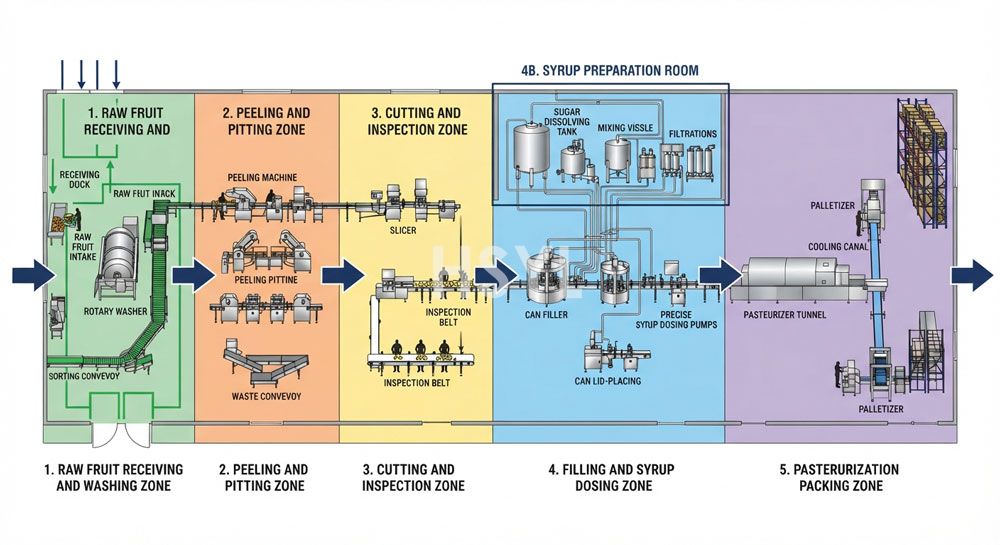
This guide walks through a canned fruit production line for stone fruit (peaches, apricots), tropical fruit (pineapple, mango), pome fruit (pears), and mixed-fruit products. The line is organized as a straight line with five zones: raw fruit receiving and grading, washing and peeling, cutting and inspection, filling and syrup dosing, and pasteurization and post-process handling. The principles apply to any fruit species; the equipment changes with fruit size, pit presence, and skin characteristics. For the broader cost factors, see the canning line cost analysis.
Raw Material: Why Fruit Drives the Line Speed
Unlike fish and meat — which can be frozen and stockpiled — most canned fruit is processed from fresh, seasonal raw material that arrives in a 6–12 week harvest window. The entire annual production volume must be processed during this window. The line speed is therefore determined by the harvest throughput, not by year-round market demand:
- Fruit species and processing window: peaches: 8–10 weeks (June–August in Northern Hemisphere); pineapples: year-round in tropical regions but with seasonal volume peaks; pears: 6–8 weeks (August–October); apricots: 4–6 weeks (June–July). A multi-fruit cannery runs different species in sequence through the same line — the line must be designed for the highest-volume species and capable of changeover between species within 24–48 hours.
- Fresh fruit condition: fruit arrives at the cannery within 24 hours of harvest — ideally within 12 hours for soft fruit like peaches. Receiving includes grading by size, colour, and ripeness. Over-ripe fruit produces mushy canned product; under-ripe fruit lacks flavour and does not peel cleanly. The grading station at receiving is the most important quality-control point in the entire line — fruit that should be rejected at grading cannot be fixed by downstream processing.
- Fruit size and pit presence: peach and apricot lines require pitting equipment — the fruit is halved and the pit removed mechanically or manually. Pineapple lines require peeling and coring — the skin, crown, and core are removed in a single machine pass. Pear lines require peeling and coring but no pitting. Each species has a dedicated preparation equipment set; a multi-fruit line must either have parallel preparation branches or a quick-changeover system for the peeling, pitting, and coring stations.
The most underestimated variable in fruit canning: fruit size distribution within a delivery batch. Pitting and peeling machines are calibrated for a specific size range. A batch with a wide size distribution produces high waste — small fruit are damaged by machinery calibrated for large fruit, and large fruit are under-processed by settings calibrated for small fruit. Pre-grading by size is not optional.
Step-by-Step Process Flow: Five Zones
Zone 1: Raw Fruit Receiving, Grading, and Washing
Fruit arrives in bins or bulk containers at the receiving dock. Each delivery is sampled for size distribution, ripeness, and defect rate — bruised, split, or mouldy fruit is rejected before it enters the line. Accepted fruit moves to the grading table where it is sorted by size and colour. Graded fruit is washed in a drum washer or bubble washer to remove field soil, pesticide residue, and surface contamination. Washing is the first food-safety step — fruit entering the peeling zone must be visibly clean.
Equipment: receiving inspection station with sampling tools, grading table with size-sorting lanes or rollers, drum or bubble washer with potable water supply, elevator conveyor to peeling zone. Layout: receiving dock adjacent to grading and washing — fruit moves from truck to washer without intermediate storage. The washing water must be potable and changed at a defined frequency. Wash-water drainage connects to the plant wastewater system with solids screening.
Zone 2: Peeling, Pitting, and Coring
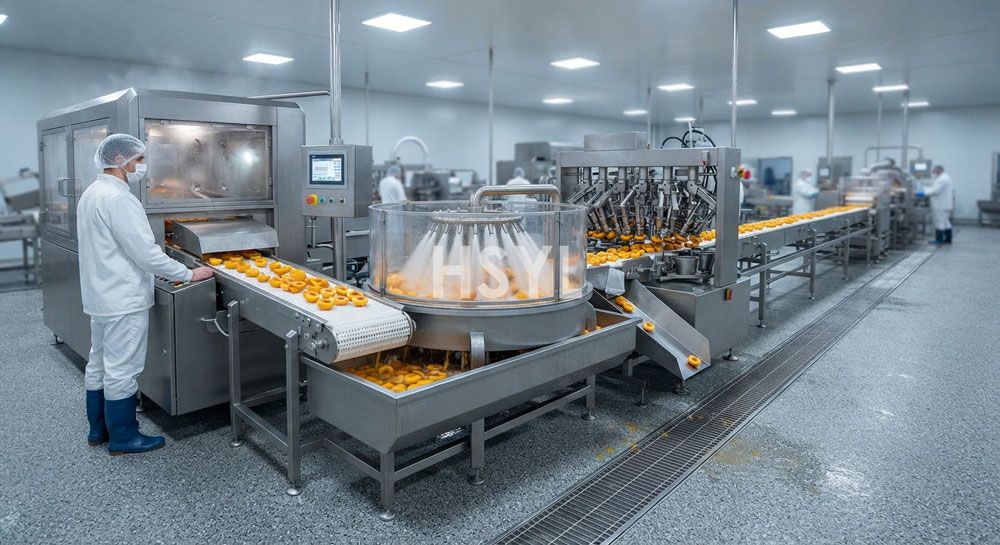
This zone transforms whole fruit into prepared fruit halves, slices, or pieces ready for can filling. The method depends on the fruit species:
- Peaches and apricots: lye peeling or steam peeling removes the skin. Lye peeling uses a hot sodium hydroxide solution (1–2% concentration, 90–95°C) that loosens the skin; the fruit then passes through a rotary washer that removes the loosened skin with water jets. Lye concentration, temperature, and dwell time must be precisely controlled — under-peeling leaves skin fragments in the can; over-peeling removes flesh and reduces yield. After peeling, the fruit is halved and pitted — either by a mechanical pitter that cuts and twists to remove the pit, or manually for premium whole or half-fruit products. Peach pits must be completely removed — pit fragments in the can are a consumer hazard and a product recall risk.
- Pineapples: a single machine — the Ginaca machine — peels, cores, and removes the crown and base in one pass. The machine produces a cylinder of pineapple flesh that is then sliced into rings or cut into chunks, tidbits, or crushed pieces. The peel, core, and crown are by-products — they can be processed into juice, animal feed, or compost. The Ginaca machine must be calibrated for fruit diameter; pineapples outside the calibration range are rejected to a manual peeling station.
- Pears: mechanical or lye peeling followed by halving and coring. Pears are softer than peaches and more susceptible to mechanical damage during peeling — gentler handling conveyors and lower drop heights are required throughout the pear line.
Layout requirements: the peeling zone generates the largest wastewater load on the line — lye solution, fruit peel, and wash water must be collected, treated, and discharged per environmental regulations. Floor drains must handle high solids loading. The peeling zone is adjacent to Zone 1 (washing) and feeds directly into Zone 3 (cutting and inspection).
Zone 3: Cutting, Sorting, and Inspection
Peeled and pitted fruit moves to the cutting and inspection zone. Fruit halves or cylinders are cut to the specified product form — halves, slices, chunks, dice, or crushed. Cutting is performed by mechanical slicers, dicers, or crushers depending on the product specification. Cut fruit passes over an inspection conveyor where operators remove defective pieces — bruising, skin fragments, pit fragments, discolouration, or pieces outside the size specification.
The inspection conveyor is the most labour-intensive station on the line. Conveyor speed determines inspection thoroughness — a conveyor running too fast for the inspector count produces defective product that reaches the can. The inspection station must have adequate lighting (minimum 500 lux at the conveyor surface), ergonomic positioning for inspectors, and a reject chute that removes defective pieces from the product stream without manual handling.
Equipment: slicer, dicer, or crusher per product specification; inspection conveyor with reject chutes; collection bins for rejected product (diverted to juice, puree, or waste depending on defect type). Layout: the cutting and inspection zone bridges the peeling zone and the filling zone. Inspected product must not cross the path of un-inspected product.
Zone 4: Filling, Syrup Dosing, and Seaming
Inspected fruit pieces are filled into cans — either manually for premium products (whole or half fruit arranged in a specific pattern) or by automatic gravity or volumetric filler for pieces and chunks. After solid fill, the can moves to the syrup dosing station.
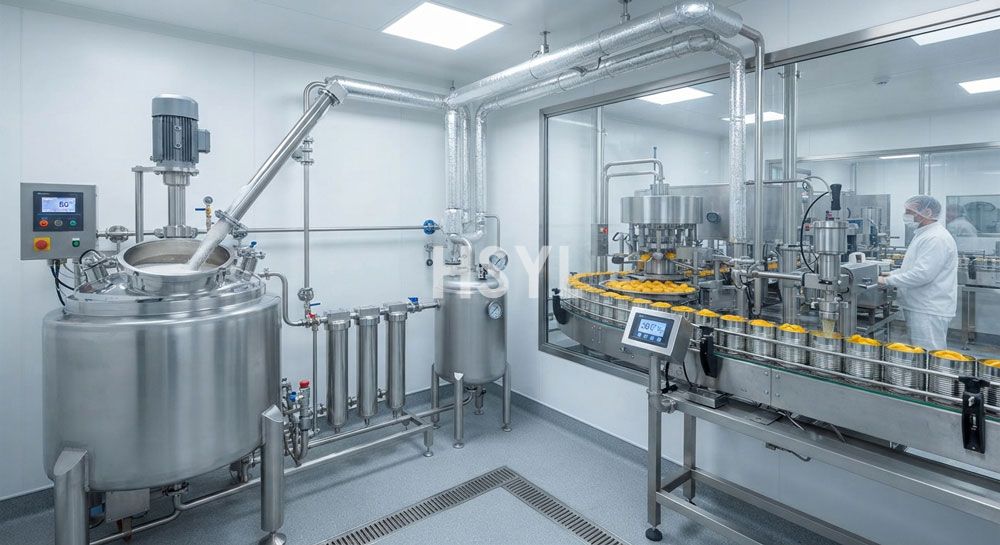
The syrup system is the defining feature of a fruit canning line. Syrup is prepared in a separate area — a syrup room — adjacent to the filling zone. Granulated sugar is dissolved in hot water in a dissolving tank, filtered to remove impurities, and held in a buffer tank at 80–85°C. The syrup is dosed into each can at a controlled temperature and volume. Brix (sugar concentration as % sucrose by weight) is the critical quality parameter:
- Extra heavy syrup: 25–30° Brix — used for premium products and export markets;
- Heavy syrup: 20–24° Brix — standard for retail canned fruit;
- Light syrup: 14–18° Brix — reduced-sugar products;
- Fruit juice pack: juice from the same fruit species replaces syrup — no added sugar;
- Water pack: water only — lowest-calorie option.
The syrup dosing system includes an in-line refractometer or Brix meter that measures syrup concentration continuously. Brix drift outside specification (±0.5° Brix) triggers an alarm and diversion of affected product. Syrup temperature at dosing (80–85°C) serves two functions: it reduces the air content in the can headspace (improving vacuum formation during cooling) and it pre-heats the can contents, reducing the come-up time in the pasteurizer.
After syrup dosing, the can passes through an exhaust box or steam-flow tunnel that heats the can contents to drive out headspace air and create the vacuum that will hold the can lid during pasteurization. The can then enters the seamer — the double-seam machine that hermetically seals the can. As with all canning lines, the seamer must be on an independent vibration-damping base, isolated from the filler.
Layout: the syrup room is a dedicated area with sugar receiving and storage, dissolving tank, filtration system, buffer tanks, and pipework to the dosing station. The syrup room must meet food-grade hygiene standards — sugar attracts pests, and syrup residue supports microbial growth. The filling zone is a controlled-hygiene area with positive air pressure. Empty cans enter from the side; filled, syrup-dosed, and sealed cans exit toward pasteurization.
Zone 5: Pasteurization, Cooling, Labeling, and Packing
Because canned fruit is an acid product (pH below 4.6), the sterilization step is pasteurization — typically 100°C in atmospheric steam or hot water for 15–30 minutes depending on can size and product — rather than pressure retort at 116–121°C. This is the fundamental thermal-process difference between fruit canning and meat/fish canning: the lower pH of fruit prevents Clostridium botulinum spore germination, so pasteurization temperatures that destroy vegetative pathogens and spoilage organisms are sufficient.
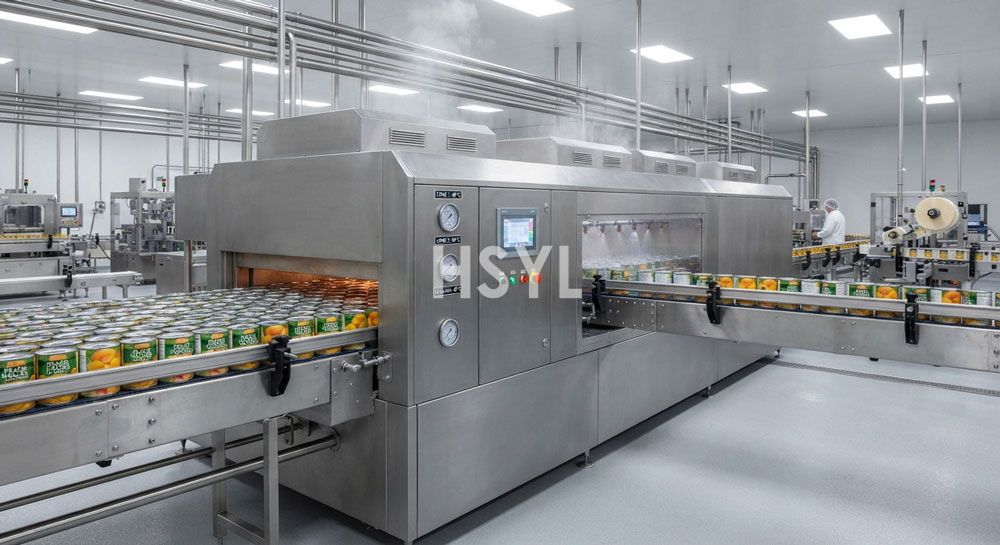
Sealed cans pass through a continuous pasteurizer — a tunnel or hydrostatic system where cans are conveyed through heating, holding, and cooling stages. The pasteurizer is a continuous process, not a batch process like retort — this means the pasteurizer does not create the batch-bottleneck that retorts create in meat and fish lines. The pasteurizer speed is set by the required holding time at pasteurization temperature for the largest can format running on the line.
After pasteurization, cans are cooled to below 40°C in the cooling section of the pasteurizer or a separate cooling canal. The vacuum formed during cooling pulls the can lid inward — a concave lid indicates a proper vacuum seal; a flat or bulging lid indicates a seal failure or inadequate vacuum. Post-pasteurization, cans are dried, labeled, date-coded, and packed into cartons or shrink-wrapped trays.
Layout: the pasteurizer is a large piece of equipment — the longest single machine on a fruit canning line. It must be positioned with adequate clearance for maintenance access to the conveyor drive, heating elements, and water-circulation pumps. The post-pasteurizer area is a clean zone — cans are commercially sterile and must be handled to prevent seam damage.
Equipment Summary by Zone
| Zone | Key Equipment | Key Process Variable |
|---|---|---|
| 1. Receiving & washing | Grading table, size sorter, drum/bubble washer | Fruit size distribution; wash-water quality |
| 2. Peeling & pitting | Lye/steam peeler, pitter, Ginaca machine (pineapple) | Lye concentration/temp/dwell; pit removal completeness |
| 3. Cutting & inspection | Slicer/dicer, inspection conveyor, reject chutes | Conveyor speed vs inspector count; lighting (500+ lux) |
| 4. Filling & syrup | Filler, syrup dissolving/filtration/dosing system, Brix meter, exhaust box, seamer | Solid fill weight; syrup Brix (±0.5°); dosing temp (80–85°C) |
| 5. Pasteurization | Continuous tunnel/hydrostatic pasteurizer, cooling canal, can dryer, labeler, packer | Pasteurization time/temp; cooling to <40°C; vacuum seal verification |
The Syrup System: The Line Within the Line
The syrup preparation and dosing system deserves separate attention because it is unique to fruit canning and because syrup problems — wrong Brix, inconsistent fill volume, or contaminated syrup — affect every can produced until the problem is detected and corrected:
- Sugar receiving and storage: granulated sugar is received in bulk or bags, stored in a dry, pest-controlled area, and metered into the dissolving tank by weight — not volume — because sugar bulk density varies with compaction and humidity.
- Dissolving: sugar is dissolved in potable water at 80–85°C in a jacketed dissolving tank with an agitator. Dissolving time depends on water temperature, agitator speed, and sugar-to-water ratio. Undissolved sugar crystals in the syrup will settle in the buffer tank and cause Brix variation between the first and last cans filled from a batch.
- Filtration: dissolved syrup passes through a filter (typically 50–100 micron) to remove any undissolved sugar, impurities from the sugar, or particles from the dissolving tank. The filter must be cleaned or replaced at a defined frequency — a clogged filter restricts syrup flow and reduces dosing accuracy.
- Buffer tank: filtered syrup is held in a jacketed buffer tank at 80–85°C with slow agitation to maintain temperature uniformity. The buffer tank volume must be sufficient to supply the filler for 15–30 minutes — this is the window for syrup-room operators to prepare the next batch without stopping the line.
Dosing: syrup is pumped from the buffer tank through a heat-traced and insulated pipe to the dosing station at the filler. The doser deposits a precise volume of syrup into each can. Dosing accuracy is typically ±1–2 mL per can. The in-line Brix meter monitors syrup concentration continuously; a Brix deviation triggers an alarm.
Critical Control Points
- CCP 1 — Pasteurization: the thermal process that destroys vegetative pathogens and spoilage organisms. Pasteurization time and temperature must be continuously recorded. For fruit products, the target is typically 100°C at the can cold point for a validated time. The pasteurizer must have automatic temperature recording and a diversion system for under-processed product.
- CCP 2 — Seam integrity: the double seam is the physical barrier preventing post-pasteurization recontamination. Seam inspection — visual and teardown measurement — at a defined frequency. Cans with defective seams diverted before pasteurization.
- CCP 3 — pH control: the product pH must be below 4.6 to permit pasteurization rather than pressure retort. pH is measured on a sample basis from each batch. A pH above 4.6 in a product designed for pasteurization requires immediate line stoppage and investigation — the product may need to be diverted to retort processing or discarded.
- CCP 4 — Foreign material (pit fragments): mechanical pitting of stone fruit carries a risk of pit fragments in the product. The inspection conveyor is the control point. Metal detection or X-ray inspection after filling — before seaming — provides a secondary control for pit fragments and any metal contamination from processing equipment.
Capacity and Bottleneck Analysis
- Pasteurizer capacity: the pasteurizer is a continuous machine — it does not create the batch bottleneck that retorts create in low-acid canning. However, the pasteurizer holding time for the largest can format determines the maximum conveyor speed, and therefore the maximum line speed. The pasteurizer length is fixed at installation; increasing throughput beyond the design capacity requires a longer pasteurizer or a second unit.
- Peeling capacity: the lye peeler or steam peeler is often the upstream bottleneck because peeling is a chemical or thermal process with a minimum residence time that cannot be reduced. Peeler throughput is determined by the belt speed and width — increasing peeler capacity means installing a wider or additional peeler.
- Inspection conveyor: the manual inspection station is the most variable bottleneck — throughput depends on inspector count, defect rate in the incoming fruit, and conveyor speed. A high-defect batch slows the inspection conveyor, which reduces throughput for the entire line. Adequate inspector staffing for peak defect-rate conditions is essential.
Syrup system: the buffer tank volume and dissolving-tank cycle time determine whether the syrup system can keep pace with the filler. A dissolving tank that takes 45 minutes to prepare a batch and a buffer tank that holds 15 minutes of filler consumption creates a 30-minute gap — the line stops waiting for syrup.
Planning Inputs for a Canned Fruit Line
Before finalizing a line layout, confirm:
- Fruit species and harvest window — determines line speed and multi-species changeover requirements;
- Fresh fruit condition and expected size distribution — determines grading and peeling equipment specifications;
- Target throughput in cans per minute and product forms (halves, slices, chunks, crushed);
- Can format(s) — diameter, height, material — determines filler, seamer, and pasteurizer specifications;
- Pack medium — syrup Brix, juice pack, or water pack — determines syrup-room equipment and dosing specifications;
- Target product pH — must be below 4.6 for pasteurization; products above 4.6 require pressure retort;
- Available utilities — steam, hot water, potable water, compressed air, electrical supply, wastewater treatment capacity;
- Building dimensions — the pasteurizer is the longest single machine; the line length must accommodate it with access aisles;
- Destination country regulations — fruit products may have specific import requirements for pesticide residues, syrup composition, and labelling.
Conclusion
A canned fruit production line is defined by three factors that do not apply to meat or fish canning: fresh seasonal raw material that must be processed within hours of harvest, acid-product pasteurization instead of pressure retort sterilization, and a syrup preparation and dosing system that is a production line within the production line. The grading station at receiving is the single most important quality decision point — fruit quality at the dock determines product quality in the can, and no downstream equipment can reverse the decision to accept sub-standard raw material.
The syrup system is where most new fruit canning operations encounter problems: undersized dissolving tanks that cannot keep pace with the filler, unheated pipework that allows syrup to cool and crystallize, and manual Brix checks that detect a deviation only after hundreds of cans have been filled incorrectly. An in-line Brix meter with automatic diversion and a syrup buffer tank sized for the dissolving-tank cycle time are not optional — they are the minimum engineering standard for a commercial fruit canning line.
If you are planning a canned fruit production line, contact the engineering team with your fruit species, harvest window, target throughput, can format, and pack-medium specification.
Frequently Asked Questions
How is a canned fruit production line different from meat or fish canning?
What is the most important quality control point in a fruit canning line?
How does the syrup system work in fruit canning?
What Brix levels are used for canned fruit syrup?
Why does canned fruit use pasteurization instead of pressure retort?
What causes pit fragments in canned peaches and how are they controlled?
What are the main capacity bottlenecks in a fruit canning line?
What information is needed to design a canned fruit production line?
Related Articles


Get professional consultation
Do you have any questions or need technical support regarding the content of this article? Fill out the form below, and our expert team will provide you with professional solutions.